Within Okapi
Why the Okapi Was First Misclassified
The okapi was first misread as horse-like, showing how partial evidence can point science in the wrong direction.
On this page
- How stripes shaped the first interpretation
- What better anatomy corrected
- Why scientific error is not the same as credulity
Page outline Jump by section
Introduction
The first scientific description of the okapi took a wrong turn. In 1901, the British zoologist Philip Lutley Sclater introduced the animal to science under the name Equus(?) johnstoni, treating it as an apparently new zebra or horse-like species from the forests near the Semliki region. The mistake was understandable: the earliest evidence consisted largely of skins, reports, and the striking black-and-white stripes on the animal’s legs and hindquarters. Yet the episode became an important lesson in how partial evidence can mislead even experienced researchers. Rather than confirming a mysterious forest zebra, later anatomical evidence showed that the okapi was actually a close relative of the giraffe. The story remains one of the clearest examples of how scientific classification can initially go wrong and then correct itself through better evidence.[Mammal Diversity]mammaldiversity.orgMammal DiversityOkapia johnstoni • OkapiSclater, P.L. 1901-06. On an apparently new species of zebra from the Semliki Forest. Proceedings…
How Stripes Shaped the First Interpretation
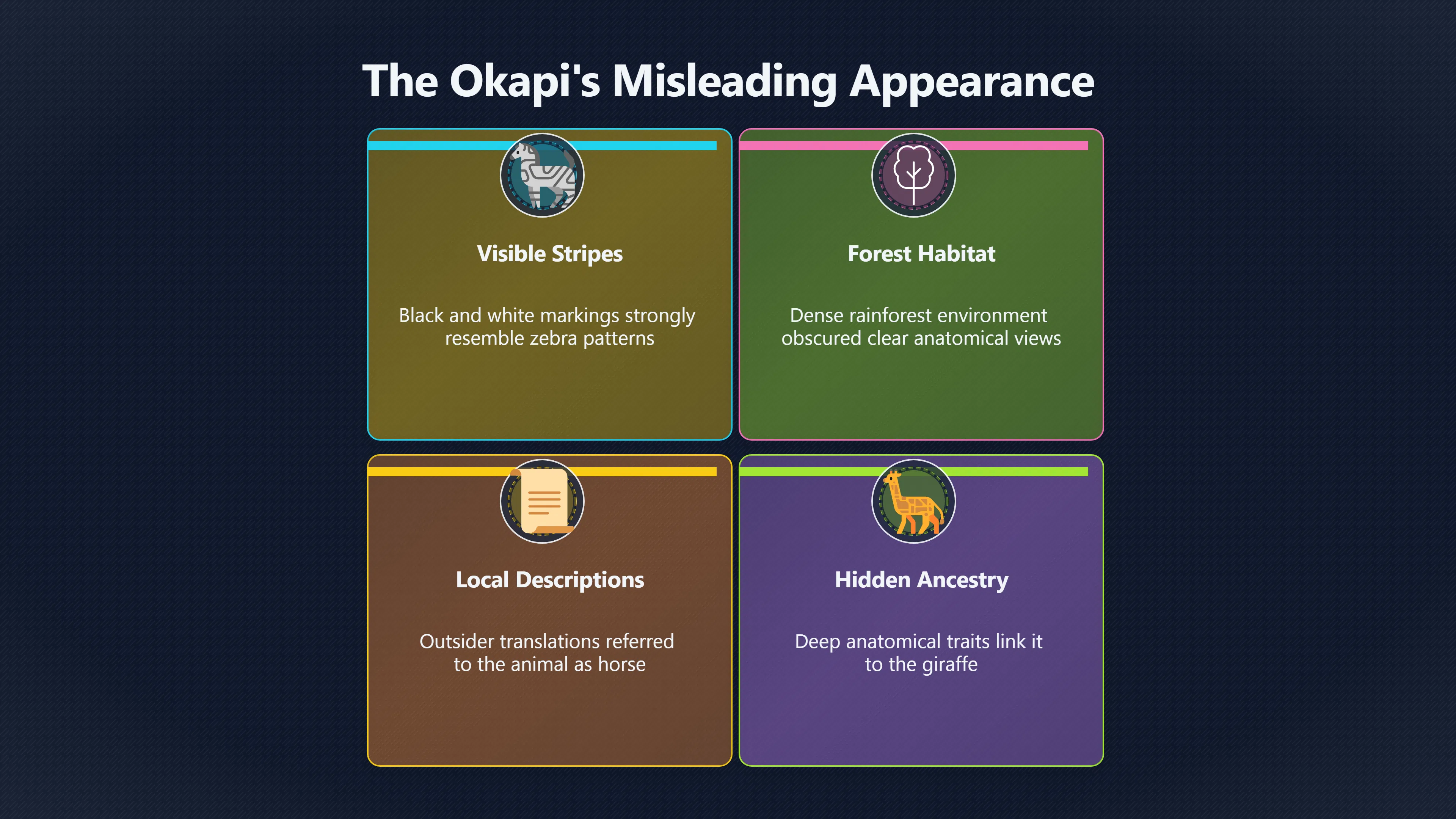
When reports of the animal first reached European zoologists, the most memorable feature was its zebra-like striping. In an era when few specimens were available and the dense forests of central Africa remained poorly known to European science, those markings strongly influenced interpretation. Sclater’s original paper was even titled “On an Apparently New Species of Zebra from the Semliki Forest”, revealing how firmly the equid comparison framed the discovery. The formal name Equus(?) johnstoni reflected both confidence and uncertainty: the question mark indicated that the placement within the horse genus Equus was tentative.[Mammal Diversity]mammaldiversity.orgMammal DiversityOkapia johnstoni • OkapiSclater, P.L. 1901-06. On an apparently new species of zebra from the Semliki Forest. Proceedings…
Several factors encouraged the error:<div class="content-enhancement content-enhancement--comparison" markdown="1">
- The striped skin fragments resembled zebra markings.
- Some local descriptions translated by outsiders referred to a forest “horse”.
- No known giraffe relative looked remotely similar to the available evidence.
- The animal came from dense rainforest rather than open savannah, making comparison with familiar African mammals more difficult.[Wikipedia]WikipediaOpen source on wikipedia.org.</div>
The result was a classic case of analogy-driven reasoning. Faced with an unfamiliar animal, scientists matched the most obvious visible trait—stripes—to a known category. The inference was reasonable, but it rested on incomplete information.
What Better Anatomy Corrected
The zebra hypothesis began to weaken as additional specimens arrived. Harry Johnston obtained more substantial material, including skulls. These remains immediately raised problems for the equid interpretation.
One clue had appeared even earlier. Johnston reportedly expected the mysterious animal to be some kind of forest horse, yet tracks associated with it showed a cloven hoof. Horses and zebras are odd-toed ungulates with a single hoof, while cloven-hoofed animals belong to a very different branch of mammals. This alone suggested that the supposed forest zebra could not be an ordinary member of Equus.[Wikipedia]WikipediaOpen source on wikipedia.org.
The decisive evidence came from the skull. Researchers recognised anatomical features inconsistent with horses and suggestive of giraffids. Male okapis possess ossicones—permanent, skin-covered bony structures also found in giraffes and unknown among living equids. Skull structure and other anatomical traits pointed toward a relationship with giraffes rather than zebras. Edwin Ray Lankester consequently established the new genus Okapia, and the species became Okapia johnstoni, the name it retains today.[PMC+3Wikipedia+3Tetrapod Zoology]WikipediaOpen source on wikipedia.org.
The correction happened remarkably quickly. The same year that Equus(?) johnstoni appeared in print, anatomists were already recognising that the animal belonged elsewhere. The error did not survive because better physical evidence became available.[Tetrapod Zoology]tetzoo.comthe discovery of the okapi part 1Tetrapod ZoologyThe Discovery of the Okapi, Part 112 Apr 2023 — Sclater's 'forest horse' Equus johnstoni clearly pertained to the same sp…
Why the Error Was Reasonable
From a modern perspective, the okapi’s giraffe relationship may seem obvious. It has a long neck, a specialised browsing tongue, cloven hooves, and giraffe-like cranial features. Yet those characteristics were not evident from the limited material initially available.
The mistake illustrates a broader challenge in zoology: superficial resemblance can obscure deeper relationships. Evolution often produces animals that share visible traits without being close relatives. In the okapi’s case, stripes were an especially misleading feature because they strongly evoked zebras while concealing the animal’s true ancestry. Modern descriptions still frequently introduce the okapi as a creature that “looks like a zebra but is related to the giraffe,” demonstrating how powerful that visual impression remains. San Diego Zoo Wildlife Explorers+2Columbus Zoo[sdzwildlifeexplorers.org]sdzwildlifeexplorers.orgSan Diego Zoo Wildlife ExplorersOkapiWith its white-and-black striped hindquarters and front legs, an okapi (oh-KOP-ee) looks like it mus…
Importantly, the error was not the result of careless thinking. It arose from a genuine shortage of evidence. Scientists were attempting to classify an animal that was effectively known through fragments, sketches, and reports rather than complete anatomical study.
Why Scientific Error Is Not the Same as Credulity
In cryptozoology discussions, the Equus johnstoni episode is sometimes presented as proof that mainstream science repeatedly dismisses real animals. The historical record supports a more nuanced lesson.
The initial zebra classification was wrong, but the correction came from the same scientific process that produced the mistake. Researchers revised their conclusions when new evidence appeared. The shift from Equus to Okapia was not a triumph of speculation over science; it was a triumph of additional specimens over premature inference.[Tetrapod Zoology]tetzoo.comthe discovery of the okapi part 1Tetrapod ZoologyThe Discovery of the Okapi, Part 112 Apr 2023 — Sclater's 'forest horse' Equus johnstoni clearly pertained to the same sp…
This distinction matters. The okapi demonstrates that experts can misinterpret fragmentary evidence and that unknown animals can be difficult to place correctly at first. It does not show that any unusual report should be accepted. Instead, it shows how hypotheses remain provisional until they are tested against anatomy, specimens, and comparative analysis.
For the broader history of cryptozoology, the “zebra mistake” is therefore instructive. It reveals both the limits of analogy and the self-correcting nature of scientific inquiry. The first interpretation was wrong because the evidence was incomplete; the later interpretation endured because the evidence became stronger.[Mammal Diversity+2Wikipedia]mammaldiversity.orgMammal DiversityOkapia johnstoni • OkapiSclater, P.L. 1901-06. On an apparently new species of zebra from the Semliki Forest. Proceedings…
Amazon book picks
Further Reading
Books and field guides related to Why the Okapi Was First Misclassified. Use these as the next step if you want deeper reading beyond the article.
The Kingdon Field Guide to African Mammals
Covers the anatomy and classification that corrected early mistakes about the okapi.
Why Evolution is True
Shows how scientific interpretations change with better evidence.
eBay marketplace picks
Marketplace Samples
Live-tested eBay searches with available results related to this page.
Endnotes
1.
Source: Wikipedia
Link:https://en.wikipedia.org/wiki/Okapi
2.
Source: Wikipedia
Title: Okapia johnstoni
Link:https://es.wikipedia.org/wiki/Okapia_johnstoni
3.
Source: pmc.ncbi.nlm.nih.gov
Link:https://pmc.ncbi.nlm.nih.gov/articles/PMC11658530/
4.
Source: mammaldiversity.org
Link:https://www.mammaldiversity.org/taxon/1006343/
5.
Source: tetzoo.com
Title: the discovery of the okapi part 1
Link:https://tetzoo.com/blog/2023/4/11/the-discovery-of-the-okapi-part-1
6.
Source: sdzwildlifeexplorers.org
Link:https://sdzwildlifeexplorers.org/animals/okapi
7.
Source: columbuszoo.org
Title: Columbus Zoo Is it a Horse?
Link:https://www.columbuszoo.org/blog/it-horse-it-zebra-its-okapi
8.
Source: gbif.org
Link:https://www.gbif.org/zh-tw/species/113392070
9.
Source: gbif.org
Link:https://www.gbif.org/species/2441207
10.
Source: taxonomicon.taxonomy.nl
Title: nl Species Okapia johnstoni
Link:https://taxonomicon.taxonomy.nl/TaxonTree.aspx?id=68116&src=957
11.
Source: ultimateungulate.com
Title: Okapia johnstoni
Link:https://www.ultimateungulate.com/Artiodactyla/Okapia_johnstoni.html
Additional References
12.
Source: facebook.com
Link:https://www.facebook.com/blankparkzoo/posts/surely-they-must-be-related-right-well-actuallywith-those-zebra-like-stripes-its/10159935694105362/
13.
Source: londonzoo.org
Link:https://www.londonzoo.org/whats-here/animals/okapi
14.
Source: ielc.libguides.com
Link:https://ielc.libguides.com/sdzg/factsheets/okapi/characteristics
15.
Source: media. eaza.net
Title: 2024 EAZA Okapi Best Practice Guidelines APPROVED c901c668ed
Link:https://media.eaza.net/uploads/2024_EAZA_Okapi_Best_Practice_Guidelines_APPROVED_c901c668ed.pdf
16.
Source: faunafocus.com
Link:https://faunafocus.com/portfolio/okapi/
17.
Source: facebook.com
Link:https://www.facebook.com/tanganyikawildlifepark/posts/what-do-you-know-about-the-okapi-okapi-endangeredspecies-funfacts-animalencounte/1156746796482960/
18.
Source: tb.plazi.org
Link:https://tb.plazi.org/GgServer/html/039F7D71A96CAD1C081CF80D7046DAD4
19.
Source: instagram.com
Link:https://www.instagram.com/p/DV8ouneDqah/
20.
Source: ielc.libguides.com
Link:https://ielc.libguides.com/sdzg/factsheets/okapi/taxonomy
21.
Source: youtube.com
Title: Real Cryptids: OKAPI! | Lindsay Nikole
Link:https://www.youtube.com/watch?v=aHaF0RqvWRk
Topic Tree