Within Sea Serpents
What Would Prove a New Sea Monster?
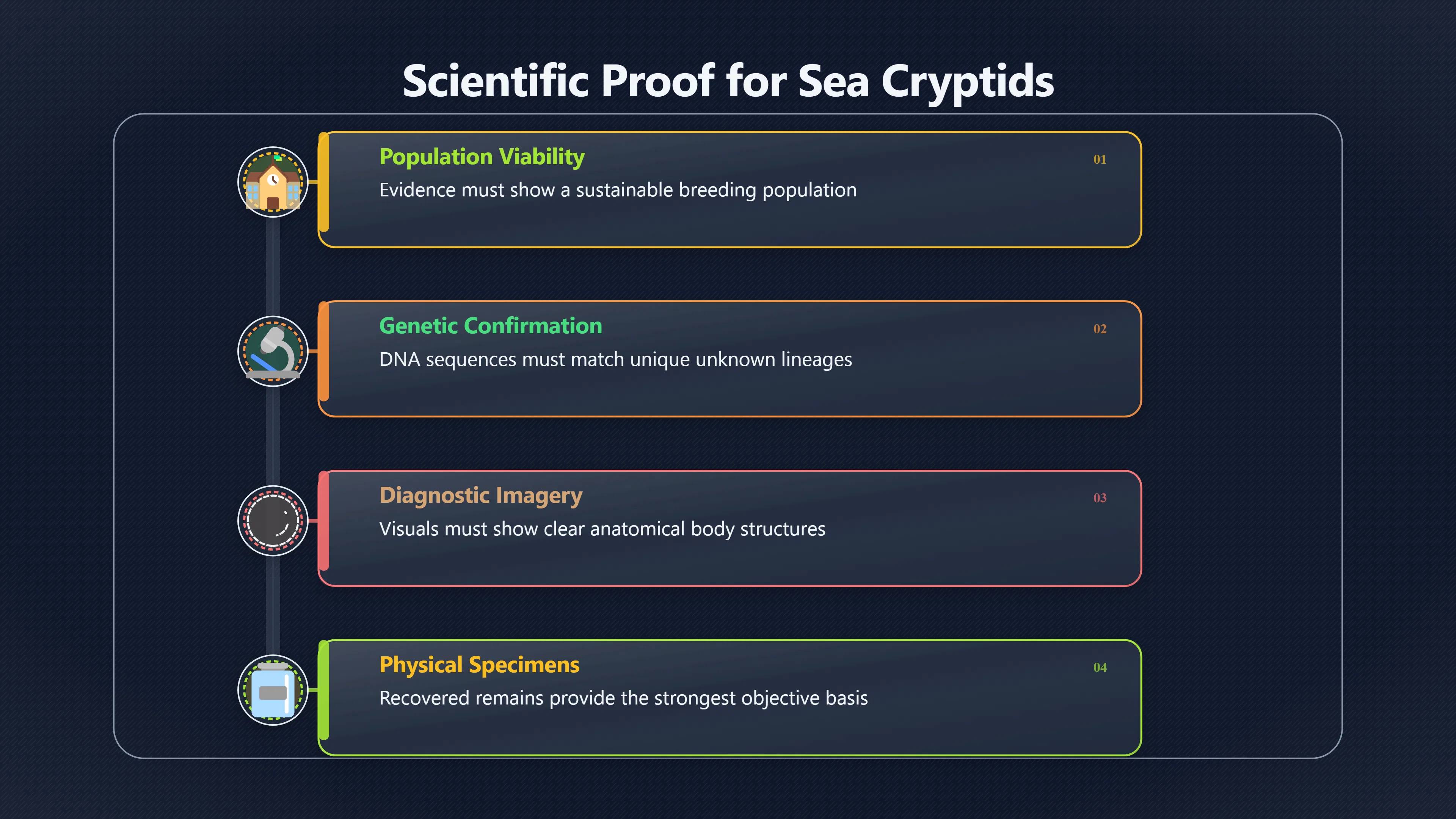
A new sea animal would need bodies, tissue, DNA or diagnostic images, not just repeated dramatic reports.
On this page
- Why unexplored ocean does not lower proof standards
- The evidence needed for a real population
- How giant squid set the modern comparison
Page outline Jump by section
Introduction
Sea serpent sightings and other ocean mystery claims become scientific discoveries only when they meet the same standards applied to any newly recognised animal. The fact that much of the ocean remains poorly explored does not lower the burden of proof. A genuine new sea cryptid would need evidence that can be independently examined and verified: physical specimens, tissue, DNA, diagnostic imagery, or a combination of these showing that a real biological population exists. Modern marine biology regularly discovers new species, including large and unusual animals, but those discoveries are accepted because they produce testable evidence rather than repeated eyewitness reports.[NOAA Ocean Exploration]oceanexplorer.noaa.govNOAA Ocean ExplorationHow much of the ocean has been explored?While the entire seafloor has been mapped using data collected from satelli… For cryptozoology, this distinction is crucial. The question is not whether the ocean can still surprise scientists—it clearly can. The question is what would be required to move a reported sea monster from folklore, anecdote, or unresolved sighting into the category of documented zoological reality.
Why Unexplored Ocean Does Not Lower Proof Standards
A common argument in sea-serpent discussions is that the ocean is vast and underexplored, so unusual reports deserve special consideration. The first half of that statement is true. Large portions of the deep ocean have never been directly observed, and high-resolution mapping still covers only part of the seafloor. Scientists continue to discover previously unknown marine species every year.[NOAA Ocean Exploration]oceanexplorer.noaa.govNOAA Ocean ExplorationHow much of the ocean has been explored?While the entire seafloor has been mapped using data collected from satelli…
However, unexplored territory creates an opportunity for discovery, not an exemption from evidence. Marine biologists do not accept claims of new species simply because a habitat is difficult to access. A species must still be distinguishable from known animals and supported by evidence that other researchers can evaluate. The standards used for a deep-sea fish, squid, jellyfish, or whale are the same standards that would apply to a proposed sea serpent.[iczn.org]iczn.orgDeclaration 45 – Addition of Recommendations to Article…Whenever feasible, new species-group taxa should be established on the basis o…
This principle is important because oceans produce many conditions that encourage misidentification:<div class="content-enhancement content-enhancement--insight-grid" markdown="1">
- Brief observations at long range.
- Animals partly hidden by waves.
- Poor lighting and atmospheric distortion.
- Unfamiliar behaviours from known species.
- Decomposed carcasses whose original anatomy is obscured.</div>
These factors explain why eyewitness testimony alone is considered a starting point for investigation rather than proof.
The Evidence Needed for a Real Population
A single dramatic encounter would rarely be enough to establish a new large marine animal. Scientists would look for multiple lines of evidence that converge on the same conclusion.
Physical Specimens Remain the Strongest Standard
The most persuasive evidence would be a body, skeleton, preserved tissue, or other recoverable remains. Zoological naming conventions are built around reference specimens, often called type specimens or holotypes, which provide an objective basis for future comparison. The International Code of Zoological Nomenclature strongly recommends preserved material whenever feasible because names must be linked to verifiable biological evidence.[code.iczn.org+2iczn.org]code.iczn.orgArticle 73Name-bearing types fixed in the original publication…A holotype is the single specimen upon which a new nominal species-group taxon is…
For a large marine cryptid, even partial remains could be decisive if they contained diagnostic features that could not be matched to known species.
DNA Can Confirm Presence
Modern genetics has transformed species discovery. Tissue samples can reveal evolutionary relationships, while environmental DNA (eDNA)—genetic traces shed into water—can detect animals that are rarely seen directly. Recent deep-sea studies have identified elusive species, including giant squid, from DNA found in seawater samples.[People.com+3Oceanographic+3ScienceDaily]oceanographicmagazine.comOceanographic Giant squid found in Western Australian waters in e DNAOceanographicGiant squid found in Western Australian waters in eDNA…May 6, 2026 — 6 May 2026 — Scientists analysing environmental DNA…
For a proposed sea monster, DNA evidence would need to satisfy several conditions:<div class="content-enhancement content-enhancement--insight-grid" markdown="1">
- The genetic material must be reproducible across samples.
- Contamination must be ruled out.
- The sequence should not match known species.
- Results should ideally be confirmed by independent laboratories.</div>
DNA alone may not fully describe a new animal, but it can provide powerful evidence that an unknown lineage exists.
Images Must Be Diagnostic
Photographs and video are far more useful today than in earlier eras, but not all imagery is equal.
A blurry shape on the horizon may generate public excitement while contributing little scientifically. Researchers instead seek diagnostic images showing identifiable anatomical features. Useful footage would reveal body structure, movement, proportions, and details that allow comparison with known species.
Increasingly, deep-sea exploration uses remotely operated vehicles, autonomous systems, and large image databases to document marine life. These technologies have dramatically improved the ability to verify unusual observations.[arXiv]arxiv.orgFathomNet: An underwater image training database for ocean exploration and discoveryJune 30, 2020…
A Population Must Exist
Perhaps the most overlooked requirement is population viability. A giant unknown vertebrate cannot survive as a single individual.
Scientists would ask:<div class="content-enhancement content-enhancement--caution" markdown="1">
- Where does the species breed?
- How many individuals exist?
- What does it eat?
- How does it avoid detection?
- What ecological niche does it occupy?</div>
A convincing case becomes stronger when evidence appears repeatedly across time and location rather than as a single unexplained event.
Why Eyewitness Reports Usually Fall Short
Many historical sea-serpent cases involved numerous witnesses, sometimes including sailors, naval officers, or coastal communities. Large numbers of observers can make a report interesting, but they do not automatically make it biologically conclusive.
Witnesses generally report what they perceived, not necessarily what was physically present. Human observers often fill gaps in incomplete information. In marine settings, a line of surfacing animals, floating debris, unusual wave patterns, or an unfamiliar fish can be interpreted as a single giant creature.
Scientific acceptance therefore depends less on the number of reports and more on whether the reports generate testable evidence. A hundred descriptions without specimens or diagnostic imagery still leave the underlying animal unidentified.
How Giant Squid Set the Modern Comparison[giant squid]ocean.si.eduSmithsonian OceanThe species was first recorded live in 2006, after researchers suspended bait beneath a research vessel off the Ogasawa… quid provides the clearest modern benchmark for evaluating sea-monster claims.
For centuries, stories of enormous tentacled creatures were associated with legends such as the Kraken. Yet giant squid were not accepted because sailors told dramatic stories. They became accepted because evidence accumulated in stages. Dead specimens washed ashore or were recovered from fishing operations. Anatomical study demonstrated that the animals were real. Later, researchers obtained the first photographs of a live giant squid in its natural habitat in 2004, providing direct visual confirmation.[Smithsonian Ocean]ocean.si.eduSmithsonian OceanGiant Squid on Baited CameraThis is the first photograph of a live giant squid (Architeuthis) in its natural habitat. I…
More recently, environmental DNA studies have detected giant squid in regions where sightings are extremely rare, adding another independent line of evidence.[Oceanographic+2Sci.News: Breaking Science News]oceanographicmagazine.comOceanographic Giant squid found in Western Australian waters in e DNAOceanographicGiant squid found in Western Australian waters in eDNA…May 6, 2026 — 6 May 2026 — Scientists analysing environmental DNA…
The giant squid story is often cited by cryptozoologists because it shows that unusual marine animals can indeed exist beyond everyday observation. Yet it also demonstrates the opposite lesson: acceptance came only after physical specimens, anatomical analysis, photography, and genetic evidence accumulated. The animal crossed from legend to zoology because the evidence became repeatable and verifiable.[Smithsonian Ocean+2Scientific American]ocean.si.eduSmithsonian OceanGiant Squid on Baited CameraThis is the first photograph of a live giant squid (Architeuthis) in its natural habitat. I…
What Would Count as Proof Today?
If reports emerged tomorrow of a giant unknown sea creature, a persuasive case would likely require several forms of evidence at once:<div class="content-enhancement content-enhancement--step-flow" markdown="1">
- High-quality photographs or video showing diagnostic anatomy.
- Tissue, skin, bone, or other physical material suitable for analysis.
- DNA evidence distinct from known marine species.
- Independent confirmation by multiple researchers or institutions.
- Repeated detections indicating a sustainable population.
- A formal scientific description comparing the animal with known species. OUP Academic+2PMC</div>
Any one piece of evidence might be intriguing. Together, they would transform a sea-monster claim into a zoological discovery.
The Practical Test for Sea-Serpent Claims
The modern standard is straightforward: extraordinary creatures do not require extraordinary rules. A new sea cryptid would be judged by the same methods used to discover any other marine animal. The ocean’s mysteries create opportunities for genuine discoveries, but they do not replace the need for specimens, genetics, diagnostic imagery, and reproducible evidence.
That is why repeated dramatic sightings remain unresolved stories, while animals such as the giant squid moved from maritime legend into accepted science. The difference is not openness to mystery. The difference is proof.
Amazon book picks
Further Reading
Books and field guides related to What Would Prove a New Sea Monster?. Use these as the next step if you want deeper reading beyond the article.
Abominable Science!
Directly addresses what counts as evidence for extraordinary animal claims.
Why Evolution is True
Explains scientific standards relevant to species discovery and verification.
eBay marketplace picks
Marketplace Samples
Live-tested eBay searches with available results related to this page.




Endnotes
1.
Source: oceanexplorer.noaa.gov
Link:https://oceanexplorer.noaa.gov/ocean-fact/explored/
2.
Source: iczn.org
Link:https://www.iczn.org/the-code/declaration-45-addition-of-recommendations/
4.
Source: code.iczn.org
Title: Article 73
Link:https://code.iczn.org/types-in-the-species-group/article-73-name-bearing-types-fixed-in-the-original-publication-holotypes-and-syntypes/
5.
Source: iczn.org
Link:https://www.iczn.org/outreach/faqs/
6.
Source: sciencedaily.com
Link:https://www.sciencedaily.com/releases/2026/05/260513221807.htm
7.
Source: sci.news
Title: giant squid dna deep canyons australia 14750
Link:https://www.sci.news/biology/giant-squid-dna-deep-canyons-australia-14750.html
8.
Source: people.com
Link:https://people.com/giant-squid-detected-in-deep-underwater-canyon-in-western-australia-11968303
9.
Source: arxiv.org
Link:https://arxiv.org/abs/2007.00114
10.
Source: arxiv.org
Title: arXiv Fathom Verse: A community science dataset for ocean animal discovery
Link:https://arxiv.org/abs/2412.01701
11.
Source: pmc.ncbi.nlm.nih.gov
Title: PMCBest practices for the naming of species
Link:https://pmc.ncbi.nlm.nih.gov/articles/PMC11933275/
12.
Source: pmc.ncbi.nlm.nih.gov
Link:https://pmc.ncbi.nlm.nih.gov/articles/PMC10443861/
13.
Source: code.iczn.org
Title: article 72 general provisions
Link:https://code.iczn.org/types-in-the-species-group/article-72-general-provisions/
14.
Source: oceanographicmagazine.com
Title: Oceanographic Giant squid found in Western Australian waters in e DNA
Link:https://oceanographicmagazine.com/news/giant-squid-found-in-western-australian-waters-in-edna-study/
15.
Source: ocean.si.edu
Link:https://ocean.si.edu/ocean-life/invertebrates/giant-squid-baited-camera
16.
Source: scientificamerican.com
Title: live giant squid photogra
Link:https://www.scientificamerican.com/article/live-giant-squid-photogra/
17.
Source: reddit.com
Title: the giant squid created myths such as the kraken
Link:https://www.reddit.com/r/TheDepthsBelow/comments/c2dnzl/the_giant_squid_created_myths_such_as_the_kraken/
18.
Source: scientificamerican.com
Title: animal species named from photos
Link:https://www.scientificamerican.com/blog/tetrapod-zoology/animal-species-named-from-photos/
19.
Source: instagram.com
Link:https://www.instagram.com/reel/DYP3UZUhlof/?hl=en
20.
Source: youtube.com
Link:https://www.youtube.com/watch?v=iXUr4lbogCw
21.
Source: ocean.si.edu
Title: giant squid
Link:https://ocean.si.edu/ocean-life/invertebrates/giant-squid
22.
Source: seahistory.org
Title: the giant squid
Link:https://seahistory.org/sea-history-for-kids/the-giant-squid/
23.
Source: Wikipedia
Link:https://en.wikipedia.org/wiki/Kraken
24.
Source: Wikipedia
Title: Giant squid
Link:https://en.wikipedia.org/wiki/Giant_squid
Additional References
25.
Source: pmc.ncbi.nlm.nih.gov
Link:https://pmc.ncbi.nlm.nih.gov/articles/PMC1559985/
26.
Source: mikesbikes.com
Link:https://mikesbikes.com/collections/giant?srsltid=AfmBOoqZ9LBP4SQiYMj200rPc5IwcSngF2hxFnrQ-iqfknm3J-lUxWnv
27.
Source: coloradoskishop.com
Link:https://coloradoskishop.com/collections/giant?srsltid=AfmBOooonnI_wGY6yzG-sUVWbPTeQGCTNWIgJMKm4e-5p2Xp-G3agvXa
28.
Source: mlb.com
Link:https://www.mlb.com/giants/
29.
Source: giantfoodstores.com
Link:https://giantfoodstores.com/home
30.
Source: giantfood.com
Link:https://giantfood.com/
31.
Source: theguardian.com
Link:https://www.theguardian.com/environment/2026/jun/26/marine-expedition-uncovers-31-new-species-two-weeks-brazil
32.
Source: futura-sciences.com
Title: scientists reveal first ever images of the oceans most elusive animal 26679
Link:https://www.futura-sciences.com/en/scientists-reveal-first-ever-images-of-the-oceans-most-elusive-animal_26679/
33.
Source: giant-bicycles.com
Link:https://www.giant-bicycles.com/us
34.
Source: youtube.com
Link:https://www.youtube.com/watch?v=kApzlhDB-28
Topic Tree