Within Photos
What a Cryptid Photo Must Prove First
A cryptid image is stronger when original files, metadata, location matches and continuous footage support the story around it.
On this page
- Original files and metadata
- Location, witnesses and chain of custody
- Why reposted images lose evidential value
Page outline Jump by section
Introduction
A cryptid photograph does not become persuasive simply because the subject is difficult to identify. Before investigators ask whether a shape resembles Bigfoot, a lake monster or another unknown creature, they need to establish where the image came from, when it was created, whether it has been altered, and how it travelled from camera to public view. In cryptozoology, provenance—the documented history of a file—is often more important than the apparent creature in the frame. Many famous cryptid images have remained controversial not because of what they show, but because original negatives, source files, metadata or custody records were missing. When provenance is weak, ordinary explanations and hoax scenarios become harder to rule out. When provenance is strong, investigators gain a factual basis for assessing location, timing, authenticity and context. Provenance does not prove a cryptid exists, but without it, visual evidence usually carries limited weight.[cameraforensics.com]cameraforensics.coma quick guide to digital image forensics in 2020Also known as forensic image analysis, the discipline focuses on image authenticity and image content.Read more…
What a Cryptid Photo Must Prove First
Original files and metadata
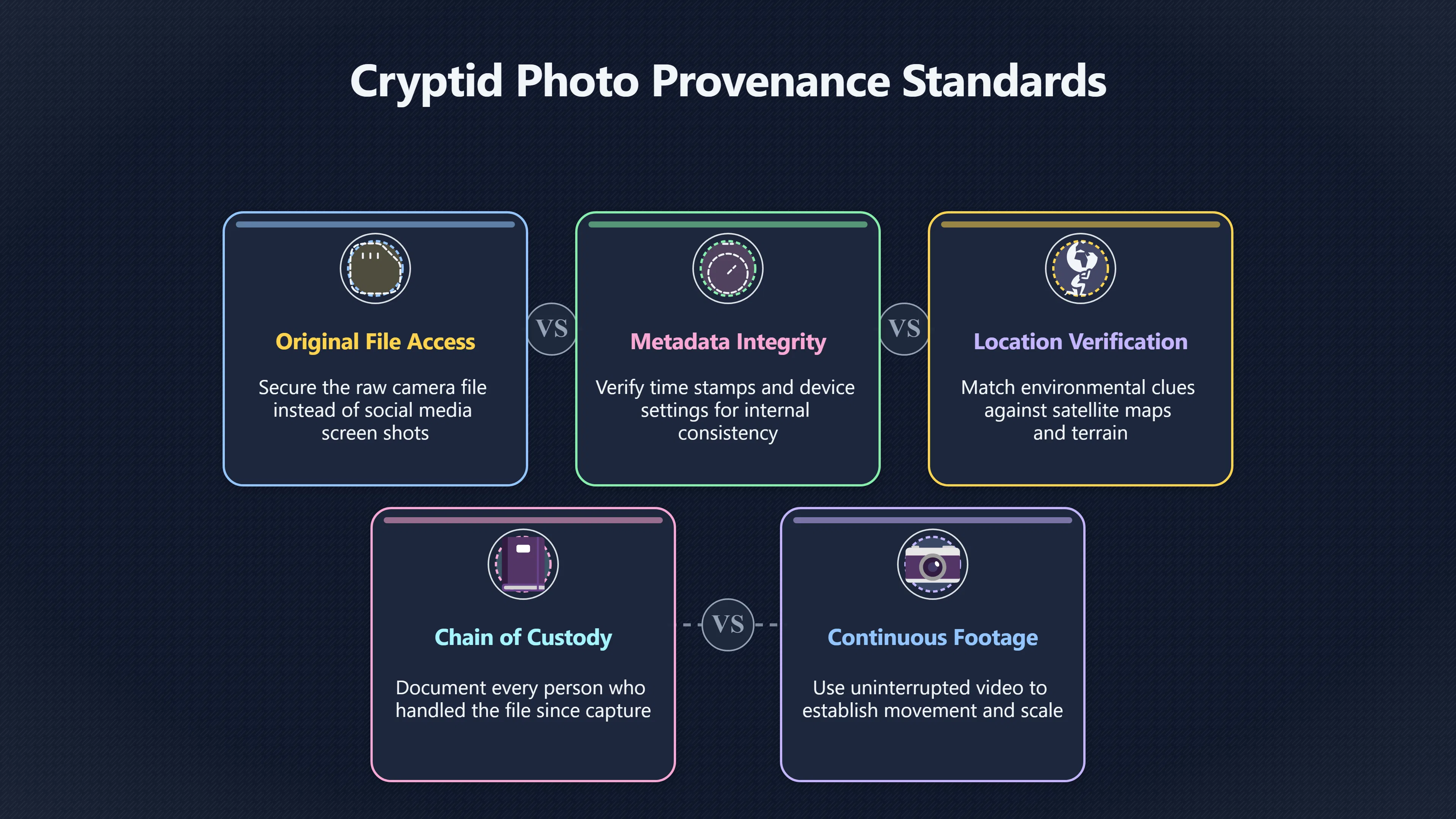
The most valuable cryptid image is not the version posted to social media. It is the original file produced by the camera or phone.
Original files often contain Exchangeable Image File Format (EXIF) metadata, which may record the date, time, device model, exposure settings and sometimes GPS coordinates. Metadata can help investigators test whether the claimed circumstances match the file itself. For example, a witness may claim a photograph was taken in a remote forest at dawn, while metadata indicates a different date, different device or editing history. Metadata can therefore support or contradict a sighting narrative.[SCIEPublish+2Springer]sciepublish.comForensic Value of Exif Data: An Analytical Evaluation…by N Soni · 2025 · Cited by 8 — ABSTRACT: Exif metadata contained in…
At the same time, metadata is not definitive proof. Digital forensic research consistently notes that EXIF information can be altered, removed or overwritten. A timestamp may reflect an incorrectly configured camera clock, and GPS data can be absent or edited. For that reason, metadata is treated as a starting point rather than a final verdict. Investigators look for consistency across multiple data points instead of relying on a single field.[TrueScreen - Trust as a Service]truescreen.ioTrue ScreenTrust as a ServiceEXIF Metadata: How to Prove the Date of a Photo in Court5 Jun 2026 — EXIF metadata cannot prove a photo's…
Several practical checks are especially valuable:<div class="content-enhancement content-enhancement--comparison" markdown="1">
- Request the original file rather than a screenshot or repost.
- Compare creation dates with the witness timeline.
- Examine camera model and image dimensions.
- Look for signs of editing software in metadata records.
- Check whether multiple files from the same event share consistent timestamps and settings.
Why continuous footage often matters more than a single frame
A lone image can be isolated from its surroundings. A longer recording provides provenance clues that still photographs often lack.
Continuous footage may show where the camera operator was standing, what happened before and after the alleged encounter, whether the subject moved naturally, and whether scale references were present. Investigators can compare environmental conditions, witness behaviour and camera motion throughout the sequence.
From a provenance perspective, continuous recordings are harder to manipulate convincingly than a single carefully selected frame. A cryptid claim supported by an uninterrupted original video file generally provides more opportunities for verification than a single image extracted from unknown circumstances.[cameraforensics.com]cameraforensics.coma quick guide to digital image forensics in 2020Also known as forensic image analysis, the discipline focuses on image authenticity and image content.Read more…
Location, Witnesses and Chain of Custody
A photograph exists within a wider evidential story. Provenance therefore extends beyond the file itself.
Investigators typically ask whether the claimed location matches visible terrain, weather conditions, vegetation, landmarks and available geographic information. Even when GPS metadata is unavailable, landscapes can sometimes be compared with maps, satellite imagery or known features in the area. Multimedia geolocation research highlights how environmental clues can help establish where a photograph was likely captured when metadata alone is insufficient.[arXiv]arxiv.orgOpen source on arxiv.org.
Witness information is equally important. Useful questions include:
- Who captured the image?
- Who first received the file?
- Has the file been edited, cropped or enhanced?
- Are there independent witnesses?
- Do multiple devices contain matching originals?
These questions form part of what digital investigators call a chain of custody: documentation showing how evidence moved from capture to examination. A strong chain of custody reduces uncertainty about whether a file was substituted, altered or misrepresented after capture. While cryptid investigations are rarely conducted under courtroom standards, the same principles help establish credibility.[Lumethic+2Fastio]lumethic.comImage Forensics and Chain of Custody: A Legal EvidenceImage Forensics and Chain of Custody: A Legal Evidence…August 24, 2025 — 24 Aug 2025 — The image forensics workflow for court…
In practical terms, a cryptid image gains evidential value when investigators can reconstruct its journey from camera to publication. An image that appears suddenly online with no identifiable photographer, no original file and no supporting witnesses provides little opportunity for independent verification.
Why Reposted Images Lose Evidential Value
Many cryptid photographs circulate for years through forums, social media accounts, videos and news articles. Each repost can reduce the amount of information available for verification.
A reposted image is often:<div class="content-enhancement content-enhancement--comparison" markdown="1">
- Cropped from the original frame.
- Resized or compressed.
- Stripped of metadata.
- Detached from the original witness account.
- Re-captioned with new claims.
- Shared without a verifiable source.[LinkedIn]linkedin.comUnderstanding Metadata in Digital Forensics: HTML vs. EXIFLike EXIF data for images, video metadata can include: Creation date an…</div>
This process can transform an image from primary evidence into a digital rumour. Provenance researchers describe online images as following complex chains of copying, modification and redistribution. As those chains grow longer, determining what the original file looked like becomes increasingly difficult.[arXiv]arxiv.orgarXiv Beyond Pixels: Image Provenance Analysis Leveraging MetadataarXiv Beyond Pixels: Image Provenance Analysis Leveraging Metadata
Cryptozoology provides many examples of images whose reputations exceeded their documented origins. Once an image becomes famous, later audiences may encounter only the cropped or enhanced version rather than the original material. Important context can disappear along the way.
Lessons from Famous Cryptid Photographs
The history of Loch Ness Monster imagery demonstrates why provenance matters.[Wikipedia]WikipediaLoch Ness MonsterLoch Ness Monster
The famous 1934”surgeon’s photograph” became one of the most influential cryptid images ever published. Decades later, investigations focused not merely on the shape visible in the water but on the photograph’s history, scale, uncropped versions and origins. Subsequent analysis of the full image and later admissions connected the image to a hoax involving a small model attached to a toy submarine. The controversy showed how an image can gain persuasive power when viewers lack access to its complete provenance.[Wikipedia]WikipediaLoch Ness MonsterLoch Ness Monster
Other Loch Ness photographs have faced similar issues. Researchers examining older claims frequently encountered lost negatives, altered reproductions, retouched images and uncertainty about what happened between capture and publication. In some cases, questions about provenance proved more significant than the visual content itself.[Wikipedia]WikipediaLoch Ness MonsterLoch Ness Monster
The lesson for modern cryptid uploads is straightforward: an unclear creature in a well-documented original file is usually stronger evidence than a sharper-looking image whose origin cannot be established.
A Practical Provenance Standard for Cryptid Uploads
Before treating a cryptid photograph as significant evidence, investigators should look for several minimum indicators:<div class="content-enhancement content-enhancement--step-flow" markdown="1">
- Original file available, not only screenshots or reposts.
- Metadata preserved and examined for consistency.
- Location independently verified through GPS data or environmental clues.
- Witness account documented close to the time of capture.
- Chain of custody recorded, showing who handled the file.
- Continuous supporting media, where available.
- No unexplained edits, crops or enhancements affecting interpretation.</div>
None of these steps can establish that a cryptid is real. What they do establish is whether the image itself deserves serious consideration. In a field where blurry shapes often dominate discussion, provenance provides the foundation on which every later interpretation must rest.[Lumethic+2cameraforensics.com]lumethic.comImage Forensics and Chain of Custody: A Legal EvidenceImage Forensics and Chain of Custody: A Legal Evidence…August 24, 2025 — 24 Aug 2025 — The image forensics workflow for court…
Amazon book picks
Further Reading
Books and field guides related to What a Cryptid Photo Must Prove First. Use these as the next step if you want deeper reading beyond the article.
Field Guide To Bigfoot, Yeti, & Other Mystery Primates Worldwide
Provides context for many disputed photographs.
eBay marketplace picks
Marketplace Samples
Live-tested eBay searches with available results related to this page.


Endnotes
1.
Source: cameraforensics.com
Title: a quick guide to digital image forensics in 2020
Link:https://www.cameraforensics.com/blog/2020/03/06/a-quick-guide-to-digital-image-forensics-in-2020/
2.
Source: arxiv.org
Title: arXiv Beyond Pixels: Image Provenance Analysis Leveraging Metadata
Link:https://arxiv.org/abs/1807.03376
3.
Source: sciepublish.com
Link:https://www.sciepublish.com/article/pii/567
4.
Source: link.springer.com
Link:https://link.springer.com/chapter/10.1007/978-3-032-17300
5.
Source: truescreen.io
Title: True Screen
Link:https://truescreen.io/insights/exif-metadata-photo-date-court-evidence/
6.
Source: truescreen.io
Link:https://truescreen.io/articles/digital-chain-of-custody-guide/
7.
Source: linkedin.com
Link:https://www.linkedin.com/pulse/understanding-metadata-digital-forensics-html-vfsvc
8.
Source: arxiv.org
Link:https://arxiv.org/abs/2402.15448
9.
Source: lumethic.com
Title: Image Forensics and Chain of Custody: A Legal Evidence
Link:https://www.lumethic.com/en/articles/forensic-photography-legal-cases-chain-of-custody-guide
10.
Source: Wikipedia
Title: Loch Ness Monster
Link:https://en.wikipedia.org/wiki/Loch_Ness_Monster
11.
Source: truescreen.io
Link:https://truescreen.io/articles/certify-photos-legal-value/
12.
Source: fast.io
Title: metadata extraction for digital forensics
Link:https://fast.io/resources/metadata-extraction-for-digital-forensics/
Additional References
13.
Source: geotag.world
Link:https://geotag.world/blog/exif-data-forensic-analysis
14.
Source: iflscience.com
Link:https://www.iflscience.com/90-years-ago-the-first-photographic-evidence-of-the-loch-ness-monster-was-revealed-71499
15.
Source: towerforensics.co.uk
Title: what is exif data and how can digital forensics aid in image analysis
Link:https://www.towerforensics.co.uk/blog/what-is-exif-data-and-how-can-digital-forensics-aid-in-image-analysis/
16.
Source: blog.it-learn.io
Title: 2026 06 02 exif metadata digital forensics hidden image data
Link:https://blog.it-learn.io/posts/2026-06-02-exif-metadata-digital-forensics-hidden-image-data/
17.
Source: youtube.com
Title: How to Extract Metadata from an Image | Photo Forensics for Incident Response
Link:https://www.youtube.com/watch?v=Mez2aT6Vsgo
18.
Source: researchgate.net
Link:https://www.researchgate.net/publication/392920789_Forensic_Value_of_Exif_Data_An_Analytical_Evaluation_of_Metadata_Integrity_across_Image_Transfer_Methods
19.
Source: gpsmapcamera.in
Link:https://gpsmapcamera.in/photo-metadata-explained-exif-gps-timestamp-2025/
20.
Source: youtu.be
Title: 4️⃣ Wazuh SIEM Part 4 – How to Send Wazuh Alerts Using SMTP (Method 1)
Link:https://youtu.be/j0C_HwDSqSg?si=rJOBzMdL0WHqIrby
21.
Source: vox.com
Title: How scientists debunked the Loch Ness Monster
Link:https://www.vox.com/2015/4/21/8459353/loch-ness-monster
22.
Source: lucidtruthtechnologies.com
Title: understanding meta data in digital forensics
Link:https://lucidtruthtechnologies.com/understanding-meta-data-in-digital-forensics/
Topic Tree