Within Sanderson
Why TV Made Sanderson More Believable
Sanderson's television animal work made later monster claims feel more vivid because audiences already knew him as a hands-on naturalist.
On this page
- The live animal persona before monster hunting
- How television made strange creatures feel immediate
- Where education, spectacle and authority blurred
Page outline Jump by section
Introduction
Before Ivan T. Sanderson became one of the best-known advocates of cryptozoology, he built a public reputation as a naturalist who handled real animals in front of audiences. That earlier career mattered. When Sanderson later discussed Yetis, lake monsters or other alleged unknown creatures, many members of the public already knew him as the man who appeared on radio and television with exotic specimens, explained zoology in plain language and seemed comfortable around unusual wildlife. The mechanism was not simply fame. Television gave Sanderson a visible form of credibility: viewers repeatedly watched him interact with living animals that most people had never seen themselves, making him appear to be a trustworthy guide to the boundary between the known and the unknown.[Wikipedia+2American Philosophical Society]WikipediaIvan T. SandersonIvan T. Sanderson
The Live-Animal Persona Before Monster Hunting
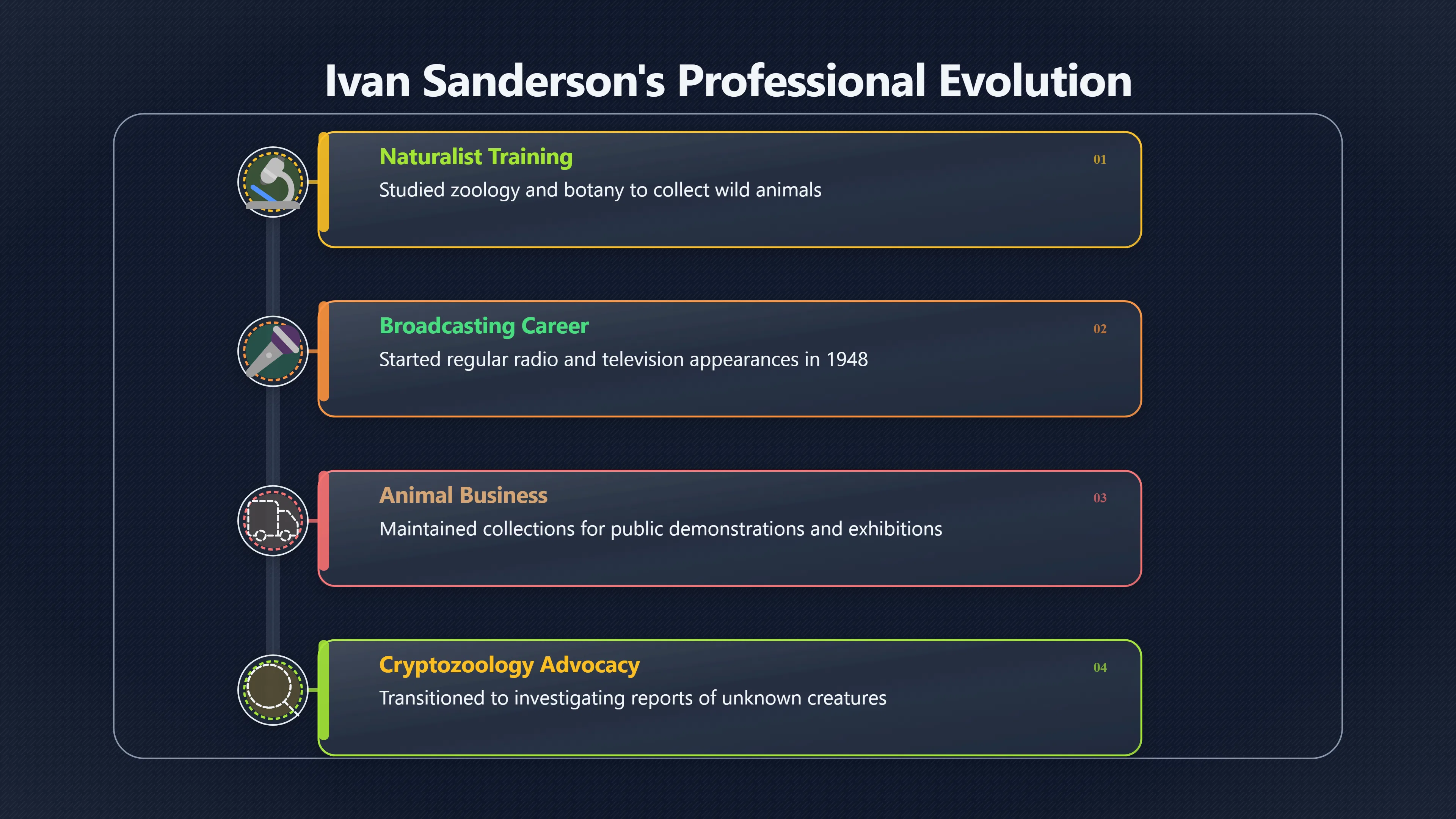
Sanderson’s authority in popular culture was built long before his most famous cryptozoological books appeared. Trained in zoology and botany, he spent years collecting animals, travelling on expeditions and writing about natural history. After the Second World War he increasingly turned to broadcasting, beginning regular radio and television appearances in the late 1940s. On these programmes he discussed zoology and frequently displayed living animals.[American Philosophical Society+2Encyclopedia.com]amphilsoc.orgnew digital library ivan sanderson papersAmerican Philosophical SocietyNew to the Digital Library: Ivan Sanderson papers21 Nov 2022 — In the late 1940s, he began making regular a…
Television was still a novelty, and wildlife broadcasting was far less common than it would later become. Sanderson occupied a distinctive role: he was not merely describing nature from a studio desk but bringing unusual creatures directly into the broadcast environment. Contemporary accounts describe him as a frequent guest on television programmes and variety shows where he displayed and explained exotic animals.[Wikipedia]WikipediaIvan T. SandersonIvan T. Sanderson
His involvement went beyond occasional appearances. Sanderson hosted natural-history programmes, participated in some of the earliest television experiments, and later developed what he called his”animal business”, maintaining collections of animals that could be used for broadcasting, exhibitions and public demonstrations. He eventually operated a roadside zoo in New Jersey and toured exhibits of rare animals.[Wikipedia]WikipediaIvan T. SandersonIvan T. Sanderson
The result was a public image grounded in direct contact with living creatures. Audiences did not primarily encounter him as a theorist. They encountered him as someone who physically handled animals and appeared to know them intimately.
How Television Made Strange Creatures Feel Immediate
The key mechanism linking Sanderson’s television career to his later monster-hunting reputation was the way television compressed distance.
Many of the animals Sanderson displayed were unfamiliar to viewers. In the middle decades of the twentieth century, most people could not easily visit tropical forests, scientific collections or specialised zoos. Television therefore transformed rare animals into household experiences. When Sanderson introduced an unusual reptile, mammal or bird, viewers could watch it move, react and behave in real time.[Wikipedia+2American Philosophical Society]WikipediaIvan T. SandersonIvan T. Sanderson
That experience subtly reshaped expectations about discovery. If television could reveal remarkable real animals that viewers had never encountered before, then claims about other unfamiliar creatures did not automatically seem impossible. Sanderson’s broadcasts repeatedly demonstrated a simple lesson: the natural world contained surprises.
This did not prove the existence of cryptids. Instead, it changed the psychological environment in which cryptid claims were received. The audience learned to associate Sanderson with encounters involving unusual wildlife. When he later argued that reports of Bigfoot-like creatures or unknown lake animals deserved investigation, he was speaking from a position already linked in viewers’ minds with zoological discovery rather than pure speculation.[Wikipedia]WikipediaIvan T. SandersonIvan T. Sanderson
Television therefore functioned as a credibility transfer mechanism. Familiarity with Sanderson’s handling of known animals increased willingness among some audiences to listen when he discussed unknown ones.
Where Education, Spectacle and Authority Blurred
Sanderson’s broadcasts sat at an intersection of science communication and entertainment. Television rewarded vivid demonstrations, unexpected behaviour and unusual specimens. A presenter who arrived with an exotic animal naturally attracted attention.
Why Television Strengthened Sanderson’s Monster Authority
Sanderson’s monster-hunting reputation did not emerge from cryptozoology alone. It rested on years of public exposure as a broadcaster who appeared knowledgeable, adventurous and comfortable with unusual animals. Television supplied three reinforcing elements:
- Demonstrated familiarity with wildlife, because viewers repeatedly watched him interact with living animals.[Wikipedia]WikipediaIvan T. SandersonIvan T. Sanderson
- Access to mass audiences, allowing his reputation to spread far beyond specialist natural-history circles.[Zippy's Telecom Blog / Grigonis Research]richardgrigonis.comZippy's Telecom Blog / Grigonis Research Ivan TSanderson — Chapter 7 — Radio and TV AppearancesOne broadcast in 1938 would include the young naturalist Ivan Sanderson appearing with a…
- A sense of discovery, because broadcasts regularly showcased creatures that were unfamiliar to ordinary viewers.[Wikipedia]WikipediaIvan T. SandersonIvan T. Sanderson
Within the history of cryptozoology, this was one of Sanderson’s most important advantages. He entered debates about unknown animals not as an obscure enthusiast but as a recognisable television naturalist. For many members of the public, the transition from showing rare animals to discussing alleged undiscovered ones felt less like a leap than it might have for someone without that broadcasting background. Television had already taught audiences to expect surprising creatures from him, and that expectation made his monster claims appear more believable than they otherwise would have been.[Wikipedia+2American Philosophical Society]WikipediaIvan T. SandersonIvan T. Sanderson
Amazon book picks
Further Reading
Books and field guides related to Why TV Made Sanderson More Believable. Use these as the next step if you want deeper reading beyond the article.
Abominable Snowmen, Legend Come to Life
Shows how established authority was transferred into cryptozoology.
Last Chance To See
Highlights how charismatic communicators shape public views of animals.
The Zoologist's Guide to the Galaxy
Explores scientific reasoning about unfamiliar creatures.
eBay marketplace picks
Marketplace Samples
Live-tested eBay searches with available results related to this page.

Endnotes
1.
Source: Wikipedia
Title: Ivan T. Sanderson
Link:https://en.wikipedia.org/wiki/Ivan_T._Sanderson
2.
Source: encyclopedia.com
Title: sanderson ivan terence 1911 1973
Link:https://www.encyclopedia.com/science/encyclopedias-almanacs-transcripts-and-maps/sanderson-ivan-terence
3.
Source: joshuablubuhs.com
Link:https://www.joshuablubuhs.com/blog/ivan-terence-sanderson-as-a-fortean
4.
Source: amphilsoc.org
Title: new digital library ivan sanderson papers
Link:https://www.amphilsoc.org/blog/new-digital-library-ivan-sanderson-papers
5.
Source: richardgrigonis.com
Title: Zippy’s Telecom Blog / Grigonis Research Ivan T
Link:https://www.richardgrigonis.com/Ch07%20Radio%20and%20TV%20Appearances.html
Additional References
6.
Source: spyguysandgals.com
Link:https://spyguysandgals.com/sgShowAuthor.aspx?id=4403
7.
Source: facebook.com
Title: ivan t sanderson1911 1973ivan t sanderson was a naturalist and writer born in ed
Link:https://www.facebook.com/instituteofmetaphysics/posts/ivan-t-sanderson1911-1973ivan-t-sanderson-was-a-naturalist-and-writer-born-in-ed/1505367731319428/
8.
Source: facebook.com
Title: the founder of cryptozoology ivan sanderson collected research on cryptids for m
Link:https://www.facebook.com/Discovery/posts/the-founder-of-cryptozoology-ivan-sanderson-collected-research-on-cryptids-for-m/962532062586713/
9.
Source: youtube.com
Link:https://www.youtube.com/watch?v=6tRUvtyAMOg
10.
Source: reddit.com
Link:https://www.reddit.com/r/Cryptozoology/comments/112jbym/ivan_t_sanderson_was_an_american_biologist_and/
11.
Source: youtube.com
Link:https://www.youtube.com/watch?v=0gGTsQkrUAw
12.
Source: youtube.com
Link:https://www.youtube.com/watch?v=omkf-eh9FAc
13.
Source: youtube.com
Link:https://www.youtube.com/watch?v=pFD7IgW8PpE
14.
Source: youtube.com
Link:https://www.youtube.com/watch?v=E3r6L-SGP0E
15.
Source: everand.com
Title: Ivan T Sanderson
Link:https://www.everand.com/author/689599217/Ivan-T-Sanderson
Topic Tree