Within Sea Serpents
Why Dead Sharks Become Sea Monsters
Rotting basking sharks can lose key features and leave shapes that look much more monstrous than the living animal.
On this page
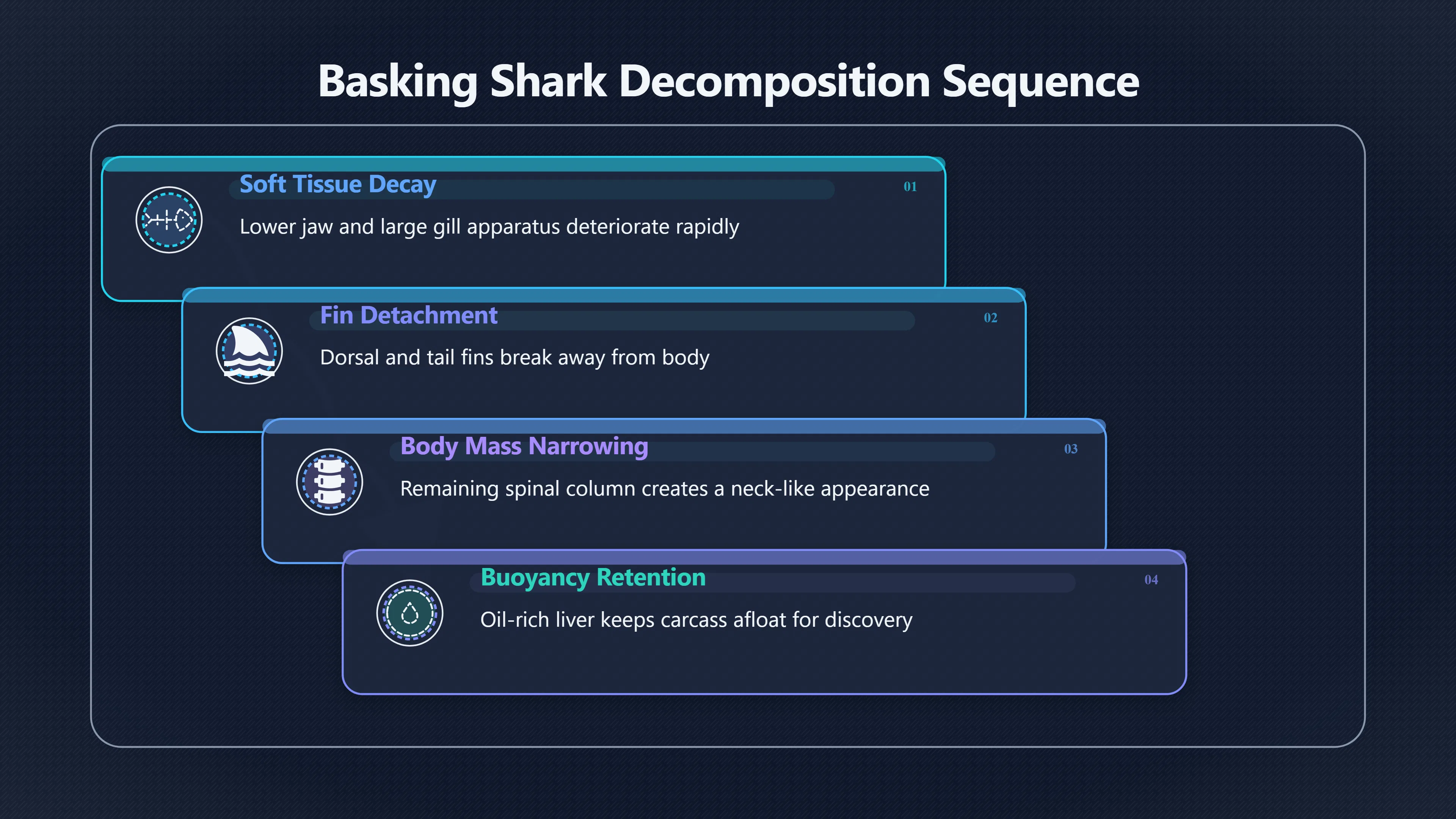
- What changes as a basking shark decomposes
- Why carcasses can look long necked
- How this explains famous monster remains
Page outline Jump by section
Introduction
Among the many explanations proposed for sea serpent sightings and “monster” carcasses, one of the most important is surprisingly mundane: the decomposition of basking sharks. Large basking sharks (Cetorhinus maximus) can transform after death into shapes that look remarkably unlike any living shark. As soft tissues break down, key identifying features disappear while other structures remain intact, creating a silhouette that resembles the long-necked marine reptiles known as plesiosaurs. This phenomenon is often called the “pseudo-plesiosaur” effect and has become one of the strongest natural explanations for several famous sea monster discoveries.[WDBOS]elasmo-research.orgWDBOSSea Monsters: Two Cases of Mistaken IdentityBasking Sharks particularly notorious among cryptozoologists, as their rotting carcasses… The mechanism matters because many celebrated cryptozoological cases were not based on living animals but on strange carcasses recovered from beaches or fishing nets. In a number of those cases, subsequent anatomical study, tissue analysis, and comparison with known shark decomposition patterns pointed toward ordinary basking sharks altered by decay rather than unknown species.[Wikipedia]WikipediaZuiyo-maru carcassZuiyo-maru carcass
What changes as a basking shark decomposes
Why carcasses can look long-necked
The pseudo-plesiosaur illusion arises because decomposition removes precisely the features that would identify the animal as a shark while preserving structures that can be misinterpreted.
A typical observer expects a shark carcass to have:<div class="content-enhancement content-enhancement--phrase-stack" markdown="1">
- A broad head.
- A prominent dorsal fin.
- A recognisable tail fin.
- A compact body shape.</div>
When those features are lost, the remaining spinal column and associated muscles may resemble a narrow neck leading to a small head. The paired pectoral and pelvic fins can then appear to be the four flippers associated with plesiosaurs. Viewed from a distance or in photographs lacking scale, the resemblance can be striking.[paleo.cc+2WDBOS]paleo.ccSea-Monster or Shark: An Alleged Plesiosaur CarcassThis should not be surprising, since basking sharks are known to decompose into "pseud…
This is not merely a visual coincidence. Researchers studying alleged sea monster carcasses have repeatedly noted that the sequence of tissue loss in basking sharks naturally produces a body plan superficially similar to classic artistic reconstructions of plesiosaurs. The result is a carcass that appears to possess a long neck, small head, barrel-shaped body and four limbs even though none of those structures existed in life.[Wikipedia]WikipediaZuiyo-maru carcassZuiyo-maru carcass
Importantly, the illusion becomes strongest after substantial decomposition. A fresh basking shark is rarely mistaken for a plesiosaur. The confusion emerges during the transitional stage when recognisable shark features have disappeared but enough of the body remains intact to suggest an alternative anatomy.[WDBOS]elasmo-research.orgWDBOSSea Monsters: Two Cases of Mistaken IdentityBasking Sharks particularly notorious among cryptozoologists, as their rotting carcasses…
How this explains famous monster remains
The Zuiyo Maru carcass
Earlier and later “sea monster” carcasses
Why the pseudo-plesiosaur effect matters in cryptozoology
The basking shark decomposition model does not explain every sea serpent report. It is specifically an explanation for certain carcasses and some observations of dead or dying animals. It does, however, demonstrate a broader lesson within cryptozoology: unfamiliar biological processes can generate convincing monster evidence without requiring an unknown species.[WDBOS]elasmo-research.orgWDBOSSea Monsters: Two Cases of Mistaken IdentityBasking Sharks particularly notorious among cryptozoologists, as their rotting carcasses…
What makes the pseudo-plesiosaur phenomenon particularly important is that it is testable. Researchers can compare photographs, measurements, tissue samples and known shark anatomy. In the strongest cases, such as the Zuiyo Maru carcass, the explanation is supported not only by visual similarity but also by biochemical evidence and repeated observations of similarly decomposed basking sharks.[Wikipedia]WikipediaZuiyo-maru carcassZuiyo-maru carcass
For the study of sea serpent claims, the lesson is straightforward: a carcass that appears reptilian is not necessarily evidence of a surviving prehistoric animal. Sometimes a sea monster is what remains after the ocean has transformed a very large shark into something that no longer resembles itself.[Wikipedia]WikipediaSea monsterSea monster
Amazon book picks
Further Reading
Books and field guides related to Why Dead Sharks Become Sea Monsters. Use these as the next step if you want deeper reading beyond the article.
On the Track of Unknown Animals
Includes discussion of sea-serpent evidence and interpretations.
Sharks of the World
Helps readers understand basking shark anatomy and misidentifications.
eBay marketplace picks
Marketplace Samples
Live-tested eBay searches with available results related to this page.


Endnotes
1.
Source: elasmo-research.org
Link:https://www.elasmo-research.org/education/topics/p_sea_monster.htm
2.
Source: paleo.cc
Link:https://www.paleo.cc/paluxy/plesios.htm
3.
Source: Wikipedia
Title: Zuiyo-maru carcass
Link:https://en.wikipedia.org/wiki/Zuiyo-maru_carcass
4.
Source: Wikipedia
Title: Sea monster
Link:https://en.wikipedia.org/wiki/Sea_monster
5.
Source: Wikipedia
Title: Basking shark
Link:https://en.wikipedia.org/wiki/Basking_shark
6.
Source: basking.io
Link:https://basking.io/
7.
Source: Wikipedia
Link:https://en.wikipedia.org/wiki/Basking
8.
Source: theguardian.com
Title: The Guardian Shark or sea monster?
Link:https://www.theguardian.com/environment/2026/may/07/basking-shark-sea-monster-canada-marine-mystery-90-years-on
Additional References
9.
Source: creation.com
Link:https://creation.com/en/articles/letting-[rotting-sharks
10.
Source: facebook.com
Link:https://www.facebook.com/groups/1002571683091379/posts/7710637085618105/
11.
Source: merriam-webster.com
Link:https://www.merriam-webster.com/dictionary/bask
12.
Source: boingboing.net
Title: a 1977 trawler hauled up a carcass that japan took for a sea monster
Link:https://boingboing.net/2026/06/12/a-1977-trawler-hauled-up-a-carcass-that-japan-took-for-a-sea-monster.html
13.
Source: creationresearch.org
Link:https://www.creationresearch.org/crsq-2001-volume-38-number-1_new-zuiyo-maru
14.
Source: facebook.com
Link:https://www.facebook.com/groups/593164994893955/posts/1603483217195456/
15.
Source: reddit.com
Link:https://www.reddit.com/r/Cryptozoology/comments/1ajltwu/in_1977_the_japanese_ship_zuiyomaru_caught_a/
16.
Source: creation.com
Link:https://creation.com/index.php?id=1854&option=com_content&view=article
17.
Source: jurassic-dreams.com
Title: But Plesiosaurs were reptiles, and therefore the breathed air.Read more
Link:https://www.jurassic-dreams.com/blogs/jurassic-dreams-the-fossils-blog/the-plesiosaur-that-survived-until-1977?srsltid=AfmBOoo2zv7iCrIYBGh1lD57hTTNOowHlrETPknXznDKSW5Fz1pGkX61
18.
Source: youtube.com
Title: Did the Japanese Trawler REALLY Catch a Plesiosaur?
Link:http://www.youtube.com/watch?v=sDKZgc1Hez8
Topic Tree