Within Cryptozoology
What Monster Legends Say About US
Cryptid legends often express anxiety about wilderness, danger, lost nature, and distrust of official expertise.
On this page
- Wild places and hidden danger
- Loss, nostalgia, and mystery
- Distrust of experts and official knowledge
Page outline Jump by section
Introduction
Monster legends in cryptozoology are not just arguments about whether a creature exists. They are also stories about what people think the world has lost: dangerous wilderness, mystery, local knowledge, and the feeling that official expertise does not have the final word. Bigfoot, the Loch Ness Monster and Mothman endure partly because they sit at the edge of maps, institutions and proof. They make forests, lochs, mountains and abandoned industrial zones feel alive with possibility, while giving believers a way to challenge scientists, journalists, agencies and sceptics who say the evidence is weak.
This does not mean that every monster story is only symbolic. Witnesses may sincerely report things they cannot explain, and some reports may begin with real animals, unusual weather, hoaxes, optical effects or frightening encounters in remote places. The key point is that cryptid legends do cultural work beyond zoology: they turn landscape into a theatre of danger, memory and contested authority.
Wild places make monsters feel possible
Cryptids tend to live where ordinary visibility breaks down: dense forests, deep water, mountains, fog, night roads, old military sites and lonely tracks. Those settings matter because they make uncertainty believable. A monster in a shopping centre would be absurd for long; a monster in a rain-soaked forest or a dark loch has room to remain unconfirmed.
Bigfoot is the clearest example. In modern North American culture, the creature is strongly tied to the wild and forested West Coast, especially Oregon, Washington, northern California and British Columbia. The Oregon Encyclopedia describes Bigfoot as a large mysterious humanoid said to inhabit “wild and forested areas” of Oregon and the West Coast, and notes that “Sasquatch” derives from a First Nations name from south-western British Columbia.[Oregon Encyclopedia]oregonencyclopedia.orgOregon Encyclopedia Bigfoot (Sasquatch) legendOregon EncyclopediaBigfoot (Sasquatch) legendMay 14, 2015 — 7 Sept 2022 — Bigfoot is a large and mysterious humanoid creature purported t… The Washington State Military Department’s public folklore page similarly frames the Northwest legend as one of hairy figures “stalking the woods” and frightening campers, lumberjacks and hikers.[mil.wa.gov]mil.wa.govOpen source on wa.gov.
That wilderness setting does two things at once. First, it provides a plausible hiding place: old-growth forest, mountains and bad weather make it easy to imagine a large animal avoiding detection. Second, it turns the creature into a boundary marker. Bigfoot is not usually imagined as a zoo animal or a city intruder; he stands for the moment when the managed world gives way to something older, less surveyed and less obedient.
The same mechanism helps explain lake monsters. Loch Ness is famous not merely because of a creature story, but because the loch itself feels like a proper hiding place: dark, deep, cold, visually deceptive and set within the Scottish Highlands. Modern interest in Nessie surged after 1933 reports and photographs, while the Official Loch Ness Monster Sightings Register now presents the legend through a continuing count of alleged sightings.[lochnesssightings.com]lochnesssightings.comOpen source on lochnesssightings.com. The register is important culturally even for readers who do not accept the creature, because it treats the landscape as a place where observation is still unfinished.
Mothman shows that “wilderness” need not be pristine nature. The first Point Pleasant reports placed the creature near the “TNT area”, a former Second World War munitions site: not untouched forest, but a marginal zone of roads, trees, ponds, abandoned structures and industrial residue. A Sheffield Hallam University case study traces the legend to teenagers who reported a winged figure near Point Pleasant in 1966, after which later media and paranormal writing transformed local sightings into a far larger cryptid mythology.[SHURA]shura.shu.ac.ukSHURAThe Mothman of West Virginia: A case study in LegendarySHURAThe Mothman of West Virginia: A case study in Legendary Here the wild place is not a national park; it is a neglected edge of town where official land use has left behind an uncanny landscape.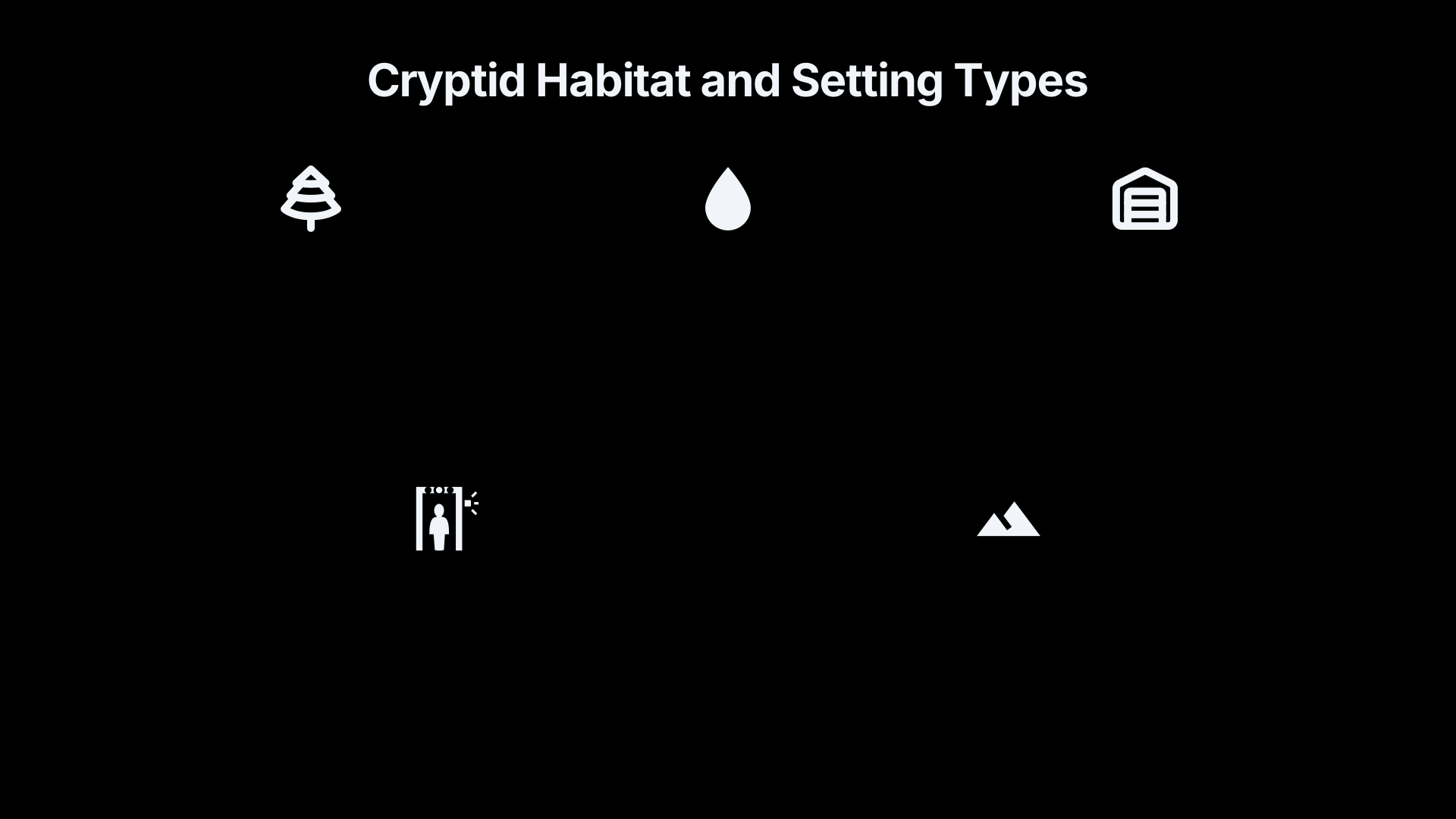
Monsters keep danger in the landscape
Many cryptid legends preserve the idea that nature is not fully safe. This is one reason they feel different from ordinary wildlife stories. A bear, eel or owl may explain a sighting; a monster gives the encounter moral and emotional force. It says: this place can still hurt you, and not everything dangerous has been named.
Loss, nostalgia and the wish for a less finished world
Cryptid legends also express nostalgia. They keep alive the feeling that the world has not been fully mapped, explained or stripped of wonder. This is especially important in modern cryptozoology, because its most famous creatures are often imagined as survivors: a relic ape, a prehistoric lake animal, a last remnant of something that should have vanished.
Peter Dendle’s work on cryptozoology is often cited for this point. In his analysis of cryptozoology in medieval and modern worlds, he argues that the modern appeal of cryptids includes the wish to recover mystery in a world perceived as rationalised and over-explored, as well as guilt over habitat destruction and species loss.[ResearchGate]researchgate.netResearch Gate Cryptozoology in the Medieval and Modern WorldsResearch Gate Cryptozoology in the Medieval and Modern Worlds That interpretation helps explain why cryptid stories are rarely just about fear. They are also about hope: perhaps the forests have not given up all their secrets; perhaps the loch still contains something ancient; perhaps modern knowledge is not complete.
Bigfoot has repeatedly shifted with these cultural needs. Joshua Blu Buhs’s history of the legend traces Bigfoot from nineteenth-century “wild man” accounts through the Yeti and into the 1958 northern California footprint story that made Bigfoot a modern American figure. The University of Chicago Press summary of Buhs’s book presents Bigfoot as “America’s favourite homegrown monster” and emphasises the way the legend moved through forests, media, hoaxes and popular culture.[University of Chicago Press]press.uchicago.eduOpen source on uchicago.edu. In this reading, Bigfoot is not only a possible animal; he is a symbol of a vanishing wilderness that people can still imagine meeting face to face.
Loch Ness shows the same nostalgia in a more romantic form. National Geographic describes Nessie as part of an “enchanted world”, Scottish identity and tourism, while noting that the monster has become a focus for the desire to believe a mysterious creature could still exist in the modern world.[National Geographic]nationalgeographic.comloch ness monster legendloch ness monster legend That desire survives repeated disappointments because the legend does not depend entirely on proof. Nessie allows visitors to look at the water as if it still has a secret.
This nostalgia can be ecological as well as emotional. Cryptids often appear in places that people fear are being degraded: logged forests, overvisited landscapes, polluted rivers, engineered lochs and former military zones. The monster can become a stand-in for a damaged or disappearing nature. A creature that refuses to be captured or classified may feel like a last rebellion against roads, cameras, sonar, DNA sampling and commercial tourism.
Distrust of experts keeps the argument alive
Cryptozoology often turns on a conflict over who gets to know. Scientists usually ask for bodies, bones, tissue, DNA, repeatable observations and ecological plausibility. Believers may answer with witness testimony, local tradition, field experience, patterns of reports, and the claim that official science is too closed-minded to investigate properly.
This divide is especially visible in Bigfoot culture. Science historian Brian Regal has studied the boundary between professional science and amateur Bigfoot research; his article “Amateur versus professional: the search for Bigfoot” explicitly examines Sasquatch, Bigfoot and the Yeti as a case of conflict between credentialled expertise and vernacular investigation.[PubMed]pubmed.ncbi.nlm.nih.govOpen source on nih.gov. Bruce Hardy, writing in Sapiens and republished by RealClearScience, uses Bigfoot to discuss public mistrust of science, noting that late-1960s Bigfoot reports drew in amateur naturalists, journalists and some credentialled anthropologists.[RealClearScience]realclearscience.comReal Clear Science What Bigfoot Teaches Us About Public Mistrust of ScienceReal Clear Science What Bigfoot Teaches Us About Public Mistrust of Science
This does not make the sceptical position weak. The problem for Bigfoot as zoology remains severe: no confirmed body, no accepted DNA, no breeding population, and many reports that can be explained as mistakes, bears, hoaxes or ambiguous traces. But as folklore, the dispute itself is part of the engine. Every official dismissal can be folded back into the story as evidence that experts are incurious, embarrassed, institutionally cautious or protecting reputations.
Why official debunking rarely ends the story
Debunking often assumes that a legend survives because people lack the correct facts. Cryptid stories show why that is only partly true. Facts matter, but legends also answer needs that facts do not always satisfy: why a place feels uncanny, why a witness felt afraid, why a community remembers a disaster, why the world seems poorer when everything is explained.
This is why hoaxes can damage a specific claim without killing the broader creature. The famous Loch Ness “Surgeon’s Photograph” became one of the best-known monster images and was later exposed as a hoax, yet Nessie remains globally recognisable.[Wikipedia]WikipediaLoch Ness MonsterLoch Ness Monster Similarly, the 1958 Bigfoot footprint episode has been linked to carved wooden feet, but Bigfoot did not vanish when the tracks became suspect.[Wikipedia]WikipediaOpen source on wikipedia.org. A hoax can even become part of the legend’s texture, proving that the story is socially powerful enough for people to fake evidence, expose evidence, defend evidence and keep arguing.
There is also a difference between explaining a sighting and explaining a tradition. A particular Mothman report might be an owl, a crane, a hoax or a frightened misperception. That does not explain why Point Pleasant embraced Mothman as a local emblem after the Silver Bridge tragedy. Research on Mothman has argued that the legend served a role in community recovery and identity, transforming the creature from terror into shared memory and tourism.[ResearchGate]researchgate.netResearch Gate Mothman: Monster, Disaster, and CommunityResearch Gate Mothman: Monster, Disaster, and Community
In this sense, official expertise and folklore often talk past each other. Science asks, “What animal, if any, caused this?” Folklore asks, “Why did this story take this shape here?” Cryptozoology sits uneasily between those questions. Its believers often want zoological proof, while its cultural power often comes from symbolic ambiguity.
The recurring pattern behind wilderness and distrust stories
Across famous cryptids, the same mechanism appears again and again:
- A marginal place creates uncertainty. Forest, loch, mountain, road edge, abandoned site or deep water gives the creature room to remain unseen.
-
A frightening report gives the place a personality. Tracks, screams, red eyes, humps, wakes or shadows turn landscape into encounter.<div class="content-enhancement content-enhancement--insight-grid" markdown="1">
- Weak evidence invites competing authorities. Witnesses, local historians, scientists, sceptics, journalists and tourism bodies all interpret the same fragments differently.
- Official explanations solve only part of the problem. An eel, bear, owl, hoax or engineering report may explain a case, but not always the emotional force of the legend.
- The monster becomes a memory device. It preserves danger, mystery, local pride, grief, ecological anxiety or suspicion of distant experts.</div>
That pattern is why monster legends belong inside cryptozoology even when the evidence for a creature is poor. They show how people negotiate the limits of knowledge. A cryptid is not only a proposed animal; it is a story about whether the world is still wild, whether modern life has made us smaller, and whether official explanations can fully account for what people think they have seen.
eBay marketplace picks
Marketplace Samples
Live-tested eBay searches with available results related to this page.
Endnotes
1.
Source: mil.wa.gov
Link:https://mil.wa.gov/the-legend-of-bigfoot
2.
Source: lochnesssightings.com
Link:https://www.lochnesssightings.com/
3.
Source: shura.shu.ac.uk
Title: SHURAThe Mothman of West Virginia: A case study in Legendary
Link:https://shura.shu.ac.uk/24606/3/Clarke_Mothman_Of_West%28AM%29.pdf
4.
Source: Wikipedia
Link:https://en.wikipedia.org/wiki/Bigfoot
5.
Source: asce.org
Link:https://www.asce.org/about-civil-engineering/history-and-heritage/historic-landmarks/silver-bridge-collapse-and-creation-of-national-bridge-inspections-standards
6.
Source: researchgate.net
Title: Research Gate Cryptozoology in the Medieval and Modern Worlds
Link:https://www.researchgate.net/publication/263067364_Cryptozoology_in_the_Medieval_and_Modern_Worlds
7.
Source: realclearscience.com
Title: Real Clear Science What Bigfoot Teaches Us About Public Mistrust of Science
Link:https://www.realclearscience.com/2023/06/14/what_bigfoot_teaches_us_about_public_mistrust_of_science_940527.html
8.
Source: transportation.wv.gov
Title: Silver Bridge
Link:https://transportation.wv.gov/highways/bridge_facts/Modern-Bridges/Pages/Silver.aspx
9.
Source: Wikipedia
Title: Loch Ness Monster
Link:https://en.wikipedia.org/wiki/Loch_Ness_Monster
10.
Source: researchgate.net
Title: Research Gate Mothman: Monster, Disaster, and Community
Link:https://www.researchgate.net/publication/250015017_Mothman_Monster_Disaster_and_Community
11.
Source: Wikipedia
Title: Bigfoot: The Life and Times of a Legend
Link:https://en.wikipedia.org/wiki/Bigfoot%3A_The_Life_and_Times_of_a_Legend
12.
Source: Wikipedia
Link:https://en.wikipedia.org/wiki/Mothman
13.
Source: Wikipedia
Title: Silver Bridge
Link:https://en.wikipedia.org/wiki/Silver_Bridge
14.
Source: researchgate.net
Link:https://www.researchgate.net/publication/367233091_Of_Monsters_Myths_and_Marketing_The_Case_of_the_Loch_Ness_Monster
15.
Source: researchgate.net
Link:https://www.researchgate.net/publication/401076924_Nessie_and_Noctilucent_Clouds_A_Meteorological_Explanation_for_Some_Loch_Ness_Monster_Sightings
16.
Source: researchgate.net
Link:https://www.researchgate.net/publication/37696518_Bigfoot_The_Life_and_Times_of_a_Legend
17.
Source: researchgate.net
Link:https://www.researchgate.net/publication/301600883_On_the_spaces_and_movement_of_monsters_The_itinerant_crossings_of_Gef_the_talking_mongoose
18.
Source: researchgate.net
Link:https://www.researchgate.net/publication/370484211_Mothman_the_Silver_Bridge_Collapse_and_the_Folklorization_and_Commemoration_of_Actual_Events
19.
Source: researchgate.net
Title: 390620130 The Loch Ness Monster If It’s Real Could It Be an Eel
Link:https://www.researchgate.net/publication/390620130_The_Loch_Ness_Monster_If_It%27s_Real_Could_It_Be_an_Eel
20.
Source: lochnesssightings.com
Link:https://www.lochnesssightings.com/report-a-sighting
21.
Source: encyclopedia.com
Link:https://www.encyclopedia.com/literature-and-arts/classical-literature-mythology-and-folklore/folklore-and-mythology/bigfoot
22.
Source: history.com
Title: Loch Ness Monster
Link:https://www.history.com/articles/loch-ness-monster
23.
Source: oregonencyclopedia.org
Title: Oregon Encyclopedia Bigfoot (Sasquatch) legend
Link:https://www.oregonencyclopedia.org/articles/bigfoot_sasquatch_legend/
24.
Source: press.uchicago.edu
Link:https://press.uchicago.edu/ucp/books/book/chicago/B/bo6407648.html
25.
Source: apnews.com
Link:https://apnews.com/article/3ab2a21c723e96f327b1f3fa53a1658e
26.
Source: otago.ac.nz
Title: first edna study of loch ness points to something fishy
Link:https://www.otago.ac.nz/news/newsroom/first-edna-study-of-loch-ness-points-to-something-fishy
27.
Source: fhwa.dot.gov
Link:https://www.fhwa.dot.gov/pressroom/fhwa1721.cfm
28.
Source: nationalgeographic.com
Title: loch ness monster legend
Link:https://www.nationalgeographic.com/history/article/loch-ness-monster-legend
29.
Source: pubmed.ncbi.nlm.nih.gov
Link:https://pubmed.ncbi.nlm.nih.gov/18514914/
30.
Source: ndl.ethernet.edu.et
Link:https://ndl.ethernet.edu.et/bitstream/123456789/47518/1/Joshua%20Blu%20Buhs.pdf
31.
Source: lochness.com
Link:https://lochness.com/report-a-sighting/
32.
Source: books.google.com
Link:https://books.google.com/books/about/Bigfoot.html?id=RI4SlHwH7h0C
33.
Source: ebsco.com
Link:https://www.ebsco.com/research-starters/social-sciences-and-humanities/mothman
34.
Source: edinburgh-tickets.com
Link:https://www.edinburgh-tickets.com/loch-ness-tours/history/
Additional References
35.
Source: nypost.com
Link:https://nypost.com/2026/05/31/world-news/loch-ness-monster-hunters-deploy-underwater-drone-in-annual-hunt-near-hot-spot-of-recent-sightings/
36.
Source: ntsb.gov
Link:https://www.ntsb.gov/investigations/AccidentReports/Reports/HAR7101.pdf
37.
Source: academia.edu
Link:https://www.academia.edu/92617638/BRIAN_REGAL_Searching_for_Sasquatch_Crackpots_Eggheads_and_Cryptozoology
38.
Source: academia.edu
Link:https://www.academia.edu/12780475/Bigfoot_The_Life_and_Times_of_a_Legend
39.
Source: academia.edu
Link:https://www.academia.edu/43568382/The_Disappearance_of_Arthur_Nestor_Parafiction_Cryptozoology_Curation
40.
Source: facebook.com
Link:https://www.facebook.com/KHON2News/posts/a-scientist-who-collected-dna-from-scotlands-loch-ness-suggests-the-lakes-fabled/10156807325566379/
41.
Source: skepticalinquirer.org
Link:https://skepticalinquirer.org/2024/08/bigfoot-and-the-folk/
42.
Source: instagram.com
Link:https://www.instagram.com/reel/DRSBhGLDRb1/?hl=en
43.
Source: amazon.de
Link:https://www.amazon.de/Bigfoot-Legend-Joshua-Blu-Buhs/dp/0226079791?tag=searcht-20
44.
Source: facebook.com
Link:https://www.facebook.com/IndigenousAmerica70/posts/call-it-bigfoot-sasquatch-or-istiyehe-indigenous-peoples-know-it-as-protector-or/122251488368259010/
Topic Tree