Within Tracks
How Mystery Tracks Should Be Recorded
Good footprint evidence starts with careful photos, scale, substrate notes and mapping before anyone casts or disturbs the print.
On this page
- Photographing tracks before casting
- Scales, angles and substrate notes
- Mapping people, animals and vehicles nearby
Page outline Jump by section
Introduction
A possible cryptid footprint is most valuable in the first few minutes after it is found. Once people walk nearby, weather changes, snow melts, mud dries, or a cast is made incorrectly, important details can be lost forever. Within cryptozoology, many famous track claims have later been criticised because the original documentation was incomplete, making it impossible to determine whether the impressions were made by a known animal, a human hoaxer, or something genuinely unusual.
Photographing Tracks Before Casting
The most common mistake in cryptid track investigations is treating a footprint as a souvenir rather than as evidence. A cast may preserve shape, but it cannot replace photographs of the track in its original setting. Forensic guidance consistently recommends documenting impressions before any collection procedure begins.[crime-scene-investigator.net]crime-scene-investigator.netthe collection of impression evidence for examination in the laboratory.Read more…
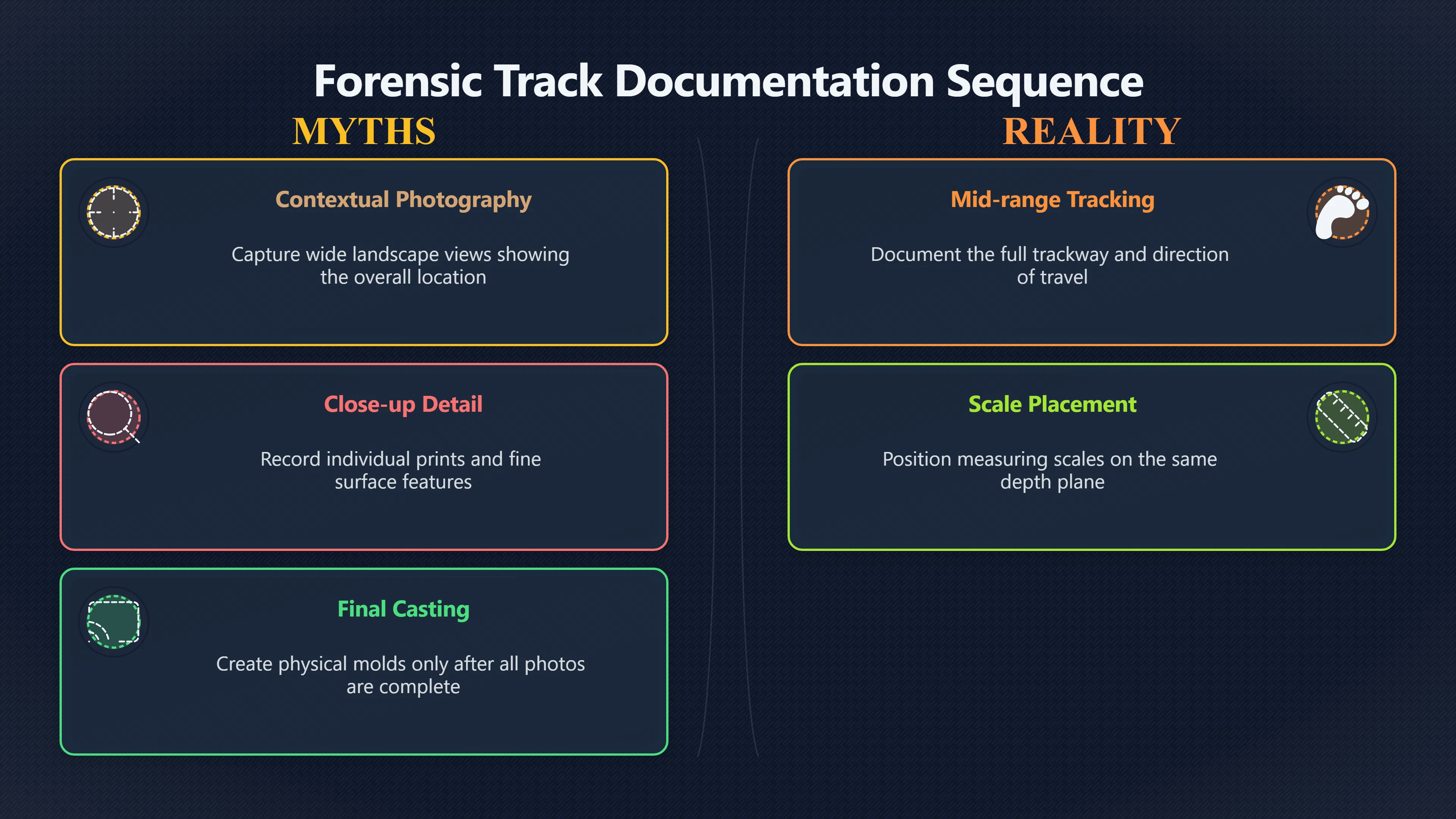
A useful photographic record proceeds from broad context to fine detail:
- Overall photographs showing the location within the landscape.
- Mid-range photographs showing the trackway, direction of travel, and nearby marks.
- Close-up photographs showing individual prints and fine details. Sage Journals
The wider scene matters because a single footprint can be misleading. A sequence of prints may reveal stride length, gait, changes in direction, and whether the trackmaker moved naturally across the terrain. It may also show overlapping human, animal, bicycle, or vehicle traces that affect interpretation.
For close photographs, the camera should be positioned as nearly perpendicular to the print as possible to reduce distortion. Investigators commonly use tripods because even slight angles can alter apparent dimensions and shape. Sage Journals+2crime-scene-investigator.net
Photographs should be taken before anyone attempts cleaning, brushing, casting, or other interventions. In forensic work, properly photographed impressions can sometimes preserve than later casts. crime-scene-investigator.net
Why Multiple Lighting Angles Matter
Many impressions contain shallow features that disappear under flat daylight. Low-angle lighting can reveal depth changes, ridges, edges, and pressure patterns that are otherwise difficult to see. Crime-scene investigators often examine impressions using light directed across the surface rather than directly downward. Office of Justice Programs
For mystery tracks in mud, sand, or snow, photographs taken from several lighting directions can help distinguish genuine depth features from shadows or camera artefacts. If lighting conditions change rapidly, recording the print under different angles may capture details that disappear later.
Scales, Angles and Substrate Notes
A photograph without scale has limited scientific value. Investigators examining footprints routinely place a measuring scale beside the impression and ensure that it sits on the same plane and depth level as the track. Otherwise, size estimates may be inaccurate. wisdoj.gov
A useful record should include:
- Overall dimensions of the print.
- Maximum length and width. * Depth measurements where practical.…</p></details>
- Stride length between successive impressions.
- Direction of travel. * Number of visible prints. IAI([https://theiai.org/footwear_and_tire_track_examin.php](https://theiai.org/footwear_and_tire_track_examin.php))…</p></details>
Equally important are notes describing the surface that received the impression. The same foot can leave dramatically different marks in wet clay, loose sand, crusted snow, leaf litter, or partially thawed ground. Forensic documentation standards specifically call for recording substrate and environmental conditions because these factors affect impression quality and interpretation. crime-scene-investigator.net
Useful substrate observations include:
- Soil type or surface composition.
- Moisture level.
- Recent weather.
- Slope of the ground.
- Snow depth or crust conditions.
- Signs of erosion, melting, or water flow. crime-scene-investigator.net
These notes become especially important in cryptozoology because some famous oversized footprints have been argued to result from melting snow, collapsing edges, or substrate distortion rather than unusually large feet. Without environmental records, later reviewers cannot assess those possibilities.
Record What the Print Looks Like Now
Human memory changes surprisingly quickly. Investigators therefore record observations immediately rather than relying on recollection.
If unusual features are visible—such as apparent toe marks, pressure ridges, claw traces, or unusual heel shapes—they should be photographed and described exactly as seen rather than interpreted. Statements such as “five toe-like projections visible at the front edge” are more useful than conclusions such as “definitely a Bigfoot footprint”.
Mapping People, Animals and Vehicles Nearby
One of the most overlooked parts of track documentation is the surrounding area. A footprint rarely exists in isolation.
Forensic footwear examinations often use impression evidence to reconstruct movement through a scene, determine direction of travel, and identify interactions between different tracks. The same logic applies to alleged cryptid traces. IAI
A field record should note:
- Human footprints nearby.
- Domestic animal tracks.
- Wildlife tracks.
- Tyre marks.
- Bicycle tracks.
- Hiking paths, roads, or work routes.
- Buildings, campsites, and access points. IAI
This context can reveal whether a mystery print sits in a genuinely isolated location or in an area with many ordinary explanations. A single large impression near a frequently used trail has a different evidential value from a long trackway crossing remote terrain.
Simple sketch maps or GPS coordinates can be extremely useful. Even a rough diagram showing the positions of tracks, roads, streams, and observers may help later investigators reconstruct the scene.
Preserve the Trackway, Not Just the Best Print
People naturally focus on the clearest impression, but the entire trackway often contains more information than any single footprint.
Successive impressions can reveal consistency. If a trackmaker supposedly has a distinctive foot shape, that shape should appear repeatedly. If only one print looks unusual while others resemble known animal or human tracks, that inconsistency becomes important evidence in itself.
Recording every visible print, even poor-quality ones, reduces the risk of unintentionally selecting only the most impressive example.
Common Documentation Failures
Many disputed cryptid track cases suffer from the same weaknesses:
- No photographs taken before casting.
- Missing scale references.
- Only one footprint documented.
- No record of weather or substrate.
- No measurements of stride or trackway length.
- No photographs showing surrounding tracks.
- Unclear chain of events after discovery. crime-scene-investigator.net+2Office of Justice Programs
These gaps do not automatically mean a track was fabricated, but they make independent evaluation far more difficult. In a field where hoaxes, misidentifications, and environmental distortions are persistent concerns, careful documentation often matters more than dramatic claims.
What Makes a Footprint Record Useful
A useful cryptid footprint record is one that allows a sceptical reviewer to reconstruct the scene without being present. The goal is not to persuade but to preserve information.
The strongest documentation package includes contextual photographs, examination-quality close-ups with scales, accurate measurements, detailed substrate notes, mapped surroundings, and a complete record of the trackway before any casting or collection takes place. When those elements are present, the footprint can be analysed years later. When they are absent, even an apparently extraordinary impression may never be more than an anecdote attached to a patch of disturbed ground.
Amazon book picks
Further Reading
Books and field guides related to How Mystery Tracks Should Be Recorded. Use these as the next step if you want deeper reading beyond the article.
Mammal Tracks & Sign
Shows how tracks should be measured, photographed, and identified.
eBay marketplace picks
Marketplace Samples
Live-tested eBay searches with available results related to this page.

Endnotes
1.
Source: crime-scene-investigator.net
Link:https://www.crime-scene-investigator.net/guide-for-the-forensic-documentation-and-photography-of-footwear-and-tire-impressions-at-the-crime-scene.html
2.
Source: wisdoj.gov
Title: Find a Footwear Impression at your Crime Scene?Read more
Link:https://www.wisdoj.gov/Forensic%20Science/Footwear%20Evidence%20Brochure.pdf
3.
Source: crime-scene-investigator.net
Link:https://www.crime-scene-investigator.net/guide-for-casting-footwear-and-tire-impression-evidence.html
4.
Source: crime-scene-investigator.net
Title: footwear and tire track photography
Link:https://www.crime-scene-investigator.net/footwear-and-tire-track-photography.html
5.
Source: crime-scene-investigator.net
Link:https://www.crime-scene-investigator.net/footwear.html
6.
Source: theiai.org
Link:https://theiai.org/footwear_and_tire_track_examin.php
7.
Source: crime-scene-investigator.net
Link:https://www.crime-scene-investigator.net/standard-for-terminology-used-for-forensic-footwear-and-tire-impression-evidence.html
9.
Source: ojp.gov
Link:https://www.ojp.gov/ncjrs/virtual-library/abstracts/shoe-and-tire-impression-evidence
10.
Source: ojp.gov
Link:https://www.ojp.gov/pdffiles1/nij/grants/233981.pdf
11.
Source: nij.ojp.gov
Title: overview impression and pattern evidence
Link:https://nij.ojp.gov/topics/articles/overview-impression-and-pattern-evidence
12.
Source: nij.ojp.gov
Title: extraction shoe print patterns impression evidence using conditional random
Link:https://nij.ojp.gov/library/publications/extraction-shoe-print-patterns-impression-evidence-using-conditional-random
Additional References
13.
Source: ebsco.com
Link:https://www.ebsco.com/research-starters/applied-sciences/footprints-and-shoe-prints-evidence
14.
Source: asteetrace.org
Link:https://www.asteetrace.org/recovery
15.
Source: forensicscience.ie
Link:https://forensicscience.ie/physical-analysis/impression-analysis/
16.
Source: youtube.com
Link:https://www.youtube.com/watch?v=1nB5SeZUhtA
17.
Source: youtube.com
Link:https://www.youtube.com/watch?v=C29XEOzi8B0
18.
Source: aafs.org
Link:https://www.aafs.org/sites/default/files/[media
19.
Source: blog.ampedsoftware.com
Title: forensic shoeprint documentation and analysis with amped five
Link:https://blog.ampedsoftware.com/2025/05/06/forensic-shoeprint-documentation-and-analysis-with-amped-five
20.
Source: forensicsciencesimplified.org
Link:https://www.forensicsciencesimplified.org/fwtt/principles.html
21.
Source: epgp.inflibnet.ac.in
Link:https://epgp.inflibnet.ac.in/epgpdata/uploads/epgp_content/S000016FS/P000690/M011454/ET/1516188773FSC_P3_M33_e-text.pdf
22.
Source: nikouiandassociates.com
Title: the art and science of footwear analysis
Link:https://www.nikouiandassociates.com/the-art-and-science-of-footwear-analysis/
Topic Tree