Within Pseudoscience
The Coelacanth Argument, Explained Carefully
The coelacanth is real evidence that science can revise itself, but it does not make every monster story equally plausible.
On this page
- What the coelacanth discovery actually showed
- Why a specimen changed the scientific question
- How cryptid advocates overextend the comparison
Page outline Jump by section
Introduction
The coelacanth is one of the most frequently cited examples in cryptozoological debates. When sceptics argue that large, unknown animals are unlikely to exist without physical evidence, believers often respond with a simple point: scientists thought the coelacanth was extinct, yet one was found alive in 1938. Therefore, they argue, creatures such as Bigfoot or the Loch Ness Monster could also turn out to be real. The comparison sounds persuasive because the coelacanth genuinely represents a dramatic scientific surprise. A fish lineage known only from fossils was discovered alive after being presumed extinct for tens of millions of years. However, the lesson of the coelacanth case is narrower than many cryptid arguments suggest. Rather than proving that monster stories deserve the benefit of the doubt, the coelacanth demonstrates how science changes its conclusions when a specimen appears and can be examined directly. The discovery illustrates scientific self-correction, not a general validation of unsupported cryptid claims.[Natural History Museum+2Smithsonian Ocean]nhm.ac.ukDiscover the story of this strange fishNatural History MuseumCoelacanths: The fish that 'outdid' the Loch Ness MonsterCoelacanths were thought to have been extinct for 70 milli…
What the coelacanth discovery actually showed
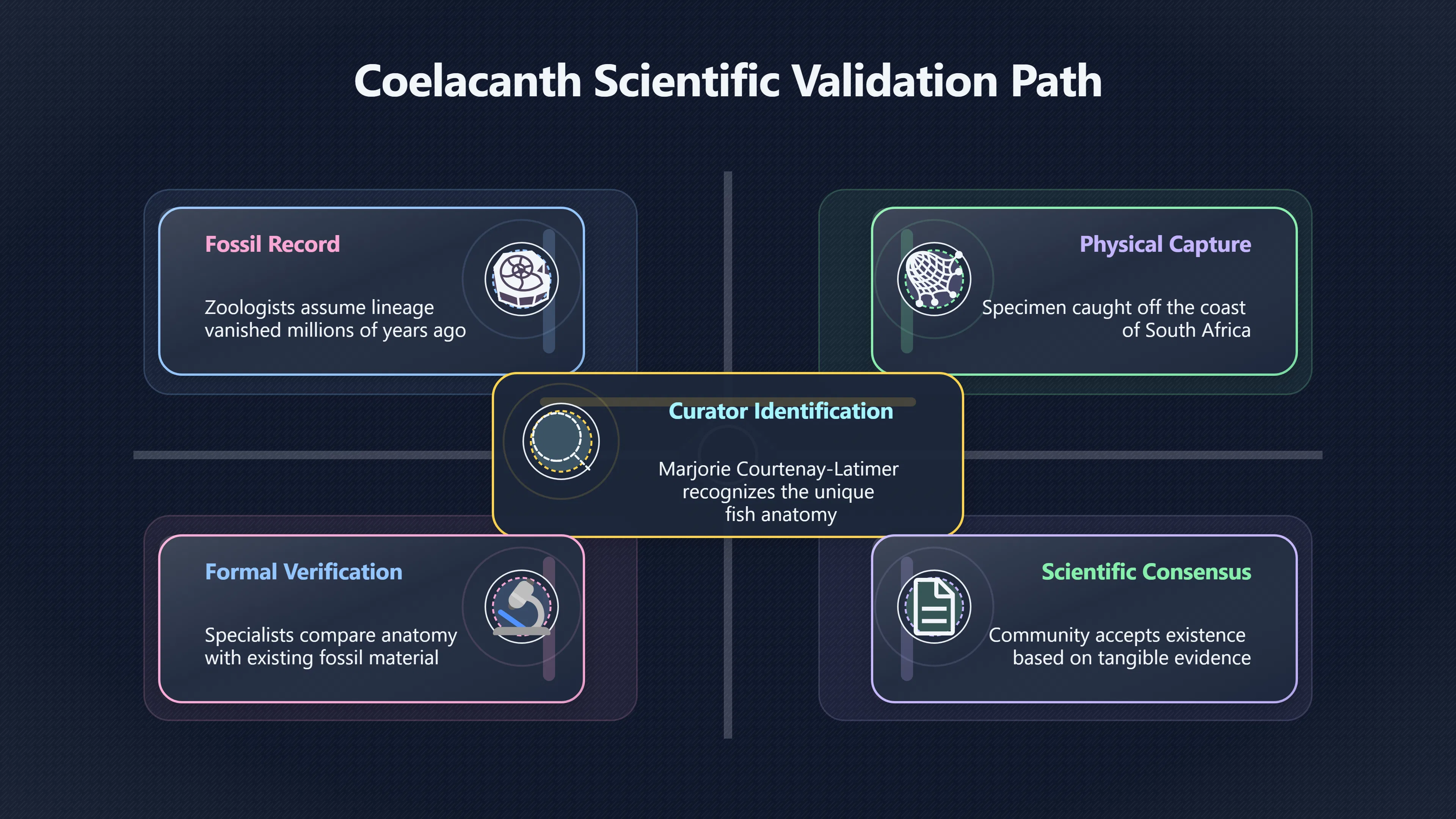
Before 1938, coelacanths were known only from fossils. Because the fossil record appeared to end tens of millions of years earlier, zoologists believed the group had disappeared. That assumption was overturned when a physical specimen was caught off the coast of South Africa and recognised by museum curator Marjorie Courtenay-Latimer. Specialists were then able to inspect the fish, compare its anatomy with fossil material and formally identify it.[Wikipedia+2Smithsonian Magazine]WikipediaOpen source on wikipedia.org.
Several features of this discovery are often overlooked in popular retellings:
-
The coelacanth was not accepted because of rumours, folklore or eyewitness reports.<div class="content-enhancement content-enhancement--insight-grid" markdown="1">
- It was not inferred from ambiguous photographs.
- It was not recognised after decades of inconclusive searches.
- Acceptance came only after a tangible specimen was available for examination.</div>
Why a specimen changed the scientific question
A key misunderstanding in cryptid discussions is that discovery and proof are treated as the same thing. The coelacanth illustrates the opposite.
Before 1938, the question was whether the lineage still existed. Once a specimen was recovered, that question was settled immediately. Scientists could then move on to more detailed questions: where the fish lived, how many populations existed, how it reproduced and how it fit into vertebrate evolution.[Smithsonian Ocean]ocean.si.eduSmithsonian OceanCoelacanth | Smithsonian OceanOne of the world's most famous "living fossils," coelacanths (seel-a-canths) were once tho…
The physical specimen transformed the debate because it allowed multiple independent forms of verification:<div class="content-enhancement content-enhancement--comparison" markdown="1">
- Anatomical examination.
- Preservation in collections.
- Comparison with fossil material.
- Later genetic and ecological research.
- Repeated observation by other researchers.</div>
Scientific confidence grew because evidence accumulated from several directions at once. The discovery did not require trust in witnesses. It created an object that anyone qualified could study.[Smithsonian Ocean+2Smithsonian Magazine]ocean.si.eduSmithsonian OceanCoelacanth | Smithsonian OceanOne of the world's most famous "living fossils," coelacanths (seel-a-canths) were once tho…
This distinction matters because many famous cryptids remain stuck at the earlier stage. Their debates continue to revolve around testimony, photographs, tracks or stories rather than specimens. The coelacanth moved beyond that stage almost immediately.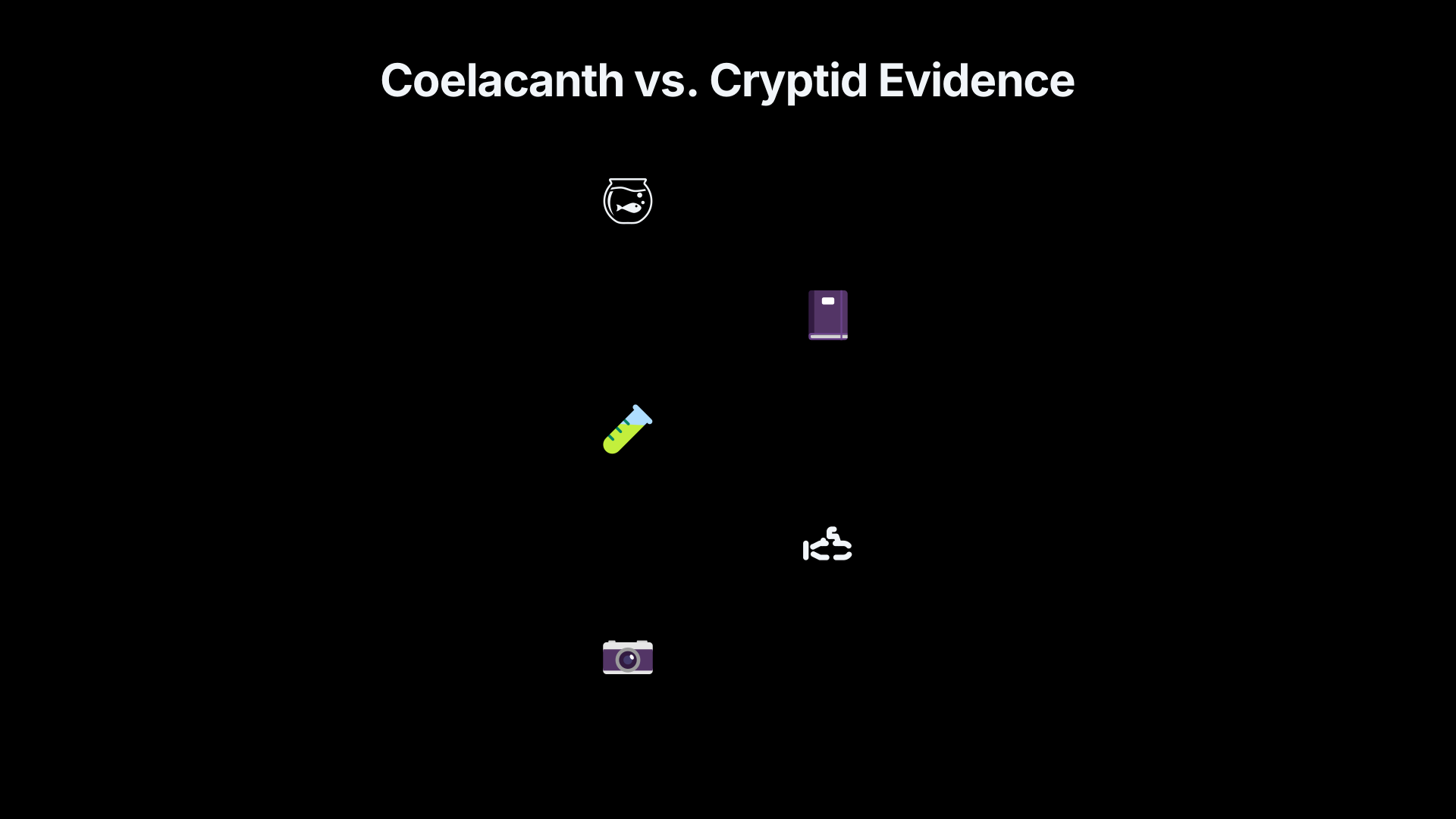
How cryptid advocates overextend the comparison
The most common misuse of the coelacanth example is to treat it as proof that any disputed animal claim deserves equal credibility.
This argument quietly shifts from one statement to another:<div class="content-enhancement content-enhancement--step-flow" markdown="1">
- Scientists can be mistaken.
- Therefore a particular cryptid is probably real.</div>
The first statement is true. The second does not follow automatically.
The coelacanth demonstrates that scientific conclusions remain open to revision when evidence changes. It does not imply that all proposed creatures have similar probabilities of existing. The strength of a claim still depends on the quality of evidence supporting it.[Natural History Museum]nhm.ac.ukDiscover the story of this strange fishNatural History MuseumCoelacanths: The fish that 'outdid' the Loch Ness MonsterCoelacanths were thought to have been extinct for 70 milli…
Another problem is that the coelacanth and many famous cryptids occupy very different evidential situations.
The coelacanth was a marine fish living in deep-water habitats that are difficult for humans to observe directly. Its rediscovery required only a small surviving population in a poorly explored environment. By contrast, many cryptid claims involve large terrestrial mammals or large lake-dwelling animals whose existence would be expected to leave numerous traces through bodies, bones, genetics, feeding evidence or clear documentation. The ecological and evidential challenges are not comparable.[Smithsonian Ocean]ocean.si.eduSmithsonian OceanCoelacanth | Smithsonian OceanOne of the world's most famous "living fossils," coelacanths (seel-a-canths) were once tho…
The comparison is therefore often used rhetorically rather than analytically. It invokes a famous scientific surprise while ignoring the specific conditions that made that surprise credible.
A useful contrast: coelacanths and Nessie
The contrast between the coelacanth and the Loch Ness Monster is particularly revealing because the two are often mentioned together.
The coelacanth entered science through a specimen. Nessie has generated decades of sightings, photographs, sonar claims and media attention, yet no verified body, tissue sample or confirmed genetic evidence has emerged. Modern environmental DNA surveys of Loch Ness detected thousands of organisms but found no evidence supporting a surviving plesiosaur-like animal. Researchers instead found ordinary biological signatures consistent with known species.[The Guardian]theguardian.comloch ness monster could be a giant eel say scientistsThe GuardianLoch Ness monster could be a giant eel, say scientists5 Sept 2019 — Loch Ness monster could be a giant eel, say scientists ·…
This does not prove that every reported sighting has an obvious explanation. It does show that the evidential trajectory differs sharply from the coelacanth case. One mystery rapidly accumulated physical confirmation. The other has accumulated large amounts of anecdotal material without producing comparable biological evidence.[Natural History Museum+2The Guardian]nhm.ac.ukDiscover the story of this strange fishNatural History MuseumCoelacanths: The fish that 'outdid' the Loch Ness MonsterCoelacanths were thought to have been extinct for 70 milli…
The contrast highlights an important scientific principle: repeated stories do not perform the same function as a specimen. A single verified specimen can change an entire field. Thousands of reports cannot substitute for it.
The real lesson of the coelacanth
The coelacanth remains a powerful example of scientific humility. It reminds researchers that the natural world can contain surprises and that accepted conclusions can be overturned by new evidence. That lesson is genuine and important.[Smithsonian Magazine]smithsonianmag.comToday, the two known living species of coelecanthSmithsonian MagazineIn the 1930s, This Natural History Curator Discovered a …22 Dec 2017 — But in 1938, the discovery of a modern coela…
Yet the discovery also reinforces another lesson that is often forgotten in cryptid debates: science changed its mind because evidence became stronger, not because standards became weaker. The coelacanth was not vindicated by belief, persistence or folklore. It was vindicated by a fish in hand.
See on Amazon</a></div></div></article><article class="fr-book-card"><a class="fr-book-cover" href="https://www.amazon.com/s?k=Hunting+Monsters+by+Darren+Naish&i=stripbooks&tag=searcht-20" target="_blank" rel="sponsored noopener noreferrer" aria-label="Open Hunting Monsters on Amazon"><span class="fr-book-cover-fallback">Book</span><img class="fr-book-cover-thumb" src="https://books.google.com/books/content?id=mN2oCwAAQBAJ&printsec=frontcover&img=1&zoom=1&edge=curl&source=gbs_api" alt="Cover for Hunting Monsters" loading="lazy" decoding="async" fetchpriority="low" referrerpolicy="no-referrer" onerror="this.hidden=true;this.closest('.fr-book-cover').classList.add('fr-book-cover-placeholder');"></a><div class="fr-book-info"><h4 class="fr-book-title"><a href="https://www.amazon.com/s?k=Hunting+Monsters+by+Darren+Naish&i=stripbooks&tag=searcht-20" target="_blank" rel="sponsored noopener noreferrer" title="Hunting Monsters">Hunting Monsters</a></h4><p class="fr-book-author">By Darren Naish</p><p class="fr-book-desc">Examines how real zoological discoveries differ from cryptid claims.</p><div class="fr-book-actions"><a href="https://www.amazon.com/s?k=Hunting+Monsters+by+Darren+Naish&i=stripbooks&tag=searcht-20" class="fr-amazon-btn" target="_blank" rel="sponsored noopener noreferrer">
See on Amazon</a></div></div></article><article class="fr-book-card"><a class="fr-book-cover" href="https://www.amazon.com/s?k=A+Fish+Caught+in+Time+by+Samantha+Weinberg&i=stripbooks&tag=searcht-20" target="_blank" rel="sponsored noopener noreferrer" aria-label="Open A Fish Caught in Time on Amazon"><span class="fr-book-cover-fallback">Book</span><img class="fr-book-cover-thumb" src="https://books.google.com/books/content?id=UDHAaqOk7jwC&printsec=frontcover&img=1&zoom=1&edge=curl&source=gbs_api" alt="Cover for A Fish Caught in Time" loading="lazy" decoding="async" fetchpriority="low" referrerpolicy="no-referrer" onerror="this.hidden=true;this.closest('.fr-book-cover').classList.add('fr-book-cover-placeholder');"></a><div class="fr-book-info"><h4 class="fr-book-title"><a href="https://www.amazon.com/s?k=A+Fish+Caught+in+Time+by+Samantha+Weinberg&i=stripbooks&tag=searcht-20" target="_blank" rel="sponsored noopener noreferrer" title="A Fish Caught in Time">A Fish Caught in Time</a></h4><p class="fr-book-author">By Samantha Weinberg</p><p class="fr-book-desc">Directly explains what the coelacanth discovery actually demonstrated.</p><div class="fr-book-actions"><a href="https://www.amazon.com/s?k=A+Fish+Caught+in+Time+by+Samantha+Weinberg&i=stripbooks&tag=searcht-20" class="fr-amazon-btn" target="_blank" rel="sponsored noopener noreferrer">
See on Amazon</a></div></div></article><article class="fr-book-card"><a class="fr-book-cover fr-book-cover-placeholder" href="https://www.amazon.com/s?k=The+Demon-haunted+World+by+Carl+Sagan&i=stripbooks&tag=searcht-20" target="_blank" rel="sponsored noopener noreferrer" aria-label="Open The Demon-haunted World on Amazon"><span class="fr-book-cover-fallback">Book</span></a><div class="fr-book-info"><h4 class="fr-book-title"><a href="https://www.amazon.com/s?k=The+Demon-haunted+World+by+Carl+Sagan&i=stripbooks&tag=searcht-20" target="_blank" rel="sponsored noopener noreferrer" title="The Demon-haunted World">The Demon-haunted World</a></h4><p class="fr-book-author">By Carl Sagan</p><p class="fr-book-desc">Shows how science updates conclusions when strong evidence appears.</p><div class="fr-book-actions"><a href="https://www.amazon.com/s?k=The+Demon-haunted+World+by+Carl+Sagan&i=stripbooks&tag=searcht-20" class="fr-amazon-btn" target="_blank" rel="sponsored noopener noreferrer">
See on Amazon</a></div></div></article></div><div class="fr-section-footer"><div class="fr-browse-links" aria-label="Browse more on Amazon"><span class="fr-browse-links-label">Browse more on Amazon:</span><a class="fr-browse-more" href="https://www.amazon.com/s?k=Abominable+Science%21&i=stripbooks&tag=searcht-20" target="_blank" rel="sponsored noopener noreferrer">Abominable Science!</a><a class="fr-browse-more" href="https://www.amazon.com/s?k=Hunting+Monsters&i=stripbooks&tag=searcht-20" target="_blank" rel="sponsored noopener noreferrer">Hunting Monsters</a><a class="fr-browse-more" href="https://www.amazon.com/s?k=A+Fish+Caught+in+Time&i=stripbooks&tag=searcht-20" target="_blank" rel="sponsored noopener noreferrer">A Fish Caught in Time</a></div><p class="fr-disclosure">As an Amazon Associate I earn from qualifying purchases.</p></div></div></section>
Amazon book picks
Further Reading
Books and field guides related to The Coelacanth Argument, Explained Carefully. Use these as the next step if you want deeper reading beyond the article.
On the Track of Unknown Animals
Represents the hidden-animal tradition that invokes examples like the coelacanth.
A Fish Caught in Time
Directly explains what the coelacanth discovery actually demonstrated.
The Demon-haunted World
Shows how science updates conclusions when strong evidence appears.
eBay marketplace picks
Marketplace Samples
Live-tested eBay searches with available results related to this page.
Endnotes
1.
Source: Wikipedia
Link:https://en.wikipedia.org/wiki/Coelacanth
2.
Source: discovermagazine.com
Link:https://www.discovermagazine.com/a-new-coelacanth-species-was-hiding-in-a-museum-for-150-years-and-it-fills-a-50-million-year-gap-49003
3.
Source: Wikipedia
Title: Loch Ness Monster
Link:https://en.wikipedia.org/wiki/Loch_Ness_Monster
4.
Source: nhm.ac.uk
Title: Discover the story of this strange fish
Link:https://www.nhm.ac.uk/discover/coelacanths-the-fish-that-outdid-the-loch-ness-monster.html
5.
Source: ocean.si.edu
Link:https://ocean.si.edu/ocean-life/fish/coelacanth
6.
Source: smithsonianmag.com
Title: Today, the two known living species of coelecanth
Link:https://www.smithsonianmag.com/smart-news/1930s-curator-discovered-[living-fossil
7.
Source: nationalgeographic.com
Link:https://www.nationalgeographic.com/animals/fish/facts/coelacanths
8.
Source: theguardian.com
Title: loch ness monster could be a giant eel say scientists
Link:https://www.theguardian.com/science/2019/sep/05/loch-ness-monster-could-be-a-giant-eel-say-scientists
9.
Source: facebook.com
Link:https://www.facebook.com/naturalhistorymuseum/posts/this-fish-swam-so-far-under-the-radar-for-66-million-years-people-thought-it-was/870335748465326/
10.
Source: britishseafishing.co.uk
Title: The Coelacanth
Link:https://britishseafishing.co.uk/the-coelacanth-the-fish-that-came-back-from-extinction/
Additional References
11.
Source: vims.edu
Link:https://www.vims.edu/research/facilities/fishcollection/_archive/highlights/coelacanth.php
12.
Source: facebook.com
Link:https://www.facebook.com/groups/470765477828717/posts/984205216484738/
13.
Source: ebsco.com
Link:https://www.ebsco.com/research-starters/zoology/loch-ness-monster-[cryptozoology
14.
Source: conservation.org
Link:https://www.conservation.org/news/fish-story-how-a-coelacanth-discovery-set-off-a-flurry-of-science-subterfuge
15.
Source: port.ac.uk
Link:https://www.port.ac.uk/news-events-and-blogs/news/150-year-old-museum-specimen-revealed-as-missing-link-in-evolution-of-ancient-fish
16.
Source: aeon.co
Title: in 1938 a fish thought extinct for 65 million years resurfaced nearly unchanged
Link:https://aeon.co/videos/in-1938-a-fish-thought-extinct-for-65-million-years-resurfaced-nearly-unchanged
17.
Source: youtube.com
Link:https://www.youtube.com/watch?v=__Woo6L1bl0
18.
Source: youtube.com
Link:https://www.youtube.com/watch?v=6MiiwSuhk8k
19.
Source: youtube.com
Link:https://www.youtube.com/watch?v=wW6eKLLViK8
20.
Source: oceanographicmagazine.com
Title: dinosaur fish thought extinct reveals itself in blancpain mission
Link:https://oceanographicmagazine.com/news/dinosaur-fish-thought-extinct-reveals-itself-in-blancpain-mission/
Topic Tree