Within Cryptozoology
How Monster Hunting Became Popular Media
Ivan T.
On this page
- Sanderson's role in the field
- Adventure, animals, and entertainment
- The line between curiosity and proof
Page outline Jump by section
Introduction
That mixture made cryptozoology more accessible and memorable, but also more vulnerable. Sanderson’s work showed how curiosity about unknown animals could open genuine questions about testimony, folklore and unexplored habitats. It also showed how weak evidence, recycled anecdotes and entertainment value could be mistaken for proof. His career is therefore one of the clearest examples of cryptozoology’s central tension: the same media skills that made “hidden animals” exciting also made them harder to separate from spectacle.
Sanderson’s role in the field
Sanderson came to monster hunting with credentials that made him more persuasive than a casual enthusiast. Born in Scotland in 1911, he was educated at Eton, Cambridge and the University of London, travelled widely as an animal collector, and collected for institutions including the British Museum. Reference accounts describe him as a naturalist, traveller, collector and exhibitor of rare animals, as well as a radio and television commentator and author. His early career therefore gave him a recognisable bridge between professional natural history and public performance.[Encyclopedia.com]encyclopedia.comsanderson ivan terencesanderson ivan terence
That bridge mattered because mid-twentieth-century cryptozoology needed more than stories. It needed people who could present reports of strange animals as if they belonged in the same broad conversation as field zoology, exploration and museum collecting. Bernard Heuvelmans is often treated as the more systematising figure, especially through On the Track of Unknown Animals, but Sanderson’s contribution was different: he was exceptionally good at popularising the chase. He made cryptids feel less like isolated legends and more like a world-spanning natural-history problem.
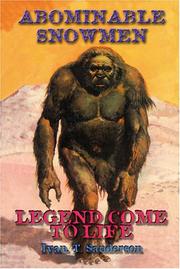
His 1961 book Abominable Snowmen: Legend Come to Life is central to that role. It did not limit itself to the Himalayan Yeti. Sanderson treated reports of wild, hairy, human-like creatures from many regions as part of a broader pattern, arguing that such beings were not merely local folklore but possible zoological realities. The book’s own framing presented “factual reports” of strange, hairy people from every continent except Australia and Antarctica, and later editions preserved its status as a classic cryptozoological text.[Google Books]books.google.comOpen source on google.com.
Sanderson’s approach was expansive. In one chapter, he divided the history of Abominable Snowman reports into stages, including ancient knowledge, explorers, mountaineers and modern “searchers”. He also argued that what Western readers treated as new discoveries were often better understood as “revelations” of knowledge long held outside Western science. That was one of the more interesting features of his writing: he took local testimony and folklore seriously, not just as colourful background, but as material he believed could point towards real animals.[Internet Sacred Text Archive]sacred-texts.comOpen source on sacred-texts.com.
The problem was that Sanderson often moved too quickly from “worth investigating” to “probably zoological”. That leap is what made him influential within cryptozoology and controversial outside it. He helped establish a style in which scattered testimony, old travel accounts, footprints, legends and speculative biological reasoning were arranged into a persuasive narrative. For readers already open to hidden animals, that was thrilling. For scientists asking for physical specimens, repeatable observations or strong biological evidence, it was not enough.
Adventure, animals and entertainment
Sanderson’s monster hunting cannot be separated from his career as a media naturalist. The American Philosophical Society’s description of his papers notes that, after the Second World War, he worked in broadcasting, lecturing and writing about natural science for a public audience. Beginning in 1948, he made regular American radio and television appearances, first with a weekly WNBC radio programme in New York and then through additional radio and television work.[as.amphilsoc.org]as.amphilsoc.orgOpen source on amphilsoc.org.
Television was especially important. Sanderson’s CBS programme was described by the American Philosophical Society finding aid as the first commercial colour television programme in the channel’s history, and from 1951 to 1958 he had a regular segment on The Garry Moore Show, appearing with live animals. He also imported rare wild animals for television, zoos and exhibitions, ran a company called Animodels, and operated a summer roadside zoo in New Jersey.[as.amphilsoc.org]as.amphilsoc.orgOpen source on amphilsoc.org.
This made him a different kind of cryptozoological figure. He was not only writing for readers who already cared about mysterious animals. He was building a public persona as someone who could bring the living animal world into the studio: strange mammals, birds, reptiles, field stories and traveller’s authority. When he later discussed Sasquatch, the Yeti, sea serpents or lake monsters, he did so from within an already established image of the adventurous animal expert.
That media background shaped the tone of popular monster hunting in three important ways:<div class="content-enhancement content-enhancement--insight-grid" markdown="1">
- It made cryptids feel visual and immediate. Sanderson’s world was not just text; it was animals on television, photographs, drawings, exhibits and dramatic accounts of fieldwork.
- It linked monsters to entertainment without fully admitting the boundary. The same public wanted education, spectacle and surprise. Cryptids could be presented as possible science while also functioning as adventure stories.
- It gave anecdote a stage. A witness account, a track cast or a traveller’s rumour became more compelling when delivered by someone already known for handling real animals and telling natural-history stories.</div>
From natural history to the unexplained
Sanderson’s shift towards the unexplained appears to have sharpened in the 1950s. The American Philosophical Society finding aid says that, while working as a freelance reporter for the North American Newspaper Alliance, he investigated the 1952 Flatwoods incident in West Virginia, where residents reported a spaceship and a monster. The archive describes this as an episode that drew him towards anomalous phenomena, cryptozoology and ufology.[as.amphilsoc.org]as.amphilsoc.orgOpen source on amphilsoc.org.
That transition helps explain why Sanderson’s later work did not remain inside narrow zoological boundaries. His interests came to include UFOs, the Loch Ness Monster, Sasquatch, the Abominable Snowman, the Bermuda Triangle and other anomalies. In 1965 he established the Ivan T. Sanderson Foundation, later called the Society for the Investigation of the Unexplained, to promote the study of the unknown; the organisation set up a research centre at his farm in Columbia, New Jersey.[as.amphilsoc.org]as.amphilsoc.orgOpen source on amphilsoc.org.
SITU was important because it treated monster reports as part of a wider ecology of anomalies. That helped popular monster hunting by giving it institutional form: a society, a research centre, files, correspondence, newsletters and an implied community of investigators. The American Philosophical Society’s 2022 note on the Sanderson papers states that the collection includes material on natural history, radio and television programming, cryptozoology, and SITU’s interests in UFOs, Loch Ness, Sasquatch, the Abominable Snowman and the Bermuda Triangle.[American Philosophical Society]amphilsoc.orgAmerican Philosophical Society New to the Digital Library: Ivan Sanderson papersAmerican Philosophical Society New to the Digital Library: Ivan Sanderson papers
For cryptozoology, this was both a strength and a weakness. The strength was network-building. Sanderson helped create a culture in which reports could be collected, compared and circulated rather than simply forgotten. The weakness was category drift. When Bigfoot, lake monsters, UFOs and mysterious disappearances were housed under the same “unexplained” umbrella, the public could easily read them as mutually reinforcing mysteries, even though each required different kinds of evidence.
This is one reason Sanderson remains such a useful figure for understanding cryptozoology. He did not merely argue that unknown animals might exist. He helped build the style, infrastructure and media habits through which monster hunting became a recognisable public activity.
The line between curiosity and proof
Sanderson’s best defence is that he asked people to take reports seriously before dismissing them. That impulse is not absurd. Natural history has always depended partly on listening to travellers, local observers, hunters, fishers and field workers. Many real animals were known to local communities before they were formally described by Western science. Sanderson’s writing drew attention to that imbalance and criticised the idea that unfamiliar reports should automatically be treated as nonsense.
His weakness was evidential discipline. In cryptozoology, the crucial question is not whether a report is interesting, but what kind of claim it can support. A footprint may show that something pressed into mud or sand; it does not by itself establish an unknown species. A local name may preserve ecological knowledge, but it may also refer to a known animal, a story-being, a taboo, a metaphor or a mixture of memories. A traveller’s account may be sincere and still mistaken.
Scientific criticism of Abominable Snowmen centred on that problem. A 1962 review in Science, titled “Myth, Obsession, Quarry?”, treated Sanderson’s book as a serious object of criticism rather than a reliable zoological case. The review record identifies the book as a 525-page illustrated Chilton volume, but its wider reputation has rested heavily on the charge that Sanderson’s standards of evidence were far too low for the scientific conclusions he wanted to draw.[Science]science.orgOpen source on science.org.
The Clearwater “giant penguin” case shows the danger in a more concrete way. In 1948, large three-toed tracks appeared around Clearwater Beach, Florida, and later became associated with claims of a huge penguin-like creature. The case was eventually exposed as a hoax involving metal feet used to create tracks. Skeptical accounts emphasise Sanderson’s role because he first had reason to suspect fakery, yet later helped give the story cryptozoological life as a possible giant penguin.[Wikipedia]WikipediaGiant penguin hoaxGiant penguin hoax
That episode is not just an embarrassing footnote. It illustrates a recurring failure mode in popular monster hunting: dramatic traces can outlive the conditions that produced them. Once a track, photograph or witness story enters the monster-hunting circuit, it can be retold, illustrated, expanded and detached from its original uncertainties. Sanderson’s career helped create that circuit, and the Clearwater case shows how easily it could reward the most exciting version of a weak claim.
Why Sanderson still matters
Sanderson matters because he made cryptozoology feel like something readers could join. He wrote as if the world still contained hidden animals just beyond the reach of official science, and he gave that possibility a tone of expedition, field notes and public wonder. In an age of television, paperbacks and illustrated magazines, that was powerful. He helped move monsters from local rumour and specialist debate into a shared popular imagination.
He also helped define a type: the monster hunter as naturalist-showman. Later cryptozoological media — Bigfoot expeditions, lake-monster documentaries, mystery-animal museums, paranormal field teams and cable television investigations — owe something to the pattern Sanderson embodied. The investigator does not simply collect evidence; he performs curiosity. He interprets tracks, interviews witnesses, invokes zoology, travels to remote places and keeps the unresolved story alive.
But Sanderson’s legacy is not simply celebratory. He is also a warning about the cost of making mystery too entertaining. His work often blurred three different activities: documenting folklore, investigating eyewitness reports and arguing for living unknown animals. Each can be valuable, but they are not the same. When they are fused too tightly, the result may be culturally fascinating but scientifically weak.
That is why Sanderson sits so near the centre of cryptozoology’s history. He gave popular monster hunting much of its modern voice: adventurous, literate, zoological, media-friendly and impatient with dismissal. At the same time, his career shows why cryptozoology remains disputed. The search for unknown animals can begin in curiosity, but it only becomes zoology when the evidence can survive without the atmosphere of the chase.
Amazon book picks
Further Reading
Books and field guides related to How Monster Hunting Became Popular Media. Use these as the next step if you want deeper reading beyond the article.
Field Guide To Bigfoot, Yeti, & Other Mystery Primates Worldwide
Covers subjects Sanderson popularized.
eBay marketplace picks
Marketplace Samples
Live-tested eBay searches with available results related to this page.
Endnotes
1.
Source: encyclopedia.com
Title: sanderson ivan terence 1911 1973
Link:https://www.encyclopedia.com/science/encyclopedias-almanacs-transcripts-and-maps/sanderson-ivan-terence
2.
Source: books.google.com
Link:https://books.google.com/books/about/Abominable_Snowmen.html?id=lCse5NMfMMAC
3.
Source: as.amphilsoc.org
Link:https://as.amphilsoc.org/repositories/2/resources/1789
4.
Source: amphilsoc.org
Title: American Philosophical Society New to the Digital Library: Ivan Sanderson papers
Link:https://www.amphilsoc.org/blog/new-digital-library-ivan-sanderson-papers
5.
Source: Wikipedia
Title: Giant penguin hoax
Link:https://en.wikipedia.org/wiki/Giant_penguin_hoax
6.
Source: Wikipedia
Title: Ivan T. Sanderson
Link:https://en.wikipedia.org/wiki/Ivan_T._Sanderson
7.
Source: archive.org
Link:https://archive.org/details/in.ernet.dli.2015.221079
8.
Source: archive.org
Title: situ no 1 5 combined
Link:https://archive.org/details/situ-no-1-5-combined
9.
Source: as.amphilsoc.org
Link:https://as.amphilsoc.org/repositories/resources?field%5B%5D=title&filter_fields%5B%5D=subjects&filter_values%5B%5D=Cryptozoology&from_year%5B%5D=&limit=resource&op%5B%5D=&q%5B%5D=%2A&sort=title_sort+asc&to_year%5B%5D=
10.
Source: as.amphilsoc.org
Title: top containers
Link:https://as.amphilsoc.org/repositories/2/top_containers/40866
11.
Source: encyclopedia.com
Title: coleman loren 1947
Link:https://www.encyclopedia.com/science/encyclopedias-almanacs-transcripts-and-maps/coleman-loren-1947
12.
Source: books.google.com
Title: Abominable Snowmen Legend Come to Life
Link:https://books.google.com/books/about/Abominable_Snowmen_Legend_Come_to_Life.html?id=MVZSSkqDCU4C
13.
Source: sacred-texts.com
Link:https://sacred-texts.com/lcr/abs/abs05.htm
14.
Source: science.org
Link:https://www.science.org/doi/10.1126/science.136.3512.252.a
15.
Source: bahaistudies.net
Title: abominable snowmen
Link:https://www.bahaistudies.net/asma/abominable_snowmen.pdf
16.
Source: cryptidarchives.fandom.com
Title: Society for the Investigation of the Unexplained
Link:https://cryptidarchives.fandom.com/wiki/Society_for_the_Investigation_of_the_Unexplained
17.
Source: cryptidarchives.fandom.com
Title: Ivan T. Sanderson
Link:https://cryptidarchives.fandom.com/wiki/Ivan_T._Sanderson
18.
Source: cryptidarchives.fandom.com
Title: Abominable Snowmen: Legend Come to Life
Link:https://cryptidarchives.fandom.com/wiki/Abominable_Snowmen%3A_Legend_Come_to_Life
19.
Source: sacred-texts.com
Link:https://sacred-texts.com/lcr/abs/index.htm
20.
Source: goodreads.com
Title: Abominable Snowmen
Link:https://www.goodreads.com/book/show/7550279
21.
Source: ripjaggerdojo.blogspot.com
Title: Abominable Snowmen
Link:https://ripjaggerdojo.blogspot.com/2024/03/abominable-snowmen-legend-come-to-life.html
22.
Source: diginsider.com
Link:https://diginsider.com/tag/ivan-t-sanderson/
23.
Source: science.org
Link:https://www.science.org/doi/10.1126/science.136.3512.251.b
24.
Source: science.org
Link:https://www.science.org/doi/pdf/10.1126/science.136.3512.252.b?download=true
25.
Source: ampersandbooks.org
Link:https://ampersandbooks.org/book/9781602068858
Additional References
26.
Source: youtube.com
Link:https://www.youtube.com/watch?v=6tRUvtyAMOg
27.
Source: youtube.com
Link:https://www.youtube.com/watch?v=E3r6L-SGP0E
28.
Source: researchgate.net
Link:https://www.researchgate.net/publication/330848500_Cold_War_Creatures_Soviet_Science_and_the_Problem_of_the_Abominable_Snowman
29.
Source: facebook.com
Link:https://www.facebook.com/ScienceNaturePage/posts/a-mystery-involving-a-15-foot-penguin-on-floridas-beaches-was-finally-solved-in-/1478641887050009/
30.
Source: scribd.com
Link:https://www.scribd.com/document/808803630/ABOMINABLE-SNOWMEN-Legend-Come-To-Life-Ivan-Sanderson
31.
Source: dokumen.pub
Link:https://dokumen.pub/abominable-science-origins-of-the-yeti-[nessie
32.
Source: audible.com
Link:https://www.audible.com/pd/Abominable-Snowmen-Legend-Come-to-Life-Audiobook/B07B1LHCXQ?srsltid=AfmBOorCoXn_nNvdFhy28REjNj7kastrd0JYu65yG_EY-xjuRcOMs1P7
33.
Source: vintagebooksmd.com
Link:https://www.vintagebooksmd.com/pages/books/13046/ivan-sanderson/abominable-snowmen-legend-come-to-life-the-story-of-sub-humans-on-five-continents-from-the-early-ice?soldItem=true
34.
Source: abebooks.com
Link:https://www.abebooks.com/first-edition/Abominable-Snowmen-Legend-Life-Story-Sub-Humans/32197052275/bd
35.
Source: ebay.com
Link:https://www.ebay.com/itm/318096089355?hash=item4a1001210b%3Ag%3Ak8YAAeSwJQppzpzl&itmmeta=01KN89HHBK4TE2AP4XEBACR490&itmprp=enc%3AAQALAAAA4DKQclQvzFwZQpmMrsO4Lupijxu%2F%2B9sR1XIxv%2FexQLeEhkXSzKkosBydtwwdLpSRVfCar64g391cU%2F3hzJtoXIYxSxGZHxkgAylEYy5ZMZe2RbpvRF50qyD0PiD9lynCWPLoTbMTxEIjmQZgU2P7rnNg16%2FJHrGvTB%2BWV%2BpXFlJgXBKrdm1v%2FmHu%2FhB1QBtf40dl48o5Gva%2FYT%2BXmCt%2F%2BHBrtgwXkGetXB3o%2BGFg%2Fy23jq6oPrdGwp%2FxOOHhec1hMMygN93DyaQ6Te%2FnN9p3RLuuZpDGMUzpBzzdgE1Q0EPx%7Ctkp%3ABk9SR_aVxomqZw&mkevt=1&mkcid=1&mkrid=710-53481-19255-0&campid=5339151051&customid=endnote-source&toolid=10001
Topic Tree