Within Samples
When a Cryptid Sample Loses Its Story
A cryptid sample can be scientifically testable yet still weak evidence if its path to the lab is undocumented.
On this page
- Why provenance matters before testing
- Common handoff and storage failures
- What a credible transfer record includes
Page outline Jump by section
Introduction
A cryptid sample can reach a reputable laboratory and still fail as persuasive evidence if nobody can demonstrate where it came from, who handled it, or whether it remained unchanged along the way. In cryptozoology, this problem is especially important because alleged hair, tissue, bone and skin samples are often collected outside formal scientific fieldwork. A laboratory may be able to identify the species represented by a specimen, but if the specimen’s history is poorly documented, the result cannot be confidently linked to the claimed encounter, location or creature. In forensic science, this documented history is known as the chain of custody: the record of collection, transfer, handling and storage from discovery to analysis. Without it, even a scientifically testable sample can lose much of its evidential value.[NIST+2NIST Computer Security Resource Center]nist.govglossary termChain Of Custody | NIST6 Apr 2026 — Chain Of Custody. chronological record (3.49) of the transfer, handling… ANSI/ASTM E1732 Stand…
Why Provenance Matters Before Testing
For cryptid investigations, the key question is not merely “What is this material?” but also “How do we know it came from the claimed source?” A strand of hair identified through DNA testing may genuinely belong to a bear, a human or another animal. However, if the sample passed through multiple collectors, sat for years in an unlabelled container, or was exchanged among enthusiasts without records, the laboratory result cannot reliably answer questions about the original sighting.
This distinction explains why forensic standards place heavy emphasis on tracking evidence from collection through storage and analysis. Chain-of-custody records exist to demonstrate that a specimen examined in the laboratory is the same specimen originally collected in the field and that it was not contaminated, substituted or mixed with other material during handling. NIST Computer Security Resource Center+2NIST Computer Security Resource Center[csrc.nist.gov]csrc.nist.govComputer Security Resource Centerchain of custodyNIST Computer Security Resource Centerchain of custody - Glossary | CSRCA process that tracks the movement of evidence through its collec…
In cryptozoology, provenance problems are common because many specimens originate from private collections, museums, expeditions, anonymous submissions or local traditions rather than controlled scientific surveys. The longer and less documented the journey, the harder it becomes to connect a biological result to a cryptid claim.
Common Handoff and Storage Failures
Unrecorded Transfers
One of the most damaging mistakes is failing to document who possessed a sample at each stage. A collector may hand material to a researcher, who sends it to another investigator, who later forwards it to a laboratory. If dates, names and transfer conditions are missing, there is no reliable record showing continuous control of the specimen.
In forensic practice, every transfer should be documented because unexplained gaps create opportunities for accidental mix-ups or deliberate substitution. When such gaps exist, confidence in the sample’s origin declines sharply.[NCBI+2Iris Unipa]ncbi.nlm.nih.govNCBIChain of CustodyIt is necessary to assure the court of law that the evidence is authentic, ie…
Vague Collection Information
Many alleged cryptid specimens are accompanied by stories rather than documentation. A label such as “found near a remote mountain trail” is far weaker than a record containing exact location data, collection date, environmental conditions and collector identity.
A sample without a precise collection context may still yield a DNA result, but that result cannot be firmly tied to a specific event or encounter. The biological material effectively becomes detached from the claim it is supposed to support.
Mixing Samples from Different Sources
Another recurring problem occurs when multiple hairs, tissue fragments or biological traces are stored together. Once specimens become mixed, investigators may no longer know which fragment originated from which location or event.
This risk is especially serious when only a small amount of material survives. A laboratory may successfully sequence DNA from a mixed collection, yet the resulting identification may correspond to a contaminating specimen rather than the material originally thought to be anomalous.
Improper Packaging
Biological evidence can degrade when packaged incorrectly. Forensic guidance stresses that storage conditions must preserve the specimen and minimise contamination. Moist biological material sealed for extended periods in unsuitable packaging can promote degradation and microbial growth, potentially damaging DNA. National Institute of Justice+2National Institute of Justice[nij.ojp.gov]nij.ojp.govpackaging transportationNational Institute of JusticeCollecting DNA Evidence at Property Crime ScenesJun 7, 2023 — Use plastic bags for the transportation of bio…
For cryptid samples, poor packaging may occur when material is kept in household containers, plastic bags, envelopes lacking seals or storage environments that expose specimens to heat, moisture or repeated handling.
Informal Handling by Multiple People
A specimen passed around among collectors, expedition members, journalists or curiosity seekers accumulates opportunities for contamination. Human skin cells, hair, saliva and environmental material can be introduced unintentionally.
Modern DNA methods are sensitive enough to detect extremely small quantities of genetic material. Consequently, contamination concerns are not limited to dramatic mishandling; repeated casual contact can be enough to complicate later analysis.[UCLan - University of Central Lancashire]knowledge.lancashire.ac.ukUniversity of Central LancashireAnti-contamination measures for trace DNA evidenceby SK Alketbi · 2023 · Cited by 35 — The chain of custo…
When Laboratory Results Cannot Rescue Poor Custody
A common misunderstanding is that advanced DNA testing can compensate for weak provenance. In reality, testing can identify material only after it arrives at the laboratory. It cannot reconstruct an undocumented history.
Suppose a tissue sample submitted as evidence of an unknown primate is identified as bear tissue. The result may be accurate, but without reliable custody records it remains unclear whether the analysed tissue was genuinely connected to the original claim. Conversely, even if a sequence appeared unusual, weak provenance would make alternative explanations—contamination, mislabelling or sample substitution—difficult to rule out.
Lessons from High-Profile Cryptid DNA Studies
Several prominent investigations of alleged yeti and related specimens illustrate the importance of traceable material. Studies led by Bryan Sykes and later by Charlotte Lindqvist analysed hair, bone, skin and other samples attributed to anomalous creatures. The analyses largely identified known animals rather than unknown primates, including bears, dogs and other recognised species.[PMC+2University at Buffalo]pmc.ncbi.nlm.nih.govGenetic analysis of hair samples attributed to yeti, bigfoot and…by BC Sykes · 2014 · Cited by 49 — We have used rigorous decontami…
These projects were valuable not because they confirmed cryptids but because they applied documented collection histories, laboratory protocols and genetic methods to available material. Even then, researchers had to address questions about sample origins, preservation and authenticity. Debate surrounding some specimens often focused not only on genetic results but also on how reliably the samples could be connected to their claimed histories.[ResearchGate]researchgate.netResearch Gate Himalayan 'yeti' DNA: Polar bear or DNA degradation?7, 2015 — We isolated DNA and assembled a complete mitogenome from a hair sample (collected in Ladakh, India, and named 'YH…
The broader lesson is that biological testing works best when provenance is established before analysis begins. A remarkable result attached to a poorly documented specimen remains weak evidence; a mundane result attached to a well-documented specimen is scientifically more informative.
What a Credible Transfer Record Includes
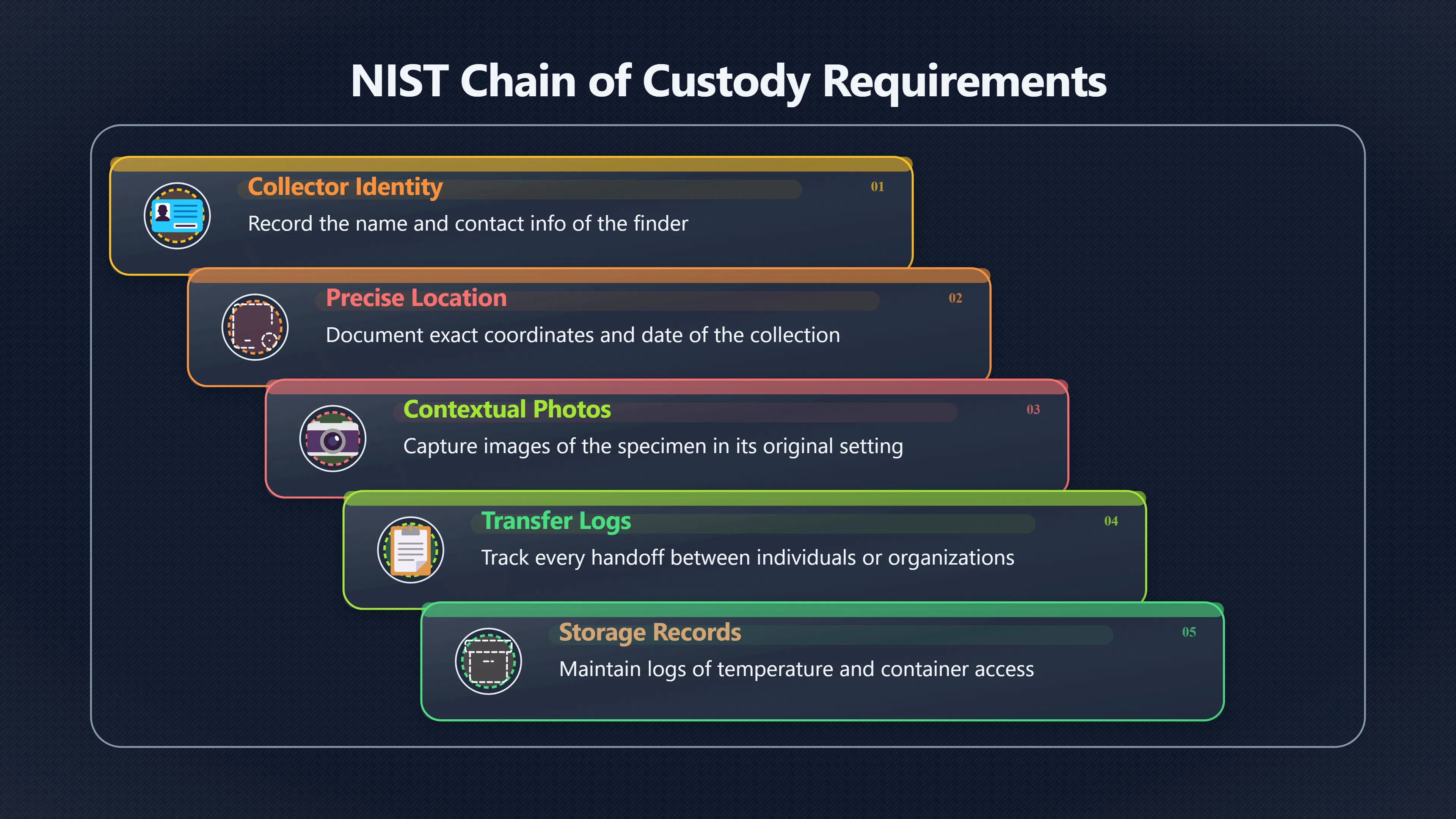
A strong custody record does not require a police investigation, but it does require disciplined documentation. Key elements include:
- The collector’s identity and contact information.
- The exact location and date of collection.
- Photographs showing the specimen in its original context.
- Notes describing collection methods and environmental conditions.
- Unique labels linking the specimen to field records.
- Documentation of every transfer between individuals or organisations.
- Records of storage conditions and any opening of containers.
- Documentation of laboratory receipt and analysis. NIST Computer Security Resource Center+2NIST Computer Security Resource Center[csrc.nist.gov]csrc.nist.govComputer Security Resource Centerchain of custodyNIST Computer Security Resource Centerchain of custody - Glossary | CSRCA process that tracks the movement of evidence through its collec…
When these elements are present, independent researchers can evaluate whether a specimen remained secure from discovery to testing. When they are absent, the sample may retain scientific interest but loses much of its value as evidence for a cryptid claim.
The Point at Which a Sample Loses Its Story
A cryptid sample does not become weak evidence solely because it turns out to belong to a known animal. It becomes weak evidence when investigators can no longer demonstrate the connection between the biological material and the event, creature or location being claimed.
The central challenge is therefore not only obtaining hair, tissue or other biological traces. It is preserving their story. Once documentation gaps appear, transfers go unrecorded, storage conditions become uncertain or contamination cannot be excluded, the specimen may still be testable in a laboratory, but its ability to support an extraordinary zoological claim is greatly diminished.[NIST+2NIST]nist.govglossary termChain Of Custody | NIST6 Apr 2026 — Chain Of Custody. chronological record (3.49) of the transfer, handling… ANSI/ASTM E1732 Stand…
Amazon book picks
Further Reading
Books and field guides related to When a Cryptid Sample Loses Its Story. Use these as the next step if you want deeper reading beyond the article.
Forensic DNA Typing
Explains evidence handling, validation, and chain-of-custody principles behind biological samples.
Forensics For Dummies
Introduces evidence collection, contamination risks, and documentation.
The Science of Sherlock Holmes
Shows how physical evidence gains or loses value depending on provenance and handling.
Field Guide To Bigfoot, Yeti, & Other Mystery Primates Worldwide
Provides context for specimen claims and cryptid investigations.
eBay marketplace picks
Marketplace Samples
Live-tested eBay searches with available results related to this page.



Endnotes
1.
Source: nist.gov
Title: glossary term
Link:https://www.nist.gov/glossary-term/20076
2.
Source: csrc.nist.gov
Title: Computer Security Resource Centerchain of custody
Link:https://csrc.nist.gov/glossary/term/chain_of_custody
3.
Source: ncbi.nlm.nih.gov
Title: NCBIChain of Custody
Link:https://www.ncbi.nlm.nih.gov/books/NBK551677/
4.
Source: csrc.nist.gov
Title: Computer Security Resource Centerchain of evidence
Link:https://csrc.nist.gov/glossary/term/chain_of_evidence
5.
Source: nist.gov
Link:https://www.nist.gov/forensic-science/interdisciplinary-topics/evidence-management
6.
Source: iris.unipa.it
Link:https://iris.unipa.it/retrieve/7f287320-ee42-4508-af37-d5cf559ae23b/healthcare-11-00634-v2.pdf
7.
Source: nist.gov
Title: new guide details steps z preserving biological evidence
Link:https://www.nist.gov/news-events/news/2013/04/new-guide-details-steps-z-preserving-biological-evidence
8.
Source: knowledge.lancashire.ac.uk
Link:https://knowledge.lancashire.ac.uk/id/eprint/46224/1/Maintaining%20the%20Chain%20of%20Custody%20Anti-Contamination%20Measures%20for%20Trace%20DNA%20Evidence.pdf
9.
Source: pmc.ncbi.nlm.nih.gov
Title: PMCThe Chain of Custody in the Era of Modern Forensics
Link:https://pmc.ncbi.nlm.nih.gov/articles/PMC10000967/
10.
Source: pmc.ncbi.nlm.nih.gov
Link:https://pmc.ncbi.nlm.nih.gov/articles/PMC4100498/
11.
Source: buffalo.edu
Title: University at Buffalo Abominable Snowman?
Link:https://www.buffalo.edu/news/releases/2017/11/037.html
12.
Source: researchgate.net
Title: Research Gate Himalayan’yeti’ DNA: Polar bear or DNA degradation?
Link:https://www.researchgate.net/publication/269695589Himalayan%27yeti%27DNA_Polar_bear_or_DNA_degradation_A_comment_on%27Genetic_analysis_of_hair_samples_attributed_to_Yeti%27_by_Sykes_et_al_2014
13.
Source: nist.gov
Link:https://www.nist.gov/forensic-science/interdisciplinary-topics/evidence-management/biological-evidence-guidance
14.
Source: nvlpubs.nist.gov
Link:https://nvlpubs.nist.gov/nistpubs/ir/2022/NIST.IR.8387.pdf
15.
Source: researchgate.net
Title: (PDF) The Biological Evidence Handbook: Best Practices
Link:https://www.researchgate.net/publication/283265260_The_Biological_Evidence_Handbook_Best_Practices_for_Evidence_Handlers
16.
Source: researchgate.net
Link:https://www.researchgate.net/publication/369940913_Maintaining_the_chain_of_custody_Anti-contamination_measures_for_trace_DNA_evidence
17.
Source: nij.ojp.gov
Title: packaging transportation
Link:https://nij.ojp.gov/nij-hosted-online-training-courses/collecting-dna-evidence-at-property-crime-scenes/evidence-collection/packaging-transportation
18.
Source: nij.ojp.gov
Link:https://nij.ojp.gov/library/publications/biological-evidence-preservation-handbook-best-practices-evidence-handlers
19.
Source: Wikipedia
Title: Forensic science
Link:https://en.wikipedia.org/wiki/Forensic_science
20.
Source: Wikipedia
Title: Chain of custody
Link:https://en.wikipedia.org/wiki/Chain_of_custody
21.
Source: nij.ojp.gov
Title: chain custody
Link:https://nij.ojp.gov/nij-hosted-online-training-courses/law-101-legal-guide-forensic-expert/pretrial/pretrial-motions/chain-custody
22.
Source: nij.ojp.gov
Title: chain custody
Link:https://nij.ojp.gov/nij-hosted-online-training-courses/what-every-law-enforcement-officer-should-know-about-dna/officer-responsibilities/chain-custody
23.
Source: komprise.com
Link:https://www.komprise.com/glossary_terms/chain-of-custody/
24.
Source: dictionary.cambridge.org
Link:https://dictionary.cambridge.org/dictionary/english/forensic
Additional References
25.
Source: cisa.gov
Link:https://www.cisa.gov/sites/default/files/publications/cisa-insights_chain-of-custody-and-ci-systems_508.pdf
26.
Source: crime-scene-investigator.net
Link:https://www.crime-scene-investigator.net/biological-evidence-preservation-handbook.html
27.
Source: study.com
Link:https://study.com/academy/lesson/what-is-the-chain-of-custody-definition-procedures-importance.html
28.
Source: evidencemanagement.com
Link:https://evidencemanagement.com/resources/emi-standards-and-best-practices/chapter-6-evidence-storage/
29.
Source: merriam-webster.com
Link:https://www.merriam-webster.com/dictionary/forensic
30.
Source: ijeais.org
Link:https://ijeais.org/wp-content/uploads/2025/6/IJAAFMR250624.pdf
31.
Source: cyfor.co.uk
Link:https://cyfor.co.uk/
32.
Source: ebsco.com
Link:https://www.ebsco.com/research-starters/engineering/quality-control-evidence
33.
Source: labmanager.com
Link:https://www.labmanager.com/evidence-chain-of-custody-best-practices-building-trust-and-traceability-across-scientific-and-forensic-labs-34564
34.
Source: evidencemanagement.com
Link:https://evidencemanagement.com/the-crucial-role-of-chain-of-custody-ensuring-evidence-integrity-and-quality-assurance/
Topic Tree