Within Populations
Why Has Nobody Found a Body?
The absence of bodies, bones, roadkill, scat and DNA becomes more damaging as a claimed population grows larger and older.
On this page
- Why dead wild animals are not always easy to find
- When absence becomes biologically meaningful
- Bodies, bones and DNA as population level evidence
Page outline Jump by section
Introduction
A missing carcass is not, by itself, proof that a cryptid does not exist. Wild animals often die in places people never visit, and carcasses can disappear surprisingly quickly through scavenging, decomposition and environmental processes. However, the argument changes dramatically when cryptozoological claims require a large breeding population that has supposedly persisted for decades, centuries or even millennia. The key issue is not whether one dead animal might go unnoticed. It is whether an entire population could continuously live, reproduce and die without leaving the kinds of physical evidence that wildlife biologists routinely use to detect known species. As the claimed population grows larger and older, the absence of bodies, bones, roadkill, scat, hair, tissue samples and DNA becomes increasingly difficult to explain. In population ecology, repeated absence of expected evidence is not conclusive proof of non-existence, but it is evidence that weighs against the claim.
Why Dead Wild Animals Are Not Always Easy to Find
Supporters of cryptids often point out that people rarely stumble across carcasses of many ordinary wild animals. This observation is broadly correct.
In most ecosystems, dead animals are rapidly recycled. Scavengers consume soft tissue, insects colonise remains, microbes break down organic matter, and weather disperses what is left. Studies of carcass ecology show that vertebrate scavengers can remove substantial animal remains in days or weeks, with decomposition and consumption proceeding even faster in warm conditions. Researchers repeatedly find that carcasses are important nutrient sources precisely because they are quickly exploited by scavenger communities.[Nature+2Wiley Online Library]nature.comCarcass detection and consumption by facultative…by A Inagaki · 2022 · Cited by 33 — Our results indicate that facultative scave…
Field studies on deer carcasses have found persistence times ranging from weeks to a few months depending on season, temperature and scavenger activity. Mammals, birds and insects all contribute to the rapid disappearance of remains.[U.S. Geological Survey]pubs.usgs.govGeological SurveyDeer carcass decomposition and potential scavenger…by CS Jennelle · 2009 · Cited by 124 — Deer carcasses persisted fo…
This means that sceptics do not argue that every dead cryptid should leave a perfectly preserved skeleton waiting to be discovered. Nature is not a museum. Many individual animals die and vanish without human observation.
That point, however, addresses only the fate of a single carcass.
When Absence Becomes Biologically Meaningful
The ecological burden changes when the claim involves a long-term breeding population.
A hypothetical Bigfoot population spread across North America, for example, would require many individuals living and dying over generations. Even if every carcass were quickly scavenged, the cumulative number of deaths would become large. Over decades, hundreds or thousands of individuals would be expected to die. Over centuries, the number would be vastly larger.
At that scale, the question is no longer”Why has nobody found this particular body?” but”Why has nobody found any convincing physical remains from the population at all?”
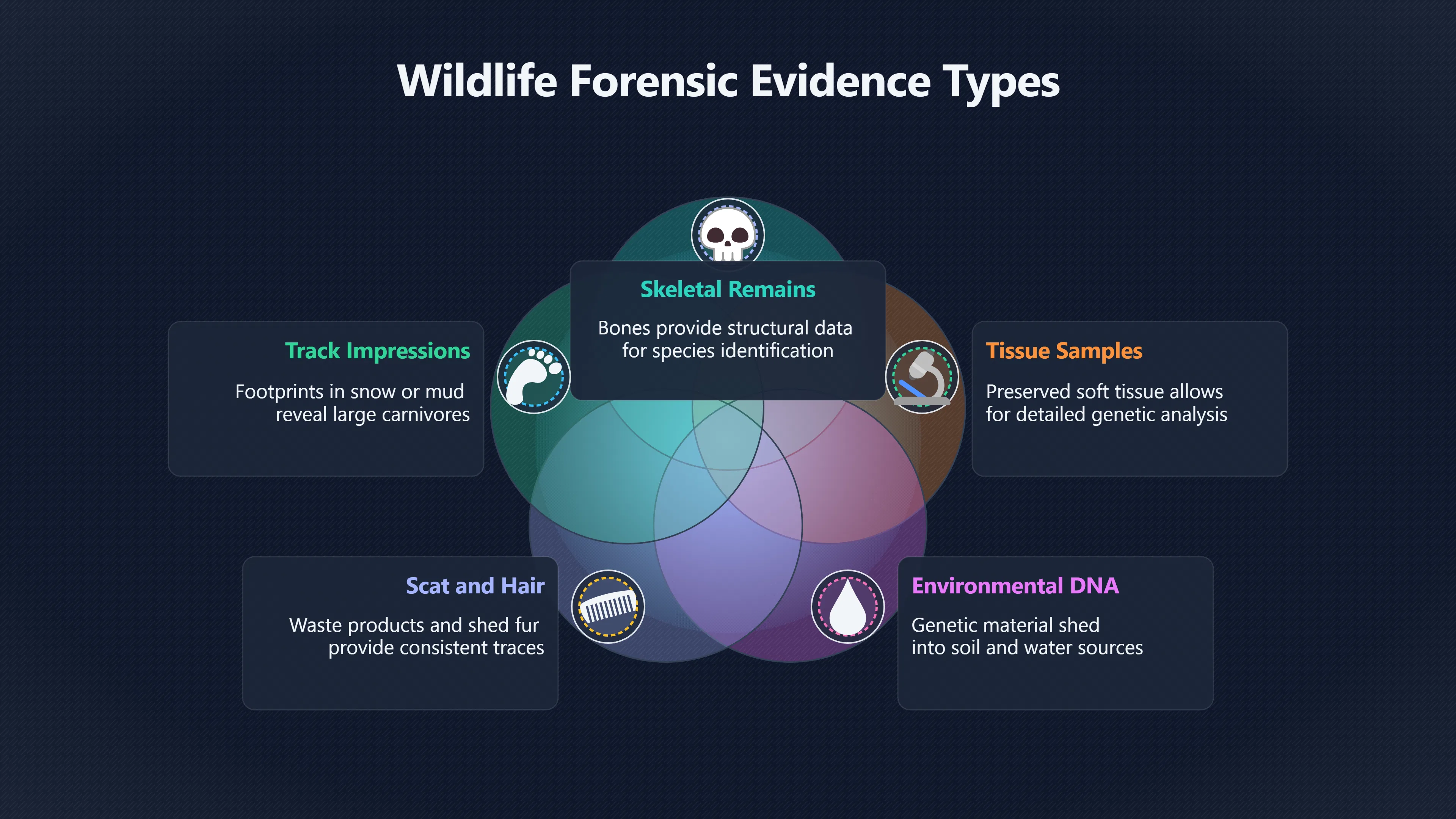
Wildlife biology routinely discovers elusive species through indirect evidence long before most people ever see the animals themselves. Researchers identify species from hair, feathers, droppings, bones, feeding traces, shed skin, saliva, environmental DNA and carcass fragments. Modern wildlife monitoring increasingly relies on exactly these traces because direct sightings are often rare.[Wiley Online Library+2World Wildlife Fund]onlinelibrary.wiley.comWiley Online LibraryReview: Wildlife forensic genetics—Biological evidence…by S Kanthaswamy · 2024 · Cited by 30 — This article review…
The larger and longer-lived the proposed cryptid population becomes, the stronger the expectation that at least some of these traces should accumulate.
This is why the body argument is fundamentally a population argument rather than a carcass argument.
Bodies, Bones and DNA as Population-Level Evidence
Physical remains matter because they are the standard route by which zoology confirms the existence of animals.
Historically, many species were recognised through collected specimens, skeletal material or preserved remains. Today, even fragmentary biological material can be analysed genetically. Wildlife forensic laboratories routinely identify species from degraded tissue, hair, bone fragments, scat and other small biological samples.[PMC+2Trace Network]pmc.ncbi.nlm.nih.govForensic species identification: practical guide for animal and…by B Corradini · 2024 · Cited by 8 — This work is intended to reaff…
The development of environmental DNA (eDNA) has made the challenge even sharper. Animals shed genetic material into water, soil, snow and air through skin cells, mucus, hair, faeces and other biological traces. Researchers now use eDNA to detect rare, endangered and elusive species that may never be directly observed during a survey.[World Wildlife Fund+2Undark Magazine]worldwildlife.orgOpen source on worldwildlife.org.
Scientists have successfully recovered identifiable DNA from snow tracks left by large carnivores and from saliva left on partially consumed prey.[PubMed]pubmed.ncbi.nlm.nih.govFingerprinting snow tracks of three large carnivore speciesby M De Barba · 2024 · Cited by 17 — We present successful individual ge…
This does not mean every unknown animal would instantly be detected. Environmental sampling has limitations and can miss low-density populations. Yet a substantial population of large mammals or aquatic vertebrates should continuously shed biological material into the environment. The longer such a population persists, the more surprising a complete lack of confirmed genetic evidence becomes.[Frontiers+2Springer]frontiersin.orgFrontiersAssessing the viability of airborne environmental DNA…by GK Moloney · 2025 · Cited by 2 — As a non-invasive alternative, envi…
Why Large Cryptids Face the Hardest Problem
The objection becomes strongest for cryptids described as large-bodied animals.
Large mammals produce more biomass, consume more food, travel farther, leave larger tracks, generate more waste and interact more extensively with their environment. They are also more likely to leave recoverable remains simply because each individual contains more skeletal material and tissue.
A hidden mouse-sized species can potentially evade detection for long periods in remote habitats. A population of giant primates, surviving prehistoric reptiles or large lake monsters faces a much higher evidential burden.
The problem is cumulative. Large animals require:<div class="content-enhancement content-enhancement--caution" markdown="1">
- More food and habitat.
- More individuals to maintain a breeding population.[facebook.com]facebook.comAny breeding population of large mammals requires hundreds of individuals to avoid genetic collapse.Read more…
- More births and deaths through time.
- More biological waste and shed material.
- More opportunities for encounters with roads, hunters, hikers, camera traps and researchers.</div>
Each factor independently increases the probability of leaving physical evidence. Together they make total absence increasingly difficult to reconcile with the existence of a long-standing population.
What Sceptics Mean by”No Body”
The strongest sceptical version of the argument is often misunderstood.
Critics are not usually claiming that a single undiscovered carcass disproves a cryptid. Rather, they argue that decades of searching have failed to produce the broader package of evidence expected from a real animal population.
That package includes:<div class="content-enhancement content-enhancement--insight-grid" markdown="1">
- Verified bones or skeletal remains.
- Preserved tissue samples.
- Consistent DNA evidence.
- Recoverable scat or hair linked to an unknown species.
- Roadkill or accidental deaths.
- Repeatable biological traces that withstand scientific examination.</div>
Any one category might occasionally be absent. The combined absence of all of them becomes more significant.
The Population Logic Behind the Objection
The”no body” objection ultimately derives its force from population ecology rather than from scavenger biology.
If a cryptid were represented by a single hypothetical individual, the absence of a carcass would reveal little. But cryptozoological claims generally require breeding populations that have persisted across many generations. Such populations should produce a continuing stream of deaths, remains and genetic traces.
Scavengers, decomposition and remote habitats can explain why particular bodies are missed. They do not easily explain why an entire population leaves no widely accepted skeletal, tissue or DNA evidence over long periods of time.
For that reason, the absence of bodies is not usually treated as a standalone disproof. Instead, it is one component of a larger evidential pattern. As the claimed population becomes larger, older and more widespread, the continued absence of physical remains becomes increasingly meaningful and increasingly difficult to reconcile with the existence of the species being proposed.
Amazon book picks
Further Reading
Books and field guides related to Why Has Nobody Found a Body?. Use these as the next step if you want deeper reading beyond the article.
Abominable Science!
Directly examines the evidence expected for unknown animals, including physical remains and biology.
Hunting Monsters
Explores how zoologists evaluate claims and what evidence populations should leave behind.
Why Evolution is True
Provides background on species, populations, and biological evidence.
The Tangled Bank
Helps explain how populations are detected and studied scientifically.
eBay marketplace picks
Marketplace Samples
Live-tested eBay searches with available results related to this page.




Endnotes
1.
Source: nature.com
Link:https://www.nature.com/articles/s41598-022-20465-4
2.
Source: onlinelibrary.wiley.com
Link:https://onlinelibrary.wiley.com/doi/full/10.1002/ece3.8576
3.
Source: link.springer.com
Link:https://link.springer.com/article/10.1007/s00442-024-05608-w
4.
Source: pubs.usgs.gov
Link:https://pubs.usgs.gov/publication/70036596
5.
Source: onlinelibrary.wiley.com
Link:https://onlinelibrary.wiley.com/doi/full/10.1111%2Fage.13390
6.
Source: undark.org
Title: edna conservation
Link:https://undark.org/2024/03/18/edna-conservation/
7.
Source: pmc.ncbi.nlm.nih.gov
Link:https://pmc.ncbi.nlm.nih.gov/articles/PMC11490437/
8.
Source: link.springer.com
Link:https://link.springer.com/article/10.1007/s10531-025-03112-y
9.
Source: worldwildlife.org
Link:https://www.worldwildlife.org/our-work/wildlife/wildlife-technology/environmental-dna/
10.
Source: tracenetwork.org
Link:https://www.tracenetwork.org/wp-content/uploads/2018/09/Summary-of-wildlife-forensic-tests-March-2018.pdf
11.
Source: pubmed.ncbi.nlm.nih.gov
Link:https://pubmed.ncbi.nlm.nih.gov/38099394/
12.
Source: frontiersin.org
Link:https://www.frontiersin.org/journals/conservation-science/articles/10.3389/fcosc.2025.1671488/full
13.
Source: pmc.ncbi.nlm.nih.gov
Link:https://pmc.ncbi.nlm.nih.gov/articles/PMC12732898/
14.
Source: merriam-webster.com
Link:https://www.merriam-webster.com/dictionary/why
15.
Source: dictionary.cambridge.org
Link:https://dictionary.cambridge.org/dictionary/english/why
16.
Source: Wikipedia
Link:https://en.wikipedia.org/wiki/Why
Additional References
17.
Source: reddit.com
Link:https://www.reddit.com/r/Cryptozoology/comments/xa2k54/if_bigfoot_is_real_why_hasnt_there_been_a_body/
18.
Source: irep.ntu.ac.uk
Link:https://irep.ntu.ac.uk/id/eprint/43094/1/10290204.pdf
19.
Source: britishecologicalsociety.org
Link:https://www.britishecologicalsociety.org/fishing-for-mammals-how-dna-from-rivers-could-revolutionise-mammal-detection-on-land/
20.
Source: discovermagazine.com
Title: why dont we see more dead animal remains while strolling in the woods 47877
Link:https://www.discovermagazine.com/why-dont-we-see-more-dead-animal-remains-while-strolling-in-the-woods-47877
21.
Source: youtube.com
Link:https://www.youtube.com/watch?v=3qHl3nsyqmw
22.
Source: facebook.com
Link:https://www.facebook.com/sinmaldynohayperreo/posts/this-is-why-weve-never-found-bigfoot-bones-challenges-everything-you-believesee-/1459331605552902/
23.
Source: nathab.com
Title: environmental dna is revolutionizing wildlife conservation
Link:https://www.nathab.com/blog/environmental-dna-is-revolutionizing-wildlife-conservation
24.
Source: facebook.com
Link:https://www.facebook.com/wildlifeatrisk/posts/scavengers-arent-the-most-charismatic-of-animals-but-they-perform-a-vital-task-b/758141763233180/
25.
Source: mossyoak.com
Title: deer carcass disposal how why and why not
Link:https://www.mossyoak.com/our-obsession/blogs/deer/deer-carcass-disposal-how-why-and-why-not
26.
Source: education.nationalgeographic.org
Title: role scavengers carcass crunching
Link:https://education.nationalgeographic.org/resource/role-scavengers-carcass-crunching/
Topic Tree