Within Bigfoot
Why One Bigfoot Would Never Be Enough
A real large mammal population would need food, mates, movement and deaths, creating biological evidence that should eventually be found.
On this page
- Why a population is required
- What large mammals leave behind
- Why roads, hunters and cameras raise the odds
Page outline Jump by section
Introduction
A key reason scientists remain unconvinced by Bigfoot is that a single animal would not be enough to explain decades of reported sightings. For a large mammal to persist across generations, there must be a breeding population with enough individuals to find mates, raise young and avoid extinction. Once that requirement is accepted, the question changes. The issue is no longer whether one elusive creature might avoid detection, but whether an entire population could do so while leaving almost no confirmed biological evidence. Large mammals inevitably interact with their environment through feeding, movement, reproduction, injury and death. Those activities normally generate tracks, hair, scat, carcasses, DNA and repeated observations that can eventually be documented. The continued absence of such evidence is one of the strongest scientific objections to the Bigfoot hypothesis.[Wikipedia]WikipediaOpen source on wikipedia.org.
Why a Population Is Required
Reports often describe Bigfoot as a rare, solitary animal. However, no long-term population can survive as a single individual. A species requires enough members to maintain genetic diversity and replace individuals that die from disease, accidents, predation, old age or environmental change.
This matters because every additional animal increases the number of opportunities for detection. A population of hundreds or thousands would not merely produce more sightings. It would also produce more footprints, more feeding traces, more sleeping sites, more biological material and more deaths. Even if each individual were extremely elusive, the combined ecological footprint of the population would be much larger than that of a lone wanderer.
Scientists routinely detect rare mammals that are seen only occasionally because populations leave cumulative evidence over time. The challenge for the Bigfoot hypothesis is that it requires enough individuals to remain viable while simultaneously producing little or no verifiable evidence.
What Large Mammals Leave Behind
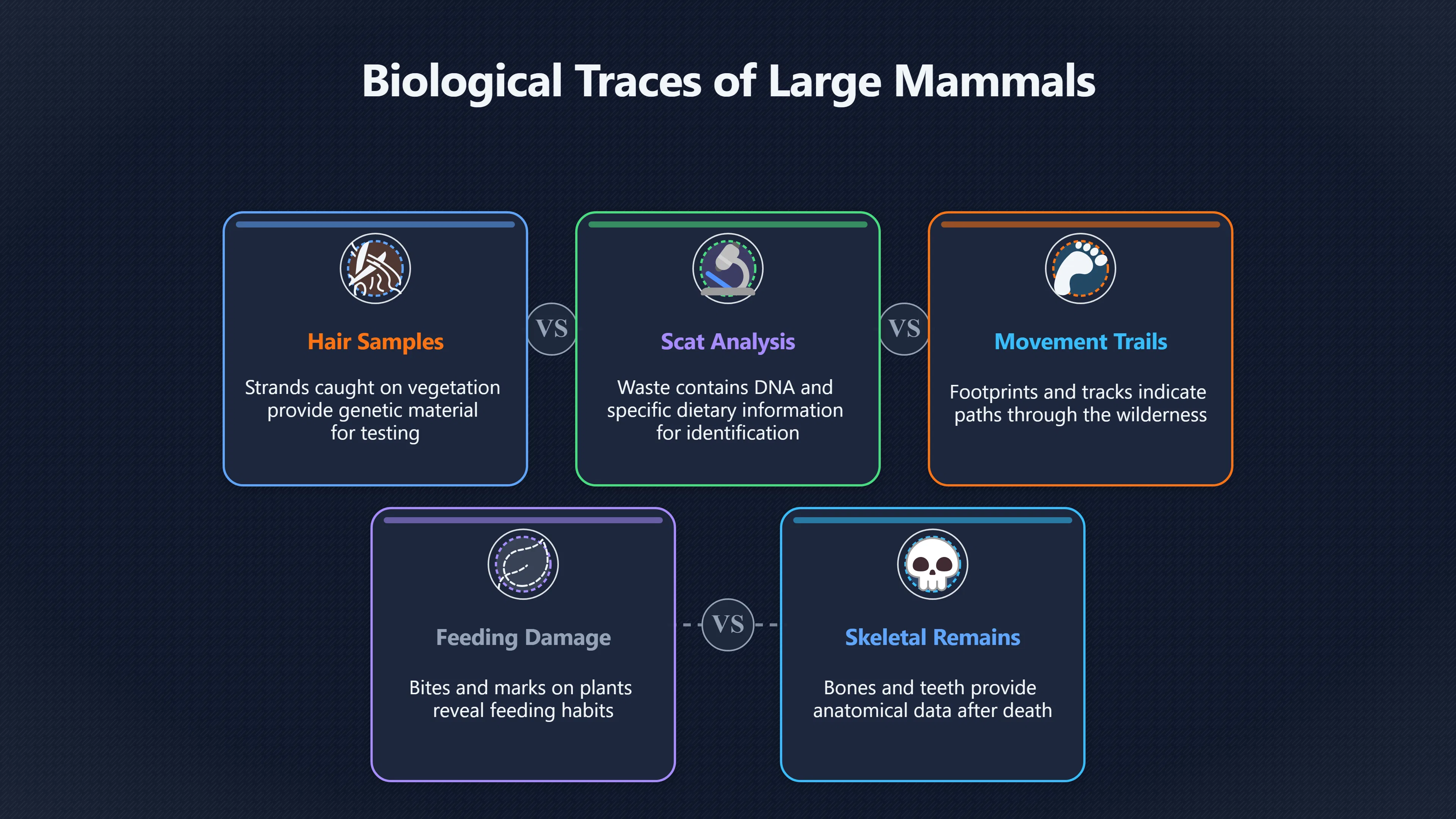
Large mammals are difficult to hide indefinitely because living bodies continuously shed material into the environment.
Common traces include:<div class="content-enhancement content-enhancement--insight-grid" markdown="1">
- Hair caught on vegetation.
- Scat containing DNA and dietary information.
- Footprints and movement trails.
- Feeding damage on plants or prey.
- Resting sites, dens or nesting areas.
- Blood, tissue or saliva from injuries.
- Skeletal remains after death.</div>
For known species, these traces often allow researchers to confirm presence even when direct sightings are uncommon. Hair and tissue can be genetically analysed. Bones can be identified anatomically. Scat can reveal species identity, diet and population structure.
This expectation is particularly relevant because numerous samples submitted as possible Bigfoot evidence have already been tested. A widely cited genetic study examining hair attributed to Bigfoot-like creatures found that the samples belonged to known animals, including bears, deer, dogs and other familiar species rather than an unknown primate.[PMC]pmc.ncbi.nlm.nih.govKeywords: yeti, almasty, bigfoot, sasquatch, mitochondrial DNA. 1. Introduction. Despite…Read more…
The absence of confirmed biological specimens does not by itself prove that Bigfoot does not exist. However, it means that decades of searching have not produced the type of evidence normally expected from a large mammal population.
Death Creates Evidence Too
Supporters sometimes argue that carcasses are rarely found in forests. There is truth to the observation that decomposition can be rapid and scavengers can disperse remains. Bones do not remain visible forever, especially in wet environments.
Yet a breeding population existing over centuries would generate not one death but thousands. Some individuals would die near rivers, roads, logging areas, campsites or trails. Others would leave partial skeletons, teeth or fragments preserved under favourable conditions. Roadkill and accidental deaths are also common sources of specimens for many known species. Modern wildlife genetics even uses road-killed animals as valuable biological material because carcasses frequently provide recoverable DNA.[PMC]pmc.ncbi.nlm.nih.govPMCFrom roads to biobanks: Roadkill animals as a valuableby MA Coba-Males · 2023 · Cited by 19 — Overall, our study shows that DNA extracted from carcasses of roadkill animals can be of suffi…
The scientific argument is therefore statistical rather than absolute. Not every animal leaves a discoverable skeleton, but a long-lived population usually leaves some physical remains somewhere.
Why Roads, Hunters and Cameras Raise the Odds
North American forests are not unexplored wilderness in the nineteenth-century sense. They contain extensive networks of roads, hiking trails, forestry operations, hunters, wildlife officers, researchers and recreational visitors.
Millions of trail-camera images are collected annually by hunters, conservation organisations and scientific surveys. Camera traps have become one of the standard tools for documenting wildlife populations, including elusive and nocturnal species. Large mammals that occur at low densities are regularly detected through these methods. Studies using extensive camera-trap networks have documented species that are difficult to observe directly and have even revealed previously unrecorded occurrences in surveyed regions.[Springer]link.springer.comOur study detected 39 terrestrial mammals during the camera trap survey of 183 locations across…Read more…
If a large bipedal primate occupied wide areas of North America, scientists would expect at least occasional clear images, repeated detections at the same locations or physical evidence associated with camera records. Instead, the available imagery remains ambiguous and disputed, despite decades of technological improvement.
The argument is not that cameras can never miss an animal. Rather, it is that a population large enough to persist should eventually be captured repeatedly by a surveillance network that routinely records far rarer known species.
Environmental DNA Makes the Question Harder
One of the most significant developments in modern wildlife monitoring is environmental DNA, usually called eDNA. Animals continuously shed genetic material through skin cells, hair, waste and bodily fluids. Researchers can collect water, soil or other environmental samples and identify species that have recently been present.
Recent studies have shown that eDNA can detect terrestrial mammals as effectively as, and sometimes more effectively than, camera traps. In some surveys, stream-water eDNA detected more mammal species than conventional camera-based monitoring. Researchers increasingly use eDNA specifically because it can reveal elusive species that are difficult to photograph directly. PLOS+3World Wildlife Fund+3Royal Society Publishing[worldwildlife.org]worldwildlife.orgWorld Wildlife FundeDNA Sampling Outperforms Camera Traps in WWF StudyJun 15, 2021 — WWF scientists find stream water eDNA detects more m…
This technology changes the Bigfoot debate in an important way. Historically, believers could argue that a shy animal might avoid cameras and people. Environmental DNA creates another pathway to detection that does not require a direct sighting. If a breeding population of large primates were regularly moving through watersheds, shedding hair and cells, researchers would expect genetic traces to appear eventually alongside those of other mammals.
So far, no confirmed eDNA evidence has revealed an unknown North American ape.
Why One Bigfoot Would Never Be Enough
The strongest version of the Bigfoot claim is not that a mysterious creature was glimpsed once. It is that a real biological species survives today. A species requires a population, and populations leave evidence.
See on Amazon</a></div></div></article><article class="fr-book-card"><a class="fr-book-cover" href="https://www.amazon.com/s?k=Bigfoot%21+by+Loren+Coleman&i=stripbooks&tag=searcht-20" target="_blank" rel="sponsored noopener noreferrer" aria-label="Open Bigfoot! on Amazon"><span class="fr-book-cover-fallback">Book</span><img class="fr-book-cover-thumb" src="https://books.google.com/books/content?id=CsDBqy9oHHkC&printsec=frontcover&img=1&zoom=1&edge=curl&source=gbs_api" alt="Cover for Bigfoot!" loading="lazy" decoding="async" fetchpriority="low" referrerpolicy="no-referrer" onerror="this.hidden=true;this.closest('.fr-book-cover').classList.add('fr-book-cover-placeholder');"></a><div class="fr-book-info"><h4 class="fr-book-title"><a href="https://www.amazon.com/s?k=Bigfoot%21+by+Loren+Coleman&i=stripbooks&tag=searcht-20" target="_blank" rel="sponsored noopener noreferrer" title="Bigfoot!">Bigfoot!</a></h4><p class="fr-book-author">By Loren Coleman</p><p class="fr-book-desc">Provides background on claims of widespread populations.</p><div class="fr-book-actions"><a href="https://www.amazon.com/s?k=Bigfoot%21+by+Loren+Coleman&i=stripbooks&tag=searcht-20" class="fr-amazon-btn" target="_blank" rel="sponsored noopener noreferrer">
See on Amazon</a></div></div></article><article class="fr-book-card"><a class="fr-book-cover" href="https://www.amazon.com/s?k=Abominable+Science%21+by+Daniel+Loxton&i=stripbooks&tag=searcht-20" target="_blank" rel="sponsored noopener noreferrer" aria-label="Open Abominable Science! on Amazon"><span class="fr-book-cover-fallback">Book</span><img class="fr-book-cover-thumb" src="https://books.google.com/books/content?id=kTsgAAAAQBAJ&printsec=frontcover&img=1&zoom=1&edge=curl&source=gbs_api" alt="Cover for Abominable Science!" loading="lazy" decoding="async" fetchpriority="low" referrerpolicy="no-referrer" onerror="this.hidden=true;this.closest('.fr-book-cover').classList.add('fr-book-cover-placeholder');"></a><div class="fr-book-info"><h4 class="fr-book-title"><a href="https://www.amazon.com/s?k=Abominable+Science%21+by+Daniel+Loxton&i=stripbooks&tag=searcht-20" target="_blank" rel="sponsored noopener noreferrer" title="Abominable Science!">Abominable Science!</a></h4><p class="fr-book-author">By Daniel Loxton, Donald R. Prothero</p><p class="fr-book-desc">Addresses ecological and biological problems facing cryptid claims.</p><div class="fr-book-actions"><a href="https://www.amazon.com/s?k=Abominable+Science%21+by+Daniel+Loxton&i=stripbooks&tag=searcht-20" class="fr-amazon-btn" target="_blank" rel="sponsored noopener noreferrer">
See on Amazon</a></div></div></article><article class="fr-book-card"><a class="fr-book-cover" href="https://www.amazon.com/s?k=Hunting+Monsters+by+Darren+Naish&i=stripbooks&tag=searcht-20" target="_blank" rel="sponsored noopener noreferrer" aria-label="Open Hunting Monsters on Amazon"><span class="fr-book-cover-fallback">Book</span><img class="fr-book-cover-thumb" src="https://books.google.com/books/content?id=mN2oCwAAQBAJ&printsec=frontcover&img=1&zoom=1&edge=curl&source=gbs_api" alt="Cover for Hunting Monsters" loading="lazy" decoding="async" fetchpriority="low" referrerpolicy="no-referrer" onerror="this.hidden=true;this.closest('.fr-book-cover').classList.add('fr-book-cover-placeholder');"></a><div class="fr-book-info"><h4 class="fr-book-title"><a href="https://www.amazon.com/s?k=Hunting+Monsters+by+Darren+Naish&i=stripbooks&tag=searcht-20" target="_blank" rel="sponsored noopener noreferrer" title="Hunting Monsters">Hunting Monsters</a></h4><p class="fr-book-author">By Darren Naish</p><p class="fr-book-desc">Explains how species are confirmed and populations inferred.</p><div class="fr-book-actions"><a href="https://www.amazon.com/s?k=Hunting+Monsters+by+Darren+Naish&i=stripbooks&tag=searcht-20" class="fr-amazon-btn" target="_blank" rel="sponsored noopener noreferrer">
See on Amazon</a></div></div></article></div><div class="fr-section-footer"><div class="fr-browse-links" aria-label="Browse more on Amazon"><span class="fr-browse-links-label">Browse more on Amazon:</span><a class="fr-browse-more" href="https://www.amazon.com/s?k=Sasquatch%3A+Legend+Meets+Science&i=stripbooks&tag=searcht-20" target="_blank" rel="sponsored noopener noreferrer">Sasquatch: Legend Meets Science</a><a class="fr-browse-more" href="https://www.amazon.com/s?k=Bigfoot%21&i=stripbooks&tag=searcht-20" target="_blank" rel="sponsored noopener noreferrer">Bigfoot!</a><a class="fr-browse-more" href="https://www.amazon.com/s?k=Abominable+Science%21&i=stripbooks&tag=searcht-20" target="_blank" rel="sponsored noopener noreferrer">Abominable Science!</a></div><p class="fr-disclosure">As an Amazon Associate I earn from qualifying purchases.</p></div></div></section>
Amazon book picks
Further Reading
Books and field guides related to Why One Bigfoot Would Never Be Enough. Use these as the next step if you want deeper reading beyond the article.
Sasquatch: Legend Meets Science
Discusses the proposed biology of a Bigfoot population.
Abominable Science!
Addresses ecological and biological problems facing cryptid claims.
eBay marketplace picks
Marketplace Samples
Live-tested eBay searches with available results related to this page.


Endnotes
1.
Source: Wikipedia
Link:https://en.wikipedia.org/wiki/Bigfoot
2.
Source: pmc.ncbi.nlm.nih.gov
Link:https://pmc.ncbi.nlm.nih.gov/articles/PMC4100498/
3.
Source: pmc.ncbi.nlm.nih.gov
Title: PMCFrom roads to biobanks: Roadkill animals as a valuable
Link:https://pmc.ncbi.nlm.nih.gov/articles/PMC10703236/
4.
Source: link.springer.com
Link:https://link.springer.com/article/10.1007/s10980-025-02156-3
5.
Source: arxiv.org
Link:https://arxiv.org/abs/1703.10726
6.
Source: journals.plos.org
Link:https://journals.plos.org/plosone/article?id=10.1371%2Fjournal.pone.0310888
7.
Source: Wikipedia
Link:https://en.wikipedia.org/wiki/Wildlife
8.
Source: wildlife.org
Title: The Wildlife Society
Link:https://wildlife.org/
9.
Source: nationalgeographic.com
Title: forensic expert says bigfoot is real
Link:https://www.nationalgeographic.com/culture/article/forensic-expert-says-bigfoot-is-real
10.
Source: worldwildlife.org
Link:https://www.worldwildlife.org/news/press-releases/environmental-dna-is-as-effective-as-camera-traps-for-monitoring-terrestrial-mammal-diversity/
11.
Source: royalsocietypublishing.org
Link:https://royalsocietypublishing.org/rspb/article/287/1918/20192353/85416/A-comparison-of-eDNA-to-camera-trapping-for
12.
Source: tpwd.texas.gov
Link:https://tpwd.texas.gov/huntwild/wild/species/
13.
Source: pmc.ncbi.nlm.nih.gov
Link:https://pmc.ncbi.nlm.nih.gov/articles/PMC9304545/
14.
Source: pmc.ncbi.nlm.nih.gov
Link:https://pmc.ncbi.nlm.nih.gov/articles/PMC11419345/
Additional References
15.
Source: fws.gov
Link:https://www.fws.gov/story/wildlife-videos
16.
Source: journal.wildlife.ca.gov
Link:https://journal.wildlife.ca.gov/2025/05/20/camera-trap-method-effectively-identifies-small-mammal-species-in-forested-habitats/
17.
Source: 3rswildlife.info
Link:https://3rswildlife.info/detection-mammals/
18.
Source: facebook.com
Link:https://www.facebook.com/Genomebc/posts/recently-published-study-led-by-wwf-showed-that-edna-collected-from-stream-water/4485144574837782/
19.
Source: news.mongabay.com
Link:https://news.mongabay.com/2021/07/for-monitoring-mammals-edna-boasts-killer-feature-over-other-methods/
20.
Source: merriam-webster.com
Link:https://www.merriam-webster.com/dictionary/wildlife
21.
Source: youtube.com
Link:https://www.youtube.com/watch?v=BrGsDXKq6FY
22.
Source: nat.au.dk
Title: people not the climate caused the decline of the giant mammals
Link:https://nat.au.dk/en/about-the-faculty/news/show/artikel/people-not-the-climate-caused-the-decline-of-the-giant-mammals
23.
Source: facebook.com
Title: David Paulides:”We Finally Found REAL Bigfoot Evidence!
Link:https://www.facebook.com/sinmaldynohayperreo/posts/david-paulides-we-finally-found-real-bigfoot-evidence-see-more-dr-emily-chen-arr/1488935159259213/
24.
Source: discovermagazine.com
Link:https://www.discovermagazine.com/hunting-for-bigfoot-relies-more-on-science-than-skeptics-think-48289
Topic Tree