Within Deep Sea
What New Species Actually Look Like
Recent species surveys reveal an ocean full of unknown life, but mostly through many small discoveries rather than single monsters.
On this page
- What recent surveys are finding
- Why discovery is often slow taxonomy
- Why unknown does not mean monster
Page outline Jump by section
Introduction
What Recent Surveys Are Finding
The Ocean Census initiative, launched to accelerate marine species discovery, reported 1,121 previously unknown marine species identified through expeditions and species-discovery workshops. The discoveries came from environments ranging from sea caves to abyssal depths exceeding 6,500 metres. The organisation described this as a 54% increase in annual identification rates, reflecting both improved exploration and efforts to reduce taxonomic bottlenecks.[Ocean Census+2Ocean Decade]oceancensus.orgOcean CensusOver 1100 New Marine Species Discovered19 May 2026 — Discoveries from depths of up to 6,575m include a new species of deep-se…
The most striking aspect of the dataset is its diversity. New finds include:
- Deep-sea ghost sharks (chimaeras), relatives of sharks and rays that diverged from other cartilaginous fishes hundreds of millions of years ago.
- Symbiotic worms living inside intricate glass sponge structures.
- New corals, shrimps, crabs, sea urchins and anemones from remote seafloor habitats.
The Ghost Shark Example
One of the most publicised Ocean Census discoveries was a previously unknown ghost shark species. Ghost sharks, also called chimaeras, inhabit deep water and are rarely encountered. Their large eyes, elongated snouts and pale appearance give them an almost fictional look. Yet they are a recognised branch of cartilaginous fishes with a long evolutionary history.[DIVE Magazine]divemagazine.comDIVE MagazineOcean Census discovers 1121 marine species in a single…19 May 2026 — Description: Often called “ghost sharks,” chimaeras…
A related example is Rhinochimaera costaricana, identified from deep Pacific waters off Costa Rica after years of specimen collection and comparison with museum material. Researchers used both anatomical characteristics and genetic evidence to confirm that it represented a distinct species rather than a variation of an already known one.[The Times of India]timesofindia.indiatimes.comThis enigmatic creature inhabits extreme depths, far beyond the reach of sunlight and where pressure is intense. Ghost sharks, also known…
The lesson is important: even an animal as unusual as a ghost shark becomes accepted science through repeatable evidence, preserved specimens and detailed analysis.
Life in the “Glass Castle”
Another Ocean Census highlight involved a tiny symbiotic bristle worm living within the complex skeleton of a deep-sea glass sponge. Researchers nicknamed the habitat a “glass castle” because of its elaborate silica architecture. The discovery illustrates how entire ecosystems can remain hidden within specialised structures on the deep seafloor.[ABC News+2The Times of India]abc.net.auocean census marine scientists discover thousands of new speciesABC NewsOcean Census project discovers 1121 new species of…20 May 2026 — 2025 to 2026 was a bumper year for the organisation, which la…
This type of finding is easy to overlook compared with dramatic monster stories, yet it reveals a richer scientific reality: unknown species often depend on equally obscure habitats. Scientists may need to discover the habitat before they can even recognise the organism living inside it.
Why Discovery Is Often Slow Taxonomy
Finding an unfamiliar animal is not the same as officially describing a new species. One reason Ocean Census exists is that marine taxonomy—the science of identifying and naming species—has become a major bottleneck.[Vox]vox.comPhotos reveal strange sea creatures that scientists have never seen beforeSpearheaded by the UK-based nonprofit Nekton and Japan's Nippon Foundation, the project aims to accelerate the identification of unknown…
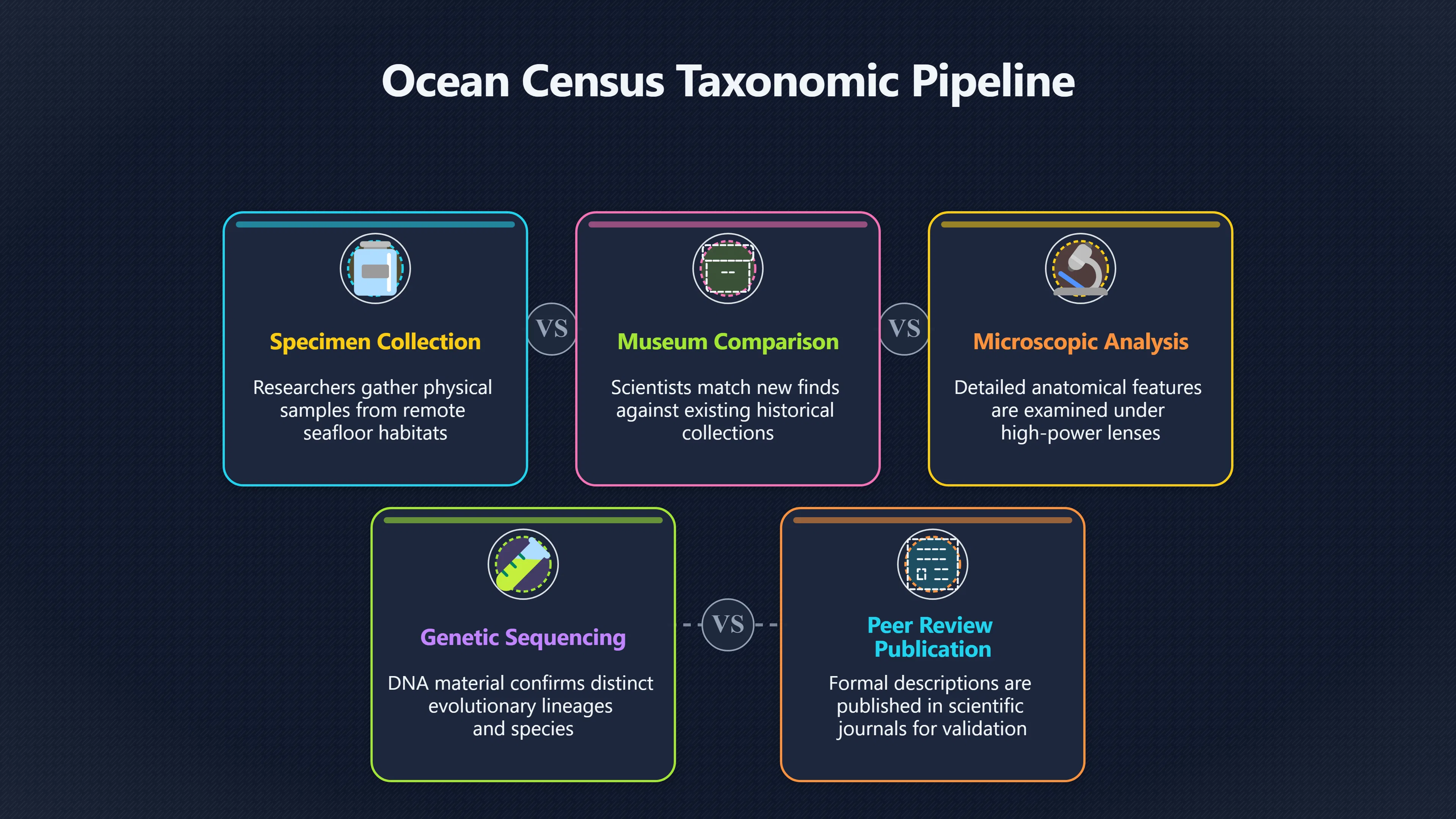
After collection, researchers typically must: <div class="content-enhancement content-enhancement--step-flow" markdown="1">
- Compare specimens with museum collections.
- Examine anatomical details under microscopes.
- Analyse genetic material.
- Determine whether the organism is truly distinct.
- Publish a formal peer-reviewed description. Vox</div>
Ocean Census leaders argue that this process can take many years under traditional systems. Some reports note that formal description may require more than a decade from discovery to publication. The programme therefore combines expeditions, digital databases and specialist workshops to move potential new species through the pipeline more quickly. Vox
The distinction between “found” and “formally described” is crucial. Many Ocean Census organisms are regarded as likely new species, but scientific validation still requires the full taxonomic process. This caution is not a weakness; it is how biology prevents misidentification and duplication. Vox
Why Unknown Does Not Mean Monster
Cryptozoological discussions often begin with a simple observation: much of the ocean remains unexplored. Ocean Census findings support the first half of that statement. There is clearly an enormous amount of marine biodiversity still undocumented. Oceanographic
However, the discoveries also show what “unknown” usually means in practice.
The newly documented organisms are typically:
- Small or moderately sized.
- Restricted to specialised habitats.
- Difficult to collect.
- Deep-living and rarely observed.
- Taxonomically overlooked rather than biologically impossible. Vox+2Scripps News
Even the most visually dramatic finds—ghost sharks, carnivorous sponges and strange worms—fit into recognised evolutionary groups. They extend existing branches of the tree of life rather than creating entirely new ones. DIVE Magazine+2The Guardian
This does not make the discoveries less remarkable. In many ways, they are more impressive because they demonstrate how much biodiversity can remain hidden without invoking giant undiscovered animals. The modern pattern of ocean exploration suggests that future surprises are likely to resemble the Ocean Census catalogue: unusual species, unexpected ecological relationships and unfamiliar forms of life emerging from habitats that scientists have only recently begun to study systematically. Ocean Census+2Ocean Census
What the Ocean Census Changes About the Unknown Ocean
The significance of Ocean Census is not merely the number of species reported. It provides a model for how marine discovery now happens: coordinated expeditions, high-resolution imaging, DNA sequencing, international collaboration and accelerated taxonomic review. Ocean Census
For the question of unknown ocean life, the project offers one of the strongest modern datasets available. It demonstrates that the ocean still contains large numbers of undocumented organisms, but that these discoveries emerge through evidence-driven investigation. The resulting picture is neither a fully known ocean nor a realm populated by mythical monsters. Instead, it is an ocean where scientific exploration continues to reveal real, often extraordinary species hiding in places that humans have only recently begun to examine. Ocean Census+2Ocean Decade
Amazon book picks
Further Reading
Books and field guides related to What New Species Actually Look Like. Use these as the next step if you want deeper reading beyond the article.
The Brilliant Abyss
Explains why vast numbers of marine organisms remain poorly known.
eBay marketplace picks
Marketplace Samples
Live-tested eBay searches with available results related to this page.



Endnotes
2.
Source: people.com
Link:https://people.com/scientists-discover-over-1-000-new-ocean-species-11982314
3.
Source: youtube.com
Title: New discoveries: Ocean census project reveals over 800 new species of ocean life
Link:https://www.youtube.com/watch?v=Xww4tmquic0
4.
Source: youtube.com
Title: Ocean Census aims to discover 100,000 new marine species
Link:https://www.youtube.com/watch?v=PK7JhVoA2Sk
5.
Source: oceancensus.org
Link:https://oceancensus.org/press-release-scientists-discover-over-1100-new-marine-species-in-landmark-ocean-census/
6.
Source: oceandecade.org
Title: scientists discover over 1100 new marine species in landmark ocean census
Link:https://oceandecade.org/news/partner-news/scientists-discover-over-1100-new-marine-species-in-landmark-ocean-census/
7.
Source: oceancensus.org
Link:https://oceancensus.org/discovery-spotlight/
8.
Source: oceanographicmagazine.com
Link:https://oceanographicmagazine.com/news/scientists/
9.
Source: divemagazine.com
Link:https://divemagazine.com/scuba-diving-news/ocean-census-discovers-1121-marine-species-in-a-single-year
10.
Source: scrippsnews.com
Link:https://www.scrippsnews.com/science-and-tech/animals-and-insects/from-ghost-sharks-to-death-ball-sponges-scientists-find-more-than-1-100-unusual-ocean-species
11.
Source: timesofindia.indiatimes.com
Link:https://timesofindia.indiatimes.com/etimes/animals/meet-rhinochimaera-costaricana-the-new-deep-sea-ghost-shark-found-off-the-coast-of-costa-rica/articleshow/131988400.cms
12.
Source: abc.net.au
Title: ocean census marine scientists discover thousands of new species
Link:https://www.abc.net.au/news/2026-05-20/ocean-census-marine-scientists-discover-thousands-of-new-species/106700356
13.
Source: timesofindia.indiatimes.com
Link:https://timesofindia.indiatimes.com/world/rest-of-world/japan-deep-sea-discovery-38-new-species-found-5000-meters-deep-inside-a-mysterious-glass-castle/articleshow/130288154.cms
14.
Source: youtube.com
Link:https://www.youtube.com/watch?v=un4Ht3PD334
15.
Source: discovermagazine.com
Link:https://www.discovermagazine.com/ocean-census-uncovers-1-121-new-marine-species-from-sea-caves-to-deep-trenches-49127
16.
Source: theguardian.com
Link:https://www.theguardian.com/environment/2025/oct/29/carnivorous-death-ball-sponge-among-new-species-found-in-depths-of-southern-ocean
17.
Source: Wikipedia
Link:https://en.wikipedia.org/wiki/Ocean
18.
Source: ocean.si.edu
Link:https://ocean.si.edu/
19.
Source: earthdata.nasa.gov
Link:https://www.earthdata.nasa.gov/topics/ocean
20.
Source: oceancensus.org
Link:https://oceancensus.org/
21.
Source: abcnews.com
Title: Marine scientists discover record number of new species
Link:https://abcnews.com/International/marine-scientists-discover-1100-new-species-new-record/story?id=133078227
22.
Source: kids.nationalgeographic.com
Link:https://kids.nationalgeographic.com/nature/habitats/article/ocean
Additional References
23.
Source: instagram.com
Link:https://www.instagram.com/reel/DYhBu3cMQtK/
24.
Source: facebook.com
Title: scientists at ocean census have discovered 1121 marine species in a single year
Link:https://www.facebook.com/oceandecade/posts/-scientists-at-ocean-census-have-discovered-1121-marine-species-in-a-single-year/1388758459954196/
25.
Source: sevenseasmedia.org
Title: 1121 new marine species in a single year what the ocean census just found
Link:https://sevenseasmedia.org/1121-new-marine-species-in-a-single-year-what-the-ocean-census-just-found/
26.
Source: news.mongabay.com
Title: ghost shark carnivorous sponge among 1000 newly discovered marine species
Link:https://news.mongabay.com/short-article/ghost-shark-carnivorous-sponge-among-1000-newly-discovered-marine-species/
27.
Source: straitstimes.com
Title: more than 1100 marine species discovered under global initiative
Link:https://www.straitstimes.com/singapore/environment/more-than-1100-marine-species-discovered-under-global-initiative
28.
Source: instagram.com
Link:https://www.instagram.com/p/DVtAR2XCiUY/
29.
Source: merriam-webster.com
Title: OCEA N Definition & Meaning5 days ago — 1
Link:https://www.merriam-webster.com/dictionary/ocean
30.
Source: indiatoday.in
Link:https://www.indiatoday.in/science/story/new-ocean-species-discovered-ghost-shark-death-ball-sponge-ocean-census-2025-2914561
31.
Source: oceanexplorer.noaa.gov
Link:https://oceanexplorer.noaa.gov/
32.
Source: discoverwildlife.com
Title: new marine species discovered
Link:https://www.discoverwildlife.com/animal-facts/marine-animals/new-marine-species-discovered
Topic Tree