Within Cryptozoology
How Local Monsters Become Tourist Icons
Local monsters can become town symbols, tourist hooks, and shared identities whether or not the creature exists.
On this page
- Lake and forest monster economies
- Souvenirs, museums, and festivals
- When belief becomes regional branding
Page outline Jump by section
Introduction
Cryptid tourism turns an unproven creature into a real local asset. In cryptozoology, the creature may remain scientifically unverified, but the place attached to it can become highly visible: a lake gains boat tours and museums, a forest town gains festivals and roadside statues, and residents gain a shared symbol that says something about where they live. The appeal is not only “do you believe?” It is also the pleasure of visiting a landscape that has been made mysterious, taking part in a local story, buying a souvenir, attending a festival, and joining a community that treats uncertainty as part of the attraction.
This is why local monsters often outlive debates about evidence. The Loch Ness Monster, Mothman, Champ and Bigfoot are not just claims about hidden animals; they are place-brands, civic mascots, seasonal events and identity markers. Their economic value comes from visitor spending, but their cultural value comes from giving a town or region a distinctive story that outsiders can recognise and locals can perform, question, joke about, protect or proudly sell.[Smithsonian Folklife Center+2MDPI]folklife.si.edumothman point pleasant west virginiaSmithsonian Folklife CenterAn Ode to a Hometown Creature: Mothman of Point Pleasant…6 Jun 2021 — The creature has risen from local app…
Why unproven monsters can make very real destinations
Cryptid tourism works because it does not require proof in the same way cryptozoology does. A zoological claim needs physical evidence: a body, DNA, repeatable observations or other verifiable material. A tourist destination needs a story people want to experience. That difference explains why a monster can fail as science but succeed as tourism.
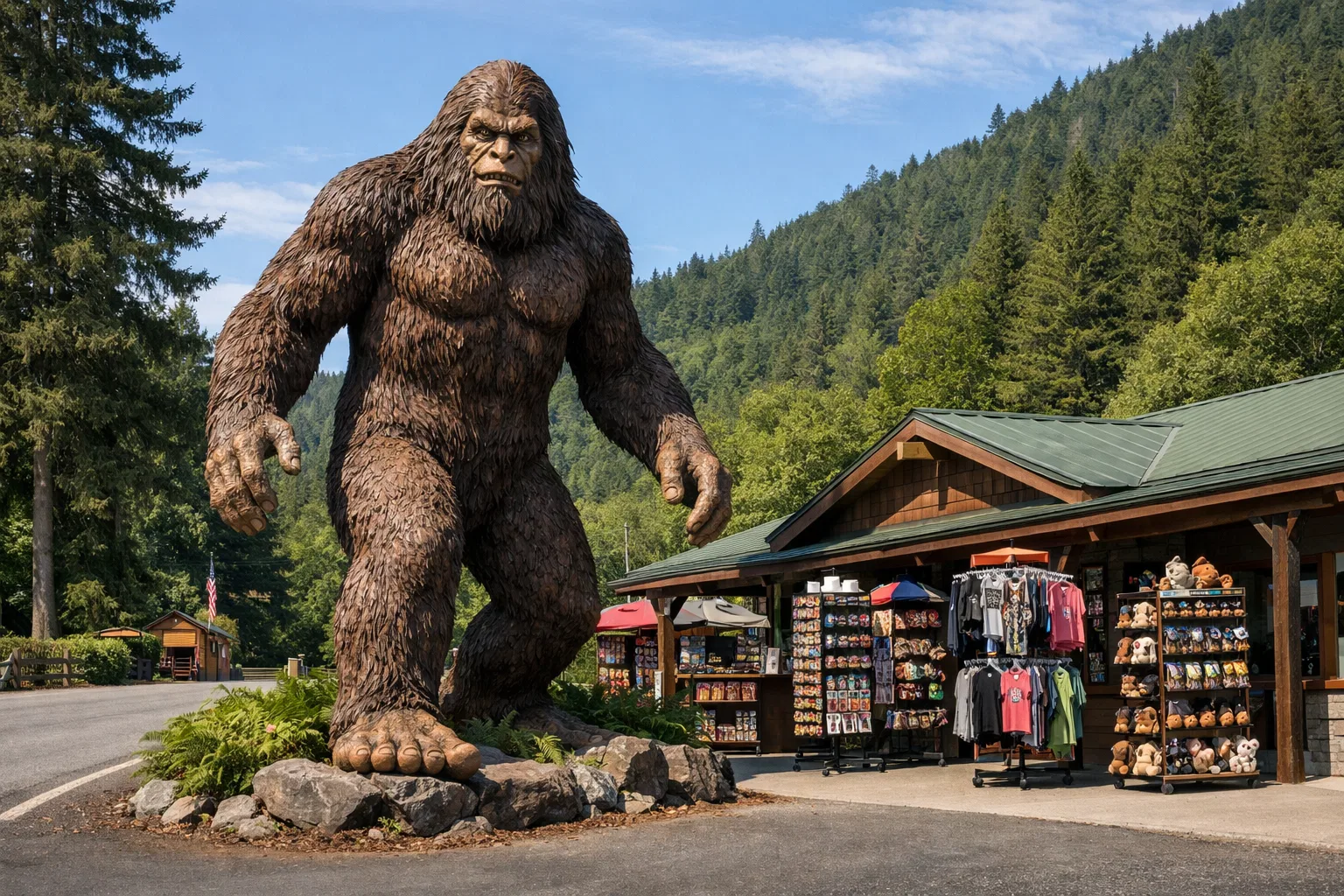
The tourist is rarely buying certainty. They are buying proximity to a mystery. Loch Ness visitors can look across dark water, visit exhibitions, take cruises and photograph “Nessie” signs without needing a confirmed animal beneath the surface. Point Pleasant visitors can stand beside the Mothman statue, visit the museum, walk Main Street during festival weekend and feel they have entered the geography of the legend. In Willow Creek, California, Bigfoot is attached to forest roads, footprint casts, murals, museums and the surrounding “Bigfoot Country” identity. The journey gives the story a physical setting. visitredwoods.com+3Visit Inverness Loch Ness+3mothmanmuseum.com[visitinvernesslochness.com]visitinvernesslochness.comOpen source on visitinvernesslochness.com.
This also makes cryptid tourism unusually flexible. It can appeal to believers, sceptics, families, horror fans, folklorists, hikers, road-trippers and collectors of odd attractions. A visitor can treat the creature as a possible animal, a campfire story, a joke, a piece of local history or a symbol of regional weirdness. That broad range of acceptable attitudes helps towns avoid forcing a single belief position. The local economy can say “come and see the mystery” rather than “you must accept the claim”.
Scholars of folklore and tourism describe this kind of attraction as part of a wider pattern in which myths, legends and place stories are used for destination storytelling, product development and cultural differentiation. The cryptid version is especially vivid because the “character” is simple, memorable and easy to reproduce on signs, shirts, statues, trails, festivals and museum displays.[ePrints Soton]eprints.soton.ac.uke Prints Soton Leveraging folklore and fantasy to promote small destinationse Prints Soton Leveraging folklore and fantasy to promote small destinations
Lake and forest monster economies
The strongest cryptid tourism economies are usually built around landscapes that already invite imagination: deep lakes, dense forests, mountains, swamps, old industrial sites and remote roads. The creature gives these landscapes a narrative hook. The landscape gives the creature plausibility, atmosphere and a reason to visit.
Loch Ness is the classic lake-monster economy. The loch was already scenic and historically rich, but the Nessie story added a globally recognisable reason to travel there. Tourism around the loch includes cruises, visitor centres, gift shops, exhibitions, accommodation, restaurants and nearby heritage sites. A widely reported 2018 estimate by Gary Campbell, keeper of the Official Loch Ness Monster Sightings Register, put the monster’s annual value to the Scottish economy at nearly £41 million, although such figures should be read as tourism-impact estimates rather than precise proof that every pound is caused by the creature alone.[Press and Journal]pressandjournal.co.ukloch ness monster worth nearly 41m a year to scottish economyloch ness monster worth nearly 41m a year to scottish economy
Souvenirs, museums and festivals turn sightings into civic infrastructure
A cryptid becomes a tourist icon when the story is made easy to encounter. Sightings and rumours are fleeting; statues, museums, festivals and merchandise make the legend repeatable. They give visitors a route, a photograph, a purchase and a date on the calendar.
Point Pleasant, West Virginia, is one of the clearest examples. Mothman sightings were reported around the area in the 1960s, but the town’s current identity depends on later infrastructure: the Mothman Museum, the annual Mothman Festival, Main Street events, tours, food vendors, speakers, retail and a prominent statue. The festival’s official site describes it as an annual event held on the third weekend of September to commemorate the 1966 Point Pleasant sighting, drawing people from around the world to celebrate the red-eyed winged legend.[MOTHMAN FESTIVAL®+2mothmanmuseum.com]mothmanfestival.comMOTHMAN FESTIVAL®MOTHMAN FESTIVAL®MOTHMAN FESTIVAL®MOTHMAN FESTIVAL®
That infrastructure changes the social meaning of the creature. A frightening report becomes a civic emblem. The Smithsonian Center for Folklife and Cultural Heritage notes that Mothman’s modern popularity has promoted “pride of place” in Point Pleasant, while an academic discussion of North American cryptids argues that legendary monsters can carry important community meanings even when their physical existence remains unproven.[Smithsonian Folklife Center]folklife.si.edumothman point pleasant west virginiaSmithsonian Folklife CenterAn Ode to a Hometown Creature: Mothman of Point Pleasant…6 Jun 2021 — The creature has risen from local app…
The festival model is powerful because it turns a place-based legend into a recurring economic and social ritual. People do not only visit a museum once; they return for an annual gathering. They meet other fans, hear speakers, buy themed goods, post images, and help circulate the destination online. Reported attendance and economic estimates vary by source and year, but local and media accounts consistently describe the Mothman Festival as a major tourism draw for a small river town, with Business Insider citing a Main Street Point Pleasant estimate of about $2 million in annual economic impact.[Business Insider]businessinsider.comBusiness Insider The creepiest urban legend from every stateThe article also shows how these legends impact local culture and economies. Point Pleasant, West Virginia, for example, hosts an annual…
Souvenirs are not trivial in this system. They are how visitors carry the local monster home. A T-shirt, mug, sticker, footprint cast, plush toy or museum ticket turns a contested sighting into a shareable object. The souvenir also softens belief. A person can buy a Mothman shirt without claiming Mothman is biologically real; the purchase says “I visited this place, I enjoyed this story, I am part of the joke or mystery.”
Museums perform a slightly different role. They give the legend an archive. The Mothman Museum advertises itself as a physical place in the heart of Point Pleasant, open most days, where visitors come from around the world. The Willow Creek museum presents Bigfoot materials alongside local heritage. ECHO’s Champ exhibition uses a large sculpture, historical records and real-world animal comparisons to make a lake monster legible inside a science-centre setting. These sites do not all make the same claim about evidence, but they all organise the story into something visitors can move through.[mothmanmuseum.com+2thebigfootmuseum.com]mothmanmuseum.comOpen source on mothmanmuseum.com.
When belief becomes regional branding
Cryptid branding is strongest when the monster becomes shorthand for the whole place. “Nessie” means Loch Ness. “Mothman” means Point Pleasant. “Bigfoot Country” points to forests in northern California and the Pacific Northwest, even though Bigfoot stories circulate much more widely. “Champ” gives Lake Champlain a mascot that is playful enough for tourism but mysterious enough to remain distinctive.
This kind of branding works because it compresses geography, atmosphere and identity into a single figure. A town does not need to explain its entire history in one roadside sign; it can show a winged red-eyed creature or a hairy forest giant and immediately become memorable. That simplicity is useful for small destinations competing for attention against better-funded cities and national attractions.
But local monster branding is not only external marketing. It also creates an internal identity. Residents may disagree about whether the creature exists, yet still recognise its usefulness as a shared symbol. A monster can become a local joke, a protective emblem, a school mascot-style figure, a festival theme, a business name, or a reason to restore and animate a downtown. In that sense, belief becomes less important than participation.
The best monster brands leave room for doubt
A successful cryptid destination usually avoids resolving the mystery too aggressively. If officials insist too strongly that the creature is real, the brand risks looking gullible or deceptive. If they dismiss the story too harshly, they drain away the fun. The durable middle ground is playful ambiguity: “legend”, “mystery”, “sighting”, “search”, “America’s lake monster”, “Bigfoot Country”.
This ambiguity lets different audiences enjoy the same place. Believers can treat the trip as pilgrimage. Sceptics can treat it as folklore tourism. Families can treat it as a quirky day out. Researchers can study the legend as community narrative. Local businesses can sell the image without taking a formal scientific position.
That middle ground is visible in how attractions present themselves. ECHO’s Champ exhibition combines a spectacular lake-monster sculpture with historical records and real-world science. The Mothman Festival invites visitors to celebrate a legend rather than prove a species. Visit North Carolina’s WNC Bigfoot Festival listing mixes playful language with references to researchers and investigators. These approaches give believers enough seriousness and casual visitors enough entertainment. ECHO, Leahy Center for Lake Champlain+2MOTHMAN FESTIVAL®[echovermont.org]echovermont.orgOpen source on echovermont.org.
The same ambiguity protects local identity from becoming brittle. A place-brand built entirely on proof can collapse if evidence fails. A place-brand built on story can survive debunking, jokes and sceptical documentaries because the attraction has shifted from “this creature is definitely real” to “this is our legend, and it is worth experiencing here”.
The risks of turning monsters into merchandise
Cryptid tourism can bring attention and money to smaller communities, but it also creates tensions. The first is over-commercialisation. A legend that once belonged to local oral tradition can become flattened into a logo, reducing complex history into a marketable cartoon. Folklore tourism researchers warn that using local stories for destination marketing raises questions about balancing economic, socio-cultural and environmental value.[RGU Repository]rgu-repository.worktribe.comOpen source on worktribe.com.
The second tension is tragedy. Mothman tourism has to coexist with the memory of the Silver Bridge collapse, which killed 46 people in December 1967 and later became entangled with Mothman narratives through books, film and popular retellings. Responsible tourism has to avoid turning community trauma into mere spooky decoration. Point Pleasant’s modern Mothman identity works best when it recognises the difference between commemorating a legend and exploiting a disaster.[Southern Living]southernliving.comOpen source on southernliving.com.
The third tension is environmental pressure. Lake and forest monster tourism depends on landscapes that can be damaged by overcrowding, poor visitor behaviour or badly planned development. Loch Ness tourism, for example, is tied to scenery, water, heritage and the wider Highland experience; the monster brand depends on the loch still feeling like a place where mystery could belong. If the setting is degraded, the legend loses force as well as beauty.
The fourth tension is cultural ownership. Some creatures marketed as cryptids overlap with Indigenous, regional or community traditions that were not created for tourist consumption. Bigfoot and Sasquatch traditions, in particular, are often discussed in relation to Indigenous stories as well as modern popular culture. A tourism campaign that treats every monster only as a novelty risks ignoring the communities for whom related beings or stories may carry deeper meaning.[mil.wa.gov]mil.wa.govOpen source on wa.gov.
These risks do not mean local monster tourism is inherently exploitative. They mean implementation matters. The strongest versions tend to combine economic benefit with local control, humour with respect, and visitor entertainment with some form of historical or cultural interpretation.
What cryptid tourism reveals about cryptozoology
Cryptid tourism shows that cryptozoology has two lives. One is evidential: the search for proof of an unknown animal. The other is cultural: the way reported creatures shape communities, landscapes and economies even when proof never arrives. Tourism belongs mostly to the second life.
That distinction helps explain why scepticism does not kill cryptid destinations. A scientist may reject the evidence for a lake monster, but a visitor can still enjoy the lake-monster economy as folklore, performance and place-making. A local resident may not believe in Bigfoot, but still value the festival that fills downtown. A museum may present sightings without claiming that the case is closed. The creature remains unresolved, but the social effects are observable.
For towns and regions, the practical lesson is that a cryptid is most valuable when it becomes more than a claim. It needs a landscape, a story, a calendar, a public symbol, visitor-friendly interpretation, local business participation and enough ambiguity for different audiences to feel welcome. Loch Ness has the lake and the global myth. Point Pleasant has the festival, museum and statue. Willow Creek has forest identity and Bigfoot heritage. Lake Champlain has Champ as a cross-border lake mascot with museum-scale interpretation.
The monster may never be found. The town, however, can still become known.
Amazon book picks
Further Reading
Books and field guides related to How Local Monsters Become Tourist Icons. Use these as the next step if you want deeper reading beyond the article.
The Mothman Prophecies
Rating: 4.5/5 from 6 Google Books ratings
Shows how a local monster story became a destination draw.
In Search of Lake Monsters
Covers legendary creatures linked to tourism-focused lakes.
eBay marketplace picks
Marketplace Samples
Live-tested eBay searches with available results related to this page.
Endnotes
1.
Source: mdpi.com
Link:https://www.mdpi.com/2076-0787/13/1/1
2.
Source: mothmanmuseum.com
Link:https://www.mothmanmuseum.com/
3.
Source: thebigfootmuseum.com
Link:https://thebigfootmuseum.com/
4.
Source: visitredwoods.com
Title: China Flat Museum
Link:https://www.visitredwoods.com/listing/china-flat-museum-bigfoot/117/
5.
Source: thebigfootmuseum.com
Link:https://thebigfootmuseum.com/mystery.html
6.
Source: sfgate.com
Title: California takes steps toward officially recognizing Bigfoot
Link:https://www.sfgate.com/northcoast/article/california-takes-steps-toward-officially-20175812.php
7.
Source: mil.wa.gov
Link:https://mil.wa.gov/the-legend-of-bigfoot
8.
Source: nature.scot
Link:https://www.nature.scot/sites/default/files/2019-07/Publication%202010%20-%20SNH%20Commissioned%20Report%20398%20-%20Assessing%20the%20economic%20impacts%20of%20nature%20based%20tourism%20in%20Scotland.pdf
9.
Source: gov.scot
Link:https://www.gov.scot/binaries/content/documents/govscot/publications/research-and-analysis/2018/04/tourism-scotland-economic-contribution-sector/documents/00534505-pdf/00534505-pdf/govscot%3Adocument/00534505.pdf
10.
Source: gov.scot
Link:https://www.gov.scot/policies/tourism-and-events/
11.
Source: mdpi.com
Link:https://www.mdpi.com/2071-1050/14/3/1165
12.
Source: youtube.com
Title: The Mothman Festival: A Guide for the Hopelessly Superstitious
Link:https://www.youtube.com/watch?v=EFJa73BXdgI
13.
Source: youtube.com
Link:https://www.youtube.com/watch?v=BPYP64n0KHg
14.
Source: folklife.si.edu
Title: mothman point pleasant west virginia
Link:https://folklife.si.edu/magazine/mothman-point-pleasant-west-virginia
15.
Source: visitinvernesslochness.com
Link:https://www.visitinvernesslochness.com/
16.
Source: eprints.soton.ac.uk
Title: e Prints Soton Leveraging folklore and fantasy to promote small destinations
Link:https://eprints.soton.ac.uk/495421/1/Leveraging_folklore_and_fantasy_to_promote_small_destinations_the_case_of_Visit_Wales.pdf
17.
Source: rgu-repository.worktribe.com
Link:https://rgu-repository.worktribe.com/OutputFile/1854574
18.
Source: pressandjournal.co.uk
Title: loch ness monster worth nearly 41m a year to scottish economy
Link:https://www.pressandjournal.co.uk/fp/news/highlands-islands/1562103/loch-ness-monster-worth-nearly-41m-a-year-to-scottish-economy/
19.
Source: visitinvernesslochness.com
Link:https://www.visitinvernesslochness.com/about-viln
20.
Source: visitnc.com
Link:https://www.visitnc.com/events/wnc-bigfoot-festival
21.
Source: lakechamplainregion.com
Link:https://www.lakechamplainregion.com/heritage/champ
22.
Source: echovermont.org
Link:https://www.echovermont.org/animals-exhibits/champ-americas-lake-monster/
23.
Source: mothmanfestival.com
Title: MOTHMAN FESTIVAL®MOTHMAN FESTIVAL®
Link:https://www.mothmanfestival.com/
24.
Source: businessinsider.com
Title: Business Insider The creepiest urban legend from every state
Link:https://www.businessinsider.com/urban-legends-from-every-us-state
25.
Source: southernliving.com
Link:https://www.southernliving.com/culture/the-mothman-legend-west-virginia
26.
Source: Wikipedia
Link:https://en.wikipedia.org/wiki/Bigfoot
27.
Source: rke.abertay.ac.uk
Link:https://rke.abertay.ac.uk/en/publications/of-monsters-myths-and-marketing-the-case-of-the-loch-ness-monster
28.
Source: facebook.com
Link:https://www.facebook.com/mothmanfestival/
29.
Source: ebsco.com
Link:https://www.ebsco.com/research-starters/social-sciences-and-humanities/mothman
30.
Source: tripadvisor.com
Title: Mothman Museum
Link:https://www.tripadvisor.com/Attraction_Review-g59426-d621279-Reviews-or10-Mothman_Museum-Point_Pleasant_West_Virginia.html
31.
Source: tripadvisor.com
Title: The Bigfoot Museum
Link:https://www.tripadvisor.com/Attraction_Review-g33274-d27078070-Reviews-The_Bigfoot_Museum-Willow_Creek_Humboldt_County_California.html
32.
Source: rgu-repository.worktribe.com
Link:https://rgu-repository.worktribe.com/output/966825/the-folklore-centric-gaze-a-relational-approach-to-landscape-folklore-and-tourism
33.
Source: Wikipedia
Title: Mothman Festival
Link:https://en.wikipedia.org/wiki/Mothman_Festival
34.
Source: visitinvernesslochness.com
Link:https://www.visitinvernesslochness.com/sites/default/files/2020-11/Uniqueness-Tourism-BID-Business-Plan.pdf
35.
Source: scotlandstowns.org
Link:https://scotlandstowns.org/swmsc-portfolio/visit-inverness-loch-ness-growing-tourism-in-a-sustainable-way/
36.
Source: fallout.fandom.com
Title: Mothman Museum
Link:https://fallout.fandom.com/wiki/Mothman_Museum
37.
Source: cryptozoologycryptids.fandom.com
Link:https://cryptozoologycryptids.fandom.com/wiki/Mothman
38.
Source: revista.domhelder.edu.br
Link:https://revista.domhelder.edu.br/index.php/veredas/article/view/5274
39.
Source: mothmanfestival.com
Link:https://www.mothmanfestival.com/faq.html
40.
Source: romanticasheville.com
Title: bigfoot festival
Link:https://www.romanticasheville.com/bigfoot-festival
41.
Source: visithuntingtonwv.org
Title: mothman festival 2026
Link:https://visithuntingtonwv.org/event/mothman-festival-2026/
Additional References
42.
Source: youtube.com
Link:https://www.youtube.com/watch?v=n1gM2Eu6FHA
43.
Source: repository.lsu.edu
Title: gradschool dissertations
Link:https://repository.lsu.edu/gradschool_dissertations/5566/
44.
Source: youtube.com
Title: The Wind in the Willow Creek: The Bigfoot Daze of Summer
Link:https://www.youtube.com/watch?v=JQX7QaRNgMo
45.
Source: researchgate.net
Link:https://www.researchgate.net/publication/388929728_The_Role_of_Local_Wisdom_Tourism_Attractions_in_Preserving_Legendary_Stories_Strategies_to_Support_Sustainable_Development_Goals_SDGS
46.
Source: clickondetroit.com
Link:https://www.clickondetroit.com/news/local/2026/06/30/a-man-claims-after-dna-testing-the-bigfoot-body-he-found-is-58-neandertal-and-41-human/
47.
Source: appalachianghostwalks.com
Link:https://www.appalachianghostwalks.com/travel-partners/marion-bigfoot-festival.html
48.
Source: foxnews.com
Link:https://www.foxnews.com/outkick-culture/bigfoot-neanderthal-human-hybrid-man-claims-found-remains
49.
Source: facebook.com
Link:https://www.facebook.com/NYLegalHistory/posts/beware-of-watery-monsters-this-halloweennestled-between-new-york-and-vermont-lak/946886884152318/
50.
Source: medium.com
Link:https://medium.com/%40seth_70987/chasing-legends-how-bigfoot-and-cryptid-tourism-are-quietly-driving-local-economies-319b2d4ea2e5
51.
Source: facebook.com
Link:https://www.facebook.com/UNBC/posts/critically-examining-cryptidsa-fourth-year-first-nations-studies-class-spent-the/1288540426641980/
Topic Tree