Within Populations
How Many Monsters Would There Need To Be?
Breeding-population thresholds show why long-lived cryptids cannot be explained by imagining one lonely survivor.
On this page
- Why breeding populations need more than one animal
- Effective breeders versus visible animals
- What viability thresholds mean for cryptid claims
Page outline Jump by section
Introduction
Claims about hidden animals often focus on a dramatic sighting: a large ape glimpsed in a forest, a lake monster surfacing briefly, or a prehistoric survivor seen by a handful of witnesses. Conservation biology asks a different question. If such creatures are real, how many of them would need to exist for the population to survive across generations? The answer is almost never “one”. Long-term persistence requires a breeding population large enough to reproduce, maintain genetic diversity, and withstand disease, accidents, environmental change, and simple bad luck. That requirement creates one of the strongest ecological challenges for many cryptid claims. A cryptid that has supposedly existed for centuries or millennia is not a single hidden animal; it is a hidden population. The larger and longer-lived the proposed species, the more demanding that population requirement becomes.[USFS Research & Development+2PubMed]research.fs.usda.govan Ne…Read more…
How Many Monsters Would There Need To Be?
The conservation concept most relevant to cryptozoology is the minimum viable population (MVP): the smallest population likely to persist over the long term without sliding into extinction. MVP is not a single universal number because species differ in lifespan, breeding patterns, mortality rates, and ecology. Nevertheless, conservation research consistently shows that persistence requires substantially more animals than casual intuition suggests.[USFS Research & Development+2Springer]research.fs.usda.govan Ne…Read more…
Historically, conservation biologists often referred to the “50/500 rule”, which proposed an effective population size of about 50 breeders to reduce short-term inbreeding problems and around 500 to preserve longer-term evolutionary potential. Subsequent research has argued that these figures may be too low and that values closer to 100 and 1,000 effective breeders may be more appropriate in many circumstances. The direction of the debate is important: scientists have generally argued for larger viable populations, not smaller ones.[Research @ Flinders+3PubMed+3library.iucn-isg.org]pubmed.ncbi.nlm.nih.govHow does the 50/500 rule apply to MVPs?by IG Jamieson · 2012 · Cited by 529 — The 50/500 rule has been used as a guiding principle…
For cryptid claims, this means that a population surviving undetected for centuries would likely require dozens, hundreds, or even thousands of individuals depending on the species involved. The burden is therefore not merely to explain one unexplained observation but to explain the existence of a sustained population.
Why Breeding Populations Need More Than One Animal
A solitary survivor is biologically irrelevant from a population perspective. Even if a witness genuinely observed a strange animal, that observation would not establish the existence of a continuing species unless reproduction were occurring.
Several processes make tiny populations vulnerable:<div class="content-enhancement content-enhancement--insight-grid" markdown="1">
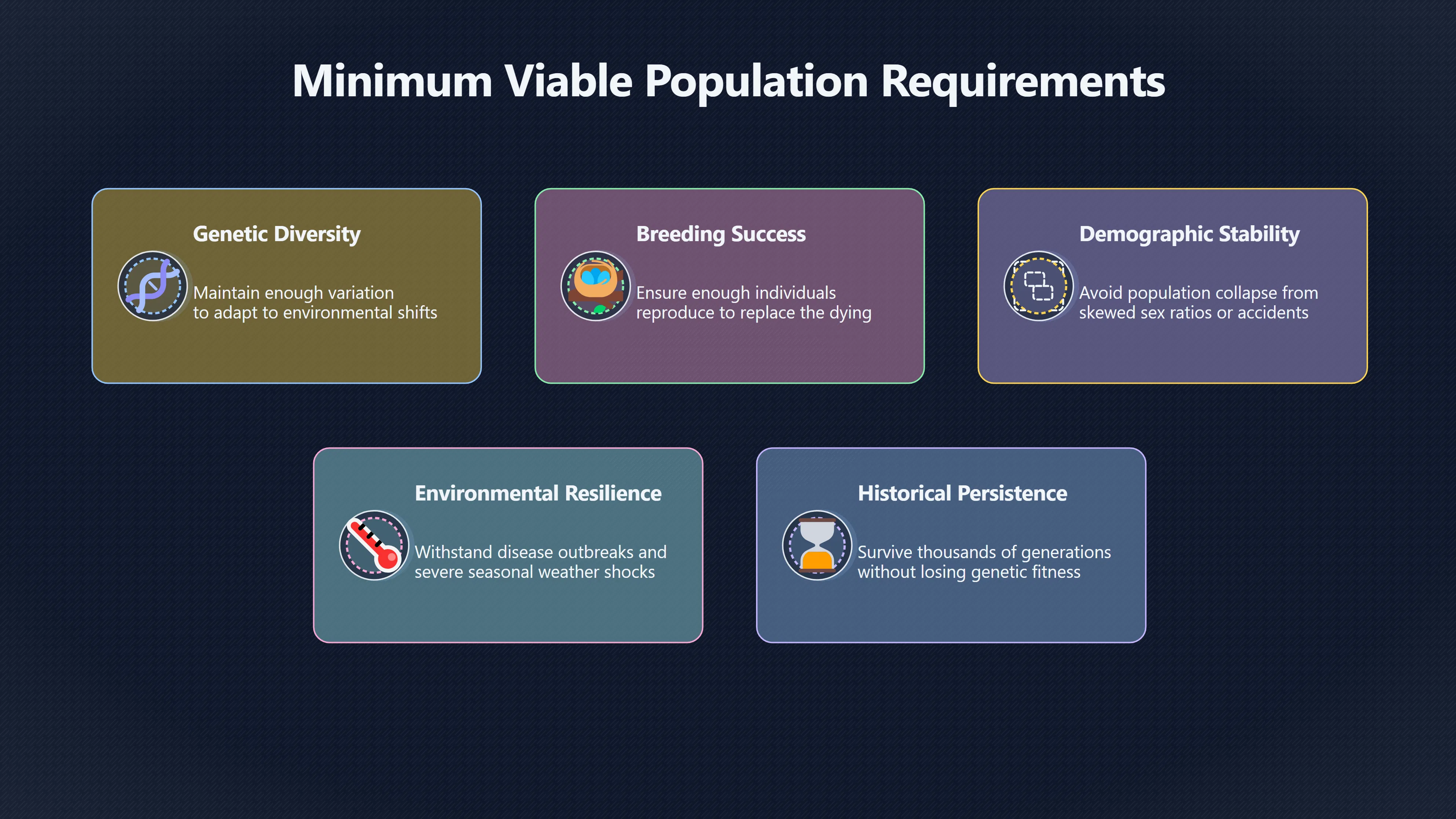
- Inbreeding depression: close relatives breeding repeatedly can reduce fertility, survival, and overall fitness.
- Genetic drift: random loss of genetic variation limits a population’s ability to adapt.
- Demographic chance: a run of poor breeding years, skewed sex ratios, or accidental deaths can eliminate small populations.
- Environmental shocks: disease outbreaks, droughts, severe winters, or habitat changes affect small populations disproportionately.[Wikipedia+2PMC]WikipediaMinimum viable populationMinimum viable population</div>
These mechanisms matter because many cryptid narratives implicitly assume very small numbers. A handful of giant apes hidden across a continent or a few lake monsters occupying an isolated body of water would face exactly the demographic and genetic pressures that conservation biology identifies as extinction risks.[USFS Research & Development+2ConservationBytes.com]research.fs.usda.govan Ne…Read more…
The problem becomes more severe when claims involve ancient lineages. A species supposedly surviving from prehistoric times would need to have passed through thousands of generations while maintaining enough reproduction and genetic diversity to avoid collapse. The longer the proposed survival period, the less plausible an extremely small population becomes.
Effective Breeders Versus Visible Animals
One reason viability estimates can sound confusing is that conservation biologists distinguish between the total number of animals and the number that actually contribute genes to future generations.
This distinction is called effective population size (Ne). In real populations, not every adult breeds equally. Some individuals leave many offspring while others leave none. As a result, the effective population size is usually smaller than the total head count.[PMC+2Nature]pmc.ncbi.nlm.nih.govDealing With the Complexity of Effective Population Size in…by A Fedorca · 2024 · Cited by 30 — The effective size of a population…
For cryptid claims, this distinction creates an additional challenge. Suppose a hypothetical species required an effective population of several hundred breeders. The actual number of animals present in the environment could need to be substantially larger because juveniles, elderly animals, non-breeding adults, and unequal reproductive success all reduce effective population size relative to census size. Research on wildlife populations has long shown that effective populations are often only a fraction of the total population.[Cambridge University Press & Assessment+2PMC]cambridge.orgCambridge University Press & AssessmentEffective population size/adult population size ratios in…by R Frankham · 1995 · Cited by 2106…
This means that a viable population of a large cryptid might require not merely dozens of individuals but potentially hundreds or more visible animals spread across the landscape. Such numbers increase the likelihood of leaving tracks, carcasses, DNA, feeding signs, roadkills, photographs, or other forms of physical evidence.
What Viability Thresholds Mean for Cryptid Claims
The MVP concept does not prove that any specific cryptid is impossible. Conservation biology cannot determine the existence or non-existence of an unknown species solely from theoretical population requirements. What it does provide is a framework for evaluating plausibility.
For example, consider a hypothetical large primate resembling reported Bigfoot descriptions. To persist over centuries across North America, the species would require enough breeding individuals to maintain genetic diversity and replace deaths. The claim therefore implies an extensive population distributed across large areas, not a few isolated individuals occasionally seen by hikers. Such a population would be expected to interact repeatedly with the environment and leave recoverable biological traces.[USFS Research & Development+2library.iucn-isg.org]research.fs.usda.govan Ne…Read more…
The same logic applies to lake-monster traditions. A breeding population of large vertebrates occupying a confined aquatic ecosystem would need enough individuals to reproduce successfully over many generations. The ecological question becomes not simply whether a witness saw an unusual shape in the water, but whether the habitat could support a viable population and whether decades of observation should already have revealed stronger evidence.
Minimum viable population theory therefore shifts the discussion from individual sightings to population-level consequences. A cryptid capable of surviving for centuries must also be capable of sustaining reproduction, maintaining genetic diversity, surviving random setbacks, and leaving the ecological footprint expected of a real population. The more extraordinary the proposed species and the longer its alleged history, the more demanding those requirements become.[Macquarie University+3Wikipedia+3PubMed]WikipediaMinimum viable populationMinimum viable population
Amazon book picks
Further Reading
Books and field guides related to How Many Monsters Would There Need To Be?. Use these as the next step if you want deeper reading beyond the article.
A Primer of Conservation Biology
Introduces minimum viable populations and extinction risk.
The Beak of the Finch
Illustrates how real populations persist and evolve over generations.
Conservation and the Genetics of Populations
Explains population size, inbreeding, and long-term viability.
eBay marketplace picks
Marketplace Samples
Live-tested eBay searches with available results related to this page.




Endnotes
1.
Source: library.iucn-isg.org
Title: Frankham 2014 Biological Conservation
Link:https://library.iucn-isg.org/documents/2014/Frankham_2014_Biological_Conservation.pdf
2.
Source: link.springer.com
Link:https://link.springer.com/article/10.1007/s10531-022-02456-z
3.
Source: Wikipedia
Title: Minimum viable population
Link:https://en.wikipedia.org/wiki/Minimum_viable_population
4.
Source: pmc.ncbi.nlm.nih.gov
Link:https://pmc.ncbi.nlm.nih.gov/articles/PMC11645448/
5.
Source: nature.com
Link:https://www.nature.com/articles/hdy201643
6.
Source: conservationbytes.com
Title: brook et al 2006 ecol lett
Link:https://conservationbytes.com/wp-content/uploads/2014/12/brook-et-al-2006-ecol-lett.pdf
7.
Source: cambridge.org
Link:https://www.cambridge.org/core/journals/genetics-research/article/effective-population-sizeadult-population-size-ratios-in-wildlife-a-review/59D48CF3CCD19ECE47163795F6EEA89E
8.
Source: pmc.ncbi.nlm.nih.gov
Title: PMCEffective/census population size ratio estimation
Link:https://pmc.ncbi.nlm.nih.gov/articles/PMC3488685/
9.
Source: conservationbytes.com
Title: frankham et al 2014 biol conserv
Link:https://conservationbytes.com/wp-content/uploads/2016/06/frankham-et-al-2014-biol-conserv.pdf
10.
Source: conservationbytes.com
Title: were sorry but 50500 is still too few
Link:https://conservationbytes.com/2014/01/28/were-sorry-but-50500-is-still-too-few/
11.
Source: conservationbytes.com
Title: 50500 or 1001000 debate not about time frame
Link:https://conservationbytes.com/2014/06/26/50500-or-1001000-debate-not-about-time-frame/
12.
Source: Wikipedia
Link:https://en.wikipedia.org/wiki/50_%28number%29
13.
Source: Wikipedia
Title: David Frankham
Link:https://en.wikipedia.org/wiki/David_Frankham
14.
Source: research.fs.usda.gov
Link:https://research.fs.usda.gov/treesearch/download/38156.pdf
15.
Source: pubmed.ncbi.nlm.nih.gov
Link:https://pubmed.ncbi.nlm.nih.gov/22868005/
16.
Source: research.fs.usda.gov
Link:https://research.fs.usda.gov/download/treesearch/38156.pdf
17.
Source: researchers.mq.edu.au
Title: genetics in conservation management revised recommendations for t
Link:https://researchers.mq.edu.au/en/publications/genetics-in-conservation-management-revised-recommendations-for-t/
18.
Source: researchnow.flinders.edu.au
Title: 50500 rules need upward revision to 1001000 response to franklin
Link:https://researchnow.flinders.edu.au/en/publications/50500-rules-need-upward-revision-to-1001000-response-to-franklin-/
19.
Source: pmc.ncbi.nlm.nih.gov
Link:https://pmc.ncbi.nlm.nih.gov/articles/PMC12811847/
20.
Source: pubmed.ncbi.nlm.nih.gov
Link:https://pubmed.ncbi.nlm.nih.gov/38613250/
21.
Source: pmc.ncbi.nlm.nih.gov
Link:https://pmc.ncbi.nlm.nih.gov/articles/PMC11496246/
22.
Source: find-and-update.company-information.service.gov.uk
Title: company-information.service.gov.ukfrankham consultancy group limited
Link:https://find-and-update.company-information.service.gov.uk/company/04409614
Additional References
23.
Source: fao.org
Link:https://www.fao.org/4/AD013E/AD013E04.htm
24.
Source: researchgate.net
Link:https://www.researchgate.net/publication/262678230_50500_or_1001000_Reconciling_short-_and_long-term_recovery_targets_and_MVPs
25.
Source: youtube.com
Link:https://www.youtube.com/watch?v=ysV8-8bmXgw
26.
Source: frankham.com
Title: We deliver expert compliance, engineering, surveying & design services
Link:https://www.frankham.com/
27.
Source: reddit.com
Link:https://www.reddit.com/r/evolution/comments/u0nwd8/what_is_the_minimum_breeding_population_needed/
28.
Source: researchgate.net
Link:https://www.researchgate.net/publication/250191645_Minimum_Sizes_for_Viable_Population_and_Conservation_Biology
29.
Source: instituteofcaninebiology.org
Title: why you should care about effective population size
Link:https://www.instituteofcaninebiology.org/blog/why-you-should-care-about-effective-population-size
30.
Source: ldc.co.uk
Title: frankham partners with ldc for next phase of growth
Link:https://www.ldc.co.uk/news/frankham-partners-with-ldc-for-next-phase-of-growth/
31.
Source: reddit.com
Link:https://www.reddit.com/r/biology/comments/g86ys0/what_is_the_minimum_population_of_humans_needed/
Topic Tree