Within Cryptozoology
Why Sea Serpent Stories Keep Returning
Sea serpent reports show why the ocean invites monster stories, but sightings still need biological proof.
On this page
- Classic sea monster reports
- Known animals that can look strange at sea
- What proof an ocean cryptid would need
Page outline Jump by section
Introduction
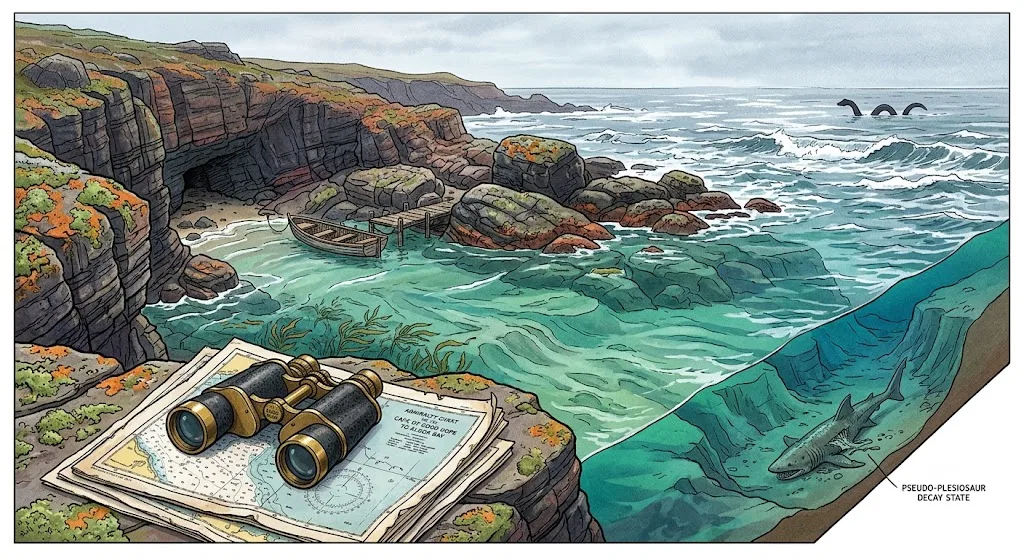
Sea serpent stories keep returning because the ocean gives them ideal conditions: distance, glare, waves, brief sightings, unfamiliar animals, and carcasses altered by decay. In cryptozoology, they are among the oldest and most persistent “maybe animals”, linking sailors’ folklore with genuine marine mystery. The most balanced answer is not that every sighting is nonsense, nor that a hidden giant reptile is likely. It is that sea serpent reports are a useful test case for cryptozoology: dramatic eyewitness claims can be culturally durable while still falling short of biological proof.
The ocean really does contain large, rarely seen animals. Giant squid, oarfish, basking sharks and other deep-water or pelagic species have all fed sea-monster traditions, and some were poorly understood until modern photography, specimen study and deep-sea observation improved the evidence. But a new ocean cryptid would need more than a vivid sighting. It would need a recoverable body, tissue, DNA, diagnostic photographs or video, and enough repeated evidence to show a real population rather than a one-off misidentification. NOAA notes that only 28.7% of the global seafloor had been mapped with modern high-resolution technology by April 2026, and only a fraction of the ocean has been visually surveyed; that leaves room for discovery, but not for lowering the standard of proof.[NOAA Ocean Exploration]oceanexplorer.noaa.govNOAA Ocean ExplorationHow much of the ocean has been explored?As of April 2026, 28.7% of the global seafloor had been mapped with modern…
Why the sea is so good at making monsters
A sea serpent sighting often begins with a simple problem: someone sees something large, distant and partly submerged, then has to describe it using familiar categories. A row of porpoises can become humps. A basking shark at the surface can become a “monster”. An oarfish can look like a silver ribbon with a red crest. A rotting carcass can lose the features that would identify it and keep the parts that look most monstrous.
That does not make witnesses dishonest. Many classic reports came from sailors, fishermen or coastal residents who were experienced at sea. The difficulty is that maritime experience does not guarantee zoological identification under poor viewing conditions. The Library of Congress, discussing the “Great American Sea Serpent”, notes that nineteenth-century observers often inherited older assumptions that sea serpents were dangerous, reptilian monsters, and those assumptions shaped how sightings were described and debated.[The Library of Congress]blogs.loc.govgreat american sea serpentThe Library of CongressThe Great American Sea Serpent | Folklife Today8 Aug 2016 — Sea serpents were seen as monsters that could attack s…
The ocean also preserves mystery better than land. A strange animal seen on a road may leave tracks, fur, dung or camera footage. A strange animal seen from a ship may leave only a short written account. Even when a carcass appears, the sea can distort it quickly. Sharks, whales and large fish decay in ways that produce misleading shapes, and the specimen may be discarded before specialists can examine it. That pattern recurs through sea serpent history.
Classic reports that shaped the tradition
The Gloucester sea serpent: mass sightings and a scientific overreach
The Gloucester or Cape Ann sea serpent is one of the most important North American cases because it was not just a tavern tale. In 1817, reports from Gloucester, Massachusetts, became serious enough that the Linnaean Society of New England investigated them. Its committee published a report on a large marine animal “supposed to be a serpent” seen near Cape Ann, and the society concluded that the creature represented a new species, naming it Scoliophis atlanticus.[Internet Archive]archive.orgInternet ArchiveLinnaean Society of New England: Free Download…18 Aug 2015 — Report of a committee of the Linnaean Society of New Eng…
That decision is revealing. It shows how early naturalists could treat eyewitness testimony as potentially scientific, especially when reports were numerous and came from people considered credible. But it also shows the danger of naming a species from observation rather than a specimen. The Gloucester creature had no body, no bones, no preserved tissue and no diagnostic anatomical description that could be independently checked.
Modern explanations vary. Sceptical investigator Joe Nickell argued that the Gloucester reports may have involved narwhals, with unfamiliar animals seen as a single multi-humped serpent, especially because some accounts mentioned a horn-like projection. His explanation is not universally accepted, but it illustrates the kind of comparative reasoning sea serpent cases demand: start with the details in the reports, then ask whether known animals, viewing conditions or group movement could create the described impression.[Skeptical Inquirer]skepticalinquirer.orgSkeptical Inquirer Gloucester Sea-Serpent Mystery: Solved after Two CenturiesSkeptical Inquirer Gloucester Sea-Serpent Mystery: Solved after Two Centuries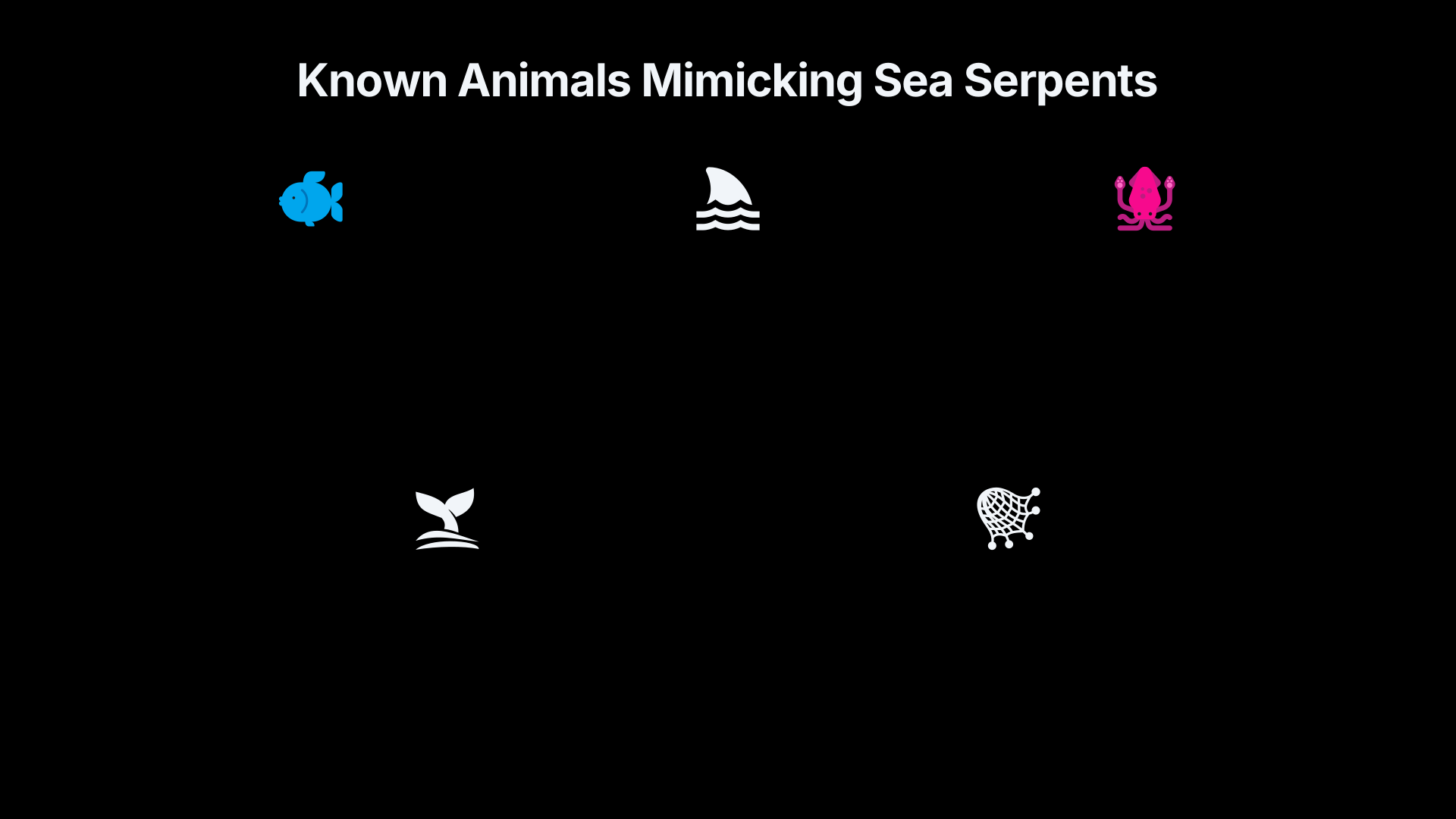
HMS Daedalus: a naval sighting with lasting influence
In 1848, the crew of HMS Daedalus reported a large serpent-like creature while sailing near the Cape of Good Hope. The sighting became famous because it involved Royal Navy officers, an official report and published illustrations in the illustrated press. The case became a credibility battle: if trained naval observers reported a huge unknown animal, many readers felt the claim deserved more respect than ordinary folklore.[theappendix.net]theappendix.netwhere be monsters daedalus sea serpent and war for credibilitywhere be monsters daedalus sea serpent and war for credibility
The Daedalus case also shows why authority is not the same as proof. The crew’s status made the report hard to dismiss, but the evidence remained observational. Later analysts have proposed known-animal explanations, including a misidentified whale or other large marine creature seen in an unusual posture. The key point is not that one debunking theory ends the matter for everyone; it is that the case still lacks the biological evidence that would allow a new species to be described.[Skeptical Inquirer]skepticalinquirer.orgthe 1848 enormous serpent of the daedalus identifiedthe 1848 enormous serpent of the daedalus identified
Cadborosaurus: a regional sea serpent with a carcass problem
Cadborosaurus, often called “Caddy”, belongs to the sea serpent tradition of the Pacific coast of North America, especially British Columbia. Reports from the late nineteenth century onwards describe a long, serpentine animal, sometimes with a horse-like or camel-like head, humps, flippers or a tail. The name ties the creature to Cadboro Bay near Victoria, and the case has remained popular among cryptozoology enthusiasts.[Tetrapod Zoology]tetzoo.comcadborosaurus carcass reviewcadborosaurus carcass review
The strongest-looking part of the Cadborosaurus story is the 1937 Naden Harbour carcass, reportedly removed from the stomach of a sperm whale in Haida Gwaii. Only photographs remain, and samples disappeared or were discarded. Some cryptozoologists still argue that it represents an unknown animal. Many scientists and sceptical zoologists, however, consider a decomposing basking shark the more likely explanation, because shark carcasses can lose the structures that make them recognisable and come to resemble long-necked monsters.[The Guardian]theguardian.comExperts now believe the carcass was likely a decomposing basking shark, known to transform significantly during decay, often appearing as…
That unresolved specimen is a perfect example of why sea serpent claims often survive. The carcass was physical evidence, which is exactly what cryptozoology needs, but it was not preserved in a way that lets modern researchers test it. With no surviving tissue, no DNA and only ambiguous photographs, the case can remain culturally alive while biologically inconclusive.
Known animals that can look strange at sea
The best explanations for sea serpent reports do not require witnesses to be foolish. They require the ocean to show real animals in unfamiliar forms.
Oarfish are perhaps the most obvious candidate for some serpent-like sightings. The Natural History Museum describes the giant oarfish as the world’s longest bony fish, documented up to about eight metres, with a metallic body, horse-like face, red crest and a fin running along its length. NOAA has likewise described the giant oarfish as a deep-sea animal whose long, tapering body and striking fins have many of the features people imagine in a sea serpent.[Natural History Museum]nhm.ac.ukOpen source on nhm.ac.uk.
Giant squid are a reminder that some sea-monster traditions did have real animals behind them. For centuries, dead or partial squid helped feed tales of the kraken and other monsters. Smithsonian Ocean notes that the first photograph of a live giant squid in its natural habitat was taken only in 2004, despite the animal’s long-standing place in scientific and popular imagination. That is an important lesson for cryptozoology, but it cuts both ways: giant squid became accepted because specimens, photographs and anatomical study accumulated, not because the legend alone was persuasive.[Smithsonian Ocean]ocean.si.eduOpen source on si.edu.
Basking sharks are central to “sea monster carcass” cases. They are enormous filter-feeding sharks, and NOAA describes them as the second-largest shark in the ocean. When they decay, the gill region, lower jaw and fins can break down or detach, leaving a small-looking head, a long spine-like structure and paddle-like remains. This “pseudo-plesiosaur” effect has been invoked in cases from the Stronsay Beast to the Zuiyo Maru carcass and the Cadborosaurus debate.[videos.fisheries.noaa.gov+2The Guardian]videos.fisheries.noaa.govTagging Basking SharksTagging Basking Sharks
Whales, seals, dolphins and swimming groups of animals can also produce deceptive impressions. A line of surfacing animals may look like one long body with humps. A whale’s back, fin or wake can seem serpent-like if the head and tail are not visible. A seal seen head-on in rough water can appear oddly long-necked. These explanations are not glamorous, but they fit many brief sightings better than a large unknown reptile or eel.
Why carcasses become “prehistoric” so often
Some of the most dramatic ocean mystery claims begin not with a sighting but with a body. A carcass seems more compelling than testimony because it can, in principle, be examined. Yet many famous “sea monster” carcasses became mysterious precisely because they were incomplete, decayed or lost before proper study.
The Stronsay Beast, washed ashore in Orkney in 1808, was described as a 55-foot sea serpent with a mane and small limbs. It caused serious interest among naturalists, but later examination identified the remains as a decomposed basking shark. The case has recently returned to public attention through museum display, but its main scientific lesson remains the same: a large dead shark can look astonishingly unlike a shark after decay.[The Times]thetimes.comThe Times Scotland's 'real' Nessie? Orkney's forgotten sea monster emergesNow, the Stromness Museum has brought the Stronsay Beast back into public attention with a newly opened exhibition showcasing its preserv…
The Zuiyo Maru carcass, hauled up by a Japanese trawler near New Zealand in 1977, repeated the pattern in a modern setting. Photographs and measurements made it look, to some observers, like a surviving plesiosaur. Later analysis, including amino-acid evidence, pointed instead to a basking shark or close relative. The case became famous because it briefly seemed to offer the physical proof sea serpent claims had lacked, but it also showed how quickly a degraded carcass can mislead even serious observers.[Wikipedia]WikipediaZuiyo-maru carcassZuiyo-maru carcass
This is why physical evidence must be preserved, not merely photographed. A carcass can be tested for anatomy, tissue type, DNA, parasites, stomach contents and age. A photograph of a carcass, especially without scale, sampling records and chain of custody, is much weaker. It may keep a mystery alive, but it rarely resolves one.
The strongest argument for openness is not enough by itself
The honest pro-mystery argument is that the ocean is still under-explored. NOAA Ocean Exploration states that the ocean covers about 70% of Earth, that 90% of it is considered deep ocean, and that only slightly more than a quarter has been mapped at high resolution, with only a fraction visually surveyed. New marine species are still being documented, including through deep-sea expeditions and newer tools such as environmental DNA, which detects genetic material shed into water.[NOAA Ocean Exploration]oceanexplorer.noaa.govwhy exploration mattersNOAA Ocean ExplorationWhy Ocean Exploration Matters13 Aug 2024 — Yet only slightly more than a quarter of the ocean has been mapped at hi…
Large animals can also remain scientifically obscure for a long time. The megamouth shark, a large filter-feeding shark, was discovered only in 1976 after one became entangled in equipment off Hawaii. The Florida Museum notes that the species is so rarely encountered that scientists maintain a detailed list of known encounters. That kind of discovery is often used by cryptozoology supporters to argue that the sea can still surprise science — and on that narrow point, they are right.[Hawaii DLNR]dlnr.hawaii.govdiscovering megamouthdiscovering megamouth
But openness is not proof. A rarely seen shark discovered by accident does not make every sea serpent report probable. It shows that discovery is possible, while also showing what confirmation looks like: a specimen, expert examination, taxonomic description and later records. The ocean’s size explains why mysteries persist; it does not remove the need for evidence.
What proof an ocean cryptid would need
For a sea serpent claim to move from folklore or cryptozoology into zoology, the evidence would need to identify an animal, not just preserve a mystery. The standard would be high because the claim is large: a breeding population of big, unknown marine animals should leave repeated traces.
The most persuasive evidence would include:<div class="content-enhancement content-enhancement--checklist" markdown="1">
- A preserved body or diagnostic body parts, collected with clear location, date, depth and handling records.
- Tissue samples suitable for DNA testing, with contamination controls and independent replication.
- Clear photographs or video, ideally with scale, location data and multiple angles rather than a distant silhouette.
- Repeated records from the same region, such as strandings, eDNA signals, sonar, baited-camera footage or encounters consistent enough to suggest a population.
- Anatomical features that do not match known animals, assessed by qualified marine biologists, taxonomists and comparative anatomists.
- A plausible ecology, including food source, breeding habitat, range, population size and why the animal has avoided reliable detection.</div>
Environmental DNA is especially relevant because it can detect species without seeing the individual animal. NOAA describes eDNA as genetic material shed into the water through mucus, faeces or tissue particles, which can be collected and processed to reveal marine life. For a claimed sea serpent, repeated eDNA results matching no known species would be far more important than another anecdotal sighting — but even eDNA would need careful interpretation, database comparison and independent confirmation.[NOAA Ocean Exploration]oceanexplorer.noaa.govOpen source on noaa.gov.
Why sea serpent stories still matter
Sea serpent sightings matter less as evidence for a single hidden monster than as a long-running demonstration of how humans interpret the sea. They show how folklore, observation, fear, scientific curiosity and misidentification can merge into a durable cryptid tradition. They also show that scepticism does not have to mean mockery. Many reports probably began with real animals or real experiences.
The best sea serpent cases are valuable because they sit exactly at the boundary cryptozoology claims to occupy. The Gloucester serpent shows how eyewitness clusters can become overconfident taxonomy. HMS Daedalus shows how authority can make a sighting famous without making it biologically conclusive. Cadborosaurus shows how a lost specimen can keep a claim alive for generations. Oarfish, giant squid, basking sharks and megamouth sharks show that the sea contains animals strange enough to inspire monsters, but also that science confirms animals through specimens, images, DNA and repeated observation.
That is why sea serpent stories keep returning. The ocean remains vast, visually deceptive and biologically rich. It can still produce surprises. But a sea serpent, as a cryptid, remains unconfirmed until the evidence stops being merely strange and starts being testable.
Amazon book picks
Further Reading
Books and field guides related to Why Sea Serpent Stories Keep Returning. Use these as the next step if you want deeper reading beyond the article.
Abominable Science!
Explains why sea-serpent stories persist and how evidence is evaluated.
In the Wake of the Sea-serpents
Focused specifically on historical sea-serpent reports.
eBay marketplace picks
Marketplace Samples
Live-tested eBay searches with available results related to this page.

Endnotes
1.
Source: oceanexplorer.noaa.gov
Link:https://oceanexplorer.noaa.gov/ocean-fact/explored/
2.
Source: oceanexplorer.noaa.gov
Title: why exploration matters
Link:https://oceanexplorer.noaa.gov/why-exploration-matters/
3.
Source: archive.org
Link:https://archive.org/details/b22333393
4.
Source: theappendix.net
Title: where be monsters daedalus sea serpent and war for credibility
Link:https://theappendix.net/issues/2014/4/where-be-monsters-daedalus-sea-serpent-and-war-for-credibility
5.
Source: nla.gov.au
Link:https://nla.gov.au/nla.obj-133263257
6.
Source: Wikipedia
Link:https://en.wikipedia.org/wiki/Cadborosaurus
7.
Source: fisheries.noaa.gov
Title: giant oarfish
Link:https://www.fisheries.noaa.gov/podcast/giant-oarfish
8.
Source: videos.fisheries.noaa.gov
Title: Tagging Basking Sharks
Link:https://videos.fisheries.noaa.gov/detail/video/2581493796001/tagging-basking-sharks?autoStart=true&q=sharks
9.
Source: Wikipedia
Title: Zuiyo-maru carcass
Link:https://en.wikipedia.org/wiki/Zuiyo-maru_carcass
10.
Source: oceanexplorer.noaa.gov
Link:https://oceanexplorer.noaa.gov/technology/edna/
11.
Source: dlnr.hawaii.gov
Title: discovering megamouth
Link:https://dlnr.hawaii.gov/sharks/hawaii-sharks/discovering-megamouth/
12.
Source: oceanexplorer.noaa.gov
Link:https://oceanexplorer.noaa.gov/multimedia/video-playlist-ex2102-edna/
13.
Source: videos.fisheries.noaa.gov
Title: get to know your pacific islands threatened species: oceanic whitetip sharks
Link:https://videos.fisheries.noaa.gov/detail/videos/sharks-rays/video/6289819824001/get-to-know-your-pacific-islands-threatened-species%3A-oceanic-whitetip-sharks
14.
Source: fisheries.noaa.gov
Title: shark conservation
Link:https://www.fisheries.noaa.gov/international-affairs/shark-conservation
15.
Source: oceanexplorer.noaa.gov
Title: annual report 2024
Link:https://oceanexplorer.noaa.gov/wp-content/uploads/2025/06/annual-report-2024.pdf
16.
Source: oceanexplorer.noaa.gov
Title: expedition 2024 expeditions
Link:https://oceanexplorer.noaa.gov/expedition-2024-expeditions/
17.
Source: research.noaa.gov
Title: funded expedition captures rare footage of giant squid in the gulf of mexico
Link:https://research.noaa.gov/noaa-funded-expedition-captures-rare-footage-of-giant-squid-in-the-gulf-of-mexico/
18.
Source: fisheries.noaa.gov
Title: new kids block species discovered our scientists
Link:https://www.fisheries.noaa.gov/feature-story/new-kids-block-species-discovered-our-scientists
19.
Source: oceanexplorer.noaa.gov
Link:https://oceanexplorer.noaa.gov/news/tjalfiella/
20.
Source: Wikipedia
Title: Gloucester sea serpent
Link:https://en.wikipedia.org/wiki/Gloucester_sea_serpent
21.
Source: Wikipedia
Link:https://en.wikipedia.org/wiki/Oarfish
22.
Source: Wikipedia
Link:https://en.wikipedia.org/wiki/Kraken
23.
Source: Wikipedia
Title: Megamouth shark
Link:https://en.wikipedia.org/wiki/Megamouth_shark
24.
Source: cadborosaurus.ca
Link:https://www.cadborosaurus.ca/History-Facts.html
25.
Source: cadborosaurus.ca
Link:https://www.cadborosaurus.ca/Caddyscan.html
26.
Source: blogs.loc.gov
Title: great american sea serpent
Link:https://blogs.loc.gov/folklife/2016/08/great-american-sea-serpent/
27.
Source: skepticalinquirer.org
Title: Skeptical Inquirer Gloucester Sea-Serpent Mystery: Solved after Two Centuries
Link:https://skepticalinquirer.org/2019/09/gloucester-sea-serpent-mystery-solved-after-two-centuries/
28.
Source: skepticalinquirer.org
Title: the 1848 enormous serpent of the daedalus identified
Link:https://skepticalinquirer.org/2015/09/the-1848-enormous-serpent-of-the-daedalus-identified/
29.
Source: tetzoo.com
Title: cadborosaurus carcass review
Link:https://tetzoo.com/blog/2020/11/16/cadborosaurus-carcass-review
30.
Source: theguardian.com
Link:https://www.theguardian.com/environment/2026/may/07/basking-shark-sea-monster-canada-marine-mystery-90-years-on
31.
Source: nhm.ac.uk
Link:https://www.nhm.ac.uk/discover/sea-monsters-inspiration-serpents-mermaids-the-kraken.html
32.
Source: ocean.si.edu
Link:https://ocean.si.edu/ocean-life/invertebrates/giant-squid-baited-camera
33.
Source: ocean.si.edu
Title: Smithsonian Ocean How Big is the Giant Squid?
Link:https://ocean.si.edu/ocean-life/invertebrates/giant-squid
34.
Source: thetimes.com
Title: The Times Scotland’s’real’ Nessie? Orkney’s forgotten sea monster emerges
Link:https://www.thetimes.com/uk/scotland/article/orkneys-forgotten-sea-monster-stronsay-beast-g8ddqx37b
35.
Source: floridamuseum.ufl.edu
Title: megamouth shark
Link:https://www.floridamuseum.ufl.edu/discover-fish/species-profiles/megamouth-shark/
36.
Source: dfo-mpo.gc.ca
Title: Basking shark
Link:https://www.dfo-mpo.gc.ca/species-especes/profiles-profils/baskingshark-requinpelerin-atl-eng.html
37.
Source: youtube.com
Link:https://www.youtube.com/watch?v=ecH-fY7a5IQ
38.
Source: facebook.com
Link:https://www.facebook.com/groups/141086595460/posts/10168187096770461/
39.
Source: greydogtales.com
Title: sea serpent
Link:https://greydogtales.com/blog/tag/sea-serpent/
40.
Source: ocean.si.edu
Title: deep sea giant squid
Link:https://ocean.si.edu/ocean-life/invertebrates/deep-sea-giant-squid
41.
Source: ocean.si.edu
Title: stunning squid pictures
Link:https://ocean.si.edu/ocean-life/invertebrates/stunning-squid-pictures
42.
Source: historicipswich.net
Title: cape ann sea serpent
Link:https://historicipswich.net/2025/03/03/cape-ann-sea-serpent/
43.
Source: dictionary.cambridge.org
Link:https://dictionary.cambridge.org/dictionary/english/giant
44.
Source: strangeanimalspodcast.blubrry.net
Title: gloucester sea serpent
Link:https://strangeanimalspodcast.blubrry.net/tag/gloucester-sea-serpent/
45.
Source: floridamuseum.ufl.edu
Link:https://www.floridamuseum.ufl.edu/discover-fish/species-profiles/oarfish/
46.
Source: cryptidarchives.fandom.com
Link:https://cryptidarchives.fandom.com/wiki/Caddy
47.
Source: cryptidz.fandom.com
Link:https://cryptidz.fandom.com/wiki/Cadborosaurus
48.
Source: linkedin.com
Link:https://www.linkedin.com/posts/noaa-ocean-exploration_ocean-exploration-seafloormapping-activity-7376678352524308480-Im4-
49.
Source: tetzoo.com
Title: shine natural history of sea serpents
Link:https://tetzoo.com/blog/2025/3/18/shine-natural-history-of-sea-serpents
50.
Source: utmsi.utexas.edu
Title: megamouth shark
Link:https://utmsi.utexas.edu/science-and-the-sea/radio-program/megamouth-shark/
Additional References
51.
Source: youtube.com
Title: Is This North American Sea Serpent Real or a Hoax? | Monstrum
Link:https://www.youtube.com/watch?v=FZG4FJi8mRI
52.
Source: youtube.com
Title: The Great American Sea Serpent: Leviathan or Legend?
Link:https://www.youtube.com/watch?v=I_G_R4lDJJU
53.
Source: academia.edu
Link:https://www.academia.edu/7697710/Zuiyo_Maru_Carcass_Review_Part_2
54.
Source: wgal.com
Link:https://www.wgal.com/article/video-rare-giant-oarfish-caught-alive-off-coast-of-japan-sea-monster-sighting-uozu/26555681
55.
Source: instagram.com
Link:https://www.instagram.com/reel/DPepvEIjoKu/?hl=en
56.
Source: brill.com
Link:https://brill.com/display/book/9789086868865/BP000006.pdf?srsltid=AfmBOooj-_RW0J77YBVagfpV_5N6wJmXDoG4CPO3dkNx_-hSU6Upe3fw
57.
Source: reddit.com
Link:https://www.reddit.com/r/UrbanMyths/comments/1924ecd/cadborosaurus_from_north_american_folklore/
58.
Source: mythfolks.com
Link:https://www.mythfolks.com/cryptids/cadborosaurus
59.
Source: facebook.com
Link:https://www.facebook.com/planetraw.my/posts/every-sea-serpent-story-was-this36-feet-long-silver-scales-a-red-crest-like-fire/122261511236169766/
60.
Source: spacedaily.com
Link:https://spacedaily.com/d-for-centuries-european-sailors-told-stories-of-a-sea-monster-called-the-kraken-a-vast-tentacled-creature-that-dragged-ships-down-into-the-deep-and-although-marine-biologists-confi/
Topic Tree