Within Tracks
When Snow Makes Monster Tracks
Snow can enlarge, soften and fuse ordinary tracks until a single print looks far stranger than the animal that made it.
On this page
- How fresh snow records animal movement
- Thaw, refreeze and edge collapse
- Why one dramatic print is weak evidence
Page outline Jump by section
Introduction
Many of the most famous cryptid footprints were found not in mud or sand but in snow. That matters because snow is not a stable recording medium. A track that begins as an ordinary fox, deer, bear or rabbit print can change dramatically within hours as sunlight, wind, thawing and refreezing alter its shape. The result can be a footprint that appears larger, more human-like or more mysterious than the original track ever was. Investigators of Bigfoot, Yeti and other track-based mysteries have repeatedly pointed to snow transformation as one of the most important reasons to treat dramatic prints with caution.[hitchcockcenter.org]hitchcockcenter.orgWatching the snow meltFootprints commonly enlarge as they serve as foci for snow melt, and… tracks can easily come to resemble moose a… The key lesson is not that every unusual track is explained by snowmelt. Rather, it is that snow can modify evidence so quickly that a striking footprint may reveal more about changing weather conditions than about the animal that first stepped there.
How Fresh Snow Records Animal Movement
Fresh snow can preserve remarkable detail. When conditions are right, tracks may show toes, claws, pad shapes and even subtle differences between front and rear feet. Wildlife trackers often regard newly formed snow prints as some of the clearest evidence of animal movement because the snow provides a clean, highly visible surface.[forestscanada.ca]forestscanada.caprinted in the snow animal tracks reveal what keeps wildlife busy in winterPrinted in the Snow: Animal tracks reveal what keeps…1 Mar 2022 — Snow provides ideal conditions to identify animals by their tracks…
In the first moments after a track is made, identification relies on features such as:<div class="content-enhancement content-enhancement--insight-grid" markdown="1">
- Number of visible toes.
- Presence or absence of claw marks.
- Overall size and shape.
- Spacing between prints.
- The pattern of movement, known as the gait.</div>
Experienced trackers often place as much weight on the trackway as on any individual print. A sequence of footprints usually reveals far more than a single isolated impression.[NatureTracking]naturetracking.comNature Tracking Identifying Animal Tracks in Snow – 5 Common BackyardIdentifying Animal Tracks in Snow – 5 Common Backyard…January 15, 2016 — Gait patterns are one of the best tools to ID t…
This becomes crucial once snow begins to change.
Thaw, Refreeze and Edge Collapse
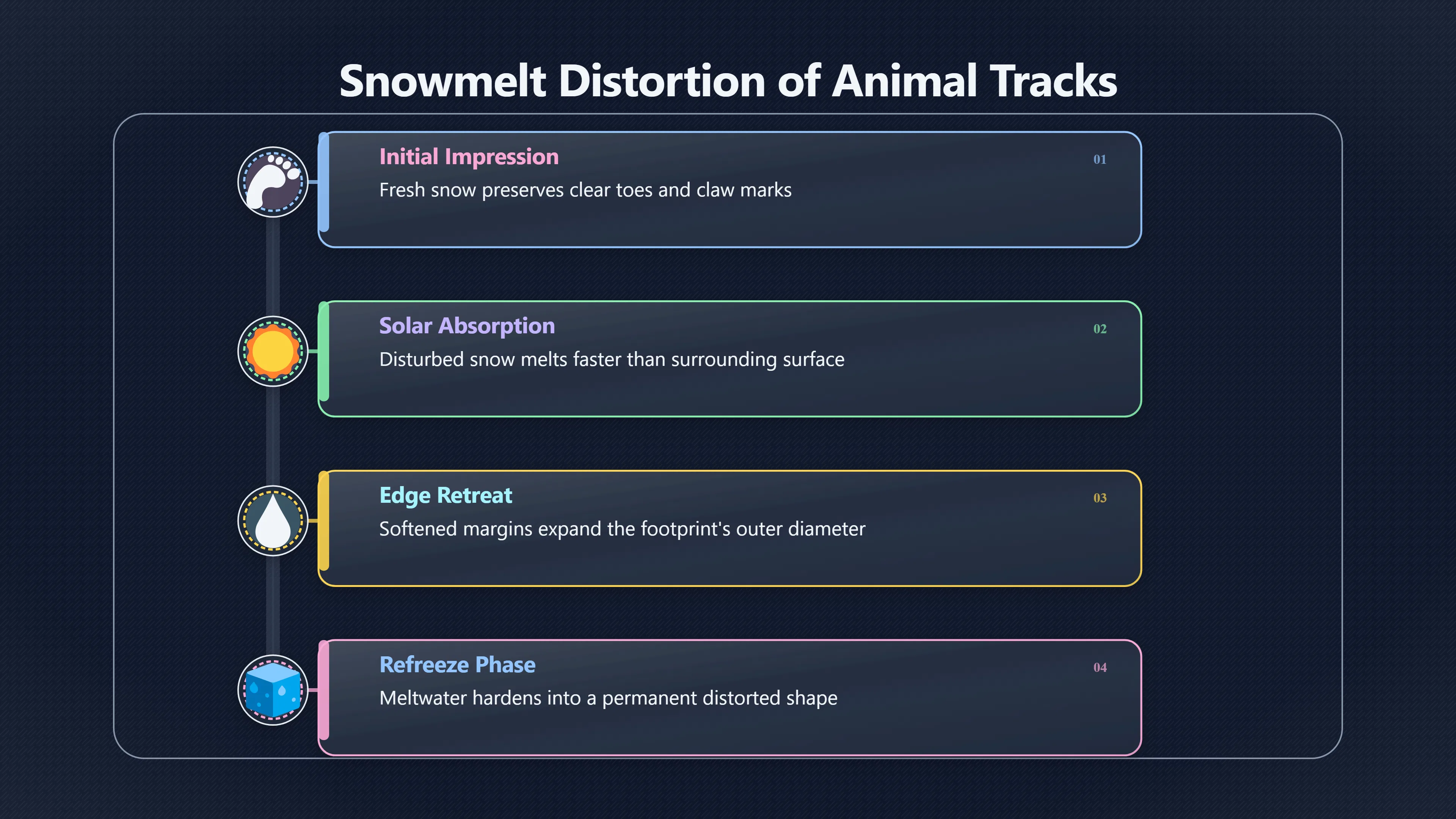
Snow rarely remains unchanged after an animal passes. Several processes can enlarge and distort tracks.
Why tracks grow larger over time
A footprint creates a depression that absorbs sunlight differently from the surrounding snow. The disturbed snow around the track often melts faster than the untouched surface. As melting continues, the edges soften and retreat outward, making the footprint appear larger than it originally was. Naturalists have long noted that footprints can act as focal points for accelerated melting.[hitchcockcenter.org]hitchcockcenter.orgWatching the snow meltFootprints commonly enlarge as they serve as foci for snow melt, and… tracks can easily come to resemble moose a…
The effect can be dramatic. Small tracks may become medium-sized, while medium-sized tracks can begin to resemble those of much larger animals. Observers of melting winter snow have reported deer tracks expanding until they resemble moose tracks and fox prints enlarging towards the size of coyote prints.[hitchcockcenter.org]hitchcockcenter.orgWatching the snow meltFootprints commonly enlarge as they serve as foci for snow melt, and… tracks can easily come to resemble moose a…
How details disappear
As the margins of a track melt, the sharp features that help identify an animal are often the first to vanish. Toe marks blur together. Claw impressions disappear. Separate depressions may merge into a single shape. What remains is a larger, smoother outline that can look unfamiliar or anomalous.[hitchcockcenter.org]hitchcockcenter.orgWatching the snow meltFootprints commonly enlarge as they serve as foci for snow melt, and… tracks can easily come to resemble moose a…
Refreezing can add another layer of confusion. Meltwater may harden into ice, preserving an enlarged version of the original track. Later observers may encounter only this distorted form and never see the print’s earlier, more identifiable state.
Deep snow creates additional distortions
Why Snow Tracks Often Resemble Cryptid Footprints
The snowmelt explanation appears repeatedly in discussions of alleged Yeti and Bigfoot tracks because it naturally produces several features that cryptid enthusiasts often regard as significant.
First, enlarged tracks suggest a larger animal. A print that began at a modest size can become impressively large after hours or days of melting. Second, the loss of claws and toe definition can make a known animal seem less recognisable. Third, overlapping prints can create shapes that resemble a single giant foot.[hitchcockcenter.org]hitchcockcenter.orgWatching the snow meltFootprints commonly enlarge as they serve as foci for snow melt, and… tracks can easily come to resemble moose a…
Bear tracks are particularly relevant. A bear’s hind foot already has a vaguely human-like appearance, and when the hind foot partially overlaps the front foot, the combined impression can become elongated. Researchers studying Himalayan Yeti reports have argued that such overprinted bear tracks, especially when modified by snow conditions, can create surprisingly human-looking forms.[Wikipedia]WikipediaOpen source on wikipedia.org.
This does not automatically explain every reported mystery track. Some famous footprint photographs remain debated, and critics of simple snowmelt explanations have argued that certain trackways preserve details that appear unusually consistent over long distances.[Idaho State University]isu.eduIdaho State University Yeti: The Ecology of a Mystery7:69-96 (2018)September 26, 2018 — Given the crispness of the outline, in particular the toes and the snow ridges between them, it is dif…
However, the existence of a debate does not remove the need to account for snow distortion before proposing an unknown animal.
Why One Dramatic Print Is Weak Evidence
A single impressive footprint found in melting snow is among the weakest forms of track evidence in cryptozoology.
The reason is straightforward: snow alteration can change size, shape and apparent anatomy after the animal has left. Once that process begins, investigators may no longer be examining the original footprint but a weather-modified version of it.[hitchcockcenter.org]hitchcockcenter.orgWatching the snow meltFootprints commonly enlarge as they serve as foci for snow melt, and… tracks can easily come to resemble moose a…
More reliable assessment comes from looking at:<div class="content-enhancement content-enhancement--insight-grid" markdown="1">
- Entire trackways rather than isolated prints.
- Multiple photographs taken soon after discovery.
- Consistency of shape across many impressions.
- Associated evidence such as stride length, direction of travel and surrounding animal sign.
- Weather conditions between track formation and discovery.</div>
Experienced wildlife trackers routinely emphasise that identification becomes stronger when many prints tell the same story. A lone giant impression in old snow may be visually dramatic, but it provides little protection against distortion, misidentification or exaggeration.[NatureTracking]naturetracking.comNature Tracking Identifying Animal Tracks in Snow – 5 Common BackyardIdentifying Animal Tracks in Snow – 5 Common Backyard…January 15, 2016 — Gait patterns are one of the best tools to ID t…
Within cryptozoology, snowmelt is therefore not merely a sceptical objection. It is a specific physical mechanism that can transform ordinary tracks into apparently extraordinary ones. Understanding that mechanism helps explain why some of the most famous “monster footprints” have emerged from environments where snow was actively changing long before anyone arrived to inspect the evidence.[hitchcockcenter.org]hitchcockcenter.orgWatching the snow meltFootprints commonly enlarge as they serve as foci for snow melt, and… tracks can easily come to resemble moose a…
Amazon book picks
Further Reading
Books and field guides related to When Snow Makes Monster Tracks. Use these as the next step if you want deeper reading beyond the article.
Tracking and the Art of Seeing
Explains environmental effects on tracks, including snow conditions.
eBay marketplace picks
Marketplace Samples
Live-tested eBay searches with available results related to this page.

Endnotes
1.
Source: hitchcockcenter.org
Link:https://www.hitchcockcenter.org/earth-matters/watching-the-snow-melt/
2.
Source: Wikipedia
Link:https://en.wikipedia.org/wiki/Yeti
3.
Source: forestscanada.ca
Title: printed in the snow animal tracks reveal what keeps wildlife busy in winter
Link:https://forestscanada.ca/en/article/printed-in-the-snow-animal-tracks-reveal-what-keeps-wildlife-busy-in-winter
4.
Source: naturetracking.com
Title: Nature Tracking Identifying Animal Tracks in Snow – 5 Common Backyard
Link:https://naturetracking.com/the-5-most-common-animal-tracks-in-snow/
5.
Source: skiology.co.uk
Link:https://www.skiology.co.uk/blog/tracks-in-the-snow-what-can-you-see-from-the-chairlift/
6.
Source: isu.edu
Title: Idaho State University Yeti: The Ecology of a Mystery
Link:https://www.isu.edu/[media
Additional References
7.
Source: shutterstock.com
Link:https://www.shutterstock.com/search/bear-tracks-snow
8.
Source: reddit.com
Link:https://www.reddit.com/r/Cryptozoology/comments/1fgno9l/explanation_for_yeti_footprint_[photos
9.
Source: forestholidays.co.uk
Link:https://www.forestholidays.co.uk/forestipedia/how-to-identify-animal-tracks-in-the-snow/
10.
Source: extension.msstate.edu
Link:https://extension.msstate.edu/blogs/extension-for-real-life/how-identify-black-bear-and-skunk-tracks
11.
Source: facebook.com
Link:https://www.facebook.com/groups/thepinebarrens/posts/2779111332443235/
12.
Source: slc.gov
Link:https://www.slc.gov/parks/animal-tracks-in-snow/
13.
Source: itv.com
Title: mountaineer releases mysterious footage are these the tracks of the yeti
Link:https://www.itv.com/news/westcountry/2016-04-11/mountaineer-releases-mysterious-footage-are-these-the-tracks-of-the-yeti
14.
Source: youtube.com
Link:https://www.youtube.com/watch?v=Xz02S-CizAU
15.
Source: instagram.com
Title: Someone else has been out walking in the snow
Link:https://www.instagram.com/p/CZ4jV5JOkzm/?hl=en
16.
Source: winterberrywildlife.ouroneacrefarm.com
Title: grizzly vs black bear tracks a careful look
Link:https://winterberrywildlife.ouroneacrefarm.com/2022/11/08/grizzly-vs-black-bear-tracks-a-careful-look/
Topic Tree