Within Cryptozoology
Why Cryptozoology Is Called Pseudoscience
Cryptozoology is often labelled pseudoscience because its famous claims usually start stronger than their evidence allows.
On this page
- What mainstream science objects to
- Patterns of weak evidence
- How fringe communities preserve belief
Page outline Jump by section
Introduction
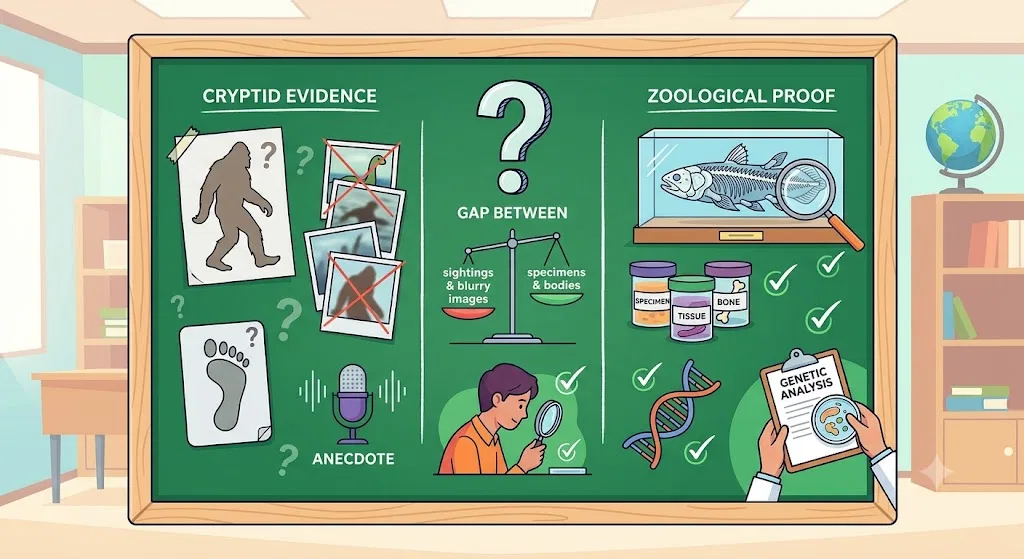
Cryptozoology is called pseudoscience not because every search for unknown animals is foolish, but because its most famous claims usually begin with a conclusion that the evidence has not earned. Bigfoot, the Yeti, the Loch Ness Monster and similar cryptids are supported mainly by eyewitness accounts, blurry images, casts, folklore, testimony and disputed traces rather than bodies, bones, tissue, repeatable observations or reliable population evidence. In mainstream zoology, anecdotes can start an investigation; they cannot verify a species on their own. That distinction is why sceptical scientists often treat cryptozoology as a fringe subculture rather than a branch of zoology.[Scientific American]scientificamerican.comOpen source on scientificamerican.com.
The point is not that science has already found every animal. It plainly has not: researchers are still describing more than 16,000 new species a year, many of them insects, plants, fungi, fish, amphibians and other organisms that are small, cryptic, remote or hard to classify.[University of Arizona News]news.arizona.eduOpen source on arizona.edu. The problem is that famous cryptid claims often ask for belief in large, distinctive, long-lived animals without the kinds of evidence that large animals normally leave behind. Cryptozoology survives in the gap between “unknown species exist” and “this legendary animal probably exists”, and that gap is where its pseudoscientific patterns and subcultural appeal are easiest to see.
What mainstream science objects to
Mainstream objections to cryptozoology are less about curiosity than method. Zoologists do not reject unknown animals in principle; taxonomy depends on finding, describing and classifying organisms that were previously unknown to science. The living coelacanth is the classic example often invoked by cryptozoology supporters: a fish lineage known from fossils and thought to have vanished tens of millions of years earlier was found alive off South Africa in 1938, then identified through a physical specimen by specialists.[Natural History Museum]nhm.ac.ukOpen source on nhm.ac.uk. That case shows science changing its mind when a body exists. It does not show that every long-lived monster story deserves the same confidence before comparable evidence appears.
The central objection is that cryptozoology often treats possibility as if it were probability. It is possible that an elusive animal remains undiscovered; it is much less likely that a breeding population of large primates, lake monsters or surviving prehistoric reptiles has persisted for decades or centuries without leaving unambiguous remains, verified DNA, clear photographs, ecological traces or specimens. In ordinary zoology, a new species claim becomes stronger when different lines of evidence converge: physical material, genetic data, repeatable observation, locality data, ecological plausibility and formal description. In famous cryptid cases, those lines tend to stay ambiguous or missing.
This is why the repeated phrase “science once laughed at the coelacanth” can mislead. The coelacanth was not accepted because witnesses kept reporting a mysterious fish; it was accepted because a specimen was caught, examined and named. Modern species discovery is also not a free-for-all. Even when thousands of new species are described, they usually enter science through specimens, genetic analysis, diagnostic traits and peer-reviewed classification, not through indefinitely accumulating sightings.[University of Arizona News]news.arizona.eduOpen source on arizona.edu.
A second objection is that cryptozoology often lacks a reliable failure condition. In science, a claim should become weaker when searches repeatedly fail, when physical samples turn out to be known animals, or when ecological constraints make the proposed animal implausible. In cryptozoological communities, failed searches may instead be absorbed into the belief: the creature is more intelligent than expected, more nocturnal, rarer, more remote, migratory, shy, paranormal, interdimensional or protected by hostile institutions. Not every enthusiast makes those moves, but the pattern helps explain why the field is often criticised as advocacy rather than open-ended investigation.[Skeptical Inquirer]skepticalinquirer.orgcryptozoology and pseudosciencecryptozoology and pseudoscience
Patterns of weak evidence
The recurring weakness in famous cryptid cases is not that there is no evidence of any kind. There is often a lot: stories, footprints, sound recordings, local traditions, photographs, videos, casts, maps and databases. The weakness is that much of it is low-quality evidence for a very high-stakes biological claim. A large unknown animal needs more than a large pile of uncertain clues.
Several patterns appear again and again:<div class="content-enhancement content-enhancement--insight-grid" markdown="1">
- Eyewitness reports carry the story but not the proof. Sightings can be sincere and still be mistaken. Distance, darkness, expectation, fear, poor scale judgement, brief exposure and later retelling can turn known animals or ordinary objects into something stranger.
- Images often arrive after belief is already primed. Blurry photographs and shaky videos invite interpretation. A viewer who expects Bigfoot sees a large biped; another sees a person, a bear, a shadow or a hoax.
- Trace evidence is rarely decisive. Footprints, hair, sounds and tree breaks may be suggestive to believers, but they often lack secure collection, chain of custody, independent verification or species-level diagnostic value.
- Negative tests do not settle the community debate. When samples are identified as known animals, supporters may argue that only the wrong samples were tested, that the real evidence remains elsewhere, or that one unexplained case is enough to keep the claim alive.</div>
Why “unknown animals exist” is not enough
Cryptozoology gains much of its rhetorical power from real zoological discovery. The argument is simple: scientists are still finding new animals; therefore scientists should not dismiss cryptids. The first sentence is true. The conclusion does not automatically follow.
New species are usually found in patterns that fit biology. Many are insects, fungi, plants, small vertebrates, deep-sea organisms, genetically distinct “cryptic species” or animals from under-surveyed regions. Researchers can describe them because there is material to study and compare.[University of Arizona News]news.arizona.eduOpen source on arizona.edu. Famous cryptids often ask for a different kind of leap: a large animal, often in a populated or repeatedly searched region, leaving no accepted remains and no clear genetic signature despite decades of attention.
That does not make every cryptid claim equally implausible. A rumoured small mammal in a remote forest, a rare whale, a poorly known deep-sea animal or a surviving population of an animal already known from recent history would be more biologically plausible than a sauropod-like creature in a central African swamp or a plesiosaur-like reptile in a Scottish loch. The critique of cryptozoology is strongest when the claim is large, spectacular, long-running and unsupported by proportionate evidence.
The coelacanth comparison is useful precisely because it cuts both ways. It proves that surprising rediscoveries can happen, but it also proves that science has a clear route for accepting them. A single physical specimen changed the status of the coelacanth; thousands of stories have not done the same for Bigfoot or Nessie.[Natural History Museum]nhm.ac.ukOpen source on nhm.ac.uk.
How fringe communities preserve belief
Cryptozoology is not just a set of disputed animal claims. It is also a participatory culture with its own experts, museums, databases, field trips, podcasts, conferences, television formats, merchandise, local pride and sceptic-versus-believer arguments. That subculture helps explain why claims endure even when scientific support remains weak.
The International Cryptozoology Museum, for example, explicitly blends “scientific, zoological specimens” with popular cultural homages, folk traditions, souvenirs and psychological or anthropological acknowledgements of sightings.[cryptozoologymuseum.com]cryptozoologymuseum.comInternational Cryptozoology Museum 490 Broadway, Bangor, MEInternational Cryptozoology Museum 490 Broadway, Bangor, ME That mix is revealing. Cryptozoology works partly as a mystery hobby, partly as folklore preservation, partly as amateur natural history, partly as tourism and partly as identity. Visitors may not require the same level of proof that a zoological journal would require; the value lies in wonder, participation and the possibility that the story might still be open.
Bigfoot culture is especially durable because it gives people roles to play. A witness can become an experiencer. A hiker can become a field investigator. A strange sound can become data. A local legend can become part of a continental map. Online databases and regional groups turn scattered reports into a shared archive, and the act of collecting reports can feel like scientific accumulation even when the underlying claims remain unverified.[BFRO]bfro.netBigfoot Field Researchers OrganizationBigfoot Field Researchers Organization
Media also helps preserve belief by making ambiguity entertaining. Television and online formats often reward suspense, night-vision searches, dramatic witness interviews and inconclusive endings. A definitive negative result ends the programme; an unresolved sound in the woods keeps the story alive. This does not mean every producer or participant is dishonest. It means the entertainment structure favours mystery over closure.
Fringe communities also develop boundary language. Mainstream scientists may be described as closed-minded, arrogant or institutionally biased; sceptics may be dismissed as people who refuse to look. On the other side, sceptics see cryptozoologists as moving the goalposts, overvaluing anecdotes and treating criticism as persecution. That social conflict becomes part of the subculture itself. The claim is no longer only “there may be an unknown animal”; it becomes “ordinary science will not take us seriously”.
The role of folklore and identity
One reason cryptozoology persists is that cryptids do cultural work even when they fail as zoological claims. Bigfoot is not only a proposed primate; it is also a modern wild-man figure, a symbol of wilderness, secrecy, anti-urban imagination and the hope that the modern world has not mapped everything. Loch Ness is not only a lake with sightings; it is a place where tourism, regional branding and mystery reinforce each other. The Yeti is not only a Himalayan animal claim; it is bound up with mountain landscapes, local stories, expedition culture and Western fascination with remote frontiers.
This cultural role does not make cryptids “fake” in the trivial sense. Folklore can be meaningful without being zoologically literal. A story can preserve local identity, encode encounters with real animals, dramatise danger, attract tourists, entertain children, create art and give communities a shared mystery. That is why folklorists and cultural historians may study cryptids seriously while biologists reject the animal claim.
The risk comes when cultural seriousness is mistaken for biological evidence. A creature can be important to a community and still not exist as a species. A sighting tradition can be old and still include misidentifications, embellishments and changing imagery. A museum display can preserve fascinating material culture without proving the animal at the centre of the display. Cryptozoology often blurs those categories, which is another reason it sits uneasily between folklore, entertainment and science.
Why belief survives failed tests
Failed tests rarely end famous cryptid beliefs because those beliefs are not held together by a single piece of evidence. They are held together by a flexible web: personal testimony, distrust of institutions, local pride, entertainment, mystery, older stories, selective anomalies and the emotional appeal of undiscovered nature. Remove one strand and the web can still hold.
This is visible in DNA cases. When alleged Yeti or Bigfoot hairs test as bear, dog, horse, cow, raccoon, human or another known animal, the result may weaken that sample but not the entire belief system. Supporters can say the wrong sample was tested, the real creature avoided detection, sceptics are overclaiming, or the negative result still leaves thousands of sightings unexplained.[Time]time.comOpen source on time.com. In strict science, repeated failure to produce decisive material lowers confidence. In fringe belief communities, repeated failure can be reframed as evidence of rarity, intelligence or suppression.
Loch Ness shows a softer form of survival. The eDNA results made a prehistoric reptile explanation highly implausible on the available data, yet they left enough room for a more ordinary possibility: unusually large eels.[University of Otago]otago.ac.nzfirst edna study of loch ness points to something fishyfirst edna study of loch ness points to something fishy That shift allows the legend to adapt. The monster need not remain a plesiosaur; it can become a large eel, a misidentified bird, a wave pattern, a seal, a fish, a log, a hoax or a mystery that science has not fully closed. Cryptozoological belief often survives by becoming less specific.
There is also a psychological asymmetry. A believer may treat one unexplained case as more important than a hundred explained ones, while a sceptic sees the explained cases as evidence of a general pattern. Both sides may accuse the other of cherry-picking. The scientific question is not whether every report has been individually explained, but whether the evidence as a whole justifies the proposed animal. For famous cryptids, mainstream science generally says it does not.
When cryptozoology can still be useful
Calling cryptozoology pseudoscience should not mean treating every participant as irrational or every story as worthless. Reports of strange animals can sometimes point towards known species outside expected ranges, rare behaviours, escaped exotic pets, local ecological change, folklore worth documenting, or public interest that can be redirected towards real biodiversity. The useful question is not “do believers deserve mockery?” but “what can be tested, preserved or learned without overstating the claim?”
Cryptozoology can be useful when it becomes more disciplined:<div class="content-enhancement content-enhancement--caution" markdown="1">
- Separate the animal claim from the cultural story. A legend may deserve documentation even if the creature is not biologically real.
- Prioritise physical evidence. Hair, scat, tissue, bones and clear photographs with reliable provenance matter more than dramatic testimony.
- Ask what would change the conclusion. A claim that cannot be weakened by failed searches is not functioning scientifically.
- Use ordinary zoological standards. Unknown species should be evaluated through the same evidence requirements as any other animal.
- Prefer modest explanations first. Known animals, hoaxes, optical effects, folklore motifs and mistakes should be considered before new megafauna.</div>
The best version of cryptozoological curiosity is not the defence of every monster story. It is the willingness to ask whether a report contains a testable biological clue, then accept the answer when the clue points to bears, eels, dogs, humans, waves or nothing at all. That is where cryptozoology can overlap with education: it can teach why evidence quality matters, why anecdotes are not enough, and why real species discovery is more demanding — and often more interesting — than the legend it replaces.
The bottom line
Cryptozoology is labelled pseudoscience because its signature claims usually rely on weak, ambiguous or culturally amplified evidence while resisting the ordinary standards used to confirm animals. It borrows the language of zoology, fieldwork and open-minded discovery, but its best-known cases rarely deliver the material proof that would make them part of mainstream biology. Bigfoot databases, Yeti relics and Loch Ness sightings may be fascinating as folklore and subculture; they are not equivalent to specimens, DNA-confirmed populations or repeatable scientific observation.
The fringe subculture matters because it explains the endurance of the claims. Cryptozoology offers mystery, community, identity and the hope that the wild still contains something enormous and hidden. Those are powerful human attractions. But they do not lower the burden of proof. The more extraordinary the animal claim, the more ordinary and testable the evidence must eventually become.
Amazon book picks
Further Reading
Books and field guides related to Why Cryptozoology Is Called Pseudoscience. Use these as the next step if you want deeper reading beyond the article.
Abominable Science!
Directly addresses why many cryptozoological claims are regarded as pseudoscientific.
Hunting Monsters
Examines evidence quality and alternative explanations for cryptid reports.
eBay marketplace picks
Marketplace Samples
Live-tested eBay searches with available results related to this page.
Endnotes
1.
Source: news.arizona.edu
Link:https://news.arizona.edu/news/new-species-are-now-being-discovered-faster-ever-study-suggests
2.
Source: bfro.net
Title: Bigfoot Field Researchers Organization
Link:https://www.bfro.net/
3.
Source: pmc.ncbi.nlm.nih.gov
Link:https://pmc.ncbi.nlm.nih.gov/articles/PMC4100498/
4.
Source: time.com
Link:https://time.com/2948745/dna-analysis-debunks-bigfoot-myth-points-to-unknown-bear-species/
5.
Source: cryptozoologymuseum.com
Title: International Cryptozoology Museum 490 Broadway, Bangor, ME
Link:https://cryptozoologymuseum.com/
6.
Source: bfro.net
Link:https://www.bfro.net/gdb/
7.
Source: cryptozoologymuseum.com
Link:https://cryptozoologymuseum.com/exhibitions/
8.
Source: scientificamerican.com
Link:https://www.scientificamerican.com/article/show-me-the-body-mythic-creatures/
9.
Source: skepticalinquirer.org
Title: cryptozoology and pseudoscience
Link:https://skepticalinquirer.org/newsletter/cryptozoology-and-pseudoscience/
10.
Source: nhm.ac.uk
Link:https://www.nhm.ac.uk/discover/coelacanths-the-fish-that-outdid-the-loch-ness-monster.html
11.
Source: royalsociety.org
Title: mysteries of the yeti
Link:https://royalsociety.org/blog/2017/11/mysteries-of-the-yeti/
12.
Source: otago.ac.nz
Title: first edna study of loch ness points to something fishy
Link:https://www.otago.ac.nz/news/newsroom/first-edna-study-of-loch-ness-points-to-something-fishy
13.
Source: royalsocietypublishing.org
Link:https://royalsocietypublishing.org/rspb/article/281/1789/20140161/77194/Genetic-analysis-of-hair-samples-attributed-to
14.
Source: royalsocietypublishing.org
Link:https://royalsocietypublishing.org/doi/abs/10.1098/rspb.2014.0161
15.
Source: royalsocietypublishing.org
Link:https://royalsocietypublishing.org/rspb/article/284/1868/20171804/78775/Evolutionary-history-of-enigmatic-bears-in-the
16.
Source: Wikipedia
Link:https://en.wikipedia.org/wiki/Loch
17.
Source: Wikipedia
Title: Loch Ness Monster
Link:https://en.wikipedia.org/wiki/Loch_Ness_Monster
18.
Source: Wikipedia
Link:https://en.wikipedia.org/wiki/Bigfoot
19.
Source: Wikipedia
Link:https://en.wikipedia.org/wiki/Cryptozoology
20.
Source: skepticalinquirer.org
Link:https://skepticalinquirer.org/2023/12/is-bigfoot-dead/
21.
Source: skepticalinquirer.org
Link:https://skepticalinquirer.org/2026/02/this-isnt-about-bigfoot/
22.
Source: pubmed.ncbi.nlm.nih.gov
Link:https://pubmed.ncbi.nlm.nih.gov/24990672/
23.
Source: pmc.ncbi.nlm.nih.gov
Link:https://pmc.ncbi.nlm.nih.gov/articles/PMC4100509/
24.
Source: pubmed.ncbi.nlm.nih.gov
Link:https://pubmed.ncbi.nlm.nih.gov/10216801/
25.
Source: pmc.ncbi.nlm.nih.gov
Link:https://pmc.ncbi.nlm.nih.gov/articles/PMC10659151/
26.
Source: pubmed.ncbi.nlm.nih.gov
Link:https://pubmed.ncbi.nlm.nih.gov/29187630/
27.
Source: pmc.ncbi.nlm.nih.gov
Link:https://pmc.ncbi.nlm.nih.gov/articles/PMC4298200/
28.
Source: ebsco.com
Link:https://www.ebsco.com/research-starters/science/cryptozoology
29.
Source: tripadvisor.com
Title: International Cryptozoology Museum
Link:https://www.tripadvisor.com/Attraction_Review-g40827-d1674550-Reviews-International_Cryptozoology_Museum-Portland_Maine.html
30.
Source: www3.ntu.edu.sg
Title: NewAtlas 171129 DNA tests on Yeti hair and bone samples bear results
Link:https://www3.ntu.edu.sg/CorpComms2/Documents/2017/11_Nov/NewAtlas_171129_DNA%20tests%20on%20Yeti%20hair%20and%20bone%20samples%20bear%20results.pdf
31.
Source: cryptozoologycryptids.fandom.com
Link:https://cryptozoologycryptids.fandom.com/wiki/Bigfoot
32.
Source: cryptidz.fandom.com
Link:https://cryptidz.fandom.com/wiki/Bigfoot/Sightings
33.
Source: explorer.natureserve.org
Link:https://explorer.natureserve.org/AboutTheData/Sources/Classification
34.
Source: cejsh.icm.edu.pl
Link:https://cejsh.icm.edu.pl/cejsh/element/bwmeta1.element.hdl_11089_21964/c/4.2.pdf
Additional References
35.
Source: nypost.com
Title: New York Post Meet the Bigfoot hunters of the Hudson Valley
Link:https://nypost.com/2026/01/13/lifestyle/the-bigfoot-hunters-of-the-hudson-valley-have-investigated-hundreds-of-sightings/
36.
Source: youtube.com
Title: Cryptozoology: The Science of Unknown Creatures | SLICE SCIENCE | FULL DOC
Link:https://www.youtube.com/watch?v=oE8ki5q6O20
37.
Source: itis.gov
Link:https://www.itis.gov/
38.
Source: search.library.ohio.gov
Link:https://search.library.ohio.gov/discovery/fulldisplay/alma991015398602308520/01OHIOLINK_SLO%3ASLO
39.
Source: researchgate.net
Link:https://www.researchgate.net/publication/272351891_Cryptozoology_and_Pseudoscience
40.
Source: academia.edu
Link:https://www.academia.edu/98109815/On_the_Fringe_Where_Science_Meets_Pseudoscience_by_Michael_D_Gordin
41.
Source: researchgate.net
Link:https://www.researchgate.net/publication/390620130_The_Loch_Ness_Monster_If_It%27s_Real_Could_It_Be_an_Eel
42.
Source: researchgate.net
Link:https://www.researchgate.net/publication/263583915_Correction_to_Genetic_analysis_of_hair_samples_attributed_to_yeti_bigfoot_and_other_anomalous_primates
43.
Source: researchgate.net
Link:https://www.researchgate.net/publication/263711067Molecular_analysis_of%27anomalous_primate%27_hair_samples_A_commentary_on_Sykes_et_al
44.
Source: researchgate.net
Link:https://www.researchgate.net/publication/321361263_Evolutionary_history_of_enigmatic_bears_in_the_Tibetan_Plateau-Himalaya_region_and_the_identity_of_the_yeti
Topic Tree
Follow this branch
Parent topic
CryptozoologyRelated pages 29
- Blurry Photos Why Blurry Bigfoot Photos Persuade People
- Coelacanth The Coelacanth Argument, Explained Carefully
- Failed Searches Why Failed Searches Do Not Kill Cryptids
- Need a Body Why Cryptids Need More Than Sightings
- Report Databases Can Sightings Databases Prove Bigfoot Exists?
- +1 more in sidebar