Within Cryptozoology
When Extinct Animals Reappear Alive
Lazarus taxa make cryptozoology feel plausible, but each survival claim still needs current physical evidence.
On this page
- What Lazarus taxa means
- Coelacanths and other survival stories
- Why survival is not proof of cryptids
Page outline Jump by section
Introduction
Lazarus taxa are animals, plants or wider biological groups that seem to vanish from the record and then reappear alive. They matter to cryptozoology because they show that science has sometimes been wrong about extinction: a fish thought gone since the age of dinosaurs, a bird written off after decades of failed searches, or an insect surviving on a sea stack can all return from the “dead”. But the lesson is narrower than the legend. Real rediscoveries are confirmed by bodies, photographs, DNA, repeated surveys, breeding populations, museum specimens or other physical evidence. They make hidden animals possible in principle; they do not make every cryptid plausible by analogy.
The best Lazarus stories are not vague tales of monsters in inaccessible places. They are cases where a specific taxon had a known history, a plausible refuge, and eventually a specimen or documented population strong enough for zoologists and conservation bodies to act on. That distinction is why Lazarus taxa are one of the most useful bridges between cryptozoology and mainstream biology — and also one of the strongest reminders that survival claims need proof, not just possibility.
What Lazarus Taxa Means
A Lazarus taxon is usually defined in two related ways. In palaeontology, it is a taxon that disappears from the fossil record for a long interval and later reappears in fossils or as a living organism. In conservation biology, the term is also used more loosely for species believed extinct in modern times but later rediscovered alive. The name refers to the biblical figure Lazarus, but the biological point is not resurrection. These animals did not come back to life; they were alive while human records failed to detect them.[Wikipedia]WikipediaLazarus taxonLazarus taxon
That difference matters. A Lazarus taxon is often a failure of observation rather than a miracle of survival. The fossil record is patchy because only a tiny fraction of organisms fossilise, fewer fossils are exposed, and fewer still are found and correctly interpreted. Modern field surveys are also incomplete: rare animals may be nocturnal, seasonal, deep-sea, cave-dwelling, cryptic in appearance, or confined to terrain that is hard to search. A species can be absent from records without being absent from the world.[Wikipedia]WikipediaLazarus taxonLazarus taxon
The International Union for Conservation of Nature sets a high bar for declaring extinction: there should be no reasonable doubt that the last individual has died, and the presumption should follow exhaustive surveys in known and expected habitat, at appropriate times, across the historic range. That standard exists precisely because rediscoveries happen. It is also why many contested species are listed as critically endangered, possibly extinct, or data deficient rather than simply extinct.[IUCN Red List]iucnredlist.orgIUCN Red ListIUCN Red List of Threatened SpeciesA taxon is presumed Extinct when exhaustive surveys in known and/or expected habitat, at…
For cryptozoology, Lazarus taxa are tempting evidence because they show that “thought extinct” does not always mean extinct. The mistake is to treat them as a blank cheque. A rediscovered stick insect or deep-sea mollusc does not automatically strengthen the case for Bigfoot, lake monsters or surviving dinosaurs. The useful question is more exact: what kind of animal is being proposed, where could it hide, how many would need to exist, and what evidence should already have appeared if it were real?
Coelacanths and Other Survival Stories
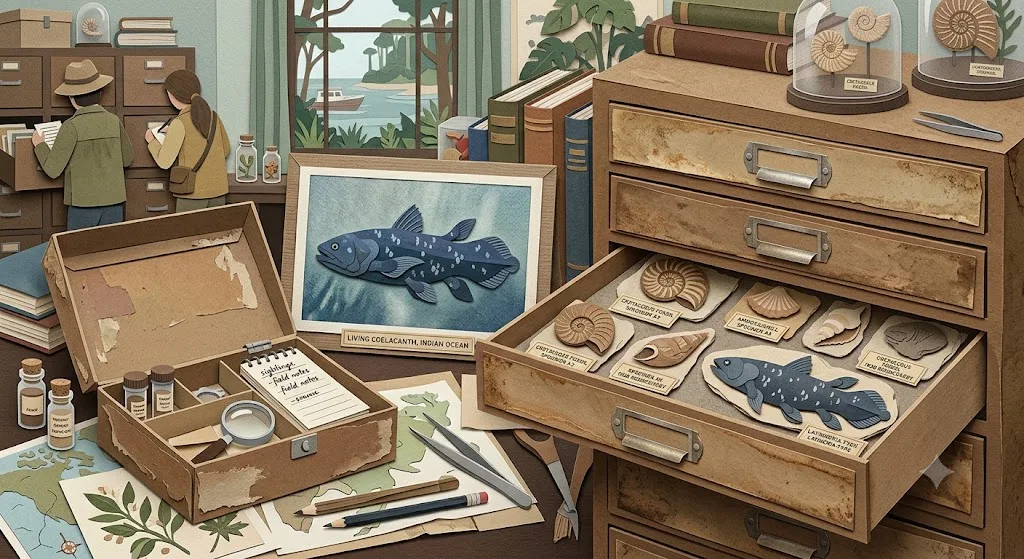
The coelacanth is the classic Lazarus animal because its rediscovery collapsed a huge apparent gap between fossil history and living reality. Coelacanths were known from fossils and were long believed to have died out around the end of the Cretaceous. Then, in December 1938, museum curator Marjorie Courtenay-Latimer found an unfamiliar lobe-finned fish among a catch landed near South Africa. Ichthyologist J. L. B. Smith later described it as Latimeria chalumnae.[Natural History Museum]nhm.ac.ukOpen source on nhm.ac.uk.
The coelacanth’s importance is often exaggerated in popular retellings. It is not a dinosaur, not a plesiosaur, and not a proof that large prehistoric reptiles are likely to survive in modern lakes. It is a deep-water marine fish from a lineage with distinctive lobed fins and a long fossil history. Smithsonian Ocean notes that living Latimeria is a genus distinct from fossil forms, even though coelacanths share recognisable features. That is a more interesting story than “unchanged for millions of years”: it shows a lineage surviving with evolutionary history still happening, not time literally standing still.[Smithsonian Ocean]si.educoelacanthcoelacanth
Several other rediscoveries show the same pattern in different habitats:
- The takahē was presumed extinct after the late nineteenth century, then rediscovered in 1948 in New Zealand’s Murchison Mountains. Its rediscovery began New Zealand’s longest-running endangered species programme, involving captive breeding, translocations and managed wild releases.[Doc.govt.nz]govt.nztakahetakahe
- The Lord Howe Island stick insect was believed wiped out after invasive rats reached Lord Howe Island, but a small population was found on Ball’s Pyramid in 2001. The case became stronger when museum genomics later helped confirm that the Ball’s Pyramid insects were the same species despite visible differences from old Lord Howe specimens.[Zoos Victoria]zoo.org.aulord howe island stick insectlord howe island stick insect
- The Bermuda petrel, or cahow, was thought extinct for centuries before 18 breeding pairs were rediscovered in 1951 on rocky islets in Castle Harbour. BirdLife records that intensive management has since produced a slow but meaningful recovery from that tiny remnant population.[BirdLife DataZone]datazone.birdlife.orgbermuda petrel pterodroma cahowbermuda petrel pterodroma cahow
- Monoplacophoran molluscs were once known only from ancient fossils until living Neopilina specimens were trawled from deep water off Costa Rica in 1952. The University of California Museum of Paleontology describes this as one of the important modern discoveries in biology, because it revealed a living representative of a group previously treated as long extinct.[ucmp.berkeley.edu]ucmp.berkeley.eduOpen source on berkeley.edu.
- The Laotian rock rat was first described from Laos in the 2000s and then argued to belong to Diatomyidae, a rodent family previously known only from fossils and thought to have vanished millions of years earlier. This case is especially useful because it shows how museum specimens, field discovery, morphology and DNA can reshape a taxonomic story.[PMC]pmc.ncbi.nlm.nih.govOpen source on nih.gov.
- The Wollemi pine, though a plant rather than an animal, is often mentioned alongside zoological Lazarus taxa because it was known from fossils before a living grove was found in Australia’s Blue Mountains in 1994. Kew and New South Wales National Parks describe it as a rare “living fossil” with a fossil history reaching deep into the age of dinosaurs.[Kew Gardens]kew.orgGardens Wollemi pineGardens Wollemi pine
What unites these cases is not romance but documentation. There were specimens, field sites, taxonomic comparisons, conservation programmes and follow-up studies. The rediscovery did not remain an anecdote.
Why These Animals Were Missed
Lazarus taxa usually survive because ordinary detection fails under particular conditions. They are not randomly hidden everywhere; they persist in places or life histories that make them easy to overlook.
The coelacanth lived in deep marine habitats and appeared in human records only when a specimen came through a fishing catch. Monoplacophorans were discovered through deep-sea trawling, not casual observation. The Lord Howe Island stick insect survived not on its original island but on Ball’s Pyramid, a steep volcanic sea stack difficult to access. The takahē survived in remote alpine grasslands. The cahow bred at night on small offshore islets. BirdLife DataZone+4Natural History Museum+4ucmp.berkeley.edu[nhm.ac.uk]nhm.ac.ukOpen source on nhm.ac.uk.
These examples point to a practical rule: rediscovery is most plausible when the animal is rare, localised, hard to detect, or living in a poorly searched refuge. Small populations can escape notice for decades if they are nocturnal, secretive, seasonal, underwater, subterranean, or restricted to politically, physically or logistically difficult terrain. That is very different from claiming that a large breeding population of conspicuous animals has persisted for centuries in heavily visited places without leaving bodies, unambiguous images, DNA, tracks, nests, scat or ecological effects.
There is also a difference between being “unknown to science” and being “known, lost and found again”. Many Lazarus taxa had old museum specimens, fossils, subfossils, historical records or local knowledge pointing towards a real organism. The rediscovery completed a chain of evidence. In cryptozoology, by contrast, the famous cases often begin with eyewitness narratives and ambiguous traces, then look for a body later.
The Cryptozoology Appeal — and the Trap
Lazarus taxa give cryptozoology one of its strongest rhetorical moves: “Scientists once said this animal was extinct, and they were wrong.” That is true in specific cases. The coelacanth, takahē, cahow and Lord Howe Island stick insect are all reminders that absence of evidence can be misleading when surveys are limited. They encourage humility about biodiversity, especially in deep seas, dense forests, isolated islands and under-studied regions.
The trap is turning humility into permission to believe anything. A real Lazarus case does not remove the need for current evidence. It raises the standard for asking where evidence should be. If an animal is large, long-lived and breeding, there should be more than fleeting sightings. There should be remains, environmental DNA, feeding signs, camera-trap records, acoustic data, local specimens, or repeated observations by independent researchers. For rediscovered species, that evidential turn eventually happens. For many cryptids, it does not.
The ivory-billed woodpecker shows why this distinction is difficult in practice. The bird is not a fantasy creature: it was a real species, historically documented, and its possible survival has been debated for decades. The U.S. Fish and Wildlife Service has considered delisting it because of extinction, while recent papers and search groups have argued that evidence may suggest persistence. That debate sits much closer to conservation biology than to monster folklore, but it also shows the problem: suggestive photos, sounds and sightings can prolong uncertainty without settling the case. U.S. Fish and Wildlife Service+2PMC[fws.gov]fws.govOpen source on fws.gov.
This is where Lazarus taxa can actually make cryptozoology more rigorous. They do not say “cryptids are likely”. They say “rediscovery is possible when a claim becomes testable”. The question becomes not whether a story is exciting, but whether it can cross the line from report to record.
What Real Rediscovery Evidence Looks Like
The strongest Lazarus cases usually include several kinds of evidence working together. A single dramatic sighting is rarely enough; the case becomes scientific when it can be checked, repeated or preserved.
A useful evidence ladder looks like this:
-
Physical specimen or remains. The coelacanth’s rediscovery began with a fish body; the Lord Howe Island stick insect was supported by living insects and museum comparison; the Laotian rock rat was studied through specimens and later genetic and fossil comparison. Smithsonian Ocean+2PubMed
-
Documented location and habitat. Rediscoveries usually identify where the animal persists: Ball’s Pyramid for the stick insect, the Murchison Mountains for the takahē, Castle Harbour islets for the cahow, limestone karst regions for the Laotian rock rat. PMC+3Zoos Victoria+3NZ Nature Fund
-
Repeatable detection. A rediscovery becomes stronger when later surveys, breeding records, camera monitoring, genetic work or conservation management continue to confirm the population. The cahow and takahē are not one-off claims; they are managed populations with decades of follow-up. Doc.govt.nz
-
Taxonomic verification. Some Lazarus cases are not obvious at first. The Ball’s Pyramid insects looked different enough from old Lord Howe specimens to raise doubts, and genomic comparison helped resolve the issue. The Laotian rock rat’s significance depended on whether it was a new family or the living member of a supposedly extinct fossil family. PubMed
Amazon book picks
Further Reading
Books and field guides related to When Extinct Animals Reappear Alive. Use these as the next step if you want deeper reading beyond the article.
The Song Of The Dodo
Explains extinction, refuges and survival of isolated populations.
Still Life
Connects museum evidence and specimen-based zoology to rediscovery stories.
eBay marketplace picks
Marketplace Samples
Live-tested eBay searches with available results related to this page.



Endnotes
1.
Source: Wikipedia
Title: Lazarus taxon
Link:https://en.wikipedia.org/wiki/Lazarus_taxon
2.
Source: doc.govt.nz
Link:https://www.doc.govt.nz/nature/native-animals/birds/birds-a-z/[takahe
3.
Source: datazone.birdlife.org
Title: bermuda petrel pterodroma cahow
Link:https://datazone.birdlife.org/species/factsheet/bermuda-petrel-pterodroma-cahow
4.
Source: ucmp.berkeley.edu
Link:https://ucmp.berkeley.edu/taxa/inverts/mollusca/monoplacophora.php
5.
Source: collections.tepapa.govt.nz
Link:https://collections.tepapa.govt.nz/topic/966
6.
Source: pmc.ncbi.nlm.nih.gov
Link:https://pmc.ncbi.nlm.nih.gov/articles/PMC4290499/
7.
Source: kew.org
Title: Gardens Wollemi pine
Link:https://www.kew.org/plants/wollemi-pine
8.
Source: pmc.ncbi.nlm.nih.gov
Link:https://pmc.ncbi.nlm.nih.gov/articles/PMC10194015/
9.
Source: Wikipedia
Link:https://en.wikipedia.org/wiki/Coelacanth
10.
Source: Wikipedia
Title: Living fossil
Link:https://en.wikipedia.org/wiki/Living_fossil
11.
Source: Wikipedia
Title: Bermuda petrel
Link:https://en.wikipedia.org/wiki/Bermuda_petrel
12.
Source: Wikipedia
Link:https://en.wikipedia.org/wiki/Takah%C4%93
13.
Source: Wikipedia
Title: Laotian rock rat
Link:https://en.wikipedia.org/wiki/Laotian_rock_rat
14.
Source: Wikipedia
Link:https://simple.wikipedia.org/wiki/Monoplacophora
15.
Source: Wikipedia
Title: Ivory billed woodpecker
Link:https://en.wikipedia.org/wiki/Ivory-billed_woodpecker
16.
Source: molluscs.at
Link:https://www.molluscs.at/monoplacophora/main.html
17.
Source: iucn.org
Link:https://iucn.org/
18.
Source: portals.iucn.org
Link:https://portals.iucn.org/library/sites/library/files/documents/RL-2001-001.pdf
19.
Source: portals.iucn.org
Link:https://portals.iucn.org/library/sites/library/files/documents/RL-2001-001-2nd.pdf
20.
Source: doc.govt.nz
Title: the takahe story
Link:https://www.doc.govt.nz/our-work/takahe-recovery-programme/the-takahe-story/
21.
Source: espace.library.uq.edu.au
Title: uq.edu.au Secrecy needed for conserving Lazarus species
Link:https://espace.library.uq.edu.au/view/UQ%3A331230/UQ331230_OA.pdf
22.
Source: nc.iucnredlist.org
Link:https://nc.iucnredlist.org/redlist/content/attachment_files/RedListGuidelines.pdf
23.
Source: iucnredlist.org
Link:https://www.iucnredlist.org/
24.
Source: nhm.ac.uk
Link:https://www.nhm.ac.uk/discover/coelacanths-the-fish-that-outdid-the-loch-ness-monster.html
26.
Source: nznaturefund.org
Title: takahe recovery programme
Link:https://nznaturefund.org/projects/takahe-recovery-programme/
29.
Source: nationalparks.nsw.gov.au
Link:https://www.nationalparks.nsw.gov.au/plants-and-animals/wollemi-pine
30.
Source: fws.gov
Link:https://www.fws.gov/species/ivory-billed-woodpecker-campephilus-principalis
31.
Source: facebook.com
Link:https://www.facebook.com/groups/978574213732574/posts/1419595592963765/
32.
Source: nc.iucnredlist.org
Title: Guidelines for Appropriate Use of IUCN Red List for Business ver 1 1
Link:https://nc.iucnredlist.org/redlist/content/attachment_files/Guidelines_for_Appropriate_Use_of_IUCN_Red_List_for_Business_ver_1_1.pdf
33.
Source: youtube.com
Title: Lazarus Taxa
Link:https://www.youtube.com/watch?v=SR5-YcsVJlE
34.
Source: fossil.fandom.com
Title: Living fossil
Link:https://fossil.fandom.com/wiki/Living_fossil
35.
Source: cryptidarchives.fandom.com
Title: Lazarus taxon
Link:https://cryptidarchives.fandom.com/wiki/Lazarus_taxon
36.
Source: pmc.ncbi.nlm.nih.gov
Link:https://pmc.ncbi.nlm.nih.gov/articles/PMC12410804/
37.
Source: nscf.org.za
Title: the coelacanth
Link:https://nscf.org.za/2017/10/17/the-coelacanth/
38.
Source: lukasguides.com
Title: lazarus taxon
Link:https://www.lukasguides.com/lazarus-taxon/
39.
Source: si.edu
Link:https://www.si.edu/collections/snapshot/coelacanth
40.
Source: nhm.ac.uk
Title: 150 year old museum specimen revealed as missing link in evoluti
Link:https://www.nhm.ac.uk/press-office/press-releases/150-year-old-museum-specimen-revealed-as-missing-link-in-evoluti.html
41.
Source: artensterben.de
Title: iucn red list 2025 extinct species
Link:https://www.artensterben.de/en/iucn-red-list-2025-extinct-species/
Additional References
42.
Source: youtube.com
Title: 3 Animals That Came Back From the Dead | Lazarus Taxa
Link:https://www.youtube.com/watch?v=Dvf5bLjR_KA
43.
Source: researchgate.net
Link:https://www.researchgate.net/publication/375620273In[situ
44.
Source: academia.edu
Link:https://www.academia.edu/146223638/Neopilina_A_Living_Fossil
45.
Source: abcnews.com
Link:https://abcnews.com/International/31-species-now-extinct-updated-icun-red-list/story?id=74584270
46.
Source: reddit.com
Link:https://www.reddit.com/r/interestingasfuck/comments/1iowry4/animals_that_were_rediscovered_after_being/
47.
Source: reddit.com
Link:https://www.reddit.com/r/Paleontology/comments/1oer2jp/can_you_name_at_least_one_relatively_popular/
48.
Source: mythicalarchives.com
Link:https://mythicalarchives.com/mythical-creatures-lists-comparisons/cryptozoology-101-hidden-animals/
49.
Source: facebook.com
Link:https://www.facebook.com/groups/acfa.cryptozoology/posts/2270663323296674/
50.
Source: reddit.com
Link:https://www.reddit.com/r/Awwducational/comments/81lssg/for_300_years_the_bermuda_petral_cahow_was/
51.
Source: pocketmags.com
Link:https://pocketmags.com/nl/skeptical-inquirer-magazine/janfeb-2025/articles/fringe-zoology-the-in-convenience-of-disappearing-evidence?srsltid=AfmBOooBJ0ngcnUmcaE2hXDmbq9L61wlbN18OrEIDsCQnRht9FLXleVU
Topic Tree