Within Prehistoric Claims
Why Living Fossil Can Mislead Readers
The phrase living fossil can help readers picture ancient lineages, but it can also falsely suggest evolution stopped.
On this page
- What the phrase gets right
- How it distorts evolution
- Better ways to describe ancient lineages
Page outline Jump by section
Introduction
In discussions of cryptozoology, the phrase living fossil is often used as if it were evidence that evolution can stop or that prehistoric animals might survive unchanged into the present. That interpretation is misleading. The term can be useful when describing lineages that retain body plans recognisable from ancient fossils, but it does not mean that modern organisms are identical to their distant ancestors or exempt from evolutionary change. Scientific research on coelacanths, horseshoe crabs and other frequently cited examples shows that these organisms have continued to evolve genetically, ecologically and biologically, even when their overall appearance remained relatively conservative.[PubMed]pubmed.ncbi.nlm.nih.govWhy coelacanths are not 'living fossils': a review…by D Casane · 2013 · Cited by 119 — A series of recent studies on extant coel… This distinction matters in debates about surviving prehistoric animals. A lineage can be ancient without being frozen in time. Understanding what “living fossil” actually means helps separate legitimate evolutionary patterns from common myths that are sometimes used to support cryptozoological claims.
What the Phrase Gets Right
The expression “living fossil” dates back to the nineteenth century and was originally intended to highlight organisms that appear similar to forms known from very old fossil records. In that limited sense, the phrase captures something real. Certain lineages have displayed long periods of morphological stability, meaning their broad body plans changed less dramatically than those of many other groups over geological time.[Frontiers]frontiersin.orgFrontiersWhy Coelacanths Are Almost “Living Fossils”?by L Cavin · 2022 · Cited by 9 — The coelacanth has become an iconic symbol of the “…
The coelacanth is the classic example. Fossil coelacanths are known from hundreds of millions of years ago, and the discovery of a living coelacanth in 1938 surprised scientists because the lineage had been thought extinct. Likewise, horseshoe crabs possess a body form that remains recognisable when compared with ancient relatives in the fossil record.[Frontiers]frontiersin.orgFrontiersWhy Coelacanths Are Almost “Living Fossils”?by L Cavin · 2022 · Cited by 9 — The coelacanth has become an iconic symbol of the “…
For readers encountering these animals for the first time, “living fossil” provides a shorthand way to visualise deep evolutionary history. It communicates that a modern species belongs to a lineage with ancient roots and that some visible features have persisted for exceptionally long periods.[OUP Academic]academic.oup.comAcademic Rethinking Living Fossils | Bio ScienceOUP AcademicRethinking Living Fossils | BioScience - Oxford Academicby S Lidgard · 2018 · Cited by 72 — Our aim in this article is to ret…
The phrase therefore succeeds as a descriptive metaphor. Problems arise when it is treated as a literal biological category.
How It Distorts Evolution
The most common misconception is that living fossils have not evolved. Modern evolutionary biology rejects that idea.
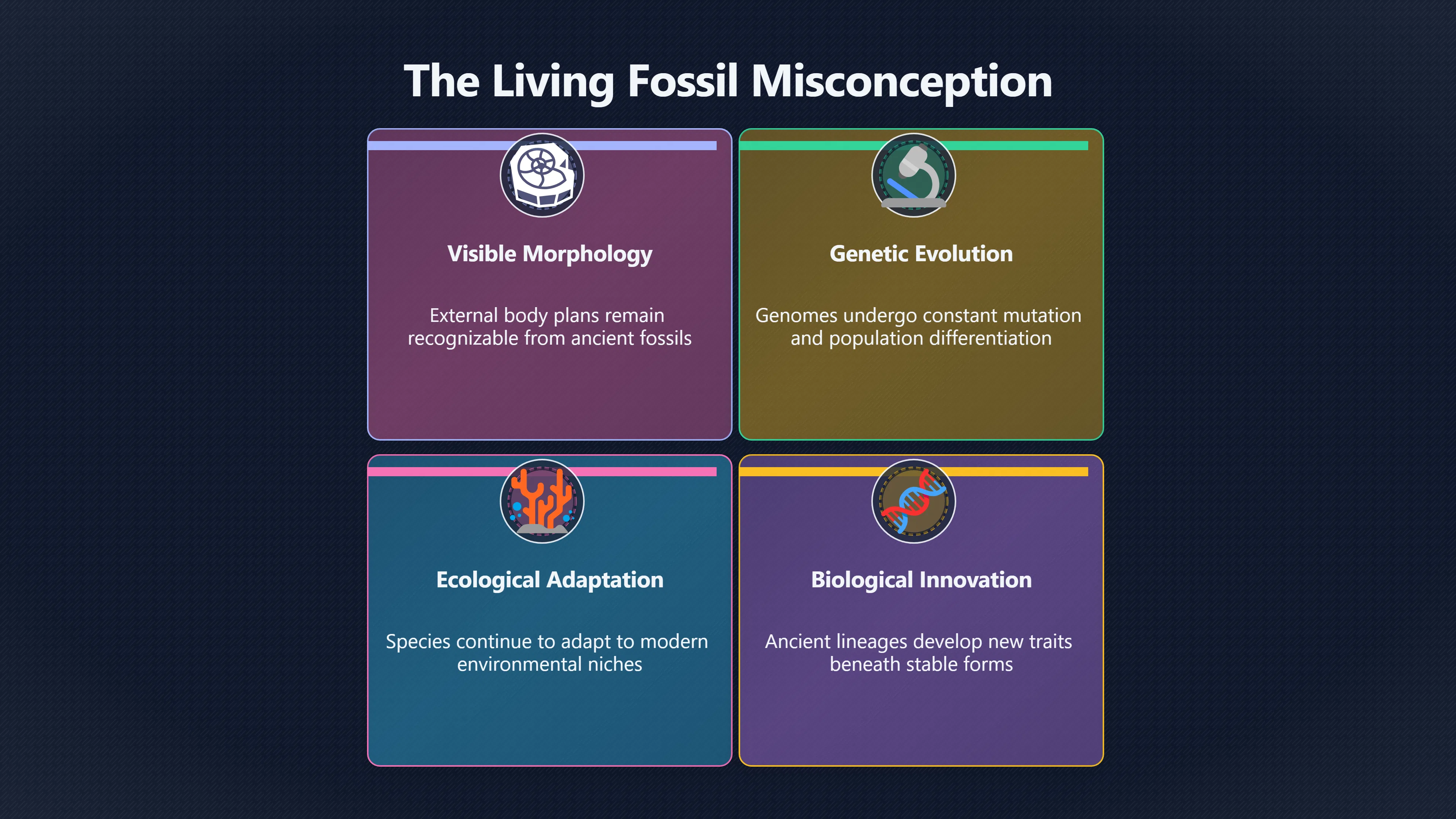
Research on coelacanths illustrates why. Although coelacanths exhibit relatively slow rates of change in some anatomical traits, studies have shown ongoing genetic evolution, population differentiation and genomic change. Scientists reviewing the evidence have explicitly argued that coelacanths should not be viewed as unchanged relics preserved from the Devonian period.[PubMed]pubmed.ncbi.nlm.nih.govWhy coelacanths are not 'living fossils': a review…by D Casane · 2013 · Cited by 119 — A series of recent studies on extant coel…
Horseshoe crabs provide a similar lesson. Their familiar helmet-shaped appearance has persisted for a very long time, yet genomic studies reveal ancient genome duplications, genetic innovation and evolutionary change beneath the surface of that apparently stable body plan.[PMC]pmc.ncbi.nlm.nih.govThe oldest actual fossils of horseshoe crabs date to the Ordovician period ~450 million years ago…Read more…
The misconception stems from equating visible similarity with evolutionary inactivity. Evolution does not require dramatic redesign. Natural selection, genetic drift, mutation and adaptation continue to operate even when a successful body plan remains broadly effective. A lineage can experience substantial genetic change while preserving a recognisable external form.[PubMed+2OUP Academic]pubmed.ncbi.nlm.nih.govWhy coelacanths are not 'living fossils': a review…by D Casane · 2013 · Cited by 119 — A series of recent studies on extant coel…
Another distortion is the assumption that ancient-looking species are direct windows into prehistoric ecosystems. Modern coelacanths are not the same species as fossil coelacanths from hundreds of millions of years ago. Horseshoe crabs alive today are likewise modern species with their own evolutionary histories. They resemble ancient relatives, but they are not biological time capsules.[PubMed]pubmed.ncbi.nlm.nih.govWhy coelacanths are not 'living fossils': a review…by D Casane · 2013 · Cited by 119 — A series of recent studies on extant coel…
Why the Myth Matters in Cryptozoology
Within cryptozoology, living fossils are sometimes invoked to suggest that reports of surviving dinosaurs, plesiosaurs or other extinct animals are more plausible than mainstream science allows. The argument usually follows a simple pattern: if coelacanths survived unnoticed, perhaps other prehistoric creatures did too.
The comparison overlooks an important difference. The coelacanth’s survival was established through physical specimens, anatomical study and repeatable scientific evidence. Its discovery demonstrated that a lineage could persist unexpectedly, not that ancient species remain unchanged or that any extinct animal might still exist without evidence.[Frontiers]frontiersin.orgFrontiersWhy Coelacanths Are Almost “Living Fossils”?by L Cavin · 2022 · Cited by 9 — The coelacanth has become an iconic symbol of the “…
The language of living fossils can unintentionally reinforce the mistaken image of prehistoric creatures persisting unchanged through time. When readers hear that an animal is “the same as it was 300 million years ago”, they may infer that evolution has somehow paused. In reality, the evidence points to long-term continuity of certain traits rather than complete biological stasis.[OUP Academic]academic.oup.comAcademic Rethinking Living Fossils | Bio ScienceOUP AcademicRethinking Living Fossils | BioScience - Oxford Academicby S Lidgard · 2018 · Cited by 72 — Our aim in this article is to ret…
This misunderstanding can make cryptozoological claims seem more compatible with evolutionary science than they actually are. Ancient lineage survival and survival of a specific extinct species are not the same proposition.
Better Ways to Describe Ancient Lineages
Many evolutionary biologists have become cautious about the term living fossil because it can create more confusion than clarity. Some researchers argue that the concept remains useful if carefully defined, while others prefer more precise language focused on specific evolutionary patterns.[OUP Academic]academic.oup.comAcademic Rethinking Living Fossils | Bio ScienceOUP AcademicRethinking Living Fossils | BioScience - Oxford Academicby S Lidgard · 2018 · Cited by 72 — Our aim in this article is to ret…
More accurate descriptions include:
- Ancient lineage – emphasises long evolutionary history without implying evolutionary inactivity.
- Morphologically conservative lineage – indicates that overall body form changed relatively little.
- Evolutionary stasis in certain traits – specifies exactly what remained stable.
- Relict lineage – highlights survival of a once more diverse group without suggesting that evolution stopped.[OUP Academic+2Springer]academic.oup.comAcademic Rethinking Living Fossils | Bio ScienceOUP AcademicRethinking Living Fossils | BioScience - Oxford Academicby S Lidgard · 2018 · Cited by 72 — Our aim in this article is to ret…
These alternatives focus attention on the actual phenomenon being discussed. They acknowledge that a lineage may retain ancient characteristics while continuing to evolve in other ways.
The Key Takeaway
See on Amazon</a></div></div></article><article class="fr-book-card"><a class="fr-book-cover" href="https://www.amazon.com/s?k=Why+Evolution+is+True+by+Jerry+A.+Coyne&i=stripbooks&tag=searcht-20" target="_blank" rel="sponsored noopener noreferrer" aria-label="Open Why Evolution is True on Amazon"><span class="fr-book-cover-fallback">Book</span><img class="fr-book-cover-thumb" src="https://books.google.com/books/content?id=J91Z6ED7MgEC&printsec=frontcover&img=1&zoom=1&edge=curl&source=gbs_api" alt="Cover for Why Evolution is True" loading="lazy" decoding="async" fetchpriority="low" referrerpolicy="no-referrer" onerror="this.hidden=true;this.closest('.fr-book-cover').classList.add('fr-book-cover-placeholder');"></a><div class="fr-book-info"><h4 class="fr-book-title"><a href="https://www.amazon.com/s?k=Why+Evolution+is+True+by+Jerry+A.+Coyne&i=stripbooks&tag=searcht-20" target="_blank" rel="sponsored noopener noreferrer" title="Why Evolution is True">Why Evolution is True</a></h4><p class="fr-book-author">By Jerry A. Coyne</p><p class="fr-book-desc">Counters misconceptions that species stop evolving.</p><div class="fr-book-actions"><a href="https://www.amazon.com/s?k=Why+Evolution+is+True+by+Jerry+A.+Coyne&i=stripbooks&tag=searcht-20" class="fr-amazon-btn" target="_blank" rel="sponsored noopener noreferrer">
See on Amazon</a></div></div></article><article class="fr-book-card"><a class="fr-book-cover" href="https://www.amazon.com/s?k=The+Complete+Dinosaur+by+James+Orville+Farlow&i=stripbooks&tag=searcht-20" target="_blank" rel="sponsored noopener noreferrer" aria-label="Open The Complete Dinosaur on Amazon"><span class="fr-book-cover-fallback">Book</span><img class="fr-book-cover-thumb" src="https://books.google.com/books/content?id=FOViD-lDPy0C&printsec=frontcover&img=1&zoom=1&edge=curl&source=gbs_api" alt="Cover for The Complete Dinosaur" loading="lazy" decoding="async" fetchpriority="low" referrerpolicy="no-referrer" onerror="this.hidden=true;this.closest('.fr-book-cover').classList.add('fr-book-cover-placeholder');"></a><div class="fr-book-info"><h4 class="fr-book-title"><a href="https://www.amazon.com/s?k=The+Complete+Dinosaur+by+James+Orville+Farlow&i=stripbooks&tag=searcht-20" target="_blank" rel="sponsored noopener noreferrer" title="The Complete Dinosaur">The Complete Dinosaur</a></h4><p class="fr-book-author">By James Orville Farlow, M. K. Brett-Surman</p><p class="fr-book-popularity">Rating: 3.5/5 from 9 Google Books ratings</p><p class="fr-book-desc">Helps readers evaluate claims involving surviving dinosaurs and ancient lineages.</p><div class="fr-book-actions"><a href="https://www.amazon.com/s?k=The+Complete+Dinosaur+by+James+Orville+Farlow&i=stripbooks&tag=searcht-20" class="fr-amazon-btn" target="_blank" rel="sponsored noopener noreferrer">
See on Amazon</a></div></div></article><article class="fr-book-card"><a class="fr-book-cover fr-book-cover-placeholder" href="https://www.amazon.com/s?k=Intracranial+Movement+in+the+Coelacanth+Latimeria+Chalumnae+Smith+%28Osteichthyes%2C+Crossopterygii%29.+by+Keith+Stewart+Thomson&i=stripbooks&tag=searcht-20" target="_blank" rel="sponsored noopener noreferrer" aria-label="Open Intracranial Movement in the Coelacanth Latimeria Chalumnae Smith (Osteichthyes, Crossopterygii). on Amazon"><span class="fr-book-cover-fallback">Book</span></a><div class="fr-book-info"><h4 class="fr-book-title"><a href="https://www.amazon.com/s?k=Intracranial+Movement+in+the+Coelacanth+Latimeria+Chalumnae+Smith+%28Osteichthyes%2C+Crossopterygii%29.+by+Keith+Stewart+Thomson&i=stripbooks&tag=searcht-20" target="_blank" rel="sponsored noopener noreferrer" title="Intracranial Movement in the Coelacanth Latimeria Chalumnae Smith (Osteichthyes, Crossopterygii).">Intracranial Movement in the Coelacanth Latimeria Chalumnae S...</a></h4><p class="fr-book-author">By Keith Stewart Thomson</p><p class="fr-book-desc">Addresses the organism most commonly cited in living fossil discussions.</p><div class="fr-book-actions"><a href="https://www.amazon.com/s?k=Intracranial+Movement+in+the+Coelacanth+Latimeria+Chalumnae+Smith+%28Osteichthyes%2C+Crossopterygii%29.+by+Keith+Stewart+Thomson&i=stripbooks&tag=searcht-20" class="fr-amazon-btn" target="_blank" rel="sponsored noopener noreferrer">
See on Amazon</a></div></div></article></div><div class="fr-section-footer"><div class="fr-browse-links" aria-label="Browse more on Amazon"><span class="fr-browse-links-label">Browse more on Amazon:</span><a class="fr-browse-more" href="https://www.amazon.com/s?k=Your+Inner+Fish&i=stripbooks&tag=searcht-20" target="_blank" rel="sponsored noopener noreferrer">Your Inner Fish</a><a class="fr-browse-more" href="https://www.amazon.com/s?k=Why+Evolution+is+True&i=stripbooks&tag=searcht-20" target="_blank" rel="sponsored noopener noreferrer">Why Evolution is True</a><a class="fr-browse-more" href="https://www.amazon.com/s?k=The+Complete+Dinosaur&i=stripbooks&tag=searcht-20" target="_blank" rel="sponsored noopener noreferrer">The Complete Dinosaur</a></div><p class="fr-disclosure">As an Amazon Associate I earn from qualifying purchases.</p></div></div></section>
Amazon book picks
Further Reading
Books and field guides related to Why Living Fossil Can Mislead Readers. Use these as the next step if you want deeper reading beyond the article.
Intracranial Movement in the Coelacanth Latimeria Chalumnae S...
Addresses the organism most commonly cited in living fossil discussions.
eBay marketplace picks
Marketplace Samples
Live-tested eBay searches with available results related to this page.
Endnotes
1.
Source: academic.oup.com
Title: Academic Rethinking Living Fossils | Bio Science
Link:https://academic.oup.com/bioscience/article/68/10/760/5065827
2.
Source: link.springer.com
Link:https://link.springer.com/article/10.1007/s10539-021-09789-z
3.
Source: pmc.ncbi.nlm.nih.gov
Link:https://pmc.ncbi.nlm.nih.gov/articles/PMC7815833/
4.
Source: pmc.ncbi.nlm.nih.gov
Title: PMCRethinking Living Fossils
Link:https://pmc.ncbi.nlm.nih.gov/articles/PMC6203082/
5.
Source: pubmed.ncbi.nlm.nih.gov
Link:https://pubmed.ncbi.nlm.nih.gov/23382020/
6.
Source: frontiersin.org
Link:https://www.frontiersin.org/journals/ecology-and-evolution/articles/10.3389/fevo.2022.896111/full
7.
Source: Wikipedia
Title: Living fossil
Link:https://en.wikipedia.org/wiki/Living_fossil
8.
Source: dictionary.cambridge.org
Link:https://dictionary.cambridge.org/dictionary/english-chinese-traditional/living
9.
Source: Wikipedia
Link:https://en.wikipedia.org/wiki/Coelacanth
10.
Source: pubmed.ncbi.nlm.nih.gov
Link:https://pubmed.ncbi.nlm.nih.gov/28565169/
11.
Source: pmc.ncbi.nlm.nih.gov
Link:https://pmc.ncbi.nlm.nih.gov/articles/PMC12246020/
12.
Source: frontiersin.org
Link:https://www.frontiersin.org/journals/earth-science/articles/10.3389/feart.2023.1086066/full
13.
Source: frontiersin.org
Link:https://www.frontiersin.org/journals/ecology-and-evolution/articles/10.3389/fevo.2023.1198224/full
14.
Source: blogs.hsc.edu
Title: Living fossils
Link:https://blogs.hsc.edu/biology/wp-content/uploads/sites/5/2014/10/Living-fossils.pdf
Additional References
15.
Source: researchgate.net
Link:https://www.researchgate.net/publication/328713409_Rethinking_Living_Fossils
16.
Source: researchgate.net
Link:https://www.researchgate.net/publication/286127407_The_evolutionary_truth_about_living_fossils
17.
Source: facebook.com
Link:https://www.facebook.com/groups/2417144643/posts/10163825005249644/
18.
Source: thinkofliving.com
Link:https://thinkofliving.com/
19.
Source: facebook.com
Link:https://www.facebook.com/1mill.creationist/posts/living-fossils-prove-evolution-wrongimagine-a-creature-that-has-hardly-changed-i/815549964463736/
20.
Source: forbes.com
Title: meet the animal that hasnt changed in 300 million years a biologist explains
Link:https://www.forbes.com/sites/scotttravers/2026/01/07/meet-the-animal-that-hasnt-changed-in-300-million-years—a-biologist-explains/
21.
Source: news.yale.edu
Title: study slowly evolving living fossils reveals key genetic insights
Link:https://news.yale.edu/2024/03/04/study-slowly-evolving-living-fossils-reveals-key-genetic-insights
22.
Source: grassfoundation.org
Title: first genome edited horseshoe crabs guilherme gainett
Link:https://grassfoundation.org/first-genome-edited-horseshoe-crabs-guilherme-gainett/
23.
Source: philsci-archive.pitt.edu
Title: In Defense of Living Fossils.Preprint.Turner.docx
Link:https://philsci-archive.pitt.edu/15739/1/In%20Defense%20of%20Living%20Fossils.Preprint.Turner.docx
24.
Source: nhm.ac.uk
Title: 310 million year old fossil horseshoe crab brain
Link:https://www.nhm.ac.uk/discover/news/2021/august/310-million-year-old-fossil-horseshoe-crab-brain.html
Topic Tree