Within Lazarus Taxa
Can 18 Breeding Pairs Save a Species?
The cahow's rediscovery shows how a tiny verified remnant can become a long conservation project rather than a loose survival rumor.
On this page
- Why the cahow seemed lost for centuries
- The 1951 breeding pair discovery
- Management after rediscovery
Page outline Jump by section
Introduction
The Bermuda petrel, or cahow, is one of the clearest examples of a real-world “Lazarus” species: an animal believed extinct for centuries that was later found alive. What makes the cahow especially significant is not merely its rediscovery but what happened afterwards. In 1951, researchers located just 18 surviving breeding pairs on tiny offshore islets in Bermuda. That discovery transformed the species from a historical mystery into a long-term conservation challenge. Rather than proving that lost species routinely survive unnoticed, the cahow demonstrated something more specific and more valuable: a tiny remnant population can persist, but recovery requires decades of intensive management and protection.[Wikipedia+2BirdLife DataZone]WikipediaBermuda petrelBermuda petrel Within discussions of cryptozoology and Lazarus taxa, the cahow stands as a reminder that confirmed rediscoveries depend on physical evidence, repeated monitoring and sustained scientific work—not on unverified survival rumours.[Wikipedia]WikipediaBermuda petrelBermuda petrel
Why the cahow seemed lost for centuries
The 1951 breeding-pair discovery
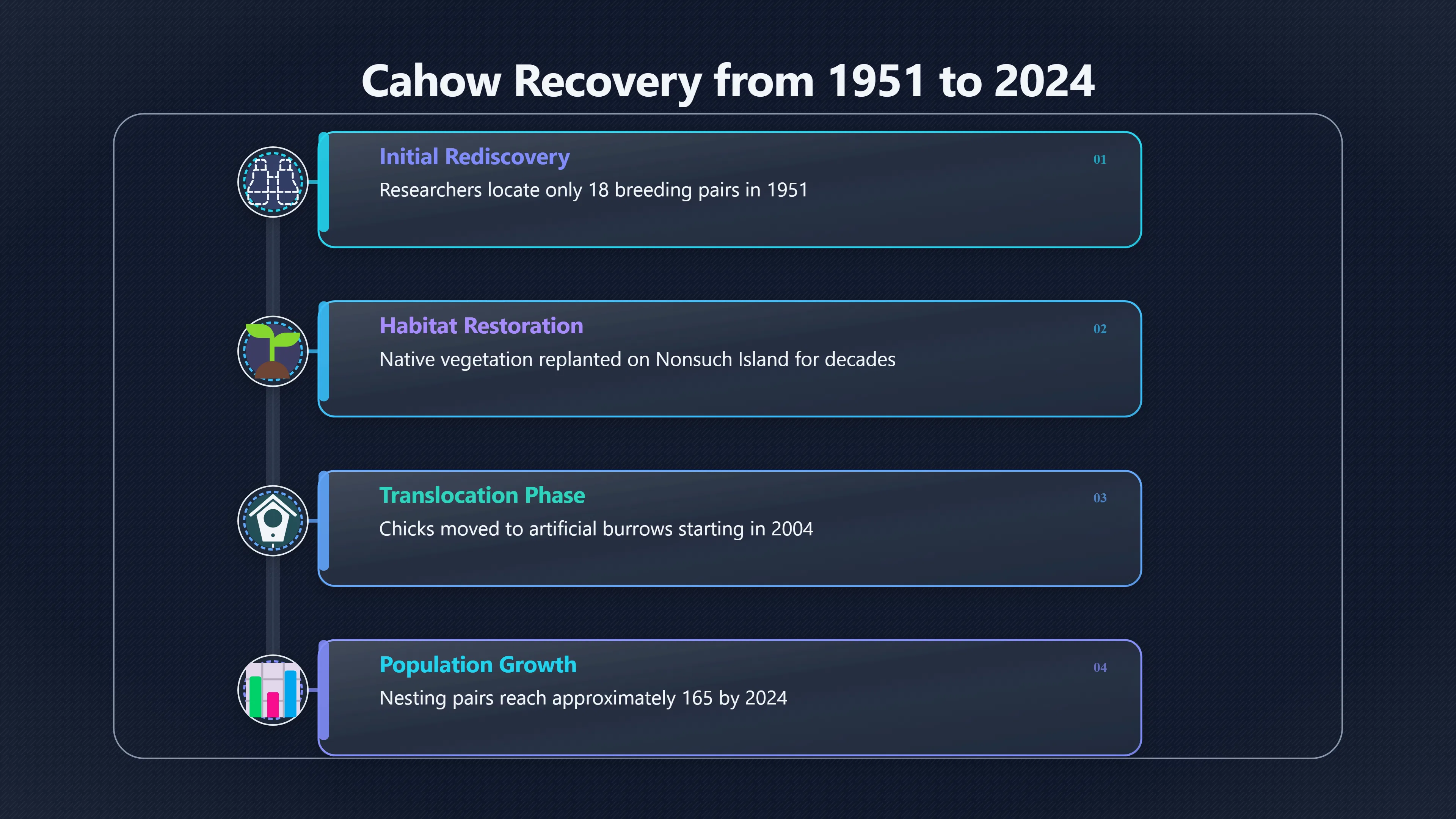
The decisive breakthrough came on 28 January 1951. American ornithologist Robert Cushman Murphy and Bermudian naturalist Louis Mowbray located surviving nesting birds on remote rocky islets in Castle Harbour. Accompanying them was a teenage Bermudian, David B. Wingate, who would later become the central figure in the species’ recovery.[Wikipedia+2The Nonsuch Expeditions]WikipediaBermuda petrelBermuda petrel
The numbers were alarming. Only 18 breeding pairs were found, scattered across a handful of tiny islets. The entire known nesting area amounted to roughly one hectare of habitat. The population was producing only a small number of chicks each year, leaving little margin for further losses.[BirdLife DataZone+2National Wildlife Federation]datazone.birdlife.orgBirdLife DataZoneBermuda Petrel Pterodroma cahow Species FactsheetIn 1951, 18 pairs were rediscovered breeding on suboptimal rocky islets…
This is why the cahow became such an important Lazarus-species case. Rediscovery did not reveal a hidden thriving population. Instead, it exposed a species balanced on the edge of extinction. The question immediately became whether 18 breeding pairs were enough to save a species.[Wikipedia]WikipediaBermuda petrelBermuda petrel
Why rediscovery alone was not enough
Finding the birds solved one mystery but revealed several new problems. The surviving colonies occupied extremely vulnerable nesting sites exposed to storms, erosion and flooding. The population’s small size increased the risk that a single disaster could erase decades of survival. Introduced predators remained a constant concern. In fact, rats later eliminated one nesting colony despite ongoing protection efforts.[ResearchGate]researchgate.net18 pairs, dispersed among five small islets…. breeding phenology. The entire breeding population of Bermuda Petrel was monitored over…
The species’ biology also slowed recovery. Cahows breed late, produce only one egg per year, and spend much of their lives at sea. Even under favourable conditions, population growth would be gradual. Conservationists could not rely on natural recovery alone.[Wikipedia]WikipediaBermuda petrelBermuda petrel
As later observers noted, conservation biology itself was still a young discipline when the rediscovery occurred. There was no established playbook for rescuing a seabird species from such a precarious starting point.[Audubon]audubon.orgReview: Rare Birds, The Extraordinary Tale of the BermudaReview: Rare Birds, The Extraordinary Tale of the Bermuda…May 17, 2013 — When the birds were found in 1951, there was no preced…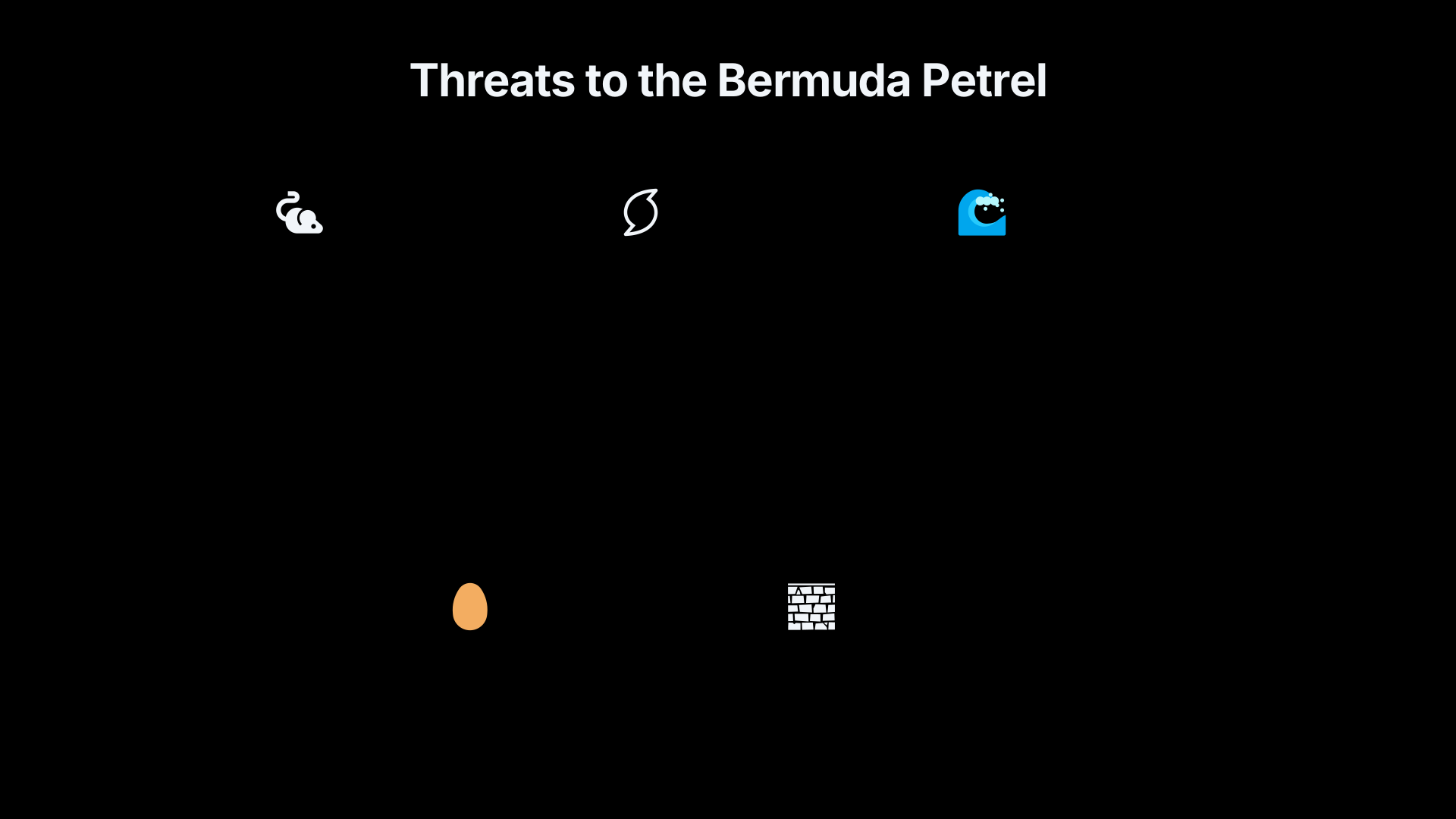
Management after rediscovery
The recovery programme that followed became one of the longest-running species-restoration efforts in the Atlantic.
Protecting the remaining colonies
Rebuilding habitat on Nonsuch Island
David Wingate’s most ambitious idea was to create a safer future breeding area on Nonsuch Island. Habitat restoration began decades before the site could support a new colony. Native vegetation was replanted and ecological conditions were gradually reconstructed to resemble Bermuda’s original environment. Thousands of native and endemic plants were introduced as part of the project.[Wikipedia]WikipediaBermuda petrelBermuda petrel
The goal was not simply to protect the remaining birds but to create room for expansion beyond the fragile original islets.[Wikipedia]WikipediaBermuda petrelBermuda petrel
Translocation and colony creation
One of the most innovative phases of recovery involved moving near-fledged chicks from the original colonies to artificial burrows on Nonsuch Island. Beginning in 2004, conservationists transferred young birds before they left for the sea, then hand-fed and monitored them until departure. The expectation was that these birds would later return to Nonsuch to breed, establishing a new colony.[Wikipedia+2Audubon]WikipediaBermuda petrelBermuda petrel
The programme achieved remarkably high fledging success and eventually helped establish breeding activity on the restored island. This reduced dependence on the tiny historic nesting sites and provided a buffer against future storm damage and sea-level rise.[Wikipedia]WikipediaBermuda petrelBermuda petrel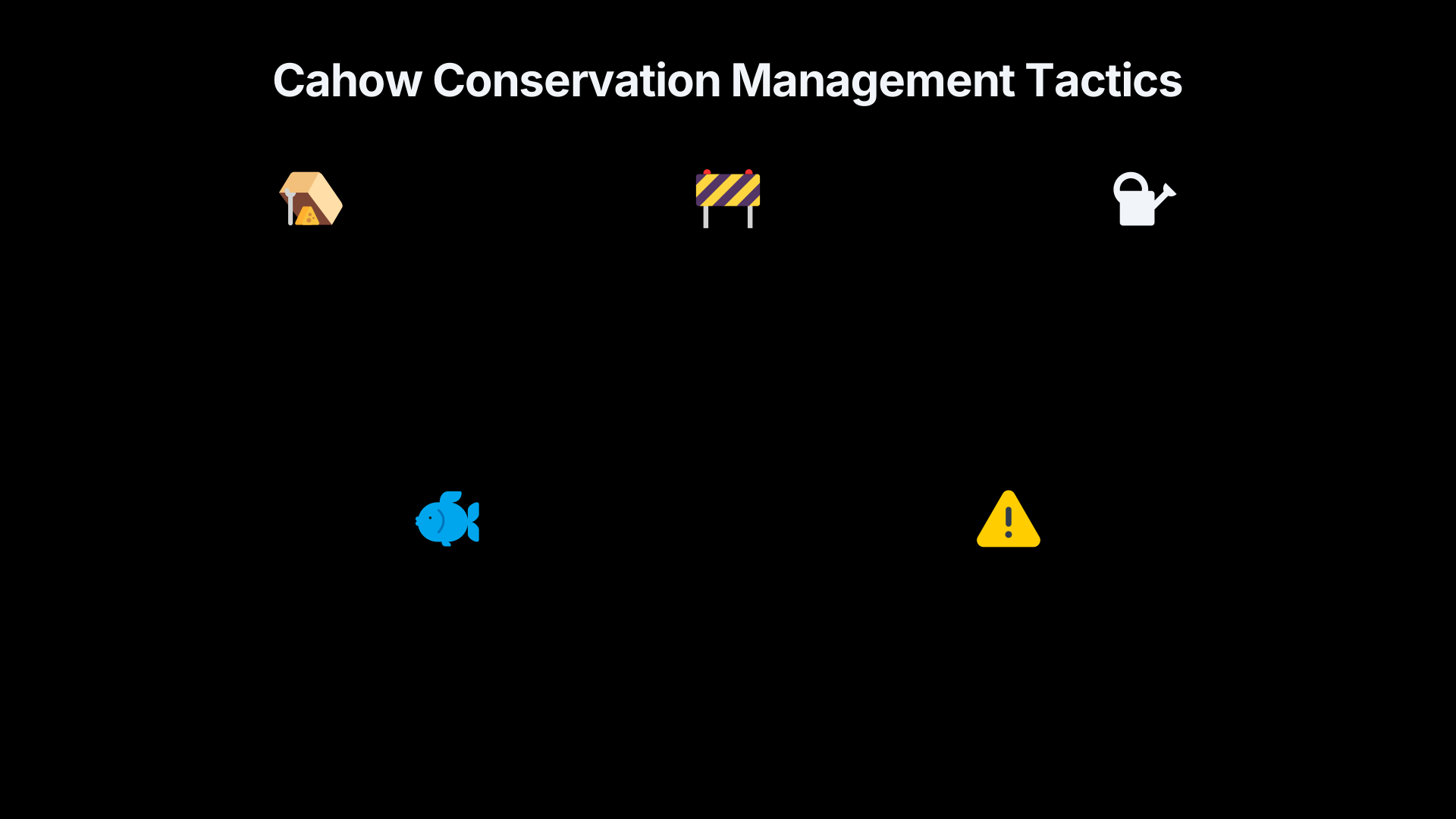
Can 18 breeding pairs save a species?
The answer, in the cahow’s case, appears to be yes—but only with extraordinary human assistance.
See on Amazon</a></div></div></article><article class="fr-book-card"><a class="fr-book-cover" href="https://www.amazon.com/s?k=The+Race+to+Save+the+Lord+God+Bird+by+Phillip+Hoose&i=stripbooks&tag=searcht-20" target="_blank" rel="sponsored noopener noreferrer" aria-label="Open The Race to Save the Lord God Bird on Amazon"><span class="fr-book-cover-fallback">Book</span><img class="fr-book-cover-thumb" src="https://books.google.com/books/content?id=4uZuAwAAQBAJ&printsec=frontcover&img=1&zoom=1&edge=curl&source=gbs_api" alt="Cover for The Race to Save the Lord God Bird" loading="lazy" decoding="async" fetchpriority="low" referrerpolicy="no-referrer" onerror="this.hidden=true;this.closest('.fr-book-cover').classList.add('fr-book-cover-placeholder');"></a><div class="fr-book-info"><h4 class="fr-book-title"><a href="https://www.amazon.com/s?k=The+Race+to+Save+the+Lord+God+Bird+by+Phillip+Hoose&i=stripbooks&tag=searcht-20" target="_blank" rel="sponsored noopener noreferrer" title="The Race to Save the Lord God Bird">The Race to Save the Lord God Bird</a></h4><p class="fr-book-author">By Phillip Hoose</p><p class="fr-book-desc">Explores evidence, searches and survival claims for a presumed-lost bird.</p><div class="fr-book-actions"><a href="https://www.amazon.com/s?k=The+Race+to+Save+the+Lord+God+Bird+by+Phillip+Hoose&i=stripbooks&tag=searcht-20" class="fr-amazon-btn" target="_blank" rel="sponsored noopener noreferrer">
See on Amazon</a></div></div></article><article class="fr-book-card"><a class="fr-book-cover" href="https://www.amazon.com/s?k=The+Song+Of+The+Dodo+by+David+Quammen&i=stripbooks&tag=searcht-20" target="_blank" rel="sponsored noopener noreferrer" aria-label="Open The Song Of The Dodo on Amazon"><span class="fr-book-cover-fallback">Book</span><img class="fr-book-cover-thumb" src="https://books.google.com/books/content?id=53kuEeItYtIC&printsec=frontcover&img=1&zoom=1&edge=curl&source=gbs_api" alt="Cover for The Song Of The Dodo" loading="lazy" decoding="async" fetchpriority="low" referrerpolicy="no-referrer" onerror="this.hidden=true;this.closest('.fr-book-cover').classList.add('fr-book-cover-placeholder');"></a><div class="fr-book-info"><h4 class="fr-book-title"><a href="https://www.amazon.com/s?k=The+Song+Of+The+Dodo+by+David+Quammen&i=stripbooks&tag=searcht-20" target="_blank" rel="sponsored noopener noreferrer" title="The Song Of The Dodo">The Song Of The Dodo</a></h4><p class="fr-book-author">By David Quammen</p><p class="fr-book-desc">Island ecology and extinction dynamics closely match Bermuda petrel themes.</p><div class="fr-book-actions"><a href="https://www.amazon.com/s?k=The+Song+Of+The+Dodo+by+David+Quammen&i=stripbooks&tag=searcht-20" class="fr-amazon-btn" target="_blank" rel="sponsored noopener noreferrer">
See on Amazon</a></div></div></article><article class="fr-book-card"><a class="fr-book-cover" href="https://www.amazon.com/s?k=The+Sixth+Extinction+by+Elizabeth+Kolbert&i=stripbooks&tag=searcht-20" target="_blank" rel="sponsored noopener noreferrer" aria-label="Open The Sixth Extinction on Amazon"><span class="fr-book-cover-fallback">Book</span><img class="fr-book-cover-thumb" src="https://books.google.com/books/content?id=wlnCAwAAQBAJ&printsec=frontcover&img=1&zoom=1&edge=curl&source=gbs_api" alt="Cover for The Sixth Extinction" loading="lazy" decoding="async" fetchpriority="low" referrerpolicy="no-referrer" onerror="this.hidden=true;this.closest('.fr-book-cover').classList.add('fr-book-cover-placeholder');"></a><div class="fr-book-info"><h4 class="fr-book-title"><a href="https://www.amazon.com/s?k=The+Sixth+Extinction+by+Elizabeth+Kolbert&i=stripbooks&tag=searcht-20" target="_blank" rel="sponsored noopener noreferrer" title="The Sixth Extinction">The Sixth Extinction</a></h4><p class="fr-book-author">By Elizabeth Kolbert</p><p class="fr-book-desc">Provides conservation context for species recovery efforts.</p><div class="fr-book-actions"><a href="https://www.amazon.com/s?k=The+Sixth+Extinction+by+Elizabeth+Kolbert&i=stripbooks&tag=searcht-20" class="fr-amazon-btn" target="_blank" rel="sponsored noopener noreferrer">
See on Amazon</a></div></div></article></div><div class="fr-section-footer"><div class="fr-browse-links" aria-label="Browse more on Amazon"><span class="fr-browse-links-label">Browse more on Amazon:</span><a class="fr-browse-more" href="https://www.amazon.com/s?k=Hope+Is+the+Thing+With+Feathers&i=stripbooks&tag=searcht-20" target="_blank" rel="sponsored noopener noreferrer">Hope Is the Thing With Feathers</a><a class="fr-browse-more" href="https://www.amazon.com/s?k=The+Race+to+Save+the+Lord+God+Bird&i=stripbooks&tag=searcht-20" target="_blank" rel="sponsored noopener noreferrer">The Race to Save the Lord God Bird</a><a class="fr-browse-more" href="https://www.amazon.com/s?k=The+Song+Of+The+Dodo&i=stripbooks&tag=searcht-20" target="_blank" rel="sponsored noopener noreferrer">The Song Of The Dodo</a></div><p class="fr-disclosure">As an Amazon Associate I earn from qualifying purchases.</p></div></div></section>
Amazon book picks
Further Reading
Books and field guides related to Can 18 Breeding Pairs Save a Species?. Use these as the next step if you want deeper reading beyond the article.
Hope Is the Thing With Feathers
Focuses on lost and rediscovered birds, fitting the cahow story.
The Race to Save the Lord God Bird
Explores evidence, searches and survival claims for a presumed-lost bird.
The Song Of The Dodo
Island ecology and extinction dynamics closely match Bermuda petrel themes.
eBay marketplace picks
Marketplace Samples
Live-tested eBay searches with available results related to this page.

Endnotes
1.
Source: Wikipedia
Title: Bermuda petrel
Link:https://en.wikipedia.org/wiki/Bermuda_petrel
2.
Source: datazone.birdlife.org
Link:https://datazone.birdlife.org/species/factsheet/bermuda-petrel-pterodroma-cahow
3.
Source: environment.bm
Title: cahow recovery programme
Link:https://environment.bm/cahow-recovery-programme
4.
Source: atlanticconservationpartnership.org
Link:https://atlanticconservationpartnership.org/conservation-research/cahow-recovery-project/
5.
Source: Wikipedia
Title: Ecology of Bermuda
Link:https://en.wikipedia.org/wiki/Ecology_of_Bermuda
6.
Source: conservation-services.squarespace.com
Link:https://conservation-services.squarespace.com/s/Bermuda-Petrel-Cahow-2005.pdf
7.
Source: researchgate.net
Link:https://www.researchgate.net/publication/259419612_Breeding_biology_and_population_increase_of_the_Endangered_Bermuda_Petrel_Pterodroma_cahow
8.
Source: researchgate.net
Title: 309032909 Conservation and at sea range of Bermuda Petrel Pterodroma cahow
Link:https://www.researchgate.net/publication/309032909_Conservation_and_at-sea_range_of_Bermuda_Petrel_Pterodroma_cahow
9.
Source: audubon.org
Title: Review: Rare Birds, The Extraordinary Tale of the Bermuda
Link:https://www.audubon.org/news/review-rare-birds-extraordinary-tale-bermuda-petrel-and-man-who-brought-it-back
10.
Source: audubon.org
Link:https://www.audubon.org/magazine/it-takes-helicopter-parent-rescue-rare-seabird-extinction
11.
Source: ecosphere-documents-production-public.s3.amazonaws.com
Link:https://ecosphere-documents-production-public.s3.amazonaws.com/sams/public_docs/species_nonpublish/2761.pdf
12.
Source: birdscaribbean.org
Title: bermuda petrel
Link:https://www.birdscaribbean.org/tag/bermuda-petrel/
13.
Source: explorer.natureserve.org
Title: Pterodroma cahow
Link:https://explorer.natureserve.org/Taxon/ELEMENT_GLOBAL.2.101145/Pterodroma_cahow
14.
Source: Wikipedia
Link:https://en.wikipedia.org/wiki/Bermuda
15.
Source: nwf.org
Title: Bermuda Petrels
Link:https://www.nwf.org/Magazines/National-Wildlife/2013/FebMarch/Conservation/Bermuda-Petrels
16.
Source: nonsuchisland.com
Title: The Nonsuch Expeditions Cahow History
Link:https://www.nonsuchisland.com/cahow-history
18.
Source: gov.bm
Link:https://www.gov.bm/
19.
Source: facebook.com
Title: exciting news from bermuda a cahow bermudas national bird hatched on nonsuch isl
Link:https://www.facebook.com/bermudatourism/posts/exciting-news-from-bermuda-a-cahow-bermudas-national-bird-hatched-on-nonsuch-isl/1379781774184179/
20.
Source: facebook.com
Title: on endangeredspeciesday we wanted to share an optimistic recovery story the caho
Link:https://www.facebook.com/waittinstitute/posts/on-endangeredspeciesday-we-wanted-to-share-an-optimistic-recovery-story-the-caho/10158250034444709/
21.
Source: todayinconservation.com
Title: january 28 bermuda petrel thought extinct for 300 years re discovered 1951
Link:https://todayinconservation.com/2018/01/january-28-bermuda-petrel-thought-extinct-for-300-years-re-discovered-1951/
22.
Source: facebook.com
Link:https://www.facebook.com/wildheart500/posts/they-thought-this-bird-was-gone-for-over-300-years-and-then-it-came-backin-the-e/933315443025440/
23.
Source: reddit.com
Link:https://www.reddit.com/r/Awwducational/comments/gj01wi/the_bermuda_petrel_was_thought_to_be_extinct_for/
24.
Source: birdsoutsidemywindow.org
Title: rare bird rediscovering the cahow
Link:https://www.birdsoutsidemywindow.org/2010/09/07/rare-bird-rediscovering-the-cahow/
25.
Source: youtube.com
Title: BOC Meeting 2.11.22
Link:https://www.youtube.com/watch?v=CGbZ9s0TMUk
26.
Source: youtube.com
Title: The Bermuda Petrel: tragedies & triumphs
Link:https://www.youtube.com/watch?v=3O_dd4TcZJE
27.
Source: youtube.com
Title: Nonsuch Island: An Oasis For The Bermuda Cahow
Link:https://www.youtube.com/watch?v=0CCOxIfZ-1o
Topic Tree