Within Cryptozoology
When Monsters Are Ordinary Animals
Many monster reports become less mysterious when bears, eels, sturgeon, seals, logs, or ordinary wildlife are considered.
On this page
- Animals often mistaken for cryptids
- Why scale and context fool witnesses
- How better identification changes the claim
Page outline Jump by section
Introduction
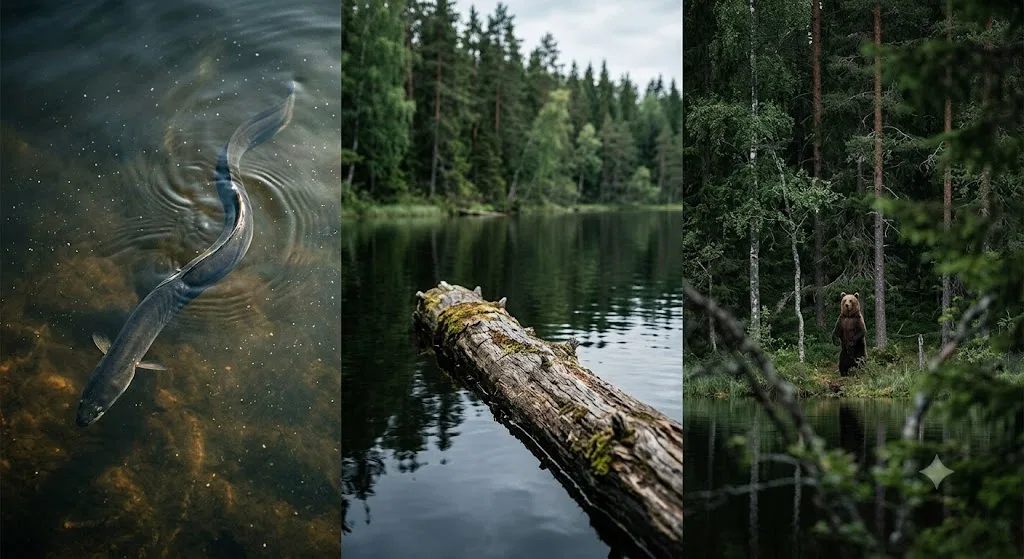
Many monster reports become less mysterious when the first question changes from “What unknown creature was this?” to “What known animal could look strange in those conditions?” In cryptozoology, misidentification is not a lazy dismissal of witnesses; it is one of the main mechanisms by which ordinary wildlife becomes extraordinary. A bear briefly standing on its hind legs, a sturgeon surfacing in dark water, a diseased coyote with most of its fur gone, a deep-sea oarfish washing ashore, or a rotting basking shark losing its familiar shape can all produce reports that feel sincere, vivid and wrong at the same time.
The strongest cases are not simply guesses. DNA tests, environmental DNA surveys, carcass analysis, wildlife disease knowledge and repeated field observations have shown that many alleged cryptids are better explained by known animals seen at bad angles, at long distance, in poor light, out of habitat, or after decomposition has changed their appearance. That does not explain every story ever told, but it changes the evidential starting point: before invoking a hidden monster, investigators have to rule out the animals already present.
Animals often mistaken for cryptids
Bears behind Bigfoot and Yeti reports
Large bears are among the most plausible sources of ape-like monster reports because they can look briefly human when standing upright, walking on hind legs, or glimpsed through trees. This does not mean every Bigfoot or Yeti account is “just a bear”, but it gives investigators a strong baseline explanation in regions where bears live.
A 2024 paper in the Journal of Zoology tested the idea that North American Bigfoot or Sasquatch sightings might correlate with American black bear populations. The study modelled sightings across the United States and Canada while adjusting for human population and forest area, and found that sightings were statistically associated with bear populations: on average, every additional 1,000 bears was linked with a 4% increase in reported Sasquatch sightings. The careful wording matters. The study did not prove that every reported Bigfoot was a bear; it showed that where there are more bears, there tend to be more Bigfoot reports, which is exactly what a misidentification hypothesis would predict.[ZSL Publications]zslpublications.onlinelibrary.wiley.comZSL Publications Bigfoot: If it's there, could it be a bear?ZSL Publications Bigfoot: If it's there, could it be a bear?
Hair and relic samples tell a similar story. A 2014 Proceedings of the Royal Society B study analysed hair samples attributed to Yeti, Bigfoot and other “anomalous primates”. The results matched known animals rather than an unknown ape, including bears, horses, canids, deer, sheep, a porcupine, a raccoon and a human sample. Science reporting on the study noted that none of the analysed samples provided evidence for a cryptid primate, even though two Himalayan samples initially raised questions about unusual bear ancestry.[Royal Society Publishing+2Science.org]royalsocietypublishing.orgOpen source on royalsocietypublishing.org.
Yeti-linked material has also repeatedly resolved into bear evidence. Later work on alleged Yeti samples from the Himalayan region found that most came from local bear species, with one outlier identified as dog; the broader implication was that the biological foundation of some Yeti traditions could include encounters with Himalayan brown bears, Tibetan brown bears, Asian black bears or related local wildlife rather than a hidden hominin.[Time]time.comAre Yetis Real? They're Probably Just Himalayan Brown Bears, Scientists SayAre Yetis Real? They're Probably Just Himalayan Brown Bears, Scientists Say
The important lesson is not that witnesses are foolish. A large bear in snow, fog, dense forest or steep terrain is a genuinely ambiguous stimulus. If a person already knows local stories about an ape-like wild man, the mind has a ready-made category into which that brief sighting can fall.
Eels, sturgeon and other “lake monster” candidates
Lake monsters often depend on distance and surface distortion. A witness sees a dark moving form, a hump, a neck-like shape, a wake, a rolling body or a long shadow below the surface. Without a clear scale reference, a fish, bird, otter, seal, log or wave train can be promoted into something far larger.
Loch Ness is the classic test case. In 2019, a University of Otago-led environmental DNA survey reported no evidence in Loch Ness for a plesiosaur-like reptile, shark, catfish or sturgeon. The survey did find eel DNA at many sampling locations, leading Professor Neil Gemmell to say that a very large eel remained a hypothesis the data could not refute, although the DNA could not show eel size. The result did not prove a giant eel is responsible for Nessie reports, but it did narrow the discussion from prehistoric reptile towards known life in the loch.[University of Otago]otago.ac.nzfirst edna study of loch ness points to something fishyfirst edna study of loch ness points to something fishy
Older surface watches at Loch Ness also show how ordinary events can generate “sightings” under controlled observation. The Loch Ness Project’s archive records a 1962 expedition that placed film cameras around the loch, covering large portions of the surface for hundreds of hours. Observers made 19 “sightings” and concluded that multi-hump “sea serpent” effects were caused by boat wakes, while diving birds explained some long-neck reports. Some echo-sounding contacts remained unexplained, but the exercise showed that monster-like appearances can be generated by known surface activity.[lochnessproject.org]lochnessproject.orgOpen source on lochnessproject.org.
In North American lakes, sturgeon are a particularly important comparison animal. The U.S. Fish & Wildlife Service notes that lake sturgeon can weigh up to 300 pounds and measure around seven feet long, with armour-like bodies and barbels hanging from the snout. Its own public explainer says lake sturgeon could easily be mistaken for mythical Great Lakes monsters such as Bessie of Lake Erie, Kingstie of Lake Ontario or Mishipeshu of Lake Superior.[U.S. Fish and Wildlife Service]fws.govU.S. Fish and Wildlife Service“Tails” from the deepU.S. Fish and Wildlife Service“Tails” from the deep
This does not mean sturgeon explain every lake monster. Some lakes lack resident sturgeon populations, and some eyewitness descriptions do not fit fish anatomy well. But sturgeon show why “known animal” does not always mean “small” or “ordinary-looking”. A rare, armoured, long-lived fish surfacing unexpectedly can feel prehistoric because, visually, it almost is.
Oarfish and living sea-serpent impressions
At sea, the giant oarfish is one of the strongest real-world sources for sea-serpent imagery. NOAA Fisheries describes the giant oarfish as a deep-sea animal that can grow beyond 20 feet, with a long tapering body and a striking dorsal fin running from the head to the tail. NOAA geneticist Russ Vetter said its body form has “all the qualities you would want in a sea serpent”, making it easy to see why rare encounters could feed sea-monster stories.[NOAA Fisheries]fisheries.noaa.govgiant oarfishgiant oarfish
The Biodiversity Heritage Library makes the same point through historical natural-history sources. Older sea-serpent accounts often included manes, hair-like growths or crests near the head. Oarfish have a red crest and a long dorsal fin, and their ribbon-like bodies can look startling when seen at the surface or washed up dead. The same source also notes that basking sharks, the second-largest living fish, have been mistaken for sea serpents, especially when decomposed.[Biodiversity Heritage Library]blog.biodiversitylibrary.orgthe quest for sea serpent oarfish orthe quest for sea serpent oarfish or
The oarfish is useful because it shows how cryptid reports can begin with a truly remarkable animal. A witness does not need to invent anything. A rarely seen deep-sea fish, already long and strange, arrives at the surface where humans lack experience with it. Folklore then does the rest.
Basking sharks and “pseudo-plesiosaur” carcasses
Some of the most dramatic sea-monster claims come from carcasses, not live sightings. Decomposition can turn a familiar animal into a false anatomical puzzle. Basking sharks are especially notorious because their cartilaginous bodies decay in ways that can leave a long spine-like “neck”, a small-looking head and paddle-like remains.
A recent Guardian investigation into a 1937 Canadian “Cadborosaurus” carcass explains why many scientists now regard the remains as likely to have been a decomposing basking shark, while some cryptozoologists still dispute that identification. Marine biologist Ben Speers-Roesch described the “pseudo-plesiosaur carcass” phenomenon: when basking sharks decay, they can appear to have a long neck, small head and large paddles, closely matching popular expectations of a prehistoric marine reptile.[The Guardian]theguardian.comExperts now believe the carcass was likely a decomposing basking shark, known to transform significantly during decay, often appearing as…
The same pattern appeared in the 1977 Zuiyō Maru case, when a Japanese trawler pulled up a carcass near New Zealand that some interpreted as a surviving plesiosaur. Later analysis of amino acids in muscle tissue suggested that the carcass was most likely a basking shark. This case remains famous because it shows the power of decomposition to produce a monster-like body even when photographs and tissue samples exist.[Wikipedia]WikipediaZuiyo-maru carcassZuiyo-maru carcass
Basking sharks also create live-sighting problems. The Library of Congress notes that a basking shark feeding near the surface can present a long conical snout, gill slits that may look like a mane, and an enormous body just under the waves. A startled observer expecting a serpent may therefore assemble separate visible parts into a single snake-like creature.[The Library of Congress]blogs.loc.govgreat american sea serpentgreat american sea serpent
Mange, coyotes and the chupacabra
Not all misidentified animals are large. Sometimes the “monster” effect comes from illness. The chupacabra, often described in North American reports as a hairless, grey, predatory creature with an uncanny body shape, is one of the clearest examples.
Texas A&M AgriLife Research explains that many chupacabra sightings are likely coyotes with late-stage mange. Mange is caused by mites that burrow into the skin, producing irritation, lesions, fur loss, scabbing, thickened skin and weight loss. In canids, those symptoms can turn a familiar animal into a gaunt, hairless, dark-skinned figure that looks unlike a normal coyote.[AgriLife Today]agrilifetoday.tamu.eduAgri Life Today From spooky lore to science fact: Unmasking the 'chupacabraAgri Life Today From spooky lore to science fact: Unmasking the 'chupacabra
The behavioural side also fits. Texas A&M wildlife specialist John Tomeček notes that a coyote in late-stage mange may become bolder around residential areas because it is weak and desperate for food. That can place a sick animal near livestock pens, bins or houses, exactly where folklore expects the chupacabra to appear.[AgriLife Today]agrilifetoday.tamu.eduAgri Life Today From spooky lore to science fact: Unmasking the 'chupacabraAgri Life Today From spooky lore to science fact: Unmasking the 'chupacabra
This is a powerful misidentification mechanism because the animal is not merely mis-seen; it is genuinely abnormal. A mange-stricken coyote does not look like the healthy animal pictured in a field guide. The witness is right that something is wrong, but wrong about the cause.
Raccoons and “mystery carcass” monsters
The Montauk Monster shows how a small carcass can become an internet-age cryptid when decomposition, missing scale and viral sharing combine. In 2008, a strange animal carcass photographed on a Long Island beach was widely circulated as an unknown creature. Zoologist Darren Naish later argued from visible dentition, skull shape and front paws that it was most consistent with a raccoon whose appearance had been altered by decomposition and water action.[Tetrapod Zoology]tetzoo.commontauk monster a look backmontauk monster a look back
The case matters because it is not a traditional remote-wilderness monster story. It is a modern media event built around one image. Without the carcass being preserved, measured and sampled, the photograph had to carry more weight than it could bear. The “monster” label spread faster than anatomical checking, and by the time experts discussed raccoon features, the image had already become folklore.
The same pattern recurs whenever a bloated, hairless or partly scavenged animal washes ashore. Decomposition removes familiar cues first: fur slips, lips retract, jaws and teeth look exaggerated, and paws appear hand-like. A raccoon, dog, seal or shark can become briefly unrecognisable, especially when photographed without a ruler, location context or multiple angles.
Why scale and context fool witnesses
Misidentification is not just a problem of ignorance. It is a problem of perception under poor conditions. Monster reports often arise in exactly the settings where humans are weakest at judging size, distance and identity: open water, twilight, forests, snowfields, surf, fog, headlight glare and fast movement.
On water, scale is especially treacherous. A bird, otter, seal, fish, log or wave may be far away with no nearby object for comparison. A small dark head on a flat loch can look enormous if the observer assumes it is closer than it is. A line of waves can be read as humps on a single body. A diving bird can create a neck-like silhouette and then vanish, giving the impression of a large creature submerging. The Loch Ness Project archive’s record of boat wakes and diving birds producing controlled “sightings” is a good example of this mechanism in practice.[lochnessproject.org]lochnessproject.orgOpen source on lochnessproject.org.
In forests, the problem is partial visibility. A bear, moose, deer or human in dark clothing may be seen for only seconds through branches. The brain fills in hidden parts from expectation. If a large black shape rises, turns, smells strongly, crashes through brush or leaves large ambiguous tracks, the witness may remember a coherent creature rather than a sequence of uncertain glimpses.
At sea, unfamiliarity compounds the problem. Most people rarely see living oarfish, basking sharks, large rays, whales, seals or decomposing marine carcasses at close range. A giant oarfish is a real animal with sea-serpent proportions; a basking shark carcass can genuinely mimic a long-necked reptile. In these cases, the witness is not converting a mundane pigeon into a dragon. They are encountering wildlife so unusual that it already sits near the edge of ordinary experience.[NOAA Fisheries+2NOAA Fisheries]fisheries.noaa.govgiant oarfishgiant oarfish
Context also changes interpretation after the sighting. A report from “Loch Ness” is filtered through Nessie before it is filtered through eel, bird or wake. A hairless canid in Texas or Puerto Rican-influenced folklore is interpreted through chupacabra imagery. A large upright animal in the Pacific Northwest is compared with Sasquatch before it is compared with a bear. Cryptozoological categories can therefore shape the report as much as the animal did.
How better identification changes the claim
The value of better identification is that it moves a monster report from story to testable claim. Instead of asking whether a witness seemed honest, investigators can ask what evidence should exist if the proposed animal were real, and whether known animals account for the available data.
Environmental DNA is one example. The Loch Ness survey did not rely on a single photograph or eyewitness memory; it sampled genetic traces in the water. Its failure to find DNA from large candidate animals such as sturgeon, catfish or sharks, combined with abundant eel DNA, changed the range of plausible explanations. A hidden plesiosaur-like reptile became much harder to defend, while eels remained within the local biological evidence.[University of Otago]otago.ac.nzfirst edna study of loch ness points to something fishyfirst edna study of loch ness points to something fishy
DNA testing of alleged Bigfoot or Yeti hair performs a similar function. A hair sample is a stronger form of evidence than a sighting only if it can be identified independently. When such samples repeatedly match known mammals, the claim changes: the question is no longer “Was the witness excited?” but “Why did material presented as anomalous resolve into bear, horse, dog, deer, sheep, raccoon or human DNA?”[Royal Society Publishing+2Science.org]royalsocietypublishing.orgOpen source on royalsocietypublishing.org.
Carcass cases show the importance of preservation. The Zuiyō Maru remains could be tested, which allowed later analysis to support a basking-shark explanation. The Montauk Monster, by contrast, became harder to settle because the original body was not secured for formal examination. A photograph can suggest raccoon, dog, seal or shark, but without the specimen, uncertainty becomes part of the legend.[Wikipedia+2Tetrapod Zoology]WikipediaZuiyo-maru carcassZuiyo-maru carcass
Better identification also protects real animals. Calling a mange-stricken coyote a chupacabra obscures a wildlife disease problem. Calling a basking shark carcass a sea monster can distract from the fact that basking sharks are rare, vulnerable and historically persecuted in some waters. Calling sturgeon “monsters” may hide a conservation success story: these huge fish are not imaginary beasts but threatened, slow-maturing animals whose recovery requires decades of habitat and fisheries work. U.S. Fish and Wildlife Service+3AgriLife Today+3AgriLife Today[agrilifetoday.tamu.edu]agrilifetoday.tamu.eduAgri Life Today From spooky lore to science fact: Unmasking the 'chupacabraAgri Life Today From spooky lore to science fact: Unmasking the 'chupacabra
The strongest cryptozoological investigations therefore begin with ordinary zoology. They ask whether the place supports bears, eels, sturgeon, seals, coyotes, raccoons, sharks or oarfish; whether disease or decomposition could alter appearance; whether the sighting conditions distort scale; and whether physical evidence can be tested. When the answer is yes, the monster report does not necessarily become worthless. It becomes evidence of a different thing: how real animals, human perception and local legend combine to create cryptids.
Amazon book picks
Further Reading
Books and field guides related to When Monsters Are Ordinary Animals. Use these as the next step if you want deeper reading beyond the article.
Abominable Science!
Directly examines misidentification and natural explanations for monster reports.
Field Guide To Bigfoot, Yeti, & Other Mystery Primates Worldwide
Provides many cases that can be compared with misidentification explanations.
eBay marketplace picks
Marketplace Samples
Live-tested eBay searches with available results related to this page.


Endnotes
1.
Source: science.org
Title: bigfoot samples analyzed lab
Link:https://www.science.org/content/article/bigfoot-samples-analyzed-lab
2.
Source: time.com
Title: Are Yetis Real? They’re Probably Just Himalayan Brown Bears, Scientists Say
Link:https://time.com/5040754/yeti-bear-study/
3.
Source: lochnessproject.org
Link:https://www.lochnessproject.org/ARCHIVE%20ROOM/loch_ness_archive_timeline.htm
4.
Source: fisheries.noaa.gov
Title: giant oarfish
Link:https://www.fisheries.noaa.gov/podcast/giant-oarfish
5.
Source: Wikipedia
Title: Zuiyo-maru carcass
Link:https://en.wikipedia.org/wiki/Zuiyo-maru_carcass
6.
Source: Wikipedia
Title: Loch Ness Monster
Link:https://en.wikipedia.org/wiki/Loch_Ness_Monster
7.
Source: Wikipedia
Title: Montauk Monster
Link:https://en.wikipedia.org/wiki/Montauk_Monster
8.
Source: Wikipedia
Link:https://en.wikipedia.org/wiki/Oarfish
9.
Source: sea.vc
Link:https://sea.vc/
10.
Source: repository.library.noaa.gov
Link:https://repository.library.noaa.gov/view/noaa/23772
11.
Source: lochnessproject.org
Link:https://www.lochnessproject.org/FIELDWORKGROUNDTRUTH/eDNA%20LOCH%20NESS/eDNA%20LOCHNESS_index.html
12.
Source: zslpublications.onlinelibrary.wiley.com
Title: ZSL Publications Bigfoot: If it’s there, could it be a bear?
Link:https://zslpublications.onlinelibrary.wiley.com/doi/abs/10.1111/jzo.13148
13.
Source: royalsocietypublishing.org
Link:https://royalsocietypublishing.org/rspb/article/281/1789/20140161/77194/Genetic-analysis-of-hair-samples-attributed-to
14.
Source: otago.ac.nz
Title: first edna study of loch ness points to something fishy
Link:https://www.otago.ac.nz/news/newsroom/first-edna-study-of-loch-ness-points-to-something-fishy
15.
Source: fws.gov
Title: U.S. Fish and Wildlife Service“Tails” from the deep
Link:https://www.fws.gov/story/2024-02/tails-deep
16.
Source: blog.biodiversitylibrary.org
Title: the quest for sea serpent oarfish or
Link:https://blog.biodiversitylibrary.org/2014/10/the-quest-for-sea-serpent-oarfish-or
17.
Source: theguardian.com
Link:https://www.theguardian.com/environment/2026/may/07/basking-shark-sea-monster-canada-marine-mystery-90-years-on
18.
Source: blogs.loc.gov
Title: great american sea serpent
Link:https://blogs.loc.gov/folklife/2016/08/great-american-sea-serpent/
19.
Source: agrilifetoday.tamu.edu
Title: Agri Life Today From spooky lore to science fact: Unmasking the’chupacabra’
Link:https://agrilifetoday.tamu.edu/2024/10/15/unmasking-the-chupacabra/
20.
Source: tetzoo.com
Title: montauk monster a look back
Link:https://tetzoo.com/blog/2021/10/23/montauk-monster-a-look-back
21.
Source: theguardian.com
Title: loch ness monster could be a giant eel say scientists
Link:https://www.theguardian.com/science/2019/sep/05/loch-ness-monster-could-be-a-giant-eel-say-scientists
22.
Source: zslpublications.onlinelibrary.wiley.com
Link:https://zslpublications.onlinelibrary.wiley.com/doi/10.1111/jzo.13148
23.
Source: ndl.ethernet.edu.et
Link:https://ndl.ethernet.edu.et/bitstream/123456789/46979/1/George%20M.%20Eberhart.pdf
24.
Source: lairofmythics.com
Title: the montauk monster
Link:https://lairofmythics.com/blogs/cryptid-case-files/the-montauk-monster?srsltid=AfmBOooyGmyUlpKyffAR-HiQ-8UmTkKHHpPkyOnC662tPF9K0I-U7vNo
25.
Source: snopes.com
Title: the montauk monster
Link:https://www.snopes.com/fact-check/the-montauk-monster/
26.
Source: tetzoo.com
Title: sea monster sightings and the plesiosaur effect
Link:https://tetzoo.com/blog/2019/4/27/sea-monster-sightings-and-the-plesiosaur-effect
27.
Source: tetzoo.com
Title: shine natural history of sea serpents
Link:https://tetzoo.com/blog/2025/3/18/shine-natural-history-of-sea-serpents
28.
Source: lochness.com
Title: methods in madness with adrian shine mistaken monsters part 3
Link:https://lochness.com/news/methods-in-madness-with-adrian-shine-mistaken-monsters-part-3/
29.
Source: monster.fandom.com
Title: Montauk Monster
Link:https://monster.fandom.com/wiki/Montauk_Monster
30.
Source: sociallifemagazine.com
Title: montauk monster
Link:https://sociallifemagazine.com/the-archive/montauk-monster/
31.
Source: otago.ac.nz
Title: otago scientist reveals loch ness monster could be a giant eel
Link:https://www.otago.ac.nz/news/newsroom/otago-scientist-reveals-loch-ness-monster-could-be-a-giant-eel
32.
Source: science.howstuffworks.com
Title: sea monster
Link:https://science.howstuffworks.com/science-vs-myth/strange-creatures/sea-monster.htm
Additional References
33.
Source: youtube.com
Title: 8 Mythical Creatures Archaeologists Finally Proved Real
Link:https://www.youtube.com/watch?v=jFlgiaxCwyE
34.
Source: researchgate.net
Link:https://www.researchgate.net/publication/367247671_If_it%27s_there_could_it_be_a_bear
35.
Source: dokumen.pub
Link:https://dokumen.pub/abominable-science-origins-of-the-yeti-nessie-and-other-famous-cryptids-9780231526814.html
36.
Source: facebook.com
Link:https://www.facebook.com/sociatycom/posts/after-decades-of-searching-for-nessie-renowned-loch-ness-expert-adrian-shine-has/1426923499467302/
37.
Source: facebook.com
Link:https://www.facebook.com/memezarrr/posts/after-spending-more-than-six-decades-searching-the-waters-of-loch-ness-for-evide/1072493345350117/
38.
Source: facebook.com
Link:https://www.facebook.com/groups/1294386217413894/posts/2535251949993975/
39.
Source: reddit.com
Link:https://www.reddit.com/r/Cryptozoology/comments/19di7nu/bigfoot_and_black_bears_a_correlational_analysis/
40.
Source: facebook.com
Link:https://www.facebook.com/groups/1002571683091379/posts/26926821730239686/
41.
Source: facebook.com
Link:https://www.facebook.com/groups/324124619374230/posts/1521680666285280/
42.
Source: scribd.com
Link:https://www.scribd.com/document/245324444/Man-and-Mystery-Vol-13-Monsters-and-Cryptids-Rev06
Topic Tree