Within Pseudoscience
Why Failed Searches Do Not Kill Cryptids
Cryptid claims often survive failed expeditions by shifting the creature's habits, location or nature beyond easy testing.
On this page
- How searches should weaken a claim
- Common escape explanations after negative results
- When persistence becomes advocacy instead of inquiry
Page outline Jump by section
Introduction
Repeated failed searches should, in principle, reduce confidence in a claim. If a large unknown animal is said to live in a particular region, then years of expeditions, camera surveys, environmental DNA studies, specimen searches and field observations that find nothing ought to make the claim less likely. Yet famous cryptid beliefs often survive decades of negative results. Bigfoot, the Loch Ness Monster and similar creatures remain culturally influential despite the absence of accepted physical evidence and despite many unsuccessful attempts to find them.[Wikipedia]WikipediaOpen source on wikipedia.org. The reason is not simply stubbornness. Cryptid beliefs often persist because they are structured in ways that absorb failure. Missing evidence becomes part of the mystery rather than a reason to abandon the idea. Each unsuccessful search can be reinterpreted as evidence that the creature is rarer, smarter, more elusive or located somewhere else. This creates a situation in which belief becomes difficult to test and even harder to disprove.
How Searches Should Weaken a Claim
In scientific reasoning, a hypothesis gains credibility when it makes risky predictions that could turn out to be wrong. A claim about a hidden animal should therefore become weaker when expected evidence repeatedly fails to appear.
For example, a large breeding population should normally leave traces. Researchers would expect some combination of bodies, bones, genetic material, clear photographs, feeding signs, tracks, ecological effects or repeated observations. As searches accumulate without producing such evidence, confidence should gradually decline. This is especially true for claims involving large mammals or other conspicuous animals rather than tiny, obscure species.[Wikipedia]WikipediaOpen source on wikipedia.org.
This does not mean that one failed expedition disproves a claim. Remote environments are difficult to survey completely. However, the cumulative effect of many unsuccessful searches matters. Science generally treats repeated negative results as information rather than as irrelevant failures.
The key issue is whether a belief has a genuine failure condition. If no conceivable result would significantly lower confidence, then the belief is no longer functioning like a normal scientific hypothesis.
Why Negative Results Often Get Reinterpreted
Cryptid traditions frequently employ explanations that protect the central claim from disconfirmation. After a failed search, believers may argue that:<div class="content-enhancement content-enhancement--insight-grid" markdown="1">
- The creature is more intelligent than researchers assumed.
- It has migrated to a different area.
- It is primarily nocturnal.
- It avoids humans with unusual effectiveness.
- The search was conducted at the wrong time of year.
- The population is much smaller than expected.
- Authorities or scientists ignored important evidence.
- The creature possesses unusual abilities that make detection difficult.</div>
Each explanation can appear reasonable in isolation. The problem emerges when every negative result receives a new explanation that preserves the original belief. The hypothesis changes whenever evidence fails to support it.
Critics of cryptozoology often identify this as a central pseudoscientific pattern. Instead of allowing evidence to narrow possibilities, the possibilities expand whenever a prediction fails.[Scientific American]scientificamerican.commy new book hunting monsters cryptozoology and the reality behind the mythsScientific AmericanMy New Book Hunting Monsters: Cryptozoology and the…Feb 16, 2016 — Cryptozoologists have thought about this stuff a…
The Shift From Animal to Mystery
A notable feature of many cryptid traditions is that the creature gradually becomes harder to define over time.
Early claims often describe a physical animal living in a specific place. As searches fail, descriptions may become broader and less testable. Bigfoot, for example, has been portrayed not only as an undiscovered primate but, in some fringe accounts, as possessing paranormal traits that explain the lack of evidence. Similar shifts have occurred in other cryptid communities when conventional explanations struggle to fit the available evidence.[Tetrapod Zoology]tetzoo.comcomments on an interview with jeff meldrumTetrapod ZoologyeDNA, Footprints and the Biological Bigfoot23 Apr 2021 — DNA and eDNA, Bigfoot's Tale and Nessie's Too. On the subject…
This transformation changes the nature of the claim. A biological animal can be investigated through zoology and ecology. A creature whose defining feature is that it evades every method of detection becomes much harder to evaluate. The mystery itself starts to replace the original animal hypothesis.
The result is a moving target. Every improvement in search technology can be met with a corresponding expansion of the creature’s supposed abilities.
The Power of Anecdotes Over Absence
Negative evidence is psychologically weaker than vivid stories.
A witness account of a strange encounter is memorable and emotionally engaging. By contrast, a scientific survey that found nothing often feels uneventful. This imbalance helps explain why decades of failed searches may have less impact on public belief than a single dramatic sighting report.
The Loch Ness Monster provides a useful example. Despite extensive investigations, disputed photographs, sonar surveys and repeated failures to find convincing biological evidence, new sightings continue to attract attention. The narrative survives because each new report feels like fresh evidence, while the absence of findings feels abstract and less compelling.[Wikipedia]WikipediaLoch Ness MonsterLoch Ness Monster
Human beings also tend to remember apparent confirmations more readily than contradictions. Reports that fit existing expectations are often treated as meaningful, while negative results are discounted as incomplete or inconclusive.
Case Study: Loch Ness After Decades of Searches
The history of Loch Ness illustrates how belief can persist despite extensive investigation.
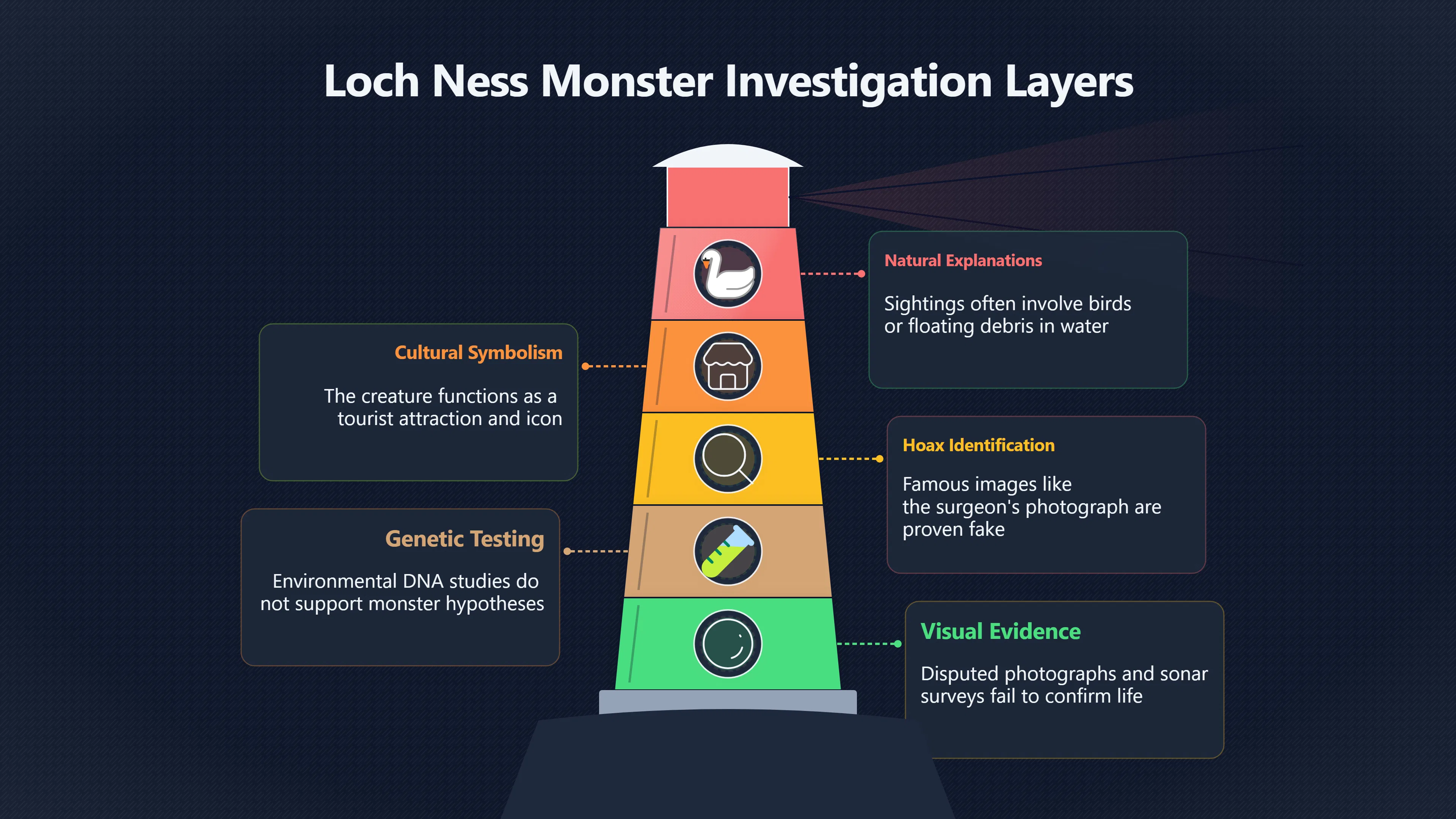
Many alleged sightings have later been attributed to hoaxes, misidentifications, boat wakes, floating objects, birds or optical effects. The famous”surgeon’s photograph” was eventually exposed as a hoax. Large-scale surveys have repeatedly failed to establish the presence of a giant unknown animal. Environmental DNA studies have also failed to support some popular monster hypotheses.[Wikipedia]WikipediaLoch Ness MonsterLoch Ness Monster
Yet belief has not disappeared. One reason is that every unresolved observation can be treated as a surviving clue. Another is that Nessie functions as more than a zoological claim. It has become a cultural symbol, a tourist attraction and a continuing mystery. Researchers and commentators have noted that the creature’s appeal extends beyond evidence for its existence.[National Geographic]nationalgeographic.comloch ness monster legendNational GeographicIs there any truth behind the legend of the Loch Ness…24 Oct 2024 — The Loch Ness monster has become a focus for th…
This means that failed searches do not merely compete with a biological hypothesis. They compete with a story that many people enjoy preserving.
When Persistence Becomes Advocacy Instead of Inquiry
There is a meaningful difference between continuing to investigate a possibility and defending a conclusion regardless of the evidence.
Inquiry asks what the evidence currently supports. Advocacy begins with the answer and searches for supporting material while explaining away contradictory findings. In mainstream science, repeated failures generally lower confidence in a claim. In some cryptid communities, repeated failures can instead reinforce commitment by demonstrating how elusive the creature supposedly is.[Scientific American]scientificamerican.commy new book hunting monsters cryptozoology and the reality behind the mythsScientific AmericanMy New Book Hunting Monsters: Cryptozoology and the…Feb 16, 2016 — Cryptozoologists have thought about this stuff a…
This distinction helps explain why failed searches rarely end cryptid belief. The issue is not simply that evidence is scarce. It is that negative evidence often has little power to change the underlying conviction. When every unsuccessful expedition becomes another chapter in the mystery rather than a reason to reassess the claim, belief can persist indefinitely.
A scientific claim remains strongest when it can lose. If no search result would significantly reduce confidence, then persistence may reflect commitment to a narrative rather than ongoing evaluation of a hypothesis.
Amazon book picks
Further Reading
Books and field guides related to Why Failed Searches Do Not Kill Cryptids. Use these as the next step if you want deeper reading beyond the article.
Why People Believe Weird Things
Analyzes paranormal and fringe claims that survive contrary evidence.
eBay marketplace picks
Marketplace Samples
Live-tested eBay searches with available results related to this page.
Endnotes
1.
Source: Wikipedia
Link:https://en.wikipedia.org/wiki/Bigfoot
2.
Source: Wikipedia
Title: Loch Ness Monster
Link:https://en.wikipedia.org/wiki/Loch_Ness_Monster
3.
Source: history.com
Title: Bigfoot Was Investigated by the FBI
Link:https://www.history.com/articles/bigfoot-fbi-file-investigation-discovery
4.
Source: history.com
Title: Loch Ness Monster
Link:https://www.history.com/articles/loch-ness-monster
5.
Source: nationalgeographic.com
Title: forensic expert says bigfoot is real
Link:https://www.nationalgeographic.com/culture/article/forensic-expert-says-bigfoot-is-real
6.
Source: scientificamerican.com
Title: my new book hunting monsters cryptozoology and the reality behind the myths
Link:https://www.scientificamerican.com/blog/tetrapod-zoology/my-new-book-hunting-monsters-cryptozoology-and-the-reality-behind-the-myths/
7.
Source: tetzoo.com
Title: comments on an interview with jeff meldrum
Link:https://tetzoo.com/blog/2021/4/23/comments-on-an-interview-with-jeff-meldrum
8.
Source: nationalgeographic.com
Title: loch ness monster legend
Link:https://www.nationalgeographic.com/history/article/loch-ness-monster-legend
9.
Source: scientificamerican.com
Link:https://www.scientificamerican.com/blog/observations/how-chasing-bigfoot-can-lead-to-actual-science/
10.
Source: scientificamerican.com
Link:https://www.scientificamerican.com/blog/news-blog/bigfoot-finding-turns-out-to-be-a-h-2008-08-19/
11.
Source: scientificamerican.com
Title: bigfoot expert weighs in im extreme 2008 08 14
Link:https://www.scientificamerican.com/blog/news-blog/bigfoot-expert-weighs-in-im-extreme-2008-08-14/
12.
Source: science.howstuffworks.com
Link:https://science.howstuffworks.com/science-vs-myth/strange-creatures/bigfoot.htm
Additional References
13.
Source: reddit.com
Link:https://www.reddit.com/r/Cryptozoology/comments/1d5jf4n/is_there_any_actual_evidence_of_bigfoot/
14.
Source: skepticalinquirer.org
Link:https://skepticalinquirer.org/2023/12/is-bigfoot-dead/
15.
Source: movieforums.com
Link:https://www.movieforums.com/community/showthread.php?t=71664
16.
Source: visitinvernesslochness.com
Link:https://www.visitinvernesslochness.com/the-lochness-monster
17.
Source: ebsco.com
Link:https://www.ebsco.com/research-starters/zoology/loch-ness-monster-cryptozoology
18.
Source: reddit.com
Link:https://www.reddit.com/r/Cryptozoology/comments/mrim12/loch_ness_theories/
19.
Source: dokumen.pub
Link:https://dokumen.pub/download/the-secret-history-of-bigfoot-9781464216633.html
20.
Source: nypost.com
Title: New York Post Is this the’answer’ to the Loch Ness Monster mystery?
Link:https://nypost.com/2024/12/19/science/scientists-simple-explanation-for-loch-ness-monster-mystery/
21.
Source: bitesizedfolklore.com
Title: beyond folklore the loch ness monsters impact on scottish identity
Link:https://bitesizedfolklore.com/episode/beyond-folklore-the-loch-ness-monsters-impact-on-scottish-identity
22.
Source: skepticalinquirer.org
Link:https://skepticalinquirer.org/wp-content/uploads/sites/29/2019/03/SI-SO-17.pdf
Topic Tree