Within New Species
What It Takes To Name An Animal
A new animal name needs checkable specimens and diagnostic traits, which is a much higher bar than sightings or folklore.
On this page
- Why type specimens anchor species names
- What a formal description must show
- How cryptid evidence falls short of taxonomy
Page outline Jump by section
Introduction
One of the biggest differences between a genuine zoological discovery and a cryptid claim is that zoology has formal rules for turning an observed animal into a recognised species. Seeing an unusual creature, collecting stories about it, or even obtaining a photograph is usually not enough. Modern animal taxonomy requires a name-bearing reference specimen, a published description, and evidence that the proposed species can be distinguished from known animals. These requirements exist so that later researchers can independently verify the claim rather than rely on trust, memory, or anecdote.[iczn.org]iczn.orgThe Code OnlineThe scientific name of a taxon at any rank above the species group consists of one name; that of a species, two names (a b… In the context of cryptozoology, this distinction is crucial. Unknown species are discovered regularly, but they enter science through a system designed to make claims testable. The gap between “people report seeing it” and “it is a recognised species” is filled by specimens, measurements, comparisons, and formal nomenclatural procedures.[OUP Academic]academic.oup.comOUP AcademicHow to describe a new species in zoology and avoid mistakesby MF Braby · 2024 · Cited by 60 — When designating a holotype, th…
Why Type Specimens Anchor Species Names
The foundation of zoological naming is the principle of typification. Under the International Code of Zoological Nomenclature (ICZN), every animal species name is tied to a name-bearing type. This provides an objective reference point for determining what the name actually applies to.[Wikipedia]WikipediaInternational Code of Zoological NomenclatureInternational Code of Zoological Nomenclature
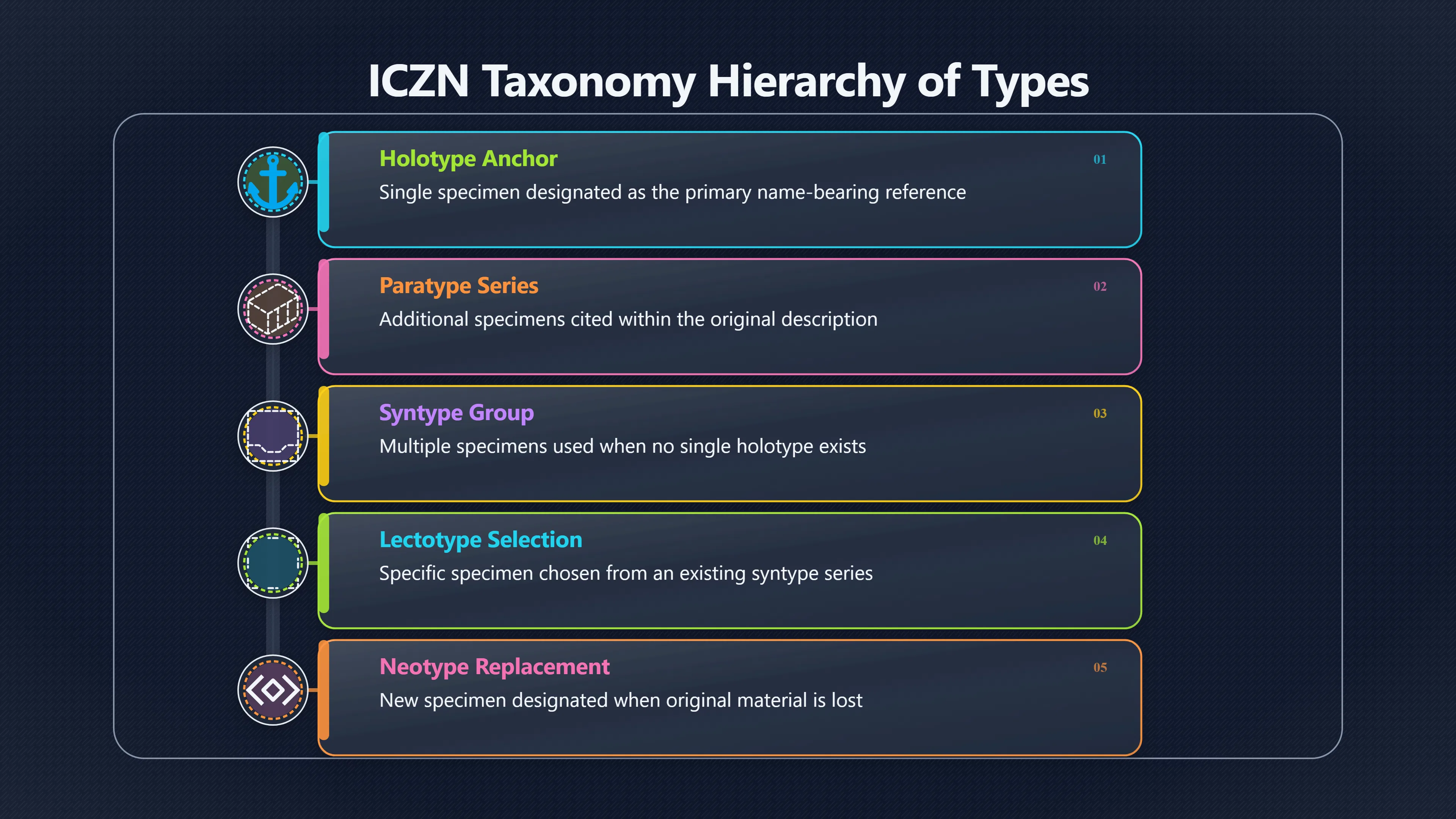
Most commonly, that reference is a holotype: a single specimen designated when the species is first described. The holotype is not necessarily the most typical individual of the species. Instead, it serves as the permanent anchor for the name. If later scientists disagree about how a species should be defined, they can return to the holotype and examine the original reference.[code.iczn.org]iczn.orgArticle 73. Name-bearing types fixed in the original publication …A holotype is the single specimen upon which a new nominal species-group taxon is based in the original publication.Read more
Taxonomists also use related categories:<div class="content-enhancement content-enhancement--insight-grid" markdown="1">
- Paratypes are additional specimens cited in the original description.
- Syntypes are multiple name-bearing specimens used when no single holotype was designated.
- Lectotypes can later be selected from a syntype series.
What a Formal Description Must Show
Possessing a specimen alone does not automatically create a new species. The specimen must be accompanied by a formal scientific description that demonstrates why the animal is distinct from already known species.[OUP Academic]academic.oup.comOUP AcademicHow to describe a new species in zoology and avoid mistakesby MF Braby · 2024 · Cited by 60 — When designating a holotype, th…
A modern species description typically includes:<div class="content-enhancement content-enhancement--metric" markdown="1">
- Diagnostic features that separate the proposed species from close relatives.
- Detailed measurements and anatomical information.
- Locality data showing where the specimen was collected.
- Information about sex, developmental stage, and collector when relevant.
- Identification of the repository where the type specimen is stored.
- Comparisons with similar known species.
- Increasingly, genetic evidence when appropriate and available.[code.iczn.org]iczn.orgArticle 73. Name-bearing types fixed in the original publication …A holotype is the single specimen upon which a new nominal species-group taxon is based in the original publication.Read more</div>
The crucial concept is the diagnosis. Taxonomists must show that the proposed species possesses characteristics that reliably distinguish it from recognised species. Simply being unusual or difficult to identify is not enough. A claim must survive comparison against museum collections, published literature, and existing taxonomic knowledge.[OUP Academic]academic.oup.comOUP AcademicHow to describe a new species in zoology and avoid mistakesby MF Braby · 2024 · Cited by 60 — When designating a holotype, th…
This requirement explains why many species discoveries emerge from museum research. Scientists sometimes find that specimens collected decades earlier actually represent undescribed species once they are compared carefully with related forms. The evidence is not a surprising sighting but a demonstrable set of distinguishing traits.[OUP Academic]academic.oup.comOUP AcademicHow to describe a new species in zoology and avoid mistakesby MF Braby · 2024 · Cited by 60 — When designating a holotype, th…
Why Museums Matter More Than Eyewitnesses
Taxonomy is designed around reproducibility. A species description should remain useful long after the original discoverer is gone. For that reason, type specimens are usually deposited in recognised museum collections where other researchers can access them.[OUP Academic]academic.oup.comOUP AcademicHow to describe a new species in zoology and avoid mistakesby MF Braby · 2024 · Cited by 60 — When designating a holotype, th…
Museum preservation allows later scientists to:<div class="content-enhancement content-enhancement--caution" markdown="1">
- Re-examine anatomical features.
- Apply new technologies such as CT scanning.
- Extract DNA when feasible.
- Resolve disputes about identification.
Can a Species Ever Be Named Without a Preserved Specimen?
How Cryptid Evidence Falls Short of Taxonomy
Many famous cryptids illustrate exactly why taxonomy demands more than sightings.
Reports of creatures such as Bigfoot, the Loch Ness Monster, or other legendary animals often involve eyewitness accounts, folklore traditions, tracks, sounds, photographs, or disputed biological samples. Such evidence may justify investigation, but it generally does not satisfy the standards required to establish a new species. There is usually no accepted type specimen, no verifiable diagnostic description, and no material that allows independent researchers to confirm the claim.[Liverpool Museums]liverpoolmuseums.org.ukLiverpool MuseumsWhat's a type? A guide to type specimensThe Code also formalised the principle of “typification”. This is the principle…
From a taxonomic perspective, the problem is not merely scepticism. It is the absence of a stable reference point. If different witnesses describe different-looking animals, which one carries the name? If a photograph is ambiguous, what anatomical features can later scientists measure? If a hair sample cannot be linked to a specific individual, how can researchers verify its origin? Type specimens exist precisely to solve these problems.[eprints.cmfri.org.in]eprints.cmfri.org.inThe purposeTypes of Typesby RG Kumar · 2013 · Cited by 1 — In zoological nomenclature, a type is a specimen (or a group of specimens) which serves t…
This is why most undiscovered species become recognised through collected specimens and formal descriptions rather than through decades of sightings. Taxonomy requires evidence that can be revisited, reanalysed, and challenged. Cryptid claims often generate intriguing observations, but without the kinds of physical reference material and diagnostic proof required by zoological nomenclature, they remain outside the framework that turns an animal from a reported mystery into a recognised species.[OUP Academic+2bio-nica.info]academic.oup.comOUP AcademicHow to describe a new species in zoology and avoid mistakesby MF Braby · 2024 · Cited by 60 — When designating a holotype, th…
Amazon book picks
Further Reading
Books and field guides related to What It Takes To Name An Animal. Use these as the next step if you want deeper reading beyond the article.
The Species Seekers: Heroes, Fools, and the Mad Pursuit of Li...
Explains how specimens and formal descriptions establish species.
Why Evolution is True
Provides background on evidence, classification, and species concepts.
eBay marketplace picks
Marketplace Samples
Live-tested eBay searches with available results related to this page.
Endnotes
1.
Source: iczn.org
Link:https://www.iczn.org/the-code/the-code-online/
2.
Source: academic.oup.com
Link:https://academic.oup.com/zoolinnean/article/202/4/zlae043/7664331
3.
Source: bio-nica.info
Link:https://www.bio-nica.info/biblioteca/ICZNCode.pdf
4.
Source: Wikipedia
Title: International Code of Zoological Nomenclature
Link:https://en.wikipedia.org/wiki/International_Code_of_Zoological_Nomenclature
5.
Source: code.iczn.org
Link:https://code.iczn.org/types-in-the-species-group/article-73-name-bearing-types-fixed-in-the-original-publication-[holotypes
6.
Source: iczn.org
Link:https://www.iczn.org/outreach/faqs/
7.
Source: Wikipedia
Title: Name-bearing type
Link:https://en.wikipedia.org/wiki/Name-bearing_type
8.
Source: eprints.cmfri.org.in
Title: The purpose
Link:https://eprints.cmfri.org.in/9651/1/Rahul_G._Kumar.pdf
9.
Source: Wikipedia
Title: Type (biology)
Link:https://en.wikipedia.org/wiki/Type_%28biology%29
10.
Source: code.iczn.org
Title: article 72 general provisions
Link:https://code.iczn.org/types-in-the-species-group/article-72-general-provisions/
11.
Source: iczn.org
Link:https://www.iczn.org/assets/c94dbdf0a7/Manual-for-Parts-of-the-List-of-Available-Names-in-Zoology-definitive-version-aproved-in-SingaporeA.pdf
12.
Source: liverpoolmuseums.org.uk
Link:https://www.liverpoolmuseums.org.uk/stories/whats-type-guide-type-specimens
Additional References
13.
Source: researchgate.net
Link:https://www.researchgate.net/publication/356174382_When_zoological_type_specimens_are_lost_ICZN-compliant_guidelines_for_when_and_when_not_to_designate_neotypes_Version_12-ix-2018
14.
Source: hooghlywomenscollege.ac.in
Link:https://hooghlywomenscollege.ac.in/ol%20doc/2nd%20SEM.%20Botany%20%28general%29%20sub.%20code-%20CC-1B-%20Type%20specimen.pdf
15.
Source: naturalhistory.museumwales.ac.uk
Title: What are Type Specimens?
Link:https://naturalhistory.museumwales.ac.uk/molluscatypes/TypeSpecimens.php
16.
Source: zookeys.pensoft.net
Link:https://zookeys.pensoft.net/article/10945/
17.
Source: zookeys.pensoft.net
Link:https://zookeys.pensoft.net/article/117699/
18.
Source: researchgate.net
Link:https://www.researchgate.net/post/If-a-new-species-is-described-using-1-holotype-and-multiple-syntypes-which-specimens-is-are-the-types-Is-the-name-actually-available
19.
Source: youtube.com
Title: How Do Dinosaurs Get Their Names?
Link:https://www.youtube.com/watch?v=Wrdmw_Ioovk
20.
Source: youtube.com
Link:https://www.youtube.com/watch?v=kowCBgcUB6Y
21.
Source: youtube.com
Title: Holotype: the name bearer of a species
Link:https://www.youtube.com/watch?v=lJybVwSh_Js
22.
Source: youtube.com
Title: What is a Holotype?
Link:https://www.youtube.com/watch?v=F4ctuuQ_jQk
Topic Tree