Within Sightings
Why Honest Witnesses Can Still Be Wrong
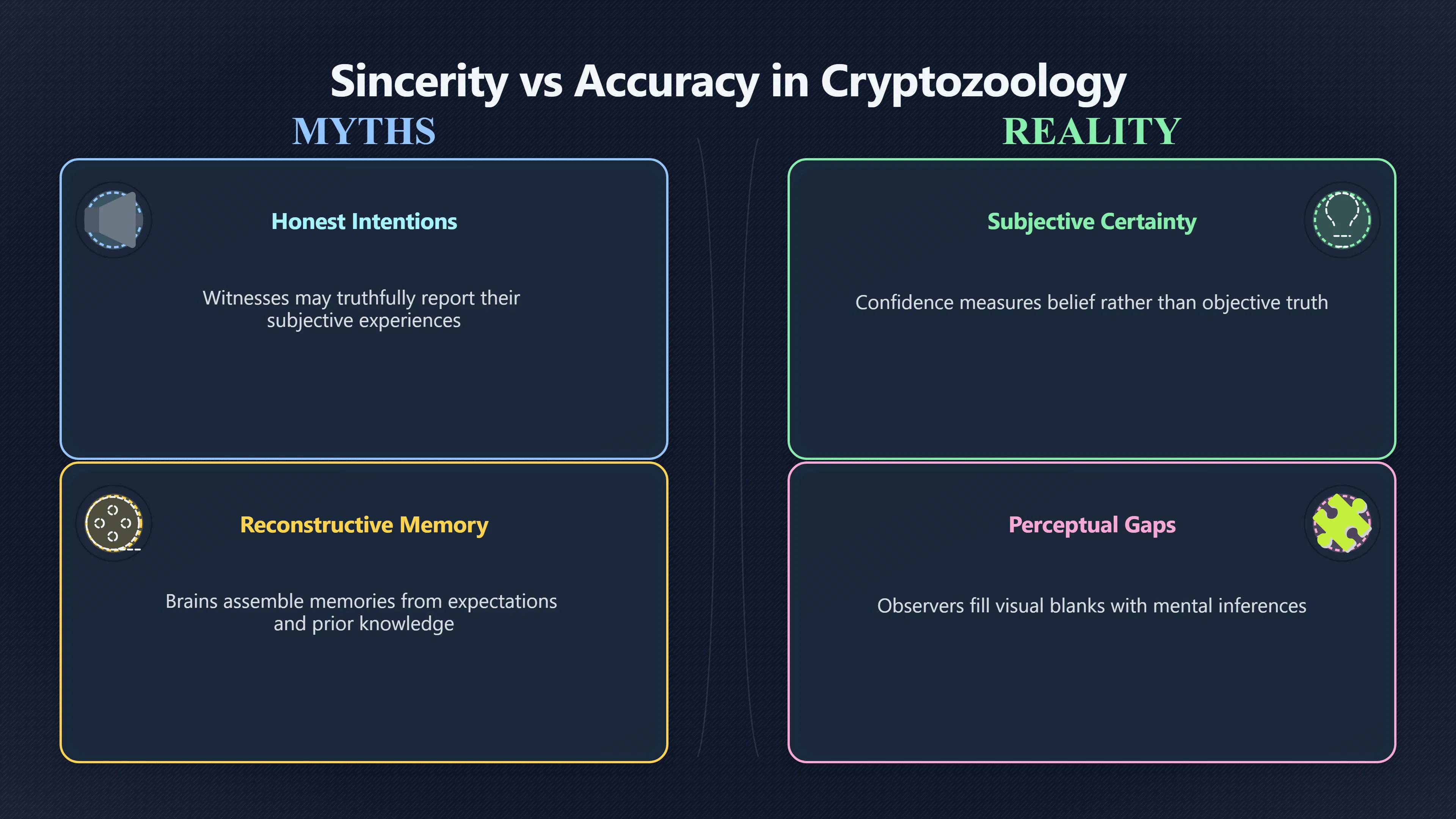
A sincere, confident witness can still be wrong because certainty measures conviction, not independent animal evidence.
On this page
- Why sincerity is not the same as accuracy
- Lessons from eyewitness misidentification research
- How to weigh cryptid testimony without insulting witnesses
Page outline Jump by section
Introduction
Within cryptozoology, eyewitness testimony is often treated as the starting point for investigation and, in many cases, as the primary evidence for the existence of an alleged animal. Reports of unknown apes, lake monsters, giant birds, or other cryptids frequently depend on people who appear sincere, emotionally affected, and absolutely certain about what they observed. The problem is that certainty and accuracy are not the same thing.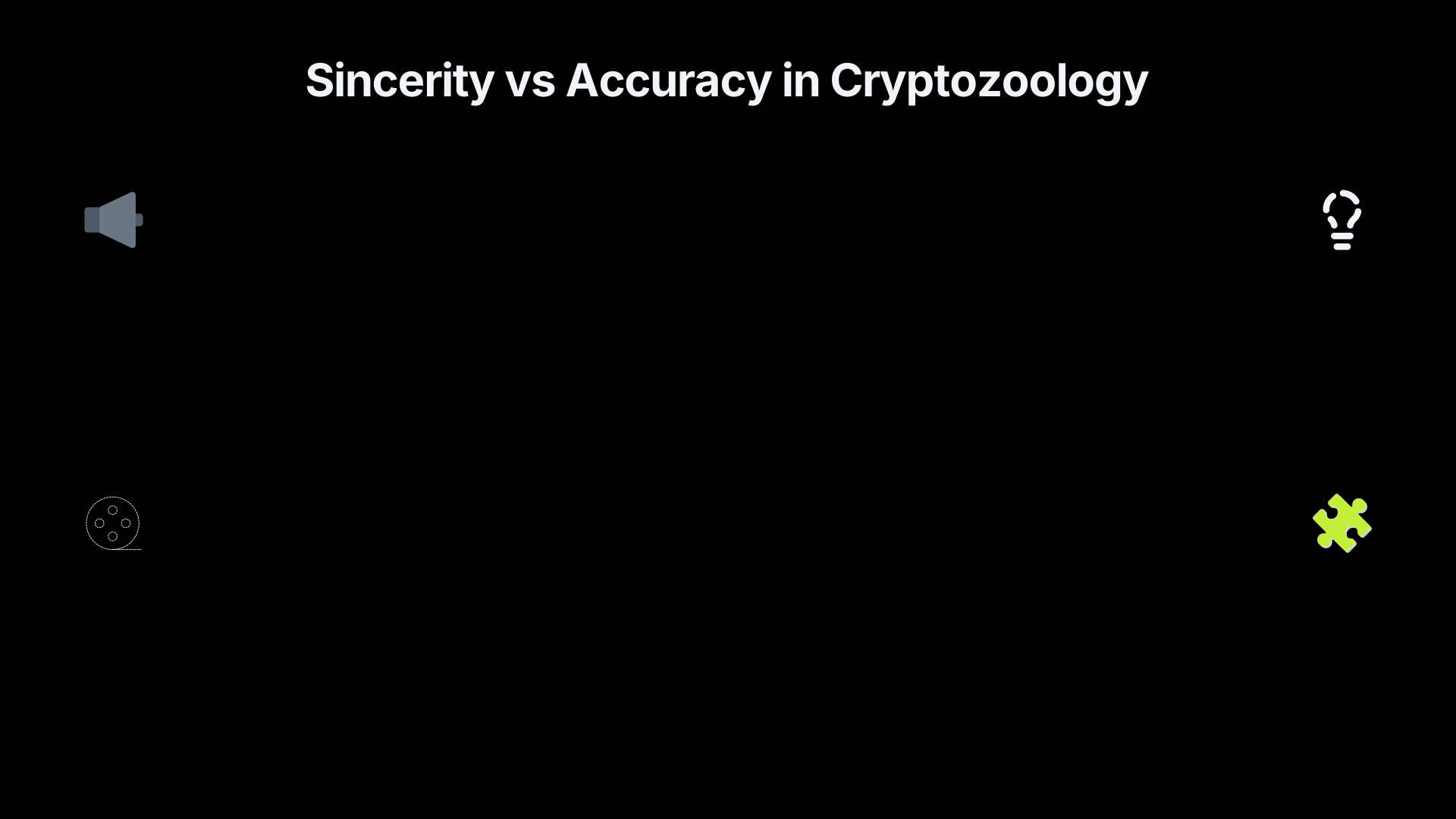 Research on eyewitness memory has repeatedly shown that a witness can be honest, confident, and mistaken simultaneously. Confidence measures how strongly a person believes a memory is correct. Accuracy measures whether the memory corresponds to what actually happened. Those two variables are related in some circumstances, but they are far from identical, and they can diverge dramatically under real-world conditions. This distinction is especially important in cryptozoology because alleged cryptid encounters often occur under precisely the conditions known to increase perceptual and memory error: brief exposure, poor lighting, long distances, surprise, emotional arousal, and the absence of independent physical evidence.[National Academies]nationalacademies.orgNational AcademiesIdentifying the Culprit: Assessing Eyewitness Identification…Throughout this report, the term identification denotes…
The result is a recurring pattern: compelling witnesses may provide vivid, detailed, and highly confident accounts of extraordinary animals that later turn out to be misidentified ordinary creatures, environmental phenomena, or memories reshaped by later interpretation. Understanding the confidence gap does not require assuming deception. Rather, it requires recognising the limits of human perception and memory.
Why Sincerity Is Not the Same as Accuracy
One of the most persistent misunderstandings in cryptozoological debates is the assumption that a truthful witness must therefore be a reliable witness. In reality, honesty addresses intention, not correctness.
A person can accurately report their experience while inaccurately identifying its cause. For example, a witness may truthfully state that they saw a large dark figure moving through woodland. The difficulty arises when that observation becomes interpreted as evidence of Bigfoot rather than a bear, a human, a shadow effect, or another ordinary explanation.
Psychologists studying eyewitness identification have long emphasised that memory is reconstructive rather than photographic. People do not store perfect recordings of events. Instead, memories are assembled from perception, expectations, prior knowledge, later discussions, and repeated recollection. As a result, confidence can become attached to a reconstruction rather than to an objectively accurate record.[PubMed]pubmed.ncbi.nlm.nih.govEyewitness testimonyby GL Wells · 2003 · Cited by 885 — We review major developments in the experimental literature concerning the…
The National Academies review of eyewitness identification highlights how visual perception is affected by illumination, viewing distance, exposure duration, emotional state, stress, and distractions. Under difficult viewing conditions, observers often fill gaps in perception with inference, sometimes without realising they are doing so.[National Academies]nationalacademies.orgNational AcademiesIdentifying the Culprit: Assessing Eyewitness Identification…Throughout this report, the term identification denotes…
For cryptozoology, this distinction is crucial. A witness may genuinely remember seeing a long neck rising from a lake or a large humanoid silhouette crossing a road. The question is not whether the witness believes the memory. The question is whether the interpretation attached to that memory accurately reflects what was present.
Lessons from Eyewitness Misidentification Research
Research into eyewitness identification developed largely because of wrongful-conviction cases, but its findings are highly relevant to reports of unknown animals.
One reason scientists take eyewitness error seriously is that misidentification has repeatedly occurred in situations where witnesses were highly motivated to be accurate. According to the Innocence Project, eyewitness misidentification has contributed to the majority of wrongful convictions later overturned through DNA testing. Multiple analyses place eyewitness error among the leading causes of documented wrongful convictions.[Innocence Project+2Innocence Project]innocenceproject.orgInnocence ProjectEyewitness MisidentificationEyewitness misidentification contributes to an overwhelming majority of wrongful convictions…
These cases demonstrate an important principle: confidence alone cannot guarantee correctness. Many mistaken witnesses were entirely convinced of what they had seen.
Research also reveals that the relationship between confidence and accuracy is more complicated than popular summaries sometimes suggest. Studies by Neil Brewer and colleagues found that simple confidence-accuracy correlations are often weak, although confidence can contain useful information under carefully controlled conditions.[PubMed]pubmed.ncbi.nlm.nih.govHowever, for positive identifications, confidence and accuracy were well…Read more…
More recent work by John Wixted and collaborators has argued that an eyewitness’s initial confidence can be a meaningful predictor of accuracy when identification procedures are”pristine”—that is, when they are free from contamination, suggestion, and feedback. However, these same researchers stress that the relationship can break down when post-event influences distort memory or confidence.[Ovid]ovid.coma0039510~initial eyewitness confidence reliably predicts eyewitnessInitial Eyewitness Confidence Reliably Predicts…by JT Wixted · 2015 · Cited by 295 — A considerable body of recent empirical work…
This nuance is frequently lost in discussions of cryptid sightings. Even if confidence has value under ideal conditions, cryptozoological encounters rarely occur under ideal conditions. Witnesses are usually not making immediate, controlled identifications. Instead, they are recalling unusual events after reflection, discussion, media exposure, or repeated storytelling.
How Confidence Becomes Inflated
One of the most important discoveries in eyewitness psychology is that confidence itself can change over time.
Many people assume that confidence reflects a stable internal measure of certainty. Research shows otherwise. Confidence can be increased through feedback, social reinforcement, repeated retelling, and exposure to additional information after the event.[PubMed+2Taylor & Francis Online]pubmed.ncbi.nlm.nih.govEffects of postidentification feedback on eyewitness…by C Semmler · 2004 · Cited by 217 — Although feedback had no influence on…
Experiments on post-identification feedback have demonstrated that people become more confident in both correct and incorrect memories when they receive confirming responses. Even simple comments implying that a witness made the”right” choice can substantially increase later confidence. Importantly, this confidence inflation can occur without any increase in actual accuracy.[PubMed]pubmed.ncbi.nlm.nih.govEffects of postidentification feedback on eyewitness…by C Semmler · 2004 · Cited by 217 — Although feedback had no influence on…
Research by Rachel Greenspan and Elizabeth Loftus found that feedback can even alter witnesses’ memories of how confident they originally were. Participants later recalled themselves as having been more certain than they actually reported at the time. Confidence inflation also occurred naturally over time, even without explicit feedback.[PubMed]pubmed.ncbi.nlm.nih.govParticipants given false feedback that they were more confident in their initial identification…Read more…
This finding has obvious implications for cryptozoology. A witness who initially reports uncertainty may become progressively more confident after years of interviews, documentaries, online discussions, supportive communities, or repeated retellings. The confidence displayed decades later may not accurately represent the confidence present during the original observation.
In practical terms, the most dramatic testimony is often the least”pristine.” By the time a famous cryptid witness appears in a television documentary, the memory has frequently undergone years of reinforcement and reinterpretation.
Why Cryptid Sightings Are Especially Vulnerable to the Confidence Gap
Several characteristics of cryptid encounters make confidence particularly difficult to interpret.
Brief observation periods. Many reports involve only a few seconds of viewing time. Short exposures reduce the amount of information available for accurate identification.[National Academies]nationalacademies.orgNational AcademiesIdentifying the Culprit: Assessing Eyewitness Identification…Throughout this report, the term identification denotes…
Poor viewing conditions. Dusk, darkness, fog, dense vegetation, and large distances are common features of cryptid narratives. These conditions increase ambiguity while simultaneously encouraging interpretation.[National Academies]nationalacademies.orgNational AcademiesIdentifying the Culprit: Assessing Eyewitness Identification…Throughout this report, the term identification denotes…
Unexpected encounters. Witnesses are usually surprised. Under surprise, attention often focuses on broad impressions rather than detailed zoological characteristics.[NCBI]ncbi.nlm.nih.govNCBIReference Guide on Eyewitness IdentificationThese variables—together with an understanding of how vision and memory work—provide a foundation for predicting the accuracy of eyew…
Existing cultural templates. Once a witness becomes aware of local folklore, media stories, or popular cryptid imagery, ambiguous memories may be interpreted through those frameworks. A large animal glimpsed in a forest may gradually become remembered as resembling a famous cryptid archetype.
Lack of immediate verification. In conventional wildlife observation, uncertainty can sometimes be resolved through photographs, tracks, specimens, or repeat sightings. Cryptid encounters typically lack such confirmation, leaving memory as the primary evidence.
These factors do not prove that every sighting is mistaken. They do, however, create conditions in which confidence becomes a poor substitute for independent corroboration.
The Persuasive Power of Confident Witnesses
Human beings are naturally influenced by confidence.
Studies repeatedly show that observers tend to regard confident witnesses as more credible than hesitant ones. People often infer competence, accuracy, and trustworthiness from certainty, even when confidence is only weakly related to correctness.[Department of Psychology]psych.utah.eduDepartment of PsychologyEyewitness Confidence Does Not Necessarily Indicate…by KN Moore · 2024 · Cited by 13 — Eyewitness confidence i…
This tendency helps explain why some cryptid reports remain influential despite lacking physical evidence. A witness who appears calm, sincere, and unwavering can be extremely persuasive. Listeners often interpret certainty as evidence.
Yet eyewitness research cautions against this shortcut. The emotional force of testimony may reflect the witness’s conviction rather than the objective strength of the observation. The confidence itself can become part of the story, overshadowing questions about lighting conditions, distance, observation time, or alternative explanations.
In effect, confidence can create an illusion of evidential weight. The report feels stronger because the witness feels certain.
How to Weigh Cryptid Testimony Without Insulting Witnesses
Recognising the confidence gap does not require dismissing witnesses as dishonest, gullible, or irrational.
A more productive approach is to separate three questions:<div class="content-enhancement content-enhancement--step-flow" markdown="1">
- Was the witness sincere?
- How good were the viewing conditions?
- Is there independent evidence supporting the interpretation?</div>
The first question concerns honesty. The second concerns reliability. The third concerns evidence.
A witness can score highly on sincerity while the observation itself remains uncertain. Conversely, a cautious witness reporting limited certainty may provide a more reliable account because they are accurately communicating ambiguity.
For this reason, investigators should pay close attention to the witness’s earliest statements, before memory has been shaped by repeated discussion or media exposure. Initial descriptions often contain more useful information than later polished narratives. This principle is consistent with modern eyewitness research, which places considerable importance on contemporaneous confidence statements and on preserving original accounts before contamination occurs.[Innocence Project]innocenceproject.orgInnocence ProjectNational Academy of Sciences Issues Landmark Report on…Oct 2, 2014 — As the report notes, the level of confidence a w…
The most scientifically useful cryptid testimony is therefore not necessarily the most dramatic. It is the testimony that remains closest to the original observation, clearly distinguishes observation from interpretation, acknowledges uncertainty where appropriate, and can be evaluated alongside independent physical evidence.
In cryptozoology, confidence can be informative, but it cannot serve as proof. The central lesson from eyewitness research is simple: conviction measures belief, not biological reality. A witness’s certainty may tell us how strongly they remember an encounter, but only corroborating evidence can tell us whether the encounter involved an unknown animal.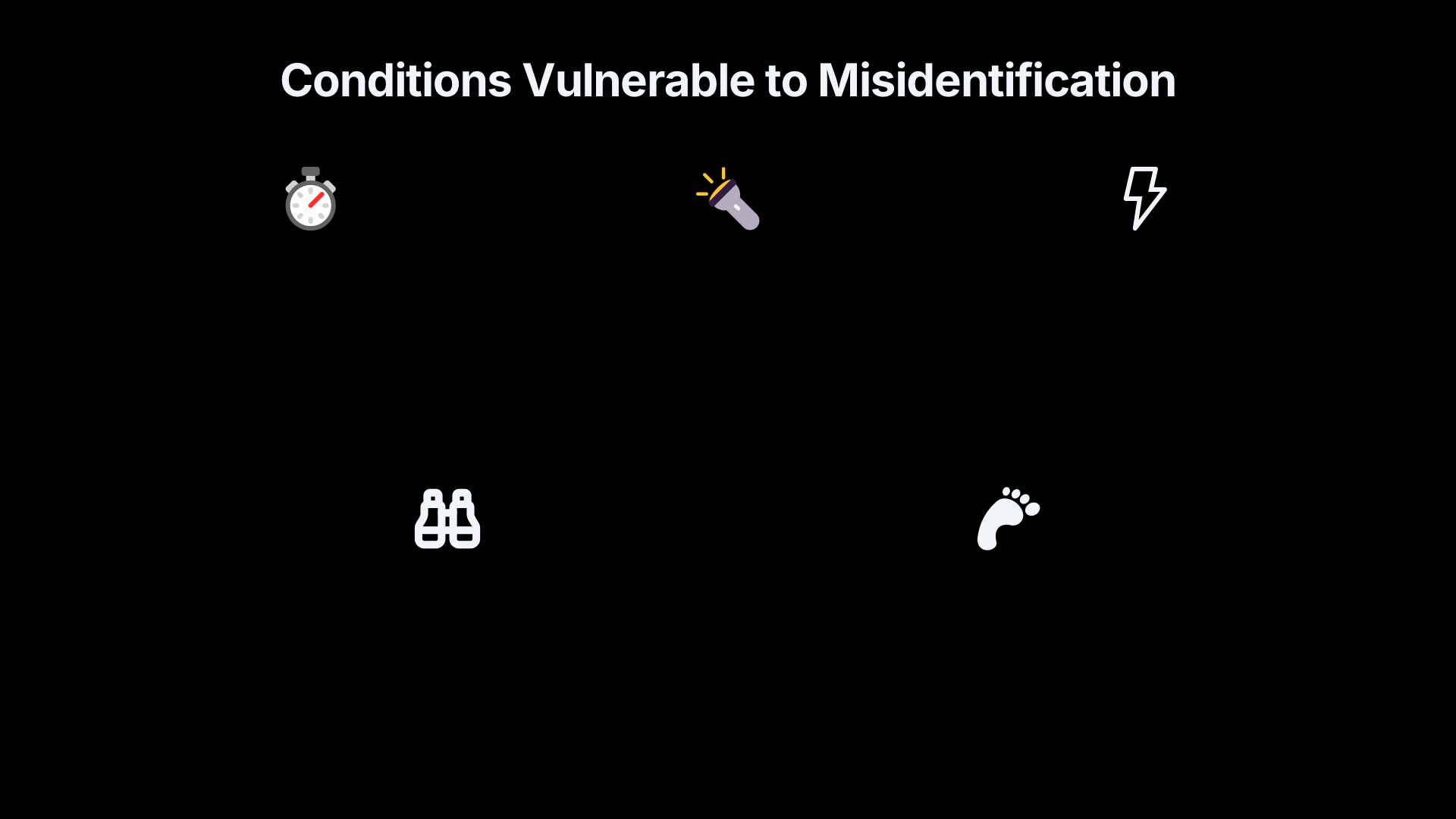
eBay marketplace picks
Marketplace Samples
Live-tested eBay searches with available results related to this page.


Endnotes
1.
Source: ncbi.nlm.nih.gov
Title: NCBIReference Guide on Eyewitness Identification
Link:https://www.ncbi.nlm.nih.gov/books/NBK621592/
2.
Source: ovid.com
Title: a0039510~initial eyewitness confidence reliably predicts eyewitness
Link:https://www.ovid.com/journals/ampsy/pdf/10.1037/a0039510~initial-eyewitness-confidence-reliably-predicts-eyewitness
3.
Source: psychology.town
Title: eyewitness confidence accuracy connection
Link:https://psychology.town/forensic/eyewitness-confidence-accuracy-connection/
4.
Source: nationalacademies.org
Link:https://www.nationalacademies.org/read/18891/chapter/2
5.
Source: pubmed.ncbi.nlm.nih.gov
Link:https://pubmed.ncbi.nlm.nih.gov/12209024/
6.
Source: innocenceproject.org
Link:https://innocenceproject.org/eyewitness-misidentification/
7.
Source: innocenceproject.org
Title: how eyewitness misidentification can send innocent people to prison
Link:https://innocenceproject.org/news/how-eyewitness-misidentification-can-send-innocent-people-to-prison/
8.
Source: pubmed.ncbi.nlm.nih.gov
Link:https://pubmed.ncbi.nlm.nih.gov/12009176/
9.
Source: jstor.org
Link:https://www.jstor.org/stable/44653380
10.
Source: pubmed.ncbi.nlm.nih.gov
Link:https://pubmed.ncbi.nlm.nih.gov/15065979/
11.
Source: tandfonline.com
Link:https://www.tandfonline.com/doi/abs/10.1080/10683160512331316316
12.
Source: pubmed.ncbi.nlm.nih.gov
Link:https://pubmed.ncbi.nlm.nih.gov/32378911/
13.
Source: psych.utah.edu
Link:https://psych.utah.edu/_resources/documents/people/committee-docs/fall-2025/2024%20-%20Moore%20et%20al%202024%20Eyewitness%20Confidence%20Does%20Not%20Necessarily%20Indicate%20Accuracy.pdf
14.
Source: innocenceproject.org
Link:https://innocenceproject.org/news/national-academy-of-sciences-issues-landmark-report-on-memory-and-eyewitness-identification/
15.
Source: tandfonline.com
Link:https://www.tandfonline.com/doi/full/10.1080/09658211.2025.2546905
16.
Source: innocenceproject.org
Title: dna exonerations in the united states
Link:https://innocenceproject.org/dna-exonerations-in-the-united-states/
17.
Source: innocenceproject.org
Link:https://innocenceproject.org/research-resources/
18.
Source: innocenceproject.org
Link:https://innocenceproject.org/tags/eyewitness-misidentification/
19.
Source: innocenceproject.org
Link:https://www.innocenceproject.org/wp-content/uploads/2016/04/Steblay_Wells_Douglass_2014_PPPL.pdf
20.
Source: innocenceproject.org
Link:https://innocenceproject.org/exonerations-data/
21.
Source: pmc.ncbi.nlm.nih.gov
Link:https://pmc.ncbi.nlm.nih.gov/articles/PMC10700421/
22.
Source: pmc.ncbi.nlm.nih.gov
Link:https://pmc.ncbi.nlm.nih.gov/articles/PMC12375059/
23.
Source: pmc.ncbi.nlm.nih.gov
Link:https://pmc.ncbi.nlm.nih.gov/articles/PMC4131297/
24.
Source: pubmed.ncbi.nlm.nih.gov
Link:https://pubmed.ncbi.nlm.nih.gov/32730053/
25.
Source: wvinnocenceproject.law.wvu.edu
Title: causes of wrongful convictions
Link:https://wvinnocenceproject.law.wvu.edu/causes-of-wrongful-convictions
26.
Source: Wikipedia
Title: Innocence Project
Link:https://en.wikipedia.org/wiki/Innocence_Project
27.
Source: nationalacademies.org
Link:https://www.nationalacademies.org/read/18891/chapter/8
28.
Source: nationalacademies.org
Link:https://www.nationalacademies.org/read/18891
29.
Source: nationalacademies.org
Title: Chapter: 5 Applied Eyewitness Identification Research Brewer and G
Link:https://www.nationalacademies.org/read/18891/chapter/7
30.
Source: ebsco.com
Link:https://www.ebsco.com/research-starters/science/innocence-project
Additional References
31.
Source: psychologicalscience.org
Title: eyewitness confidence can predict accuracy of identifications researchers find
Link:https://www.psychologicalscience.org/observer/eyewitness-confidence-can-predict-accuracy-of-identifications-researchers-find
32.
Source: researchgate.net
Link:https://www.researchgate.net/publication/283506350_Confidence_and_Accuracy_of_Eyewitness_Identification
33.
Source: nacdl.org
Link:https://www.nacdl.org/Content/EyewitnessIDReformResources
34.
Source: mtinnocenceproject.org
Link:https://mtinnocenceproject.org/eyewitness-identification/
35.
Source: exonerationproject.org
Link:https://www.exonerationproject.org/issues/false-confessions/
36.
Source: lawteacher.net
Link:https://www.lawteacher.net/free-law-essays/criminal-law/problems-of-eyewitness-testimony.php
37.
Source: researchgate.net
Link:https://www.researchgate.net/publication/341241660_Eyewitness_confidence_malleability_Misinformation_as_post-identification_feedback
38.
Source: judicature.duke.edu
Link:https://judicature.duke.edu/articles/a-clearer-view-the-impact-of-the-national-academy-of-sciences-report-on-eyewitness-identification/
39.
Source: researchgate.net
Link:https://www.researchgate.net/publication/349254534_Innocence_Project_DNA_Exonerations_1989-2014_Review_Of_Data_And_Findings_From_The_First_25_Years
40.
Source: ojp.gov
Link:https://www.ojp.gov/pdffiles1/nij/250705.pdf
Topic Tree