Within Lazarus Taxa
How the Takahe Came Back Into View
The takahe became credible not because people hoped it survived, but because searchers found a real population in a plausible refuge.
On this page
- Why the bird was presumed extinct
- The Murchison Mountains rediscovery
- Conservation evidence after the find
Page outline Jump by section
Introduction
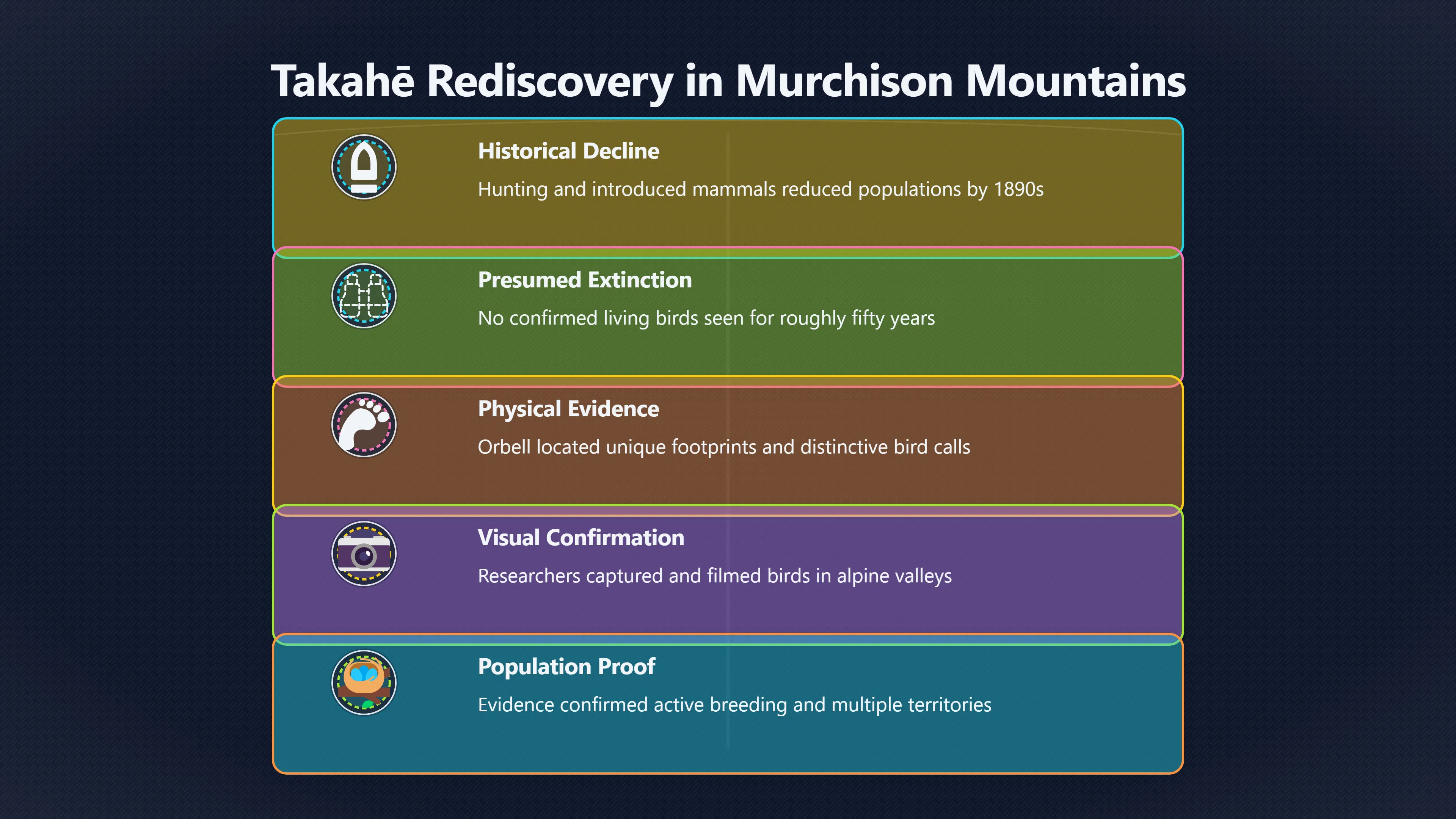
Among the best-known examples of a Lazarus taxon, the takahē stands out because its rediscovery was not based on rumours, isolated sightings or wishful thinking. The species returned to scientific view when searchers located a real, surviving population in a remote and ecologically plausible refuge. The flightless New Zealand bird had been widely regarded as extinct for roughly half a century, yet in 1948 investigators found not a lone survivor but a breeding population in the Murchison Mountains of Fiordland. That distinction matters. The takahē became a credible survival story because evidence accumulated rapidly: footprints, calls, photographs, captured birds, mapped territories and, most importantly, proof that the population was reproducing.[Doc.govt.nz+2Science Learning Hub]doc.govt.nzthe takahe storyThe incredible takahē story: Takahē Recovery ProgrammeTakahē were believed to be extinct, not once, but twice. The first in 1850, then in… Within the broader history of cryptozoology and lost-animal searches, the takahē illustrates how a presumed-extinct species is genuinely rediscovered. The key was not mystery but verification.
Why the Bird Was Presumed Extinct
The South Island takahē (Porphyrio hochstetteri) was once widespread across New Zealand’s South Island. By the nineteenth century, however, hunting, habitat change and the arrival of introduced mammals had driven dramatic declines. European naturalists obtained only a handful of specimens, and sightings became increasingly rare. By the end of the 1890s, no confirmed living birds could be found despite continued interest from ornithologists.[Doc.govt.nz+2NZ Nature Fund]doc.govt.nzthe takahe storyThe incredible takahē story: Takahē Recovery ProgrammeTakahē were believed to be extinct, not once, but twice. The first in 1850, then in…
The assumption of extinction was understandable. Takahē are large, flightless birds, and many people believed such a conspicuous species could not remain undetected for decades. Yet that reasoning underestimated the geography of Fiordland. The region contains some of the most rugged and isolated terrain in New Zealand, with steep mountains, difficult access and extensive alpine grasslands. If any remnant population had survived, this was one of the few places where it could have escaped regular observation.[bioGraphic]biographic.comthe tenacious takaheThe Tenacious TakahēSep 20, 2023 — In 1948, a South Island physician found a remnant population living in the remote Murchison…
This is an important feature of the case. The rediscovery did not occur in a heavily surveyed landscape where survival would have been implausible. It occurred in a habitat that matched the ecological requirements of the species and where detection was genuinely difficult.<div class="youtube-embed-container youtube-embed-fallback youtube-embed-link-only"><div class="youtube-embed-card"><div class="youtube-embed-link-panel">The coelacanth: A living fossil of a fish - Erin Eastwood</div><div class="youtube-embed-footer"><p class="youtube-embed-title">The coelacanth: A living fossil of a fish - Erin Eastwood</p><p class="youtube-embed-actions">Open on YouTube</p></div></div></div>
The Murchison Mountains Rediscovery
The breakthrough came through a targeted search rather than an accidental encounter. Invercargill physician and amateur ornithologist Geoffrey Orbell had long suspected that takahē might persist in Fiordland. In 1948, he and colleagues searched the Murchison Mountains near Lake Te Anau for physical signs of the bird. They found unusual footprints whose structure matched museum specimens of takahē tracks, along with distinctive calls.[Science Learning Hub+2Conservation blog]sciencelearn.org.nz2704 takahe conservation effortsScience Learning HubTakahē conservation effortsFeb 11, 2019 — Orbell, Rex Watson and Neil McCrostie went into the remote Murchison Mounta…
These clues were significant because they provided testable evidence. The team returned later in the year with photographic equipment and capture gear. On 20 November 1948 they succeeded in locating living takahē in an isolated alpine valley. Two birds were briefly captured, photographed and filmed before being released. The resulting documentation convinced the scientific community that the supposedly extinct species was still alive.[Conservation blog+2Wikipedia]blog.doc.govt.nzConservation blogThe rediscovery of the takahē – seventy years onNov 20, 2018 — Seventy years ago today, New Zealand was given a second c…
The rediscovery immediately differed from many controversial animal claims. There was no dependence on anecdotal testimony. Researchers obtained direct observation, photographs and physical examination of living birds. The evidence was strong enough that the existence of the species ceased to be a matter of debate almost immediately.[Wikipedia]WikipediaFifty years later, however, after a carefully planned search, South Island takahē were dramatically rediscovered in November 1948 by Geof…
Why the Discovery Proved a Breeding Refuge
Finding one surviving animal would not have demonstrated long-term persistence. The crucial evidence was that the Murchison Mountains held a functioning population.
Researchers quickly determined that the rediscovered birds occupied a substantial area of alpine tussock grassland. The presence of multiple individuals across several territories indicated that the valley system was not sheltering a final pair or a handful of ageing survivors. Instead, it contained a population that had persisted for decades beyond the presumed extinction date. New Zealand Ecological Society+2NZ Nature Fund[newzealandecology.org]newzealandecology.orgNew Zealand Ecological SocietyDemography of takahe (Porphyrio hochstetteri) in FiordlandDecember 15, 2011 — by D Hegg · 2012 · Cited by 3…
Several lines of evidence pointed to active breeding:
- Birds were found in more than one locality within the refuge area rather than at a single point.
- Population estimates indicated numerous individuals rather than a lone remnant.
- Territorial behaviour and age variation showed ongoing recruitment of younger birds.
- Continued monitoring after 1948 documented nesting and reproduction within the wild population. New Zealand Ecological Society+2New Zealand Geographic[newzealandecology.org]newzealandecology.orgNew Zealand Ecological SocietyDemography of takahe (Porphyrio hochstetteri) in FiordlandDecember 15, 2011 — by D Hegg · 2012 · Cited by 3…
The refuge itself helped explain survival. High-altitude tussock grasslands in the Murchison Mountains provided suitable food and nesting habitat while remaining relatively inaccessible to people. The region effectively acted as a biological sanctuary where a reduced population could endure unnoticed for many years.[NZ Nature Fund+2bioGraphic]nznaturefund.orgtakahe recovery programmeNZ Nature FundTakahē Recovery ProgrammeAfter being presumed extinct for nearly 50 years, the takahē was famously rediscovered in 1948. Ge…
For a Lazarus taxon, this is exactly the pattern scientists expect to see: a plausible refuge, a small but reproducing population and evidence that survival continued uninterrupted rather than being rediscovered through chance alone.<div class="youtube-embed-container youtube-embed-fallback youtube-embed-link-only"><div class="youtube-embed-card"><div class="youtube-embed-link-panel">Animated Life: The Living Fossil Fish | HHMI BioInteractive Video</div><div class="youtube-embed-footer"><p class="youtube-embed-title">Animated Life: The Living Fossil Fish | HHMI BioInteractive Video</p><p class="youtube-embed-actions">Open on YouTube</p></div></div></div>
Conservation Evidence After the Find
The rediscovery did not end the story. In some respects, it marked the beginning of the real test. A species can be rediscovered yet still disappear if the surviving population is too small or vulnerable.
Soon after the find, authorities established protected areas around the takahē’s habitat, including a special conservation zone in the Murchison Mountains. Long-term surveys revealed that the population remained precarious and later declined significantly, reaching roughly 120 birds by the early 1980s despite surviving the initial rediscovery.[New Zealand Ecological Society]newzealandecology.orgNew Zealand Ecological SocietyDemography of takahe (Porphyrio hochstetteri) in FiordlandDecember 15, 2011 — by D Hegg · 2012 · Cited by 3…
What followed provided further proof that the Murchison Mountains population had been a genuine breeding refuge rather than a biological dead end. Conservationists were able to monitor family groups, collect eggs, rear chicks, manage predators and establish additional populations elsewhere. These efforts depended on the existence of a continuing source population capable of reproduction. Doc.govt.nz+2Predator Free NZ Trust[doc.govt.nz]doc.govt.nzTakahē: NZ native land birdsSince 1948, measures to ensure takahē are never again considered extinct have included pioneering conservatio…
The recovery programme eventually became New Zealand’s longest-running endangered-species initiative. Captive breeding, translocations, habitat management and predator control increased numbers from their low point, producing a growing national population that now extends beyond the original refuge. Island Conservation+3Doc.govt.nz+3New Zealand Ecological Society[doc.govt.nz]doc.govt.nzTakahē: NZ native land birdsSince 1948, measures to ensure takahē are never again considered extinct have included pioneering conservatio…
What the Takahē Case Demonstrates
The takahē is often cited in discussions of cryptozoology because it shows that extinction declarations can be wrong. Yet the lesson is more specific than many popular retellings suggest.
The species was not rediscovered because belief alone kept the possibility alive. It was rediscovered because searchers investigated a credible refuge, gathered physical evidence, located a surviving population and demonstrated that the birds were breeding. The Murchison Mountains population transformed the takahē from a presumed-extinct species into a documented conservation reality.[Science Learning Hub+2Conservation blog]sciencelearn.org.nz2704 takahe conservation effortsScience Learning HubTakahē conservation effortsFeb 11, 2019 — Orbell, Rex Watson and Neil McCrostie went into the remote Murchison Mounta…
As a Lazarus taxon, the takahē remains one of the clearest examples of how a lost animal returns to science: not through mystery, but through verifiable evidence of a real population surviving in a place where survival was genuinely possible.[Doc.govt.nz+2Doc.govt.nz]doc.govt.nzthe takahe storyThe incredible takahē story: Takahē Recovery ProgrammeTakahē were believed to be extinct, not once, but twice. The first in 1850, then in…<div class="youtube-embed-container youtube-embed-fallback youtube-embed-link-only"><div class="youtube-embed-card"><div class="youtube-embed-link-panel">The Coelacanth: Ancient Fish That Defied Extinction | FULL DOCUMENTARY</div><div class="youtube-embed-footer"><p class="youtube-embed-title">The Coelacanth: Ancient Fish That Defied Extinction | FULL DOCUMENTARY</p><p class="youtube-embed-actions">Open on YouTube</p></div></div></div>
Amazon book picks
Further Reading
No matched book cards were available for How the Takahe Came Back Into View, so this fallback keeps a direct Amazon reading path visible.
Topical books
Takahē breeding refuge guide
Browse books, explainers and reference titles related to this topic.
Search AmazonRelated search
New Zealand ornithology guide
Browse books, explainers and reference titles related to this topic.
Search AmazonRelated search
Alpine Tussock Grassland guide
Browse books, explainers and reference titles related to this topic.
Search AmazonEndnotes
1.
Source: doc.govt.nz
Title: the takahe story
Link:https://www.doc.govt.nz/our-work/takahe-recovery-programme/the-takahe-story/
2.
Source: blog.doc.govt.nz
Link:https://blog.doc.govt.nz/2018/11/20/the-rediscovery-of-the-takehe-seventy-years-on/
3.
Source: biographic.com
Title: the tenacious takahe
Link:https://www.biographic.com/the-tenacious-takahe/
4.
Source: Wikipedia
Title: Murchison Mountains
Link:https://en.wikipedia.org/wiki/Murchison_Mountains
5.
Source: Wikipedia
Link:https://en.wikipedia.org/wiki/Takah%C4%93
6.
Source: doc.govt.nz
Link:https://www.doc.govt.nz/nature/native-animals/birds/birds-a-z/takahe/
7.
Source: doc.govt.nz
Title: Visit a takahē: Takahē Recovery Programme
Link:https://www.doc.govt.nz/our-work/takahe-recovery-programme/visit-a-takahe/
8.
Source: sciencelearn.org.nz
Title: 2704 takahe conservation efforts
Link:https://www.sciencelearn.org.nz/resources/2704-takahe-conservation-efforts
9.
Source: nznaturefund.org
Title: takahe recovery programme
Link:https://nznaturefund.org/projects/takahe-recovery-programme/
10.
Source: newzealandecology.org
Link:https://newzealandecology.org/system/files/articles/NZJEcol36_1_75.pdf
11.
Source: nzgeo.com
Title: New Zealand Geographic Takahe
Link:https://www.nzgeo.com/stories/takahe-the-bird-that-came-back-from-the-dead/
12.
Source: predatorfreenz.org
Title: Predator Free NZ Trust Overlooked takahē
Link:https://predatorfreenz.org/stories/overlooked-takahe-april-month/
13.
Source: reviverestore.org
Link:https://reviverestore.org/takahe/
14.
Source: islandconservation.org
Title: south island takahe makes big comeback near extinction
Link:https://www.islandconservation.org/south-island-takahe-makes-big-comeback-near-extinction/
15.
Source: facebook.com
Link:https://www.facebook.com/groups/8633729870037397/posts/25669981829318935/
16.
Source: aucklandzoo.co.nz
Link:https://www.aucklandzoo.co.nz/animals/takahe
17.
Source: sciencelearn.org.nz
Title: 1188 extinction
Link:https://www.sciencelearn.org.nz/resources/1188-extinction
Additional References
18.
Source: forbes.com
Link:https://www.forbes.com/sites/scotttravers/2025/12/08/meet-the-takah—the-flightless-bird-that-fell-off-the-face-of-the-planet-for-decades/
19.
Source: facebook.com
Title: after their legendary rediscovery in the murchison mountains by dr geoffrey orbe
Link:https://www.facebook.com/100090155882115/posts/after-their-legendary-rediscovery-in-the-murchison-mountains-by-dr-geoffrey-orbe/946399211708600/
20.
Source: facebook.com
Title: for about 50 years new zealands takahe was believed to be extinct until a small
Link:https://www.facebook.com/travinthebush/posts/for-about-50-years-new-zealands-takahe-was-believed-to-be-extinct-until-a-small-/1010161647883902/
21.
Source: theguardian.com
Title: prehistoric bird once thought extinct returns to new zealand wild
Link:https://www.theguardian.com/environment/2023/aug/29/prehistoric-bird-once-thought-extinct-returns-to-new-zealand-wild
22.
Source: thekidshouldseethis.com
Title: flightless takahe bird new zealand conservation
Link:https://thekidshouldseethis.com/post/flightless-takahe-bird-new-zealand-conservation
23.
Source: facebook.com
Link:https://www.facebook.com/docgovtnz/posts/meet-the-neighbours-takah%C4%93once-thought-extinct-these-rare-flightless-birds-have-/1106827118305349/
24.
Source: facebook.com
Link:https://www.facebook.com/WillowbankWildlifeReserve/posts/the-takah%C4%93-was-once-thought-to-be-extinct-but-was-rediscovered-in-the-murchinson/1123301419824808/
25.
Source: reddit.com
Title: once thought to be extinct the takahe was
Link:https://www.reddit.com/r/Awwducational/comments/5u4sxw/once_thought_to_be_extinct_the_takahe_was/
26.
Source: forestandbird.org.nz
Title: birds attitude rediscovering takahe
Link:https://www.forestandbird.org.nz/about-us/our-history/force-nature/birds-attitude-rediscovering-takahe
27.
Source: thebrighterside.news
Title: prehistoric bird thought to be extinct returns to the wild
Link:https://www.thebrighterside.news/post/prehistoric-bird-thought-to-be-extinct-returns-to-the-wild/
Amazon book picks
Further Reading
Books and field guides related to How the Takahe Came Back Into View. Use these as the next step if you want deeper reading beyond the article.
Hope Is the Thing With Feathers
Covers lost birds and rediscovery themes closely aligned with the takahē.
Topic Tree