Within Prehistoric Claims
Why the Coelacanth Does Not Prove Monsters
The coelacanth shows how survival claims become accepted: with specimens, species names and living populations, not resemblance alone.
On this page
- What the 1938 discovery actually showed
- Why living species are not unchanged fossils
- What cryptid claims would need to match
Page outline Jump by section
Introduction
The coelacanth is the most famous example used to argue that prehistoric animals might still survive undiscovered. In 1938, a fish lineage believed extinct from the fossil record was found alive off the coast of South Africa, creating one of the greatest zoological surprises of the twentieth century. That rediscovery is real, scientifically documented and based on physical specimens. It is also frequently misunderstood. In cryptozoological debates, the coelacanth often functions as a “monster loophole”: if one supposedly extinct animal survived, perhaps plesiosaurs, dinosaurs or other legendary creatures survived too. The actual lesson is more limited and more demanding. The coelacanth became accepted because scientists obtained bodies, described living species, studied their habitat and eventually documented populations. The case demonstrates how survival claims become established, not how evidence can be bypassed.[Wikipedia+2Smithsonian Ocean]WikipediaOpen source on wikipedia.org.
What the 1938 discovery actually showed
Why living species are not unchanged fossils
A common retelling claims that the coelacanth is a 400-million-year-old fish unchanged since prehistoric times. That description is catchy but inaccurate.
The surviving coelacanths belong to an ancient lineage whose fossil history extends hundreds of millions of years into the past. However, the living animals are modern species, not identical copies of Devonian or Cretaceous coelacanths. The fossil record contains many extinct coelacanth species with their own anatomical differences, and ongoing research continues to uncover new fossil forms that help fill evolutionary gaps within the lineage.[Smithsonian Ocean+2University of Portsmouth]ocean.si.eduSmithsonian OceanCoelacanth | Smithsonian OceanOne of the world's most famous "living fossils," coelacanths (seel-a-canths) were once tho…
Scientists have increasingly criticised the simplistic idea that coelacanths are “living fossils” in the sense of being evolutionarily frozen. Reviews of genetic and anatomical evidence show that although coelacanths may exhibit relatively slow rates of change in some respects, they have continued to evolve. Their genomes have changed, their species have diverged and their evolutionary history is more complex than the popular myth suggests.[PubMed+2basny.org]pubmed.ncbi.nlm.nih.govWhy coelacanths are not 'living fossils': a review…by D Casane · 2013 · Cited by 118 — A series of recent studies on extant coel…
The important lesson is that survival of a lineage does not mean survival of an unchanged species. Modern coelacanths are descendants of ancient coelacanths, not literal fossils swimming through the present day.[PubMed+2Frontiers]pubmed.ncbi.nlm.nih.govWhy coelacanths are not 'living fossils': a review…by D Casane · 2013 · Cited by 118 — A series of recent studies on extant coel…
Why the coelacanth is a poor model for famous monsters
Cryptozoological arguments often jump from “the coelacanth survived” to “therefore a plesiosaur or dinosaur might survive.” The comparison overlooks major differences.
The coelacanth occupied deep marine habitats that were difficult for humans to observe directly. Even after the 1938 discovery, decades passed before scientists could study living individuals in their natural environment. The fish spends much of its time in deep water and underwater caves, conditions that help explain why it escaped scientific detection for so long.[Virginia Institute of Marine Science]vims.eduVirginia Institute of Marine ScienceCoelacanthThe coelacanth is a piscivorous (fish-eating), nocturnal animal. It resides in caves during…
By contrast, many cryptid survival claims involve large air-breathing or surface-dwelling animals supposedly living in lakes, rivers, swamps or forests that have been extensively explored. A breeding population of large reptiles or dinosaur-sized animals would leave traces: carcasses, bones, DNA, clear photographs, ecological impacts or repeated verifiable observations. The coelacanth eventually produced exactly the kind of evidence that cryptid claims typically lack.[Smithsonian Ocean+2Natural History Museum]ocean.si.eduSmithsonian OceanCoelacanth | Smithsonian OceanOne of the world's most famous "living fossils," coelacanths (seel-a-canths) were once tho…
The rediscovery therefore demonstrates that surprising zoological discoveries are possible while simultaneously showing the standard required for acceptance.
What cryptid claims would need to match
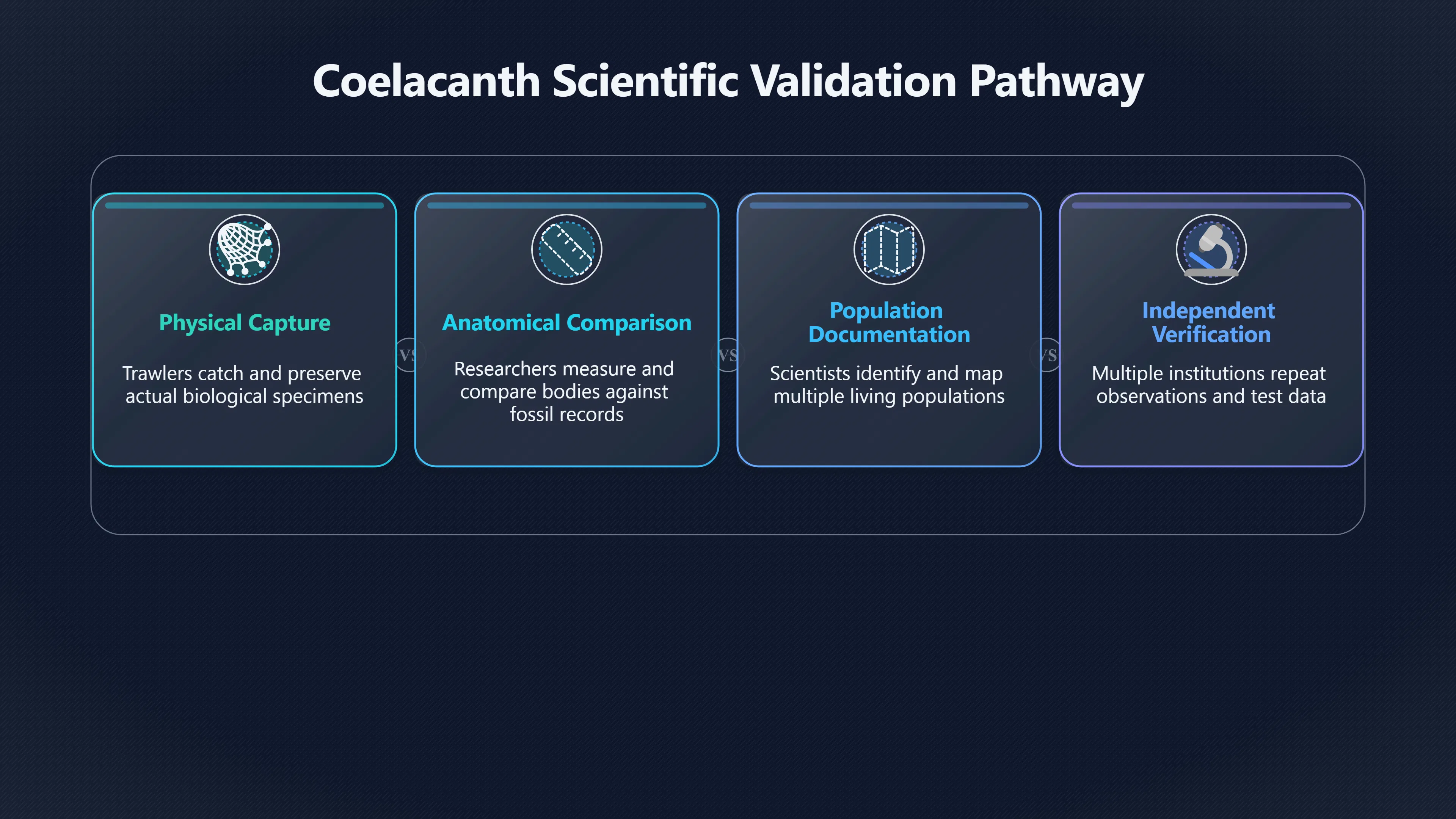
If a modern claim about a surviving prehistoric animal were to follow the coelacanth pathway from speculation to science, several things would have to happen.
A physical specimen would need to exist. The decisive step in the coelacanth story was the capture and preservation of actual animals. Anecdotes alone were not enough.[Wikipedia]WikipediaOpen source on wikipedia.org.
The organism would need scientific description. Researchers would compare it with known fossils and living species, determine its anatomy and formally classify it. This is exactly what happened with Latimeria.[Wikipedia]WikipediaOpen source on wikipedia.org.
A population would need to be documented. One strange sighting does not establish a surviving lineage. Coelacanth acceptance grew stronger as additional specimens and populations were discovered.[American Museum of Natural History]amnh.orgAmerican Museum of Natural HistoryThe Coelacanth: Five Fast FactsJan 21, 2015 — There are two living species of coelacanth, the West Indi…
Independent verification would follow. Scientists from different institutions would be able to examine the evidence, repeat observations and test competing explanations. The coelacanth passed this process; famous monster claims generally have not.[American Museum of Natural History]amnh.orgThe Museum stood ready to preserve a newly discoveredAmerican Museum of Natural HistoryDiscovery and Preservation of a CoelacanthIn 1938, a newly discovered coelacanth surprised scientists…
The real lesson of the coelacanth
See on Amazon</a></div></div></article><article class="fr-book-card"><a class="fr-book-cover" href="https://www.amazon.com/s?k=Abominable+Science%21+by+Daniel+Loxton&i=stripbooks&tag=searcht-20" target="_blank" rel="sponsored noopener noreferrer" aria-label="Open Abominable Science! on Amazon"><span class="fr-book-cover-fallback">Book</span><img class="fr-book-cover-thumb" src="https://books.google.com/books/content?id=kTsgAAAAQBAJ&printsec=frontcover&img=1&zoom=1&edge=curl&source=gbs_api" alt="Cover for Abominable Science!" loading="lazy" decoding="async" fetchpriority="low" referrerpolicy="no-referrer" onerror="this.hidden=true;this.closest('.fr-book-cover').classList.add('fr-book-cover-placeholder');"></a><div class="fr-book-info"><h4 class="fr-book-title"><a href="https://www.amazon.com/s?k=Abominable+Science%21+by+Daniel+Loxton&i=stripbooks&tag=searcht-20" target="_blank" rel="sponsored noopener noreferrer" title="Abominable Science!">Abominable Science!</a></h4><p class="fr-book-author">By Daniel Loxton, Donald R. Prothero</p><p class="fr-book-desc">Addresses misuse of evidence in cryptid arguments.</p><div class="fr-book-actions"><a href="https://www.amazon.com/s?k=Abominable+Science%21+by+Daniel+Loxton&i=stripbooks&tag=searcht-20" class="fr-amazon-btn" target="_blank" rel="sponsored noopener noreferrer">
See on Amazon</a></div></div></article><article class="fr-book-card"><a class="fr-book-cover" href="https://www.amazon.com/s?k=Cryptozoology+A+To+Z+by+Loren+Coleman&i=stripbooks&tag=searcht-20" target="_blank" rel="sponsored noopener noreferrer" aria-label="Open Cryptozoology A To Z on Amazon"><span class="fr-book-cover-fallback">Book</span><img class="fr-book-cover-thumb" src="https://books.google.com/books/content?id=uOccNMgNSNYC&printsec=frontcover&img=1&zoom=1&edge=curl&source=gbs_api" alt="Cover for Cryptozoology A To Z" loading="lazy" decoding="async" fetchpriority="low" referrerpolicy="no-referrer" onerror="this.hidden=true;this.closest('.fr-book-cover').classList.add('fr-book-cover-placeholder');"></a><div class="fr-book-info"><h4 class="fr-book-title"><a href="https://www.amazon.com/s?k=Cryptozoology+A+To+Z+by+Loren+Coleman&i=stripbooks&tag=searcht-20" target="_blank" rel="sponsored noopener noreferrer" title="Cryptozoology A To Z">Cryptozoology A To Z</a></h4><p class="fr-book-author">By Loren Coleman, Jerome Clark</p><p class="fr-book-desc">Places coelacanth discussions within wider cryptozoological debates.</p><div class="fr-book-actions"><a href="https://www.amazon.com/s?k=Cryptozoology+A+To+Z+by+Loren+Coleman&i=stripbooks&tag=searcht-20" class="fr-amazon-btn" target="_blank" rel="sponsored noopener noreferrer">
See on Amazon</a></div></div></article><article class="fr-book-card"><a class="fr-book-cover" href="https://www.amazon.com/s?k=The+Complete+Dinosaur+by+James+Orville+Farlow&i=stripbooks&tag=searcht-20" target="_blank" rel="sponsored noopener noreferrer" aria-label="Open The Complete Dinosaur on Amazon"><span class="fr-book-cover-fallback">Book</span><img class="fr-book-cover-thumb" src="https://books.google.com/books/content?id=FOViD-lDPy0C&printsec=frontcover&img=1&zoom=1&edge=curl&source=gbs_api" alt="Cover for The Complete Dinosaur" loading="lazy" decoding="async" fetchpriority="low" referrerpolicy="no-referrer" onerror="this.hidden=true;this.closest('.fr-book-cover').classList.add('fr-book-cover-placeholder');"></a><div class="fr-book-info"><h4 class="fr-book-title"><a href="https://www.amazon.com/s?k=The+Complete+Dinosaur+by+James+Orville+Farlow&i=stripbooks&tag=searcht-20" target="_blank" rel="sponsored noopener noreferrer" title="The Complete Dinosaur">The Complete Dinosaur</a></h4><p class="fr-book-author">By James Orville Farlow, M. K. Brett-Surman</p><p class="fr-book-popularity">Rating: 3.5/5 from 9 Google Books ratings</p><p class="fr-book-desc">Helps readers evaluate claims involving surviving dinosaurs and ancient lineages.</p><div class="fr-book-actions"><a href="https://www.amazon.com/s?k=The+Complete+Dinosaur+by+James+Orville+Farlow&i=stripbooks&tag=searcht-20" class="fr-amazon-btn" target="_blank" rel="sponsored noopener noreferrer">
See on Amazon</a></div></div></article></div><div class="fr-section-footer"><div class="fr-browse-links" aria-label="Browse more on Amazon"><span class="fr-browse-links-label">Browse more on Amazon:</span><a class="fr-browse-more" href="https://www.amazon.com/s?k=A+Fish+Caught+in+Time&i=stripbooks&tag=searcht-20" target="_blank" rel="sponsored noopener noreferrer">A Fish Caught in Time</a><a class="fr-browse-more" href="https://www.amazon.com/s?k=Abominable+Science%21&i=stripbooks&tag=searcht-20" target="_blank" rel="sponsored noopener noreferrer">Abominable Science!</a><a class="fr-browse-more" href="https://www.amazon.com/s?k=Cryptozoology+A+To+Z&i=stripbooks&tag=searcht-20" target="_blank" rel="sponsored noopener noreferrer">Cryptozoology A To Z</a></div><p class="fr-disclosure">As an Amazon Associate I earn from qualifying purchases.</p></div></div></section>
Amazon book picks
Further Reading
Books and field guides related to Why the Coelacanth Does Not Prove Monsters. Use these as the next step if you want deeper reading beyond the article.
A Fish Caught in Time
Directly explains what the coelacanth rediscovery did and did not prove.
Cryptozoology A To Z
Places coelacanth discussions within wider cryptozoological debates.
Your Inner Fish
Explains deep evolutionary lineages without relying on living-fossil myths.
eBay marketplace picks
Marketplace Samples
Live-tested eBay searches with available results related to this page.
Endnotes
1.
Source: Wikipedia
Link:https://en.wikipedia.org/wiki/Coelacanth
2.
Source: basny.org
Title: id2794 coelacanth may not be a living fossil
Link:https://www.basny.org/id2794-coelacanth-may-not-be-a-living-fossil.html
3.
Source: Wikipedia
Title: Living fossil
Link:https://en.wikipedia.org/wiki/Living_fossil
4.
Source: Wikipedia
Link:https://es.wikipedia.org/wiki/Actinistia
5.
Source: Wikipedia
Title: Marjorie Courtenay Latimer
Link:https://en.wikipedia.org/wiki/Marjorie_Courtenay-Latimer
6.
Source: ocean.si.edu
Link:https://ocean.si.edu/ocean-life/fish/coelacanth
7.
Source: scielo.org.za
Link:https://scielo.org.za/scielo.php?pid=S0038-23532020000200011&script=sci_arttext
8.
Source: amnh.org
Link:https://www.amnh.org/explore/news-blogs/coelacanth-five-facts
9.
Source: amnh.org
Title: The Museum stood ready to preserve a newly discovered
Link:https://www.amnh.org/explore/videos/shelf-life/coelacanth-discovery-preservation
10.
Source: port.ac.uk
Link:https://www.port.ac.uk/news-events-and-blogs/news/150-year-old-museum-specimen-revealed-as-missing-link-in-evolution-of-ancient-fish
11.
Source: pubmed.ncbi.nlm.nih.gov
Link:https://pubmed.ncbi.nlm.nih.gov/23382020/
12.
Source: frontiersin.org
Link:https://www.frontiersin.org/journals/ecology-and-evolution/articles/10.3389/fevo.2022.896111/full
13.
Source: vims.edu
Link:https://www.vims.edu/research/facilities/fishcollection/_archive/highlights/coelacanth.php
14.
Source: nhm.ac.uk
Title: Discover the story of this strange fish
Link:https://www.nhm.ac.uk/discover/coelacanths-the-fish-that-outdid-the-loch-ness-monster.html
15.
Source: facebook.com
Link:https://www.facebook.com/naturalhistorymuseum/posts/this-fish-swam-so-far-under-the-radar-for-66-million-years-people-thought-it-was/870335748465326/
16.
Source: frontiersin.org
Link:https://www.frontiersin.org/journals/ecology-and-evolution/articles/10.3389/fevo.2014.00049/full
Additional References
17.
Source: reddit.com
Link:https://www.reddit.com/r/evolution/comments/lhn08b/coelacanths_are_not_living_fossils_new_study_shows/
18.
Source: nationalgeographic.com
Link:https://www.nationalgeographic.com/animals/fish/facts/coelacanths
19.
Source: facebook.com
Link:https://www.facebook.com/groups/evolutionx/posts/1573620377088542/
20.
Source: agencia.fapesp.br
Link:https://agencia.fapesp.br/new-examination-of-fish-considered-a-living-fossil-changes-our-understanding-of-vertebrate-skull-evolution/55451
21.
Source: discovermagazine.com
Title: living fossils like the coelacanth have remained unchanged for 400 million 47826
Link:https://www.discovermagazine.com/living-fossils-like-the-coelacanth-have-remained-unchanged-for-400-million-47826
22.
Source: youtube.com
Link:https://www.youtube.com/watch?v=__Woo6L1bl0
23.
Source: shop.minimuseum.com
Title: the fish that didnt stay extinct the story of the coelacanth
Link:https://shop.minimuseum.com/blogs/cool-things/the-fish-that-didnt-stay-extinct-the-story-of-the-coelacanth?srsltid=AfmBOop5DAhjI-li2WaIN40mFR9ndghQHG48byfWyq4dw1nRWWdPULd7
24.
Source: siarchives.si.edu
Title: Smithsonian Institution Archives Coelacanth Fish, NMNH
Link:https://siarchives.si.edu/collections/siris_sic_7497
25.
Source: smithsonianmag.com
Title: Today, the two known living species of coelecanth
Link:https://www.smithsonianmag.com/smart-news/1930s-curator-discovered-living-fossil-well-sort-180967616/
26.
Source: reddit.com
Title: thought extinct for 66 million years and known
Link:https://www.reddit.com/r/Awwducational/comments/sr5pfg/thought_extinct_for_66_million_years_and_known/
Topic Tree