Within Okapi
Who Knew the Okapi Before Science?
The okapi story begins with forest expertise that European zoology later translated into museum evidence.
On this page
- Forest knowledge and outsider reports
- Why discovery language can mislead
- What cryptozoology should learn from local testimony
Page outline Jump by section
Introduction
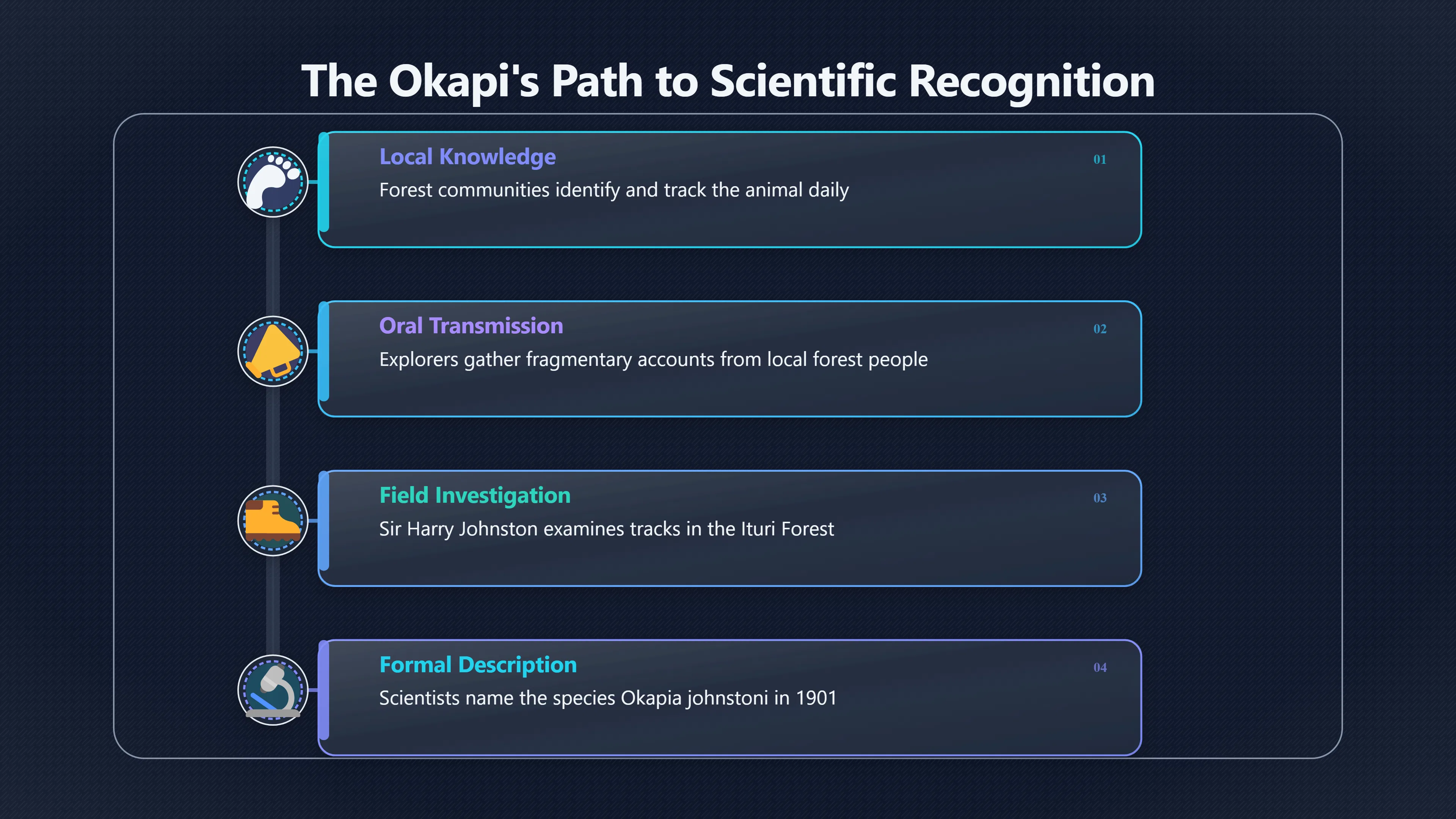
The question “Who discovered the okapi?” has a deceptively simple answer. European zoology formally described the animal in 1901, but the okapi was already well known to people living in the forests of what is now the Democratic Republic of the Congo. Long before museum specimens reached London or Brussels, hunters, trackers, and forest communities recognised the animal, distinguished it from other species, and shared information about its behaviour and habitat. The okapi therefore provides an important example for cryptozoology: an animal can be unknown to outside scientific institutions while being entirely familiar within its local ecological world. Understanding that distinction helps explain both the value and the limits of appeals to “unknown animals”.
Forest Knowledge and Outsider Reports
Why “Discovery” Language Can Mislead
The traditional discovery story often centres on the moment when European scientists named the species Okapia johnstoni. While that event was important for zoological classification, it can obscure the fact that the animal had not been “discovered” in any universal sense.
The language of discovery reflects the priorities of scientific institutions. From the perspective of museums and taxonomists, the species became known when physical specimens could be examined, compared, and formally described. From the perspective of people living in the Congo forests, however, the animal was already part of everyday ecological reality.[Wikipedia]WikipediaOpen source on wikipedia.org.
Recent scholarship on the history of the okapi has emphasised how colonial politics shaped the way the story was told. Indigenous African trackers, hunters, guides, and knowledge holders supplied information that made specimen collection possible, yet many popular accounts gave most of the credit to European officials and naturalists. Historians now increasingly view the episode as an interaction between different knowledge systems rather than a simple tale of a Western explorer revealing a hidden animal to the world.[Cambridge University Press & Assessment]cambridge.orgCambridge University Press & AssessmentDiscovering the Okapi: Western Science, Indigenous…by C Hodgkinson · 2025 — Pooley examines how…
The problem is not that zoological discovery was unimportant. Scientific description transformed local knowledge into a globally recognised species with a place in biological classification. The problem arises when the word “discovery” erases the people who already knew the animal existed.[Cambridge University Press & Assessment]cambridge.orgCambridge University Press & AssessmentDiscovering the Okapi: Western Science, Indigenous…by C Hodgkinson · 2025 — Pooley examines how…
What Local Testimony Actually Contributed
The okapi case is sometimes reduced to a slogan: “Scientists laughed at reports until they were proved true.” The historical record is more nuanced.
Local testimony contributed several kinds of information:
- Existence: forest communities consistently reported a distinctive large mammal living in dense rainforest.
- Location: they identified the habitats where the animal could be found.
- Identification: they treated it as a recognised species rather than a legendary creature.
- Tracking evidence: they understood its footprints, movements, and behaviour.
- Material access: local people helped outsiders obtain skins and other remains that could be examined scientifically.[Tetrapod Zoology+2legendsandlegaciesofafrica.org]tetzoo.comthe discovery of the okapi part 1Tetrapod ZoologyThe Discovery of the Okapi, Part 1April 12, 2023 — 12 Apr 2023 — In 1899/1900, Harry Johnston was tasked with returning a…
These contributions were indispensable. Without them, European zoologists would have had little chance of obtaining the specimens that ultimately confirmed the animal’s identity. Yet local testimony alone did not create scientific consensus. Acceptance came when testimony and physical evidence converged. Skins, skulls, and anatomical study transformed reports into a formally recognised species.[Tetrapod Zoology]tetzoo.comthe discovery of the okapi part 2Tetrapod ZoologyThe Discovery of the Okapi, Part 228 Apr 2023 — Harry Johnston is credited with being the first European to obtain – and…
The sequence is important because it shows how different forms of knowledge interacted rather than competed. Local expertise guided the search; scientific institutions provided a framework for classification and wider verification.
What Cryptozoology Should Learn from Local Testimony
The okapi remains one of the most frequently cited examples in cryptozoology because it demonstrates that local reports can point to real animals overlooked by outside observers. In heavily forested regions, people who live and work in an environment often possess detailed ecological knowledge unavailable to distant researchers. Ignoring such testimony can be a serious mistake.[Tetrapod Zoology]tetzoo.comthe discovery of the okapi part 1Tetrapod ZoologyThe Discovery of the Okapi, Part 1April 12, 2023 — 12 Apr 2023 — In 1899/1900, Harry Johnston was tasked with returning a…
At the same time, the okapi story does not support the idea that every unverified creature report should be treated as established fact. What made the okapi case successful was not merely that people reported it. Several stronger features were present:
- Reports came from communities with direct environmental familiarity.
- Descriptions were relatively consistent over time.
- The animal occupied a plausible ecological niche.
- Physical traces and specimens could eventually be obtained.
- Independent investigators were able to test the claims.[Tetrapod Zoology+2Wikipedia]tetzoo.comthe discovery of the okapi part 1Tetrapod ZoologyThe Discovery of the Okapi, Part 1April 12, 2023 — 12 Apr 2023 — In 1899/1900, Harry Johnston was tasked with returning a…
For cryptozoology, the lesson is therefore twofold. First, local and Indigenous knowledge deserves serious attention because it may contain information unavailable to outsiders. Second, the okapi became accepted not because testimony replaced evidence, but because testimony led to evidence. The history of the okapi is best understood not as a triumph of rumour over science, but as a reminder that scientific knowledge often begins with people who already know the landscape.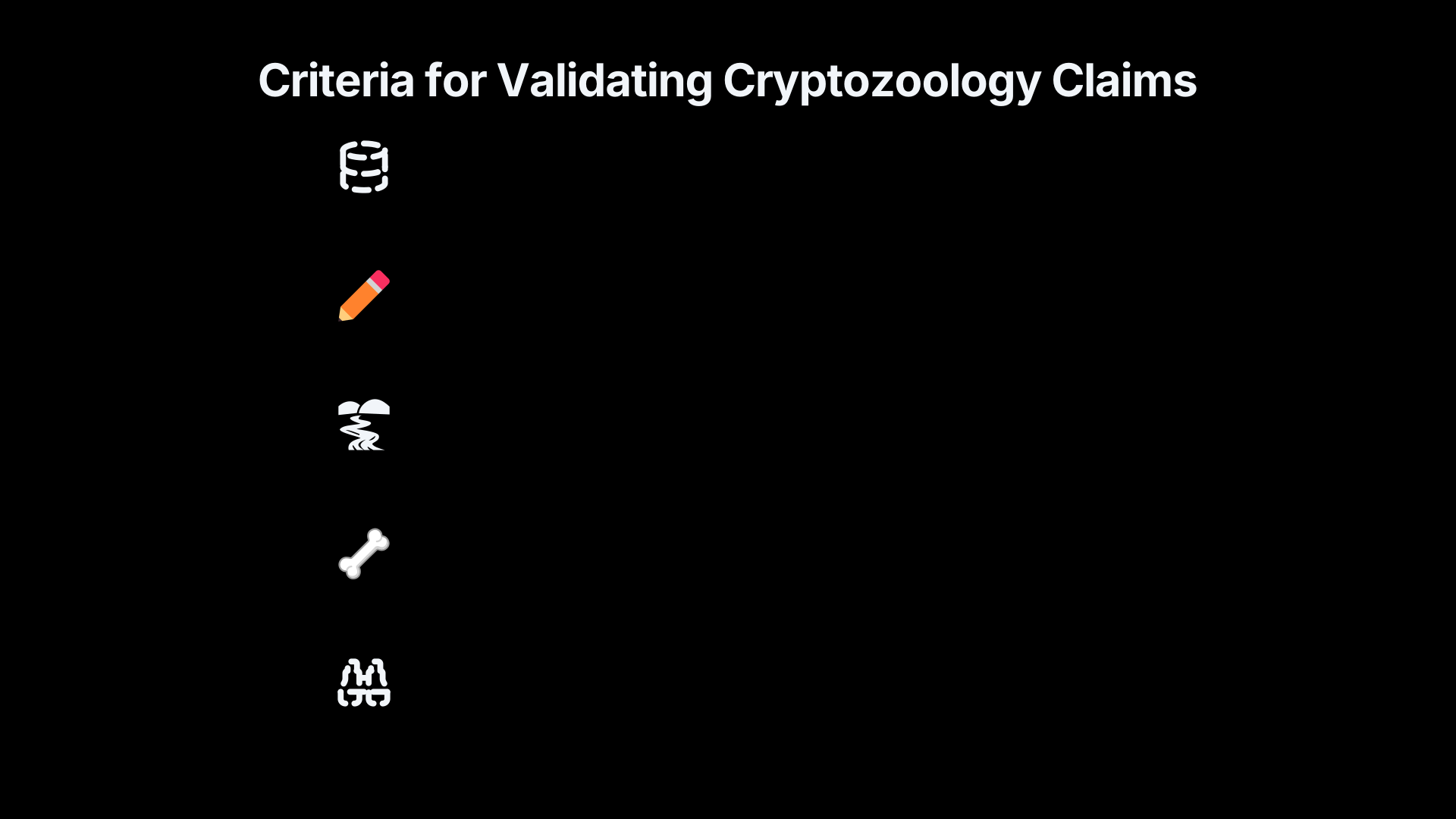
Amazon book picks
Further Reading
Books and field guides related to Who Knew the Okapi Before Science?. Use these as the next step if you want deeper reading beyond the article.
Mammals of Africa
Covers the species known locally before formal scientific description.
The Kingdon Field Guide to African Mammals
Provides ecological and cultural context for the okapi.
The Beasts That Hide from Man
Includes discussion of reports from local knowledge traditions.
eBay marketplace picks
Marketplace Samples
Live-tested eBay searches with available results related to this page.



Endnotes
1.
Source: Wikipedia
Link:https://en.wikipedia.org/wiki/Okapi
2.
Source: cambridge.org
Link:https://www.cambridge.org/core/journals/oryx/article/discovering-the-okapi-western-science-indigenous-knowledge-and-the-search-for-a-rainforest-enigma-by-simon-pooley-2025-392-pp-johns-hopkins-university-press-baltimore-usa-isbn-9781421452487-pbk-usd-3995/D47FD895492576FD39B1B89DD7A0D4A0
3.
Source: legendsandlegaciesofafrica.org
Title: John Lukas
Link:https://legendsandlegaciesofafrica.org/johnlukas.php
4.
Source: tetzoo.com
Title: the discovery of the okapi part 1
Link:https://tetzoo.com/blog/2023/4/11/the-discovery-of-the-okapi-part-1
5.
Source: tetzoo.com
Title: the discovery of the okapi part 2
Link:https://tetzoo.com/blog/2023/4/28/the-discovery-of-the-okapi-part-2
6.
Source: creation.com
Link:https://creation.com/en/articles/okapi
7.
Source: members.linnean.org
Link:https://members.linnean.org/events/6929db02865d470008d904ae/description
Additional References
8.
Source: cardiff.ac.uk
Link:https://www.cardiff.ac.uk/biosciences/research/impact/Okapi-discovery-leads-to-creation-of-national-park
9.
Source: reddit.com
Link:https://www.reddit.com/r/Cryptozoology/comments/1leqfcv/okapi/
10.
Source: facebook.com
Title: happy world okapi day did you know the okapi sometimes called the forest giraffe
Link:https://www.facebook.com/yorkshirewildlifepark/posts/happy-world-okapi-day-did-you-know-the-okapi-sometimes-called-the-forest-giraffe/962166319290750/
11.
Source: researchgate.net
Link:https://www.researchgate.net/publication/388942596_Discovering_the_Okapi_Western_Science_Indigenous_Knowledge_and_the_Search_for_a_Rainforest_Enigma
12.
Source: amazon.nl
Link:https://www.amazon.nl/Discovering-Okapi-Indigenous-Knowledge-Rainforest-ebook/dp/B0F1GRZV1X?tag=searcht-20
13.
Source: africamuseum.be
Title: Okapis | Royal Museum for Central Africa
Link:https://www.africamuseum.be/en/learn/[provenance
14.
Source: facebook.com
Link:https://www.facebook.com/witspress/posts/discovering-the-okapi-by-simon-pooley-offers-a-riveting-portrait-of-the-okapi-an/1686486205754140/
15.
Source: instagram.com
Link:https://www.instagram.com/p/DYzUAEqiBRC/
16.
Source: iheart.com
Title: The Okapi and the Western World
Link:https://www.iheart.com/podcast/105-stuff-you-missed-in-histor-21124503/episode/the-okapi-and-the-western-world-96333554/
17.
Source: awionline.org
Title: discovering the okapi
Link:https://awionline.org/awi-quarterly/spring-2026/discovering-the-okapi/
Topic Tree