Within Populations
Why One Bigfoot Sighting Is Not Enough
A single strange encounter is far weaker than the evidence expected from a breeding population spread across a continent.
On this page
- From encounter claim to population claim
- Mates, juveniles and repeated field signs
- Why scattered adult sightings create an ecological problem
Page outline Jump by section
Introduction
A dramatic Bigfoot encounter may be compelling as a personal experience, but it does not establish the existence of a hidden breeding population. The key issue is that the biological claim is much larger than the sighting claim. A witness might report seeing one large, ape-like figure crossing a road or moving through a forest. For Bigfoot to be a real North American species, however, there would need to be enough individuals to survive, find mates, reproduce, raise young, and maintain a population over many generations. That transition—from “someone saw something unusual” to “a population exists”—is where the evidential burden increases sharply. Modern wildlife biology evaluates populations through repeated, independent traces such as DNA, camera-trap images, tracks, carcasses, scat, and other field evidence, not through isolated encounters alone. 3Rs Principles in Wildlife Research+2Wildlife ACT[3rswildlife.info]3rswildlife.info3Rs Principles in Wildlife ResearchDETECTION: MAMMALS | 3Rs Principles In Wildlife…Camera traps are an increasingly popular tool for m…
From Encounter Claim to Population Claim
A single sighting, even if sincere, only addresses one question: whether a witness observed something unusual. It does not answer the much harder question of whether a species exists in sufficient numbers to persist.
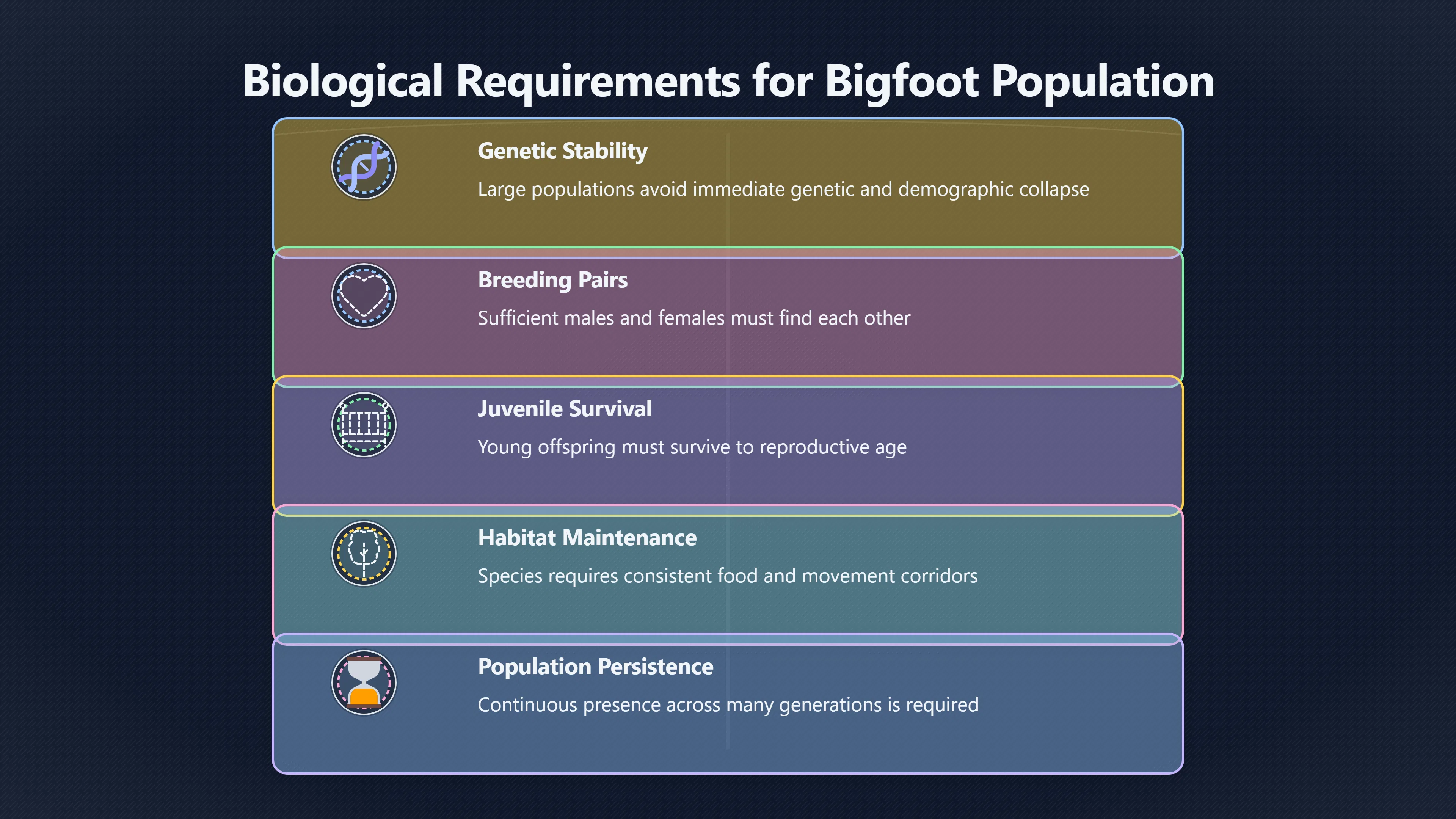
Large mammals do not survive as solitary legends. They exist as populations. Conservation biology has long recognised that populations require enough breeding individuals to avoid immediate genetic and demographic collapse. Although scientists debate exact thresholds, even the most conservative discussions of minimum viable populations involve many breeding animals rather than a handful of isolated individuals.[PubMed+2Springer]pubmed.ncbi.nlm.nih.govHow does the 50/500 rule apply to MVPs?by IG Jamieson · 2012 · Cited by 528 — The 50/500 rule has been used as a guiding principle…
This distinction matters because Bigfoot reports are usually framed as encounters with individual adults. Even if one report were accepted as genuine, the biological implications would be far broader. The sighting would imply that many other animals also exist but remain largely undetected. The evidence required for those unseen animals becomes part of the claim.
In other words, one sighting does not merely ask observers to accept one animal. It asks them to accept an entire hidden population.
Mates, Juveniles and Repeated Field Signs
A breeding population should produce evidence beyond occasional reports of adult individuals.
If a large primate-like species inhabited North America, observers would reasonably expect evidence of:
- Males and females.
- Juveniles and family groups.
- Repeated use of habitat.
-
Consistent tracks and trail networks.<div class="content-enhancement content-enhancement--metric" markdown="1">
- Hair, scat, bones, or other biological remains.
- Recoverable environmental DNA.
- Repeated photographic detections from camera traps.[conservation.org]conservation.orgstudy camera traps key to closing biodiversity data gapsStudy: Camera traps key to closing biodiversity data gaps7 Jun 2023 — Wildlife Insights bridges information gaps in two ways: First, came…</div>
Wildlife researchers routinely detect elusive mammals through these kinds of traces. Species that are difficult to observe directly are nevertheless documented through indirect evidence gathered over time. Camera trapping, genetic sampling, and other monitoring techniques are now standard tools for studying animals that actively avoid people. Wiley Online Library+33Rs Principles in Wildlife Research+3Wildlife ACT[3rswildlife.info]3rswildlife.info3Rs Principles in Wildlife ResearchDETECTION: MAMMALS | 3Rs Principles In Wildlife…Camera traps are an increasingly popular tool for m…
One recurring problem in Bigfoot reports is that most accounts describe solitary adults. Reports of juveniles, breeding groups, dens, or other indicators of population structure are far less common and far less well documented. Yet a self-sustaining population would inevitably contain individuals of different ages and sexes.
The absence of a clear population pattern does not automatically disprove every sighting report, but it weakens the inference that those reports collectively describe a real species.
Why Scattered Adult Sightings Create an Ecological Problem
The most common Bigfoot narrative involves a lone figure briefly seen in remote terrain. From an ecological perspective, that pattern creates a puzzle.
A large-bodied primate would require food, habitat, movement corridors, and access to mates. If sightings are spread across vast areas of North America, the species would either need a very large population distributed across those regions or a smaller population moving across enormous ranges. Either scenario should leave detectable ecological traces.[Wikipedia]WikipediaOpen source on wikipedia.org.
Palaeontologist Darren Naish and other critics have argued that a real Bigfoot population should generate far more consistent evidence than currently exists. They note that large animals normally leave repeated tracks, genetic traces, identifiable vocalisations, carcasses, and other signs that accumulate over time. The continued absence of confirmed biological evidence is difficult to reconcile with the existence of a widespread population.[Wikipedia]WikipediaOpen source on wikipedia.org.
This is why ecologists often view the issue differently from eyewitnesses. A witness may ask, “Could I have seen a real creature?” An ecologist asks, “Where are the other hundreds of animals required to sustain the population?”
The second question is much harder to answer.
Why Modern Detection Methods Raise the Bar
The challenge for the population hypothesis has grown as wildlife monitoring has improved.
Large-scale camera-trap networks now record elusive mammals across many habitats. Researchers use these systems to estimate abundance, occupancy, and movement patterns for species that are rarely observed directly. Modern monitoring increasingly combines cameras, genetic sampling, automated image analysis, and environmental DNA techniques.[Facebook+3PMC+3arXiv]pmc.ncbi.nlm.nih.govRapid systematic literature review: Camera trap sampling in…by E Nogues · 2025 · Cited by 4 — The use of camera traps in wildlife c…
No monitoring method is perfect. Animals can avoid cameras, inhabit remote areas, or occur at low densities. Yet the existence of a continent-wide population of large primates would be expected to generate recurring detections through at least some of these methods.
As a result, an isolated sighting carries less weight than it once might have. The question is no longer whether a witness could have encountered something unusual. The question is why a supposedly widespread population has not produced the range of evidence that modern wildlife science routinely collects for other large mammals.
The Core Problem
The weakness of a single Bigfoot sighting is not necessarily that the witness is dishonest or mistaken. The weakness lies in the leap from an individual observation to a population claim.
A breeding population is not an invisible background assumption. It is the central biological requirement behind the Bigfoot hypothesis. Such a population would need mates, offspring, territories, food resources, deaths, dispersal, and a continuing physical presence in the landscape.
See on Amazon</a></div></div></article><article class="fr-book-card"><a class="fr-book-cover" href="https://www.amazon.com/s?k=Abominable+Science%21+by+Daniel+Loxton&i=stripbooks&tag=searcht-20" target="_blank" rel="sponsored noopener noreferrer" aria-label="Open Abominable Science! on Amazon"><span class="fr-book-cover-fallback">Book</span><img class="fr-book-cover-thumb" src="https://books.google.com/books/content?id=kTsgAAAAQBAJ&printsec=frontcover&img=1&zoom=1&edge=curl&source=gbs_api" alt="Cover for Abominable Science!" loading="lazy" decoding="async" fetchpriority="low" referrerpolicy="no-referrer" onerror="this.hidden=true;this.closest('.fr-book-cover').classList.add('fr-book-cover-placeholder');"></a><div class="fr-book-info"><h4 class="fr-book-title"><a href="https://www.amazon.com/s?k=Abominable+Science%21+by+Daniel+Loxton&i=stripbooks&tag=searcht-20" target="_blank" rel="sponsored noopener noreferrer" title="Abominable Science!">Abominable Science!</a></h4><p class="fr-book-author">By Daniel Loxton, Donald R. Prothero</p><p class="fr-book-desc">Examines why sightings alone do not establish species existence.</p><div class="fr-book-actions"><a href="https://www.amazon.com/s?k=Abominable+Science%21+by+Daniel+Loxton&i=stripbooks&tag=searcht-20" class="fr-amazon-btn" target="_blank" rel="sponsored noopener noreferrer">
See on Amazon</a></div></div></article><article class="fr-book-card"><a class="fr-book-cover" href="https://www.amazon.com/s?k=Bigfoot+by+Joshua+Blu+Buhs&i=stripbooks&tag=searcht-20" target="_blank" rel="sponsored noopener noreferrer" aria-label="Open Bigfoot on Amazon"><span class="fr-book-cover-fallback">Book</span><img class="fr-book-cover-thumb" src="https://books.google.com/books/content?id=O_ZbRQAACAAJ&printsec=frontcover&img=1&zoom=1&source=gbs_api" alt="Cover for Bigfoot" loading="lazy" decoding="async" fetchpriority="low" referrerpolicy="no-referrer" onerror="this.hidden=true;this.closest('.fr-book-cover').classList.add('fr-book-cover-placeholder');"></a><div class="fr-book-info"><h4 class="fr-book-title"><a href="https://www.amazon.com/s?k=Bigfoot+by+Joshua+Blu+Buhs&i=stripbooks&tag=searcht-20" target="_blank" rel="sponsored noopener noreferrer" title="Bigfoot">Bigfoot</a></h4><p class="fr-book-author">By Joshua Blu Buhs</p><p class="fr-book-desc">Explores how Bigfoot reports developed and persisted.</p><div class="fr-book-actions"><a href="https://www.amazon.com/s?k=Bigfoot+by+Joshua+Blu+Buhs&i=stripbooks&tag=searcht-20" class="fr-amazon-btn" target="_blank" rel="sponsored noopener noreferrer">
See on Amazon</a></div></div></article><article class="fr-book-card"><a class="fr-book-cover" href="https://www.amazon.com/s?k=Where+the+Wild+Things+Were+by+William+Stolzenburg&i=stripbooks&tag=searcht-20" target="_blank" rel="sponsored noopener noreferrer" aria-label="Open Where the Wild Things Were on Amazon"><span class="fr-book-cover-fallback">Book</span><img class="fr-book-cover-thumb" src="https://books.google.com/books/content?id=W5hiYE4qbvEC&printsec=frontcover&img=1&zoom=1&source=gbs_api" alt="Cover for Where the Wild Things Were" loading="lazy" decoding="async" fetchpriority="low" referrerpolicy="no-referrer" onerror="this.hidden=true;this.closest('.fr-book-cover').classList.add('fr-book-cover-placeholder');"></a><div class="fr-book-info"><h4 class="fr-book-title"><a href="https://www.amazon.com/s?k=Where+the+Wild+Things+Were+by+William+Stolzenburg&i=stripbooks&tag=searcht-20" target="_blank" rel="sponsored noopener noreferrer" title="Where the Wild Things Were">Where the Wild Things Were</a></h4><p class="fr-book-author">By William Stolzenburg</p><p class="fr-book-desc">Shows what large mammal populations do to ecosystems.</p><div class="fr-book-actions"><a href="https://www.amazon.com/s?k=Where+the+Wild+Things+Were+by+William+Stolzenburg&i=stripbooks&tag=searcht-20" class="fr-amazon-btn" target="_blank" rel="sponsored noopener noreferrer">
See on Amazon</a></div></div></article></div><div class="fr-section-footer"><div class="fr-browse-links" aria-label="Browse more on Amazon"><span class="fr-browse-links-label">Browse more on Amazon:</span><a class="fr-browse-more" href="https://www.amazon.com/s?k=Sasquatch%3A+Legend+Meets+Science&i=stripbooks&tag=searcht-20" target="_blank" rel="sponsored noopener noreferrer">Sasquatch: Legend Meets Science</a><a class="fr-browse-more" href="https://www.amazon.com/s?k=Abominable+Science%21&i=stripbooks&tag=searcht-20" target="_blank" rel="sponsored noopener noreferrer">Abominable Science!</a><a class="fr-browse-more" href="https://www.amazon.com/s?k=Bigfoot&i=stripbooks&tag=searcht-20" target="_blank" rel="sponsored noopener noreferrer">Bigfoot</a></div><p class="fr-disclosure">As an Amazon Associate I earn from qualifying purchases.</p></div></div></section>
Amazon book picks
Further Reading
Books and field guides related to Why One Bigfoot Sighting Is Not Enough. Use these as the next step if you want deeper reading beyond the article.
eBay marketplace picks
Marketplace Samples
Live-tested eBay searches with available results related to this page.


Endnotes
1.
Source: wildlifeact.com
Title: why camera traps are essential for monitoring elusive wildlife species
Link:https://www.wildlifeact.com/blog/why-camera-traps-are-essential-for-monitoring-elusive-wildlife-species
2.
Source: pmc.ncbi.nlm.nih.gov
Link:https://pmc.ncbi.nlm.nih.gov/articles/PMC12277094/
3.
Source: link.springer.com
Link:https://link.springer.com/article/10.1007/s10531-022-02456-z
4.
Source: onlinelibrary.wiley.com
Link:https://onlinelibrary.wiley.com/doi/10.1111/brv.13152
5.
Source: Wikipedia
Link:https://en.wikipedia.org/wiki/Bigfoot
6.
Source: arxiv.org
Link:https://arxiv.org/abs/2108.13572
7.
Source: arxiv.org
Link:https://arxiv.org/abs/2606.10940
8.
Source: facebook.com
Link:https://www.facebook.com/naturalhistorymuseum/posts/animals-can-be-detected-from-hundreds-of-metres-away-just-by-the-presence-of-the/10157940570276537/
9.
Source: zslpublications.onlinelibrary.wiley.com
Link:https://zslpublications.onlinelibrary.wiley.com/doi/10.1111/jzo.13148
10.
Source: onlinelibrary.wiley.com
Link:https://onlinelibrary.wiley.com/doi/10.1111/mec.17353
11.
Source: facebook.com
Link:https://www.facebook.com/RMSOBigfoot/posts/perhaps-one-of-these-thought-to-be-extinct-bears-are-responsible-for-bigfoot-sig/1231860708560698/
12.
Source: Wikipedia
Title: Minimum viable population
Link:https://en.wikipedia.org/wiki/Minimum_viable_population
13.
Source: conservation.org
Title: study camera traps key to closing biodiversity data gaps
Link:https://www.conservation.org/news/study-camera-traps-key-to-closing-biodiversity-data-gaps
14.
Source: 3rswildlife.info
Link:https://3rswildlife.info/detection-mammals/
15.
Source: pubmed.ncbi.nlm.nih.gov
Link:https://pubmed.ncbi.nlm.nih.gov/22868005/
16.
Source: pubmed.ncbi.nlm.nih.gov
Link:https://pubmed.ncbi.nlm.nih.gov/38613250/
17.
Source: theguardian.com
Link:https://www.theguardian.com/world/2026/jun/11/sasquatch-[bigfoot-sightings
Additional References
18.
Source: vioreldpopescu.com
Link:https://vioreldpopescu.com/research/wildlife-monitoring/
19.
Source: reddit.com
Link:https://www.reddit.com/r/evolution/comments/u0nwd8/what_is_the_minimum_breeding_population_needed/
20.
Source: studeersnel.nl
Link:https://www.studeersnel.nl/nl/document/wageningen-university-research/wildlife-conservation-genetics/one-pager-effective-population-size/125861466
21.
Source: library.iucn-isg.org
Link:https://library.iucn-isg.org/documents/2014/Frankham_2014_Biological_Conservation.pdf
22.
Source: reddit.com
Link:https://www.reddit.com/r/zoology/comments/156gz5h/bigfoot_almost_certainly_doesnt_exist_but_how/
23.
Source: researchgate.net
Title: 377389781 Bigfoot If it’s there could it be a bear
Link:https://www.researchgate.net/publication/377389781_Bigfoot_If_it%27s_there_could_it_be_a_bear
24.
Source: reddit.com
Link:https://www.reddit.com/r/biology/comments/g86ys0/what_is_the_minimum_population_of_humans_needed/
25.
Source: researchgate.net
Link:https://www.researchgate.net/post/Are-there-any-ways-to-estimate-a-population-of-mammals-without-having-to-capture-it
26.
Source: reddit.com
Link:https://www.reddit.com/r/zoology/comments/kj5h01/can_someone_explain_the_50500_rule_in_a_simple_way/
27.
Source: conservationbytes.com
Title: were sorry but 50500 is still too few
Link:https://conservationbytes.com/2014/01/28/were-sorry-but-50500-is-still-too-few/
Topic Tree