Within Tracks
One Print Is Not a Trackway
A full trackway can reveal stride, direction and repeated anatomy, while a lone print often preserves too little to identify anything safely.
On this page
- What repeated prints can show
- Why isolated impressions mislead
- How stride and surrounding tracks change the case
Page outline Jump by section
Introduction
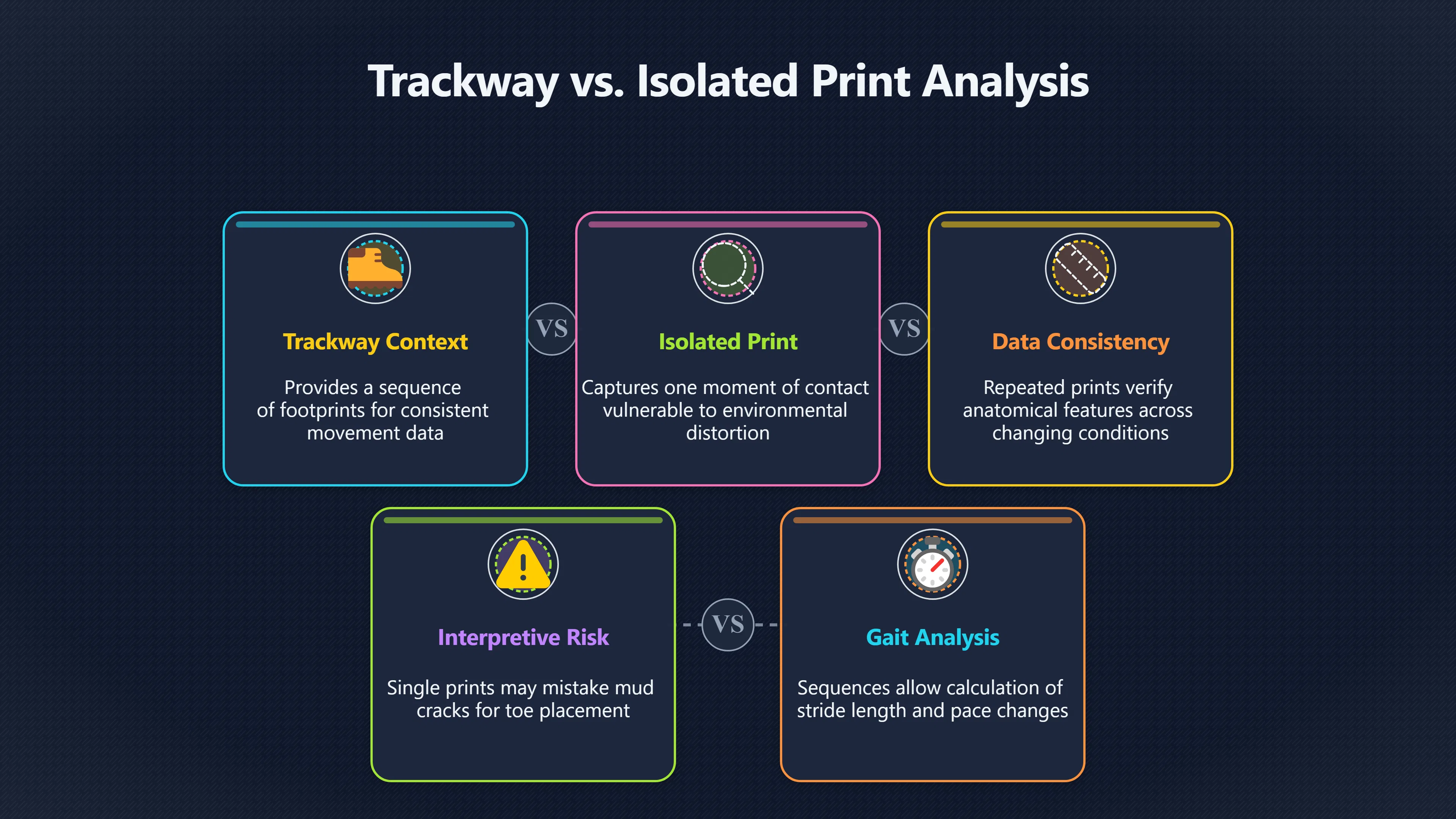
In cryptozoology, a single dramatic footprint often attracts the most attention, but investigators generally learn far more from a complete trackway than from one isolated impression. A trackway—a sequence of footprints made by the same moving animal—can reveal consistency, gait, stride length, direction of travel, weight distribution and repeated anatomical features. By contrast, a lone print captures only one moment of contact between foot and ground and is highly vulnerable to distortion from mud, snow, erosion, melting, overprinting or human manipulation. For that reason, many researchers regard a trackway as the minimum context needed before serious interpretation can begin. The question is not simply what one print looks like, but whether the surrounding prints tell the same story.[NCBI+2ucmp.berkeley.edu]ncbi.nlm.nih.govNCBIForensic Gait AnalysisStatPearls - NCBI Bookshelfby A Badiye · 2022 · Cited by 27 — The forensic gait analysis's general source or evidence comprises the serie…
What Repeated Prints Can Show
A trackway allows investigators to test whether apparent anatomical details recur from print to print. If a track appears to show unusual toe placement, a distinctive arch, or a particular foot shape, those features should appear repeatedly under changing conditions along the trail. Consistency matters because genuine anatomy tends to reappear, while random distortions often do not. Track morphology is considered stronger when similar features are preserved across multiple footprints rather than resting on a single impression.[palaeo-electronica.org]palaeo-electronica.orgGlossary of tetrapod tracksby JN Lallensack · 2025 · Cited by 43 — Track morphology can provide strong evidence if it is consistent acros…
Repeated tracks also permit measurements that cannot be made from one print alone. Investigators can calculate:<div class="content-enhancement content-enhancement--metric" markdown="1">
- Step length and stride length.[ucmp.berkeley.edu]ucmp.berkeley.eduActivity: Interpreting the TracksTrackways provide direct data in the form of foot length/size and stride length. These data can provide…
- Changes in pace.
- Direction of travel.[theiai.org]theiai.orgFootwear and Tire Track Examination SubcommitteeThese forensic examinations can provide information on the number of potential perpetrato…
- Whether the maker was walking, running or turning.
- Whether left and right footprints form a coherent gait pattern.[ucmp.berkeley.edu+2Nikoui and Associates |]ucmp.berkeley.eduOpen source on berkeley.edu.</div>
This is why trackways play such a large role in fields outside cryptozoology. Forensic investigators use sequences of impressions to reconstruct movement through a crime scene, while palaeontologists use fossil trackways to infer speed, posture and behaviour in extinct animals. In both cases, the value comes from relationships between prints rather than from any single footprint viewed in isolation.[PubMed+2theiai.org]pubmed.ncbi.nlm.nih.govthe forensic analysis of footprints and footwear impressionsby VL Naples · 2004 · Cited by 37 — Analysis of footwear characteristic…
A long trackway can also reveal whether an apparently unusual footprint remains unusual throughout the trail. If only one print looks extraordinary while the rest appear ordinary or ambiguous, the extraordinary print may simply be a product of substrate conditions rather than anatomy.
Why Isolated Impressions Mislead
Single prints create several interpretive problems. The first is that investigators cannot determine whether visible features are repeatable. A shape that appears to be a toe may be a crack in drying mud. An apparent heel may be a collapse of sediment after the foot was lifted. Without neighbouring prints for comparison, these possibilities are difficult to eliminate.
Snow tracks provide a classic example. Melting and refreezing can enlarge impressions and soften their edges. A bear track, especially one altered by weather or overstepping, may begin to resemble a giant humanoid footprint. When only the most striking impression is photographed and preserved, the wider pattern that might identify the actual trackmaker can be lost.
Another problem is selection bias. Witnesses often notice and photograph the clearest or largest print rather than documenting the entire trail. The result is a dataset centred on the most dramatic impression rather than the most representative one. In cryptid investigations, this can unintentionally exaggerate the apparent strength of the evidence.
A lone print also prevents meaningful gait analysis. Foot size alone says little. Large impressions can be produced by substrate conditions, sliding motion, double-register tracks, or deliberate enlargement. Without a sequence showing consistent spacing and movement, size becomes an unreliable guide to the identity of the maker.[NCBI+2Sage Journals]ncbi.nlm.nih.govNCBIForensic Gait AnalysisStatPearls - NCBI Bookshelfby A Badiye · 2022 · Cited by 27 — The forensic gait analysis's general source or evidence comprises the serie…
How Stride Changes the Case
Stride is one of the most important pieces of information that a trackway can provide. The distance between successive footprints reflects movement, body mechanics and terrain interaction. In forensic and biomechanical studies, stride patterns are routinely used to infer aspects of gait and locomotion.[NCBI+2Police Chief Magazine]ncbi.nlm.nih.govNCBIForensic Gait AnalysisStatPearls - NCBI Bookshelfby A Badiye · 2022 · Cited by 27 — The forensic gait analysis's general source or evidence comprises the serie…
In cryptozoology, unusually long reported strides are sometimes cited as evidence for a large unknown primate. However, stride claims can only be evaluated when multiple consecutive prints are documented accurately. A reported six-foot stride based on two impressions may represent a jump, a slope effect, missing intermediate prints, or a mistaken identification of which prints belong together.
A genuine trackway allows investigators to ask more rigorous questions:<div class="content-enhancement content-enhancement--insight-grid" markdown="1">
- Is the stride length consistent?
- Does it vary logically with terrain?
- Are left and right footprints positioned realistically?
- Does the trail show acceleration, turning or stopping?
- Does the pattern match known animal locomotion?</div>
Without these comparisons, stride claims remain largely anecdotal.
The Surrounding Tracks Matter Too
The value of a trackway extends beyond the cryptid prints themselves. Context includes all impressions in the area, whether made by humans, wildlife or vehicles. A complete survey can reveal whether a purported cryptid trail intersects with known animal tracks, emerges from an area accessible to people, or contains signs of alteration.
Forensic footwear examination emphasises the importance of understanding the entire pattern of impressions at a scene because movement pathways can reveal direction, timing and relationships between tracks. The same principle applies to cryptid investigations. A print removed from its surroundings loses much of its evidential value.[forensicsciencesimplified.org+2theiai.org]forensicsciencesimplified.orgFootwear & Tire Track Examination: How It's DoneExaminers will use the submitted shoes and/or tires to make test standards, impressions o…
Context can also expose hoaxes. If a supposed cryptid trackway begins abruptly in an accessible clearing, ends without explanation, or shows inconsistencies in spacing and orientation, investigators gain clues that would never be visible from a single cast displayed on a table.
When a Trackway Still Falls Short
A trackway is stronger evidence than an isolated print, but it is not automatically convincing evidence for an unknown species. Consistent tracks can demonstrate that something moved across a landscape in a particular way, yet they do not establish what that thing was.
Even long and apparently coherent trackways can have multiple interpretations. Known animals can leave unusual impressions under uncommon conditions. Human-made tracks can be laid down with surprising consistency. Environmental processes can modify trails after they are formed.
See on Amazon</a></div></div></article><article class="fr-book-card"><a class="fr-book-cover" href="https://www.amazon.com/s?k=Sasquatch%3A+Legend+Meets+Science+by+Jeff+Meldrum&i=stripbooks&tag=searcht-20" target="_blank" rel="sponsored noopener noreferrer" aria-label="Open Sasquatch: Legend Meets Science on Amazon"><span class="fr-book-cover-fallback">Book</span><img class="fr-book-cover-thumb" src="https://books.google.com/books/content?id=hPST5ZLI4dAC&printsec=frontcover&img=1&zoom=1&edge=curl&source=gbs_api" alt="Cover for Sasquatch: Legend Meets Science" loading="lazy" decoding="async" fetchpriority="low" referrerpolicy="no-referrer" onerror="this.hidden=true;this.closest('.fr-book-cover').classList.add('fr-book-cover-placeholder');"></a><div class="fr-book-info"><h4 class="fr-book-title"><a href="https://www.amazon.com/s?k=Sasquatch%3A+Legend+Meets+Science+by+Jeff+Meldrum&i=stripbooks&tag=searcht-20" target="_blank" rel="sponsored noopener noreferrer" title="Sasquatch: Legend Meets Science">Sasquatch: Legend Meets Science</a></h4><p class="fr-book-author">By Jeff Meldrum</p><p class="fr-book-desc">Discusses footprint sequences and anatomical consistency.</p><div class="fr-book-actions"><a href="https://www.amazon.com/s?k=Sasquatch%3A+Legend+Meets+Science+by+Jeff+Meldrum&i=stripbooks&tag=searcht-20" class="fr-amazon-btn" target="_blank" rel="sponsored noopener noreferrer">
See on Amazon</a></div></div></article><article class="fr-book-card"><a class="fr-book-cover" href="https://www.amazon.com/s?k=Abominable+Science%21+by+Daniel+Loxton&i=stripbooks&tag=searcht-20" target="_blank" rel="sponsored noopener noreferrer" aria-label="Open Abominable Science! on Amazon"><span class="fr-book-cover-fallback">Book</span><img class="fr-book-cover-thumb" src="https://books.google.com/books/content?id=kTsgAAAAQBAJ&printsec=frontcover&img=1&zoom=1&edge=curl&source=gbs_api" alt="Cover for Abominable Science!" loading="lazy" decoding="async" fetchpriority="low" referrerpolicy="no-referrer" onerror="this.hidden=true;this.closest('.fr-book-cover').classList.add('fr-book-cover-placeholder');"></a><div class="fr-book-info"><h4 class="fr-book-title"><a href="https://www.amazon.com/s?k=Abominable+Science%21+by+Daniel+Loxton&i=stripbooks&tag=searcht-20" target="_blank" rel="sponsored noopener noreferrer" title="Abominable Science!">Abominable Science!</a></h4><p class="fr-book-author">By Daniel Loxton, Donald R. Prothero</p><p class="fr-book-desc">Addresses evidential standards in cryptid investigations.</p><div class="fr-book-actions"><a href="https://www.amazon.com/s?k=Abominable+Science%21+by+Daniel+Loxton&i=stripbooks&tag=searcht-20" class="fr-amazon-btn" target="_blank" rel="sponsored noopener noreferrer">
See on Amazon</a></div></div></article><article class="fr-book-card"><a class="fr-book-cover fr-book-cover-placeholder" href="https://www.amazon.com/s?k=Tracking+and+the+Art+of+Seeing+by+Paul+Rezendes&i=stripbooks&tag=searcht-20" target="_blank" rel="sponsored noopener noreferrer" aria-label="Open Tracking and the Art of Seeing on Amazon"><span class="fr-book-cover-fallback">Book</span></a><div class="fr-book-info"><h4 class="fr-book-title"><a href="https://www.amazon.com/s?k=Tracking+and+the+Art+of+Seeing+by+Paul+Rezendes&i=stripbooks&tag=searcht-20" target="_blank" rel="sponsored noopener noreferrer" title="Tracking and the Art of Seeing">Tracking and the Art of Seeing</a></h4><p class="fr-book-author">By Paul Rezendes</p><p class="fr-book-desc">Focuses on reading movement patterns from multiple tracks.</p><div class="fr-book-actions"><a href="https://www.amazon.com/s?k=Tracking+and+the+Art+of+Seeing+by+Paul+Rezendes&i=stripbooks&tag=searcht-20" class="fr-amazon-btn" target="_blank" rel="sponsored noopener noreferrer">
See on Amazon</a></div></div></article></div><div class="fr-section-footer"><div class="fr-browse-links" aria-label="Browse more on Amazon"><span class="fr-browse-links-label">Browse more on Amazon:</span><a class="fr-browse-more" href="https://www.amazon.com/s?k=Mammal+Tracks+%26+Sign&i=stripbooks&tag=searcht-20" target="_blank" rel="sponsored noopener noreferrer">Mammal Tracks & Sign</a><a class="fr-browse-more" href="https://www.amazon.com/s?k=Sasquatch%3A+Legend+Meets+Science&i=stripbooks&tag=searcht-20" target="_blank" rel="sponsored noopener noreferrer">Sasquatch: Legend Meets Science</a><a class="fr-browse-more" href="https://www.amazon.com/s?k=Abominable+Science%21&i=stripbooks&tag=searcht-20" target="_blank" rel="sponsored noopener noreferrer">Abominable Science!</a></div><p class="fr-disclosure">As an Amazon Associate I earn from qualifying purchases.</p></div></div></section>
Amazon book picks
Further Reading
Books and field guides related to One Print Is Not a Trackway. Use these as the next step if you want deeper reading beyond the article.
Sasquatch: Legend Meets Science
Discusses footprint sequences and anatomical consistency.
Tracking and the Art of Seeing
Focuses on reading movement patterns from multiple tracks.
eBay marketplace picks
Marketplace Samples
Live-tested eBay searches with available results related to this page.
Endnotes
1.
Source: ncbi.nlm.nih.gov
Title: NCBIForensic Gait Analysis
Link:https://www.ncbi.nlm.nih.gov/books/NBK557684/
2.
Source: ucmp.berkeley.edu
Link:https://ucmp.berkeley.edu/education/dynamic/session3/sess3_act2.htm
3.
Source: theiai.org
Link:https://theiai.org/footwear_and_tire_track_examin.php
4.
Source: palaeo-electronica.org
Link:https://palaeo-electronica.org/content/2025/5439-glossary-of-tetrapod-tracks
5.
Source: forensicsciencesimplified.org
Link:https://www.forensicsciencesimplified.org/fwtt/how.html
6.
Source: nikouiandassociates.com
Link:https://www.nikouiandassociates.com/the-art-and-science-of-footwear-analysis/
7.
Source: pubmed.ncbi.nlm.nih.gov
Link:https://pubmed.ncbi.nlm.nih.gov/15278937/
8.
Source: journals.sagepub.com
Link:https://journals.sagepub.com/doi/10.1177/09710973251322020
9.
Source: policechiefmagazine.org
Link:https://www.policechiefmagazine.org/gait-footprints-and-footwear-how-forensic-podiatry-can-identify-criminals/
10.
Source: forensicscience.ie
Link:https://forensicscience.ie/physical-analysis/impression-analysis/
11.
Source: pmc.ncbi.nlm.nih.gov
Link:https://pmc.ncbi.nlm.nih.gov/articles/PMC12780217/
Additional References
12.
Source: forensisgroup.com
Link:https://www.forensisgroup.com/forensis-expert-witness/expertise/footprint-examination
13.
Source: podiatrym.com
Link:https://podiatrym.com/pdf/2019/12/Silva120web.pdf
14.
Source: royalsociety.org
Link:https://royalsociety.org/-/[media
15.
Source: tdx.cat
Link:https://www.tdx.cat/bitstream/handle/10803/402231/nora1de3.pdf?isAllowed=y&sequence=1
16.
Source: slideshare.net
Link:https://www.slideshare.net/slideshow/understanding-footprints-in-forensics-pptx/272142046
17.
Source: reddit.com
Link:https://www.reddit.com/r/Cryptozoology/comments/1e97n8p/why_bigfoot_tracks_dont_make_sense/
18.
Source: facebook.com
Title: we dont usually think twice about the way we walkbut today that changedin our se
Link:https://www.facebook.com/ForensicScienceInstitute/posts/we-dont-usually-think-twice-about-the-way-we-walkbut-today-that-changedin-our-se/1150269810477413/
19.
Source: colorado.edu
Link:https://www.colorado.edu/cumuseum/media/2256
20.
Source: researchgate.net
Link:https://www.researchgate.net/figure/Methods-of-trackway-and-footprint-measurements-used-in-this-study-DIV-digit_fig11_264157930
21.
Source: courts.maine.gov
Title: brackett dana footprint evidence report
Link:https://www.courts.maine.gov/news/brackett/brackett-dana-footprint-evidence-report.pdf
Topic Tree