Within Sanderson
How Magazines Sold Monster Hunting
Adventure magazines gave Sanderson's cryptid stories the ideal mix of plausibility, suspense and unresolved mystery.
On this page
- Why adventure magazines suited cryptid stories
- How vivid reporting shaped reader belief
- The risk of turning weak evidence into entertainment
Page outline Jump by section
Introduction
Ivan T. Sanderson’s monster hunting was not built primarily in academic journals or specialist zoological publications. It flourished in mass-market magazines, especially adventure-oriented titles such as Argosy, which reached large audiences eager for exploration, mystery and supposedly factual accounts of the unknown. These magazines provided the perfect environment for cryptozoological stories: they combined the authority of reportage with the excitement of adventure fiction, allowing tales of Bigfoot, sea serpents and other alleged creatures to be presented as unresolved investigations rather than mere folklore. In the process, they helped transform cryptozoology from a niche interest into a popular cultural phenomenon.[SF Encyclopedia]sf-encyclopedia.comSF EncyclopediaSFE: Argosy, TheThe Argosy began as a weekly boys' magazine, The Golden Argosy, in small tabloid format of just eight page… For Sanderson, magazines were not simply a place to publish. They were a mechanism for recruiting readers into the hunt. By blending eyewitness testimony, field observations, dramatic illustrations and scientific language, mass-circulation magazines made readers feel that hidden animals might genuinely be waiting beyond the boundaries of accepted zoology.
Why Adventure Magazines Suited Cryptid Stories
By the mid-twentieth century, magazines such as Argosy, TRUE, and similar men’s adventure publications specialised in narratives that sat between journalism and entertainment. Their pages featured war stories, exploration accounts, survival tales and mysteries from remote parts of the world. Cryptid reports fit naturally into this editorial formula.[SF Encyclopedia]sf-encyclopedia.comSF EncyclopediaSFE: Argosy, TheThe Argosy began as a weekly boys' magazine, The Golden Argosy, in small tabloid format of just eight page…
Sanderson understood that monster reports became more persuasive when framed as investigations rather than legends. A story about an unknown ape or lake monster could be presented using many of the same narrative devices employed in adventure reporting:<div class="content-enhancement content-enhancement--phrase-pills" markdown="1">
- Named witnesses.
- Geographic detail.
- Descriptions of expeditions.
- References to zoology and natural history.
- Claims that the mystery remained unsolved.</div>
How Vivid Reporting Shaped Reader Belief
One reason Sanderson became so influential was his ability to turn scattered reports into compelling narratives. Rather than presenting a single sighting in isolation, he frequently assembled multiple accounts from different regions and eras into a broader pattern. Readers were encouraged to see recurring footprints, eyewitness descriptions and local traditions as pieces of the same puzzle.
A notable example was his role in popularising Sasquatch reports. The December 1959 issue of TRUE magazine carried Sanderson’s article”America’s Abominable Snowman,” helping introduce what would become the Bigfoot story to a national audience. The article connected California footprint reports to the wider tradition of”abominable snowmen” already familiar from Himalayan Yeti stories. This framing transformed a local mystery into part of a global zoological question.[Reddit]reddit.comThe first appearance of Bigfoot by Ivan TSanderson: r…February 18, 2023 — The December 1959 issue of the men's adventure magazine TRUE featured an article by cryptozoology pi…
Sanderson later continued this approach through other mass-market publications. An article he wrote for Argosy shortly after the 1967 Patterson–Gimlin film helped expose many readers to what became the most famous alleged Bigfoot footage ever recorded. The magazine presentation gave the images a context of investigation and discovery rather than simple curiosity.[Reddit]reddit.comcreature in Pattersons film. mobinchild. •. 3y ago.Read moreRedditfirst publication of photos from the Patterson-Gimlin film : r …May 2, 2023 — The photos are accompanied by an article by pioneer…
The effect was cumulative. Readers encountered not one mystery but a growing catalogue of mysteries, all linked by Sanderson’s suggestion that conventional science had overlooked important evidence.
The Magazine Formula: Plausibility, Suspense and Mystery
The editorial style of magazines like Argosy rewarded stories that ended without a definitive resolution. Unlike scientific papers, which aim to narrow uncertainty, adventure magazines often used uncertainty as a selling point.
Sanderson’s monster-hunting articles benefited from three recurring ingredients:
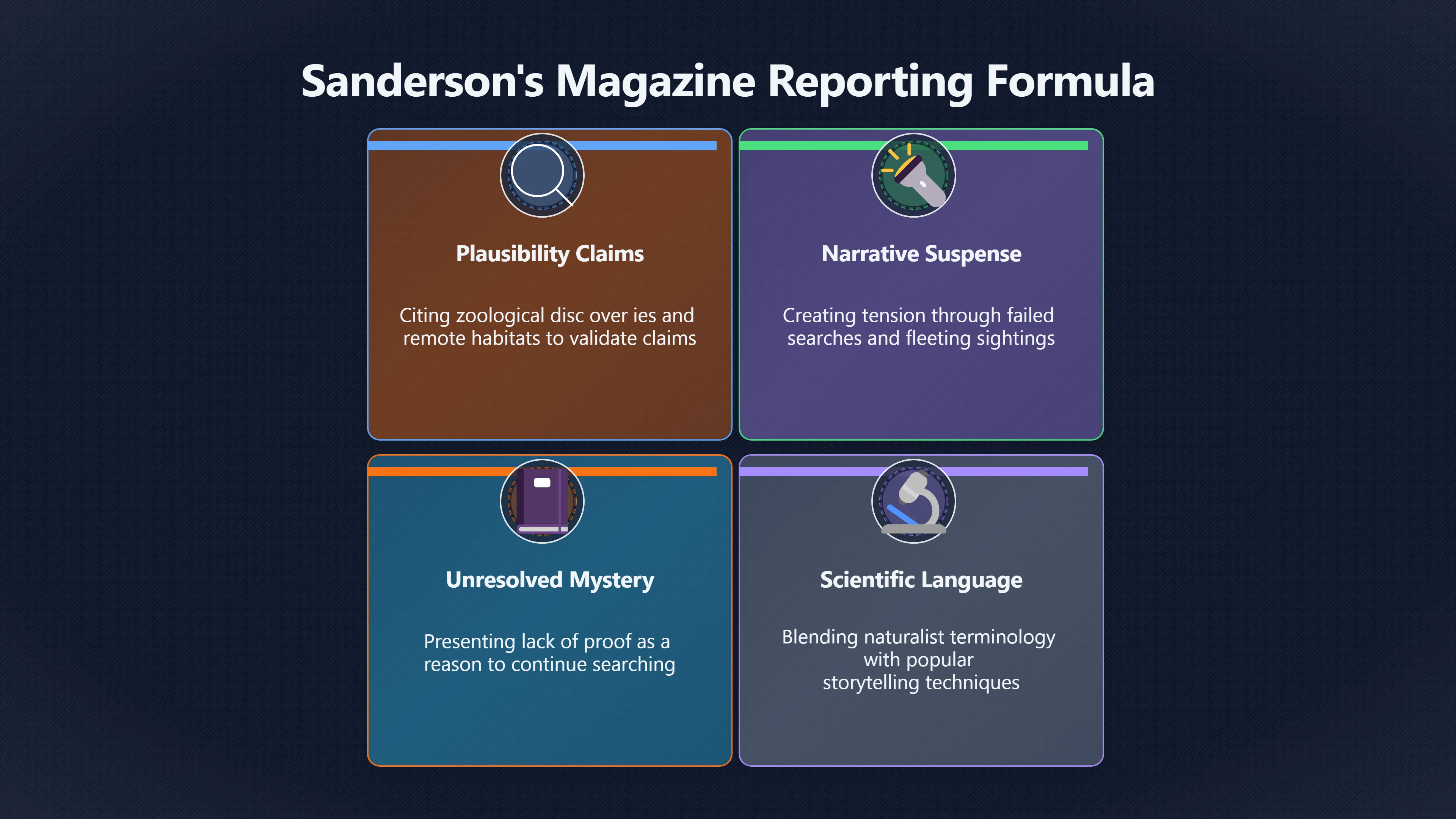
Plausibility. He frequently cited zoological discoveries, remote habitats and witness testimony to argue that unknown animals were not impossible.
Suspense. Expeditions, failed searches and fleeting sightings created narrative tension.
Unresolved mystery. The absence of a specimen or conclusive proof was often presented not as a failure but as a reason to continue searching.
This structure encouraged readers to participate imaginatively in the hunt. The mystery remained alive from one issue to the next, creating ongoing interest and anticipation. In commercial terms, unresolved monsters were often more valuable than solved ones.
How Mass-Market Reach Changed Cryptozoology
The significance of these magazines was not merely literary. They expanded the audience for cryptozoology far beyond natural history enthusiasts.
Mass-market magazines reached readers in supermarkets, newsstands, waiting rooms and homes across North America. Through them, stories about unknown creatures entered mainstream popular culture. Sanderson’s ideas therefore circulated among people who would never read specialist zoological literature.[as.amphilsoc.org]as.amphilsoc.orgIvan Terence Sanderson papers, [ca1920-1973]He illustrated his own books and was widely published. Sanderson wrote works for a popular audience in the natural sciences, in…
This broad readership had several consequences:
- Reports from ordinary witnesses gained greater visibility.
- Readers began submitting their own sightings and stories.
- Cryptids became recurring media subjects rather than isolated curiosities.
- Monster hunting acquired the feel of a public participatory project.
The magazine ecosystem effectively created a feedback loop. Publications printed sightings, readers supplied more reports, and writers such as Sanderson incorporated those reports into new investigations.
The Risk of Turning Weak Evidence into Entertainment
The same qualities that made magazines effective vehicles for monster hunting also created problems for evaluating evidence.
Adventure publications depended on dramatic narratives, eye-catching headlines and engaging mysteries. As a result, weak or ambiguous evidence could receive treatment similar to stronger evidence if it made a compelling story. Critics later argued that Sanderson sometimes accepted anecdotal reports too readily and gave insufficient weight to alternative explanations.[Wikipedia]WikipediaIvan T. SandersonIvan T. Sanderson
The magazine format encouraged several tendencies:
- Emphasising witness testimony over physical evidence.
- Treating lack of proof as evidence of concealment or rarity.
- Combining folklore, rumours and observations into a single narrative.
- Rewarding the most dramatic interpretations of uncertain events.
Because readers encountered these stories in publications that resembled factual journalism, the boundary between investigation and entertainment could become blurred. What felt like evidence gathering often remained largely a process of collecting anecdotes.
This tension became a defining feature of modern cryptozoology. Sanderson’s articles invited readers to think like investigators, but the commercial demands of mass-market publishing also rewarded mystery, suspense and speculation.
Magazine Monsters and the Legacy of Popular Monster Hunting
See on Amazon</a></div></div></article><article class="fr-book-card"><a class="fr-book-cover" href="https://www.amazon.com/s?k=On+the+Track+of+Unknown+Animals+by+Bernard+Heuvelmans&i=stripbooks&tag=searcht-20" target="_blank" rel="sponsored noopener noreferrer" aria-label="Open On the Track of Unknown Animals on Amazon"><span class="fr-book-cover-fallback">Book</span><img class="fr-book-cover-thumb" src="https://books.google.com/books/content?id=OYudQgAACAAJ&printsec=frontcover&img=1&zoom=1&source=gbs_api" alt="Cover for On the Track of Unknown Animals" loading="lazy" decoding="async" fetchpriority="low" referrerpolicy="no-referrer" onerror="this.hidden=true;this.closest('.fr-book-cover').classList.add('fr-book-cover-placeholder');"></a><div class="fr-book-info"><h4 class="fr-book-title"><a href="https://www.amazon.com/s?k=On+the+Track+of+Unknown+Animals+by+Bernard+Heuvelmans&i=stripbooks&tag=searcht-20" target="_blank" rel="sponsored noopener noreferrer" title="On the Track of Unknown Animals">On the Track of Unknown Animals</a></h4><p class="fr-book-author">By Bernard Heuvelmans</p><p class="fr-book-desc">Represents the broader monster-hunting culture magazines promoted.</p><div class="fr-book-actions"><a href="https://www.amazon.com/s?k=On+the+Track+of+Unknown+Animals+by+Bernard+Heuvelmans&i=stripbooks&tag=searcht-20" class="fr-amazon-btn" target="_blank" rel="sponsored noopener noreferrer">
See on Amazon</a></div></div></article><article class="fr-book-card"><a class="fr-book-cover" href="https://www.amazon.com/s?k=Invisible+Residents+by+Ivan+T.+Sanderson&i=stripbooks&tag=searcht-20" target="_blank" rel="sponsored noopener noreferrer" aria-label="Open Invisible Residents on Amazon"><span class="fr-book-cover-fallback">Book</span><img class="fr-book-cover-thumb" src="https://books.google.com/books/content?id=_BKYTHMBLj8C&printsec=frontcover&img=1&zoom=1&edge=curl&source=gbs_api" alt="Cover for Invisible Residents" loading="lazy" decoding="async" fetchpriority="low" referrerpolicy="no-referrer" onerror="this.hidden=true;this.closest('.fr-book-cover').classList.add('fr-book-cover-placeholder');"></a><div class="fr-book-info"><h4 class="fr-book-title"><a href="https://www.amazon.com/s?k=Invisible+Residents+by+Ivan+T.+Sanderson&i=stripbooks&tag=searcht-20" target="_blank" rel="sponsored noopener noreferrer" title="Invisible Residents">Invisible Residents</a></h4><p class="fr-book-author">By Ivan T. Sanderson</p><p class="fr-book-desc">Shows how mass-market presentation expanded interest in unexplained phenomena.</p><div class="fr-book-actions"><a href="https://www.amazon.com/s?k=Invisible+Residents+by+Ivan+T.+Sanderson&i=stripbooks&tag=searcht-20" class="fr-amazon-btn" target="_blank" rel="sponsored noopener noreferrer">
See on Amazon</a></div></div></article><article class="fr-book-card"><a class="fr-book-cover" href="https://www.amazon.com/s?k=Bigfoot%21+by+Loren+Coleman&i=stripbooks&tag=searcht-20" target="_blank" rel="sponsored noopener noreferrer" aria-label="Open Bigfoot! on Amazon"><span class="fr-book-cover-fallback">Book</span><img class="fr-book-cover-thumb" src="https://books.google.com/books/content?id=CsDBqy9oHHkC&printsec=frontcover&img=1&zoom=1&edge=curl&source=gbs_api" alt="Cover for Bigfoot!" loading="lazy" decoding="async" fetchpriority="low" referrerpolicy="no-referrer" onerror="this.hidden=true;this.closest('.fr-book-cover').classList.add('fr-book-cover-placeholder');"></a><div class="fr-book-info"><h4 class="fr-book-title"><a href="https://www.amazon.com/s?k=Bigfoot%21+by+Loren+Coleman&i=stripbooks&tag=searcht-20" target="_blank" rel="sponsored noopener noreferrer" title="Bigfoot!">Bigfoot!</a></h4><p class="fr-book-author">By Loren Coleman</p><p class="fr-book-desc">Illustrates how popular media sustained cryptid narratives.</p><div class="fr-book-actions"><a href="https://www.amazon.com/s?k=Bigfoot%21+by+Loren+Coleman&i=stripbooks&tag=searcht-20" class="fr-amazon-btn" target="_blank" rel="sponsored noopener noreferrer">
See on Amazon</a></div></div></article></div><div class="fr-section-footer"><div class="fr-browse-links" aria-label="Browse more on Amazon"><span class="fr-browse-links-label">Browse more on Amazon:</span><a class="fr-browse-more" href="https://www.amazon.com/s?k=Abominable+Snowmen%2C+Legend+Come+to+Life&i=stripbooks&tag=searcht-20" target="_blank" rel="sponsored noopener noreferrer">Abominable Snowmen, Legend Come to Life</a><a class="fr-browse-more" href="https://www.amazon.com/s?k=On+the+Track+of+Unknown+Animals&i=stripbooks&tag=searcht-20" target="_blank" rel="sponsored noopener noreferrer">On the Track of Unknown Animals</a><a class="fr-browse-more" href="https://www.amazon.com/s?k=Invisible+Residents&i=stripbooks&tag=searcht-20" target="_blank" rel="sponsored noopener noreferrer">Invisible Residents</a></div><p class="fr-disclosure">As an Amazon Associate I earn from qualifying purchases.</p></div></div></section>
Amazon book picks
Further Reading
Books and field guides related to How Magazines Sold Monster Hunting. Use these as the next step if you want deeper reading beyond the article.
On the Track of Unknown Animals
Represents the broader monster-hunting culture magazines promoted.
Mysterious America
Captures the entertainment-driven environment that helped monster stories spread.
Invisible Residents
Shows how mass-market presentation expanded interest in unexplained phenomena.
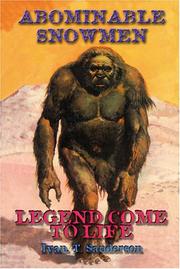
Abominable Snowmen
Demonstrates the storytelling style that magazine audiences embraced.
eBay marketplace picks
Marketplace Samples
Live-tested eBay searches with available results related to this page.
Endnotes
1.
Source: sf-encyclopedia.com
Link:https://sf-encyclopedia.com/entry/argosy_the
2.
Source: as.amphilsoc.org
Title: Ivan Terence Sanderson papers, [ca
Link:https://as.amphilsoc.org/repositories/2/resources/1789
3.
Source: Wikipedia
Title: Ivan T. Sanderson
Link:https://en.wikipedia.org/wiki/Ivan_T._Sanderson
4.
Source: reddit.com
Title: The first appearance of Bigfoot by Ivan T
Link:https://www.reddit.com/r/Cryptozoology/comments/115ia5q/true_magazine_december_1959_the_first_appearance/
5.
Source: reddit.com
Title: creature in Pattersons film. mobinchild. •. 3y ago.Read more
Link:https://www.reddit.com/r/bigfoot/comments/13557ex/argosy_february_1968first_publication_of[photos
6.
Source: amphilsoc.org
Title: new digital library ivan sanderson papers
Link:https://www.amphilsoc.org/blog/new-digital-library-ivan-sanderson-papers
7.
Source: cryptidarchives.fandom.com
Title: Ivan T. Sanderson
Link:https://cryptidarchives.fandom.com/wiki/Ivan_T._Sanderson
Additional References
8.
Source: ebay.com
Link:https://www.ebay.com/b/Argosy-Magazines/280/bn_36838411?mkevt=1&mkcid=1&mkrid=710-53481-19255-0&campid=5339151051&customid=endnote-source&toolid=10001
9.
Source: facebook.com
Link:https://www.facebook.com/instituteofmetaphysics/posts/ivan-t-sanderson1911-1973ivan-t-sanderson-was-a-naturalist-and-writer-born-in-ed/1505367731319428/
10.
Source: amazon.com
Link:https://www.amazon.com/Books-Ivan-T-Sanderson/s?page=2&rh=n%3A283155%2Cp_27%3AIvan%2BT.%2BSanderson&tag=searcht-20
11.
Source: facebook.com
Title: in the 1900s ivan sanderson created the largest archive of unclassified creature
Link:https://www.facebook.com/Discovery/posts/in-the-1900s-ivan-sanderson-created-the-largest-archive-of-unclassified-creature/953361330170453/
12.
Source: skepticalinquirer.org
Title: the clearwater monster how market forces created modern pseudoscience
Link:https://skepticalinquirer.org/exclusive/the-clearwater-monster-how-market-forces-created-modern-pseudoscience/
13.
Source: facebook.com
Link:https://www.facebook.com/Discovery/posts/the-founder-of-cryptozoology-ivan-sanderson-collected-research-on-cryptids-for-m/962532062586713/
14.
Source: youtube.com
Link:https://www.youtube.com/watch?v=PCJrfP0JUpI
15.
Source: youtube.com
Link:https://www.youtube.com/watch?v=7R2FfKyWwu4
16.
Source: karlshuker.blogspot.com
Title: in pink with americas giant crypto
Link:https://karlshuker.blogspot.com/2012/02/in-pink-with-americas-giant-crypto.html
17.
Source: thepulp.net
Title: cryptozoology anthology
Link:https://thepulp.net/pulpsuperfan/2024/10/21/cryptozoology-anthology/
Topic Tree