Within Hidden Mammals
Remote forest is not an unlimited hiding place
Real hidden mammals occupy constrained habitats, which makes giant widespread cryptids face tougher ecological questions.
On this page
- Why real ranges get narrower after evidence
- Breeding populations and visible traces
- Habitat mapping as a reality check
Page outline Jump by section
Introduction
Remote forests can conceal real animals, but they are not limitless hiding places. One of the strongest ecological critiques of giant cryptid claims is not simply that evidence is lacking; it is that large mammals require habitat, food, breeding partners and long-term population persistence. As zoologists discover and map rare forest mammals, their ranges usually become narrower and more specific, not broader and more mysterious. Species such as the saola demonstrate that elusive animals can remain poorly documented for decades, yet they are still tied to identifiable habitats, constrained distributions and measurable ecological requirements. The larger and more widespread a proposed cryptid is, the harder it becomes to explain how it could remain undetected while maintaining a viable population.[World Wildlife Fund+2ResearchGate]worldwildlife.orgWorld Wildlife FundSaola | WWFThe rare saola is critically endangered. Learn how WWF works to conserve this elusive species and its fores…
Why real ranges get narrower after evidence appears
A common assumption in cryptozoology is that unexplored wilderness provides unlimited opportunities for hidden animals. In practice, scientific discoveries often move in the opposite direction. When evidence accumulates, researchers usually learn that a species occupies a much smaller and more specialised range than originally imagined.
Breeding populations leave traces
The key ecological question is not whether a single unknown animal could avoid observation. It is whether an entire breeding population could do so.
Large mammals require enough individuals to reproduce over many generations. Conservation biology debates the exact numbers needed for long-term persistence, but viable populations generally require far more than a handful of animals. A species surviving for centuries must continually find mates, rear young and maintain genetic diversity.[PMC]pmc.ncbi.nlm.nih.govPMCThe limits to population density in birds and mammalsby PA Stephens · 2019 · Cited by 61 — We address two fundamental ecological questions: what are the limits to animal population densit…
Once populations reach those levels, detectable traces tend to multiply:<div class="content-enhancement content-enhancement--insight-grid" markdown="1">
- Tracks and trails accumulate.
- Feeding damage becomes visible.
- Hair, faeces and DNA enter the environment.
- Carcasses eventually appear.
- Animals are photographed by camera traps.[mpg.de]mpg.decamera traps image analysisEstimating the size of animal populations from camera trap…10 May 2017 — Camera traps are a useful means for researchers to observe th…
- Encounters become geographically clustered rather than random.</div>
This pattern is visible even for exceptionally elusive mammals. The saola remains one of the world’s rarest large land mammals, yet scientists know it through skulls, remains, captured individuals, camera-trap images and repeated local reports tied to specific landscapes. Its rarity has not prevented physical evidence from existing.[World Wildlife Fund+2Panda]worldwildlife.orgWorld Wildlife FundSaola | WWFThe rare saola is critically endangered. Learn how WWF works to conserve this elusive species and its fores…
By contrast, many giant cryptids are proposed as large-bodied, long-lived and geographically widespread while leaving little or no verified biological material. The larger the proposed animal, the more difficult this discrepancy becomes to explain ecologically.
The size problem
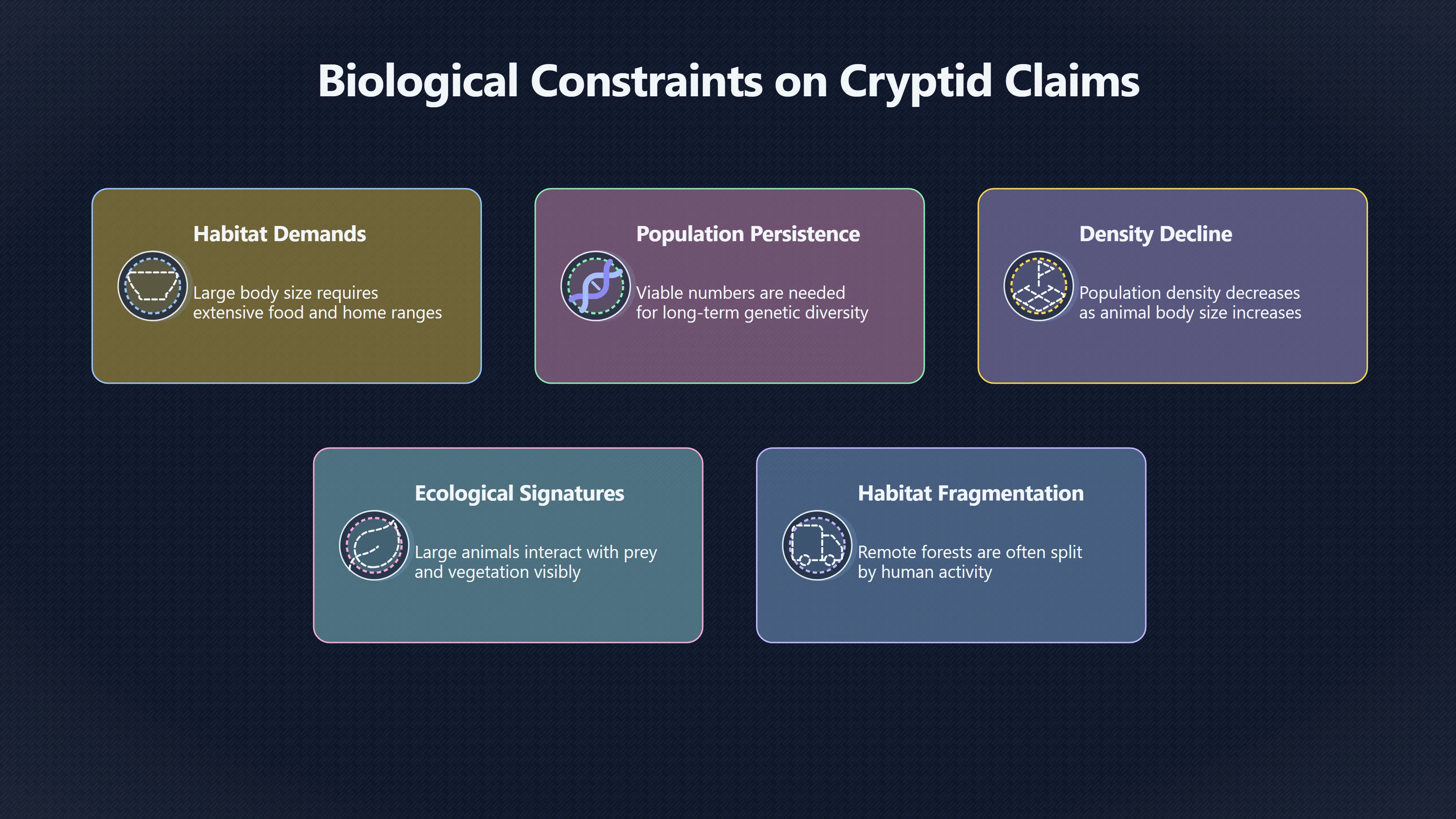
Body size increases habitat demands.
Large mammals generally need more food, larger home ranges and lower population densities than small mammals. Ecological research shows that population density tends to decline as body size increases, meaning that large animals require extensive areas to support viable numbers.[PMC]pmc.ncbi.nlm.nih.govPMCThe limits to population density in birds and mammalsby PA Stephens · 2019 · Cited by 61 — We address two fundamental ecological questions: what are the limits to animal population densit…
A hidden giant primate, for example, would not simply need a remote valley. It would likely require a network of habitats capable of supporting enough individuals across generations. Such a population would interact with prey, vegetation, water sources and competitors on a scale that should leave detectable ecological signatures.
Habitat mapping as a reality check
Modern wildlife surveys increasingly test claims about hidden animals by asking a practical question: where exactly could they live?
Habitat suitability modelling combines information about vegetation, elevation, climate, water availability and human disturbance to identify areas capable of supporting a species. This approach has become routine in conservation planning and studies of rare mammals.[ResearchGate]researchgate.netWe assessed Saola macrohabitat and microhabitat characteristics using Saola sighting location…Read more…
When applied to known elusive species, habitat mapping often produces surprisingly limited results. Suitable environments may exist only in fragmented patches, isolated mountain blocks or narrow ecological corridors. These constraints help explain why some species remain rare and difficult to detect.[WWF Österreich]wwf.atÖsterreich Introducing the saola (Pseudoryx nghetinhensisWWF ÖsterreichIntroducing the saola (Pseudoryx nghetinhensis)…June 3, 2005 — It is believed that the saola is a relic species that, alo…
The same logic can be applied to cryptid claims. If a proposed giant mammal requires substantial food resources, breeding populations and long-term persistence, then suitable habitat should be identifiable. Researchers can estimate how much land would be required and whether that habitat remains intact today.
Modern detection technologies reduce the hiding space
Another reason habitat limits matter is that remote areas are no longer surveyed solely by direct observation.
Camera traps, environmental DNA techniques, satellite mapping and occupancy modelling have dramatically expanded researchers’ ability to detect elusive wildlife. Camera-trap networks are now widely used to inventory medium and large mammals in difficult terrain and can reveal species that are rarely seen by people.[forestgeo.si.edu+2British Ecological Society]forestgeo.si.eduProtocol for camera-trap surveys of mammals at ForestGEO sitesThis document outlines procedures for surveying large terrestrial mammals a…
These technologies do not make discovery inevitable. Extremely rare species can still evade detection for years. The saola itself demonstrates that point. However, modern monitoring changes the scale of the challenge. A giant cryptid would need not only to avoid people but also increasingly sophisticated methods designed specifically to find uncommon mammals.[World Wildlife Fund+2ResearchGate]worldwildlife.orgWorld Wildlife FundSaola | WWFThe rare saola is critically endangered. Learn how WWF works to conserve this elusive species and its fores…
The ecological question therefore shifts from”Could a forest hide an animal?” to”Could a forest hide a large, reproducing population that leaves almost no verifiable traces despite expanding surveillance?”
Remote forest is not an unlimited hiding place
The strongest lesson from real hidden mammals is not that anything might be out there. It is that biology imposes constraints. Rare species survive in particular habitats, at particular densities and within measurable ecological limits. As evidence improves, those limits become clearer.
For cryptozoology, this creates a useful reality check. Discoveries such as the saola show that science can overlook remarkable mammals. Yet those same discoveries also demonstrate that elusive animals are eventually anchored to habitats, ranges, populations and physical evidence. Remote forest can delay discovery, but it does not suspend the ecological requirements of large mammals.[World Wildlife Fund+2ResearchGate]worldwildlife.orgWorld Wildlife FundSaola | WWFThe rare saola is critically endangered. Learn how WWF works to conserve this elusive species and its fores…<div class="youtube-embed-container youtube-embed-fallback youtube-embed-link-only"><div class="youtube-embed-card"><div class="youtube-embed-link-panel">Could Bigfoot ACTUALLY Exist?</div><div class="youtube-embed-footer"><p class="youtube-embed-title">Could Bigfoot ACTUALLY Exist?</p><p class="youtube-embed-actions">Open on YouTube</p></div></div></div>
Amazon book picks
Further Reading
Books and field guides related to Remote forest is not an unlimited hiding place. Use these as the next step if you want deeper reading beyond the article.
The Song Of The Dodo
Directly addresses distribution, isolation and viable populations.
Where the Wild Things Were
Explains habitat limits and ecological requirements of wildlife.
eBay marketplace picks
Marketplace Samples
Live-tested eBay searches with available results related to this page.




Endnotes
1.
Source: researchgate.net
Link:https://www.researchgate.net/publication/317710461_Habitat_Use_of_the_Saola_Pseudoryx_nghetinhensis_Mammalia_Bovidae_Based_on_Local_Sightings_in_the_Northern_Annamite_Mountains_of_Lao_PDR
2.
Source: pmc.ncbi.nlm.nih.gov
Title: PMCThe limits to population density in birds and mammals
Link:https://pmc.ncbi.nlm.nih.gov/articles/PMC6850427/
3.
Source: pmc.ncbi.nlm.nih.gov
Title: PMCEstimating Species Richness and Modelling Habitat
Link:https://pmc.ncbi.nlm.nih.gov/articles/PMC4108438/
4.
Source: forestgeo.si.edu
Link:https://forestgeo.si.edu/sites/default/files/ctfs-forestgeo_cameratrap_protocol_1.3.pdf
5.
Source: awsassets.panda.org
Link:https://awsassets.panda.org/downloads/saolaproceedingenglish.pdf
6.
Source: laos.wcs.org
Title: Laos Wildlife Saola
Link:https://laos.wcs.org/Saving-Wildlife/Saola.aspx
7.
Source: wwf.at
Title: Österreich Introducing the saola (Pseudoryx nghetinhensis)
Link:https://www.wwf.at/wp-content/cms_documents/saola_4da69fbde63df.pdf
8.
Source: researchgate.net
Link:https://www.researchgate.net/publication/381170398Detection_and_monitoring_of_the_fauna_of_medium_and_large_mammals_using_camera_traps_in_a_forest_remnant_area_in_the_municipality_of_Agua_Fria_de_Goias_Brazil-_A_tool_for_nature_conservation
9.
Source: researchgate.net
Link:https://www.researchgate.net/publication/393658232_From_Squid_Game_to_Organizational_Governance_A_Neurobehavioral_Framework_of_Four_Leadership_Archetypes
10.
Source: ndl.ethernet.edu.et
Link:https://ndl.ethernet.edu.et/bitstream/123456789/46979/1/George%20M.%20Eberhart.pdf
11.
Source: worldwildlife.org
Link:https://www.worldwildlife.org/species/saola/
12.
Source: britishecologicalsociety.org
Title: animal populations camera trap surveys
Link:https://www.britishecologicalsociety.org/animal-populations-camera-trap-surveys/
13.
Source: Wikipedia
Link:https://en.wikipedia.org/wiki/Saola
Additional References
14.
Source: hangar1publishing.com
Link:https://hangar1publishing.com/blogs/cryptids/cryptid-habitats-and-ecosystems?srsltid=AfmBOoona1i0z2NeOVMT1PisdAe4pzbObALH1fxKSMqSstQD0KHEGXNm
15.
Source: ecaslab.com
Link:https://ecaslab.com/tetradensity-database/
16.
Source: 3rswildlife.info
Link:https://3rswildlife.info/detection-mammals/
17.
Source: facebook.com
Title: scientists are racing to find a living legendthe asian unicornbefore it disappea
Link:https://www.facebook.com/61555526537201/posts/scientists-are-racing-to-find-a-living-legendthe-asian-unicornbefore-it-disappea/122266523804184217/
18.
Source: downtoearth.org.in
Title: saola scientists map genome of worlds rarest large land mammal
Link:https://www.downtoearth.org.in/wildlife-biodiversity/saola-scientists-map-genome-of-worlds-rarest-large-land-mammal
19.
Source: checklist.pensoft.net
Title: neta case study of Manas National Park, Assam, India
Link:https://checklist.pensoft.net/article/83560/
20.
Source: facebook.com
Link:https://www.facebook.com/newscientist/posts/from-woolly-mammoths-to-giant-sloths-via-some-lesser-known-ice-age-beasts-like-k/1268497515318863/
21.
Source: instagram.com
Link:https://www.instagram.com/p/DMhvwLoNgi0/
22.
Source: mpg.de
Title: camera traps image analysis
Link:https://www.mpg.de/11280830/camera-traps-image-analysis
23.
Source: mooc-conservation.org
Link:https://www.mooc-conservation.org/assets/courseware/v1/54c7fa8b34a8299e3afa8ab29861cc9f/asset-v1%3AIUCN-Papaco%2BMOOC-SE%2BEN-1%2Btype%40asset%2Bblock/M3_L6.pdf
Topic Tree