Within Media
Can Algorithms Really Find Bigfoot?
Expedition Bigfoot shows how data language can make unverified reports feel more modern and precise.
On this page
- What the data driven framing promises
- Why sighting databases are not proof
- How tech language refreshes monster hunting
Page outline Jump by section
Introduction
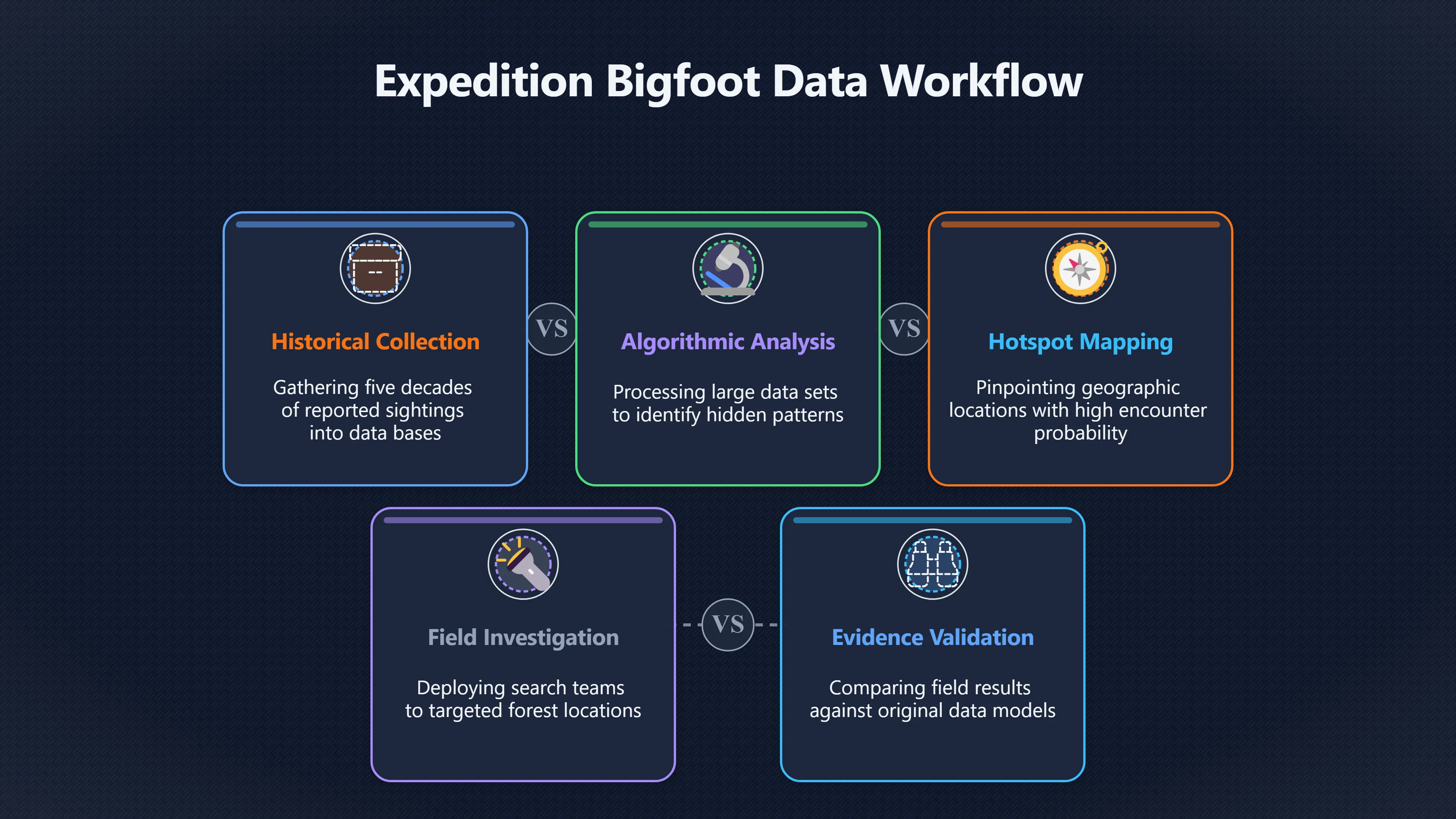
Expedition Bigfoot represents a notable shift in television cryptozoology. Instead of relying primarily on eyewitness stories and night-time stakeouts, the series promotes the idea that Bigfoot can be found through data analysis. Promotional material for the programme repeatedly emphasises an “advanced data algorithm” that analyses decades of reported sightings to identify where investigators are most likely to encounter the creature. This framing gives the search a modern, technological appearance and suggests that patterns hidden within large datasets can reveal a real, elusive animal.[Discovery UK+2Sky]discoveryuk.comDiscovery UKExpedition BigfootDiscovery UKAn elite team of investigators use an advanced data algorithm to analyse five decades of Bigfoot sightings to pinpoint when a… The appeal is obvious. In an era shaped by predictive analytics, mapping software and artificial intelligence, audiences are familiar with the idea that algorithms can discover patterns humans miss. The key question, however, is whether an algorithm can transform thousands of unverified reports into evidence of an unknown species. The answer reveals both the strengths and limitations of data-driven cryptid hunting.
What the Data-Driven Framing Promises
The central promise of Expedition Bigfoot is not simply that investigators are searching for Bigfoot. It is that they are searching intelligently. According to descriptions of the series, investigators use an algorithm to analyse roughly five decades of sightings and identify locations where an encounter is supposedly most likely.[Discovery UK]discoveryuk.comDiscovery UKExpedition BigfootDiscovery UKAn elite team of investigators use an advanced data algorithm to analyse five decades of Bigfoot sightings to pinpoint when a…
This approach borrows concepts familiar from legitimate scientific and commercial applications:
- Mapping clusters of observations.
- Identifying geographic hotspots.
- Looking for recurring environmental conditions.
- Predicting future activity from past reports.
- Using large datasets to guide fieldwork.
In principle, these are real analytical methods. Ecologists routinely use sighting records, habitat data and statistical modelling to estimate where known species are likely to occur. Wildlife managers use similar techniques to track migration routes, invasive species and population distributions.
Why Sighting Databases Are Not Proof
The weakness in the algorithmic promise lies in the quality of the underlying data.
Bigfoot databases are extensive. The Bigfoot Field Researchers Organization (BFRO) maintains thousands of reports from across North America, while independent mapping projects compile similar records into interactive geographic systems.[bfro.net+2BigfootMap.com]bfro.netBFRO Geographical Database of Bigfoot Sightings & ReportsThis comprehensive database of credible sightings and related reports is maintai…
However, a large database is not the same thing as a verified dataset.
Most entries in Bigfoot sighting archives are anecdotal reports. They vary widely in detail, reliability and verification. Some involve brief glimpses in poor lighting. Others are second-hand accounts. Many cannot be independently confirmed. The database may therefore record reports of sightings rather than confirmed encounters with a biological organism.[bfro.net]bfro.netBFRO Geographical Database of Bigfoot Sightings & ReportsThis comprehensive database of credible sightings and related reports is maintai…
This creates a classic data-quality problem. An algorithm can identify patterns only within the information it receives. If the input data contains errors, misunderstandings, hoaxes or mistaken identifications, the resulting patterns may simply map the distribution of reports rather than the distribution of an actual creature.
A useful comparison comes from wildlife science. If researchers collect thousands of confirmed observations of wolves, a predictive model can help locate wolf habitat. If researchers instead collect thousands of rumours about wolves, the model primarily predicts where rumours are common.
The distinction matters because pattern detection does not establish existence. A map can reveal clusters of reports without demonstrating that the reported animal is real.
When Patterns Reflect People Rather Than Creatures
Another challenge is that sighting databases often reflect human behaviour.
People are more likely to report unusual experiences in certain circumstances:
- In heavily forested recreational areas.
- During seasons when more people are outdoors.
- In regions where Bigfoot stories are already well known.
- After media coverage increases public attention.
Data analyses of Bigfoot reports frequently reveal geographic and seasonal patterns, but those patterns can often be explained by where people travel, hike, hunt or expect to see Bigfoot.[Medium]medium.comCan data science find Bigfoot? | TDS ArchiveSo far our EDA has helped us understand that the number of Bigfoot sightings reported t…
This issue is well known in ecology and social science. Observational datasets often contain reporting bias. Areas with more observers generate more reports. Areas with strong local folklore generate more claims. An algorithm may identify a hotspot that reflects human activity rather than animal activity.
How Tech Language Refreshes Monster Hunting
The most significant contribution of the algorithm narrative may be cultural rather than scientific.
Cryptozoology has long borrowed the appearance of scientific investigation. Earlier eras emphasised plaster casts, photographs, footprint measurements and field expeditions. Contemporary audiences are surrounded by discussions of machine learning, predictive analytics, geographic information systems (GIS) and big data. Expedition Bigfoot updates monster hunting by adopting that vocabulary.[Discovery UK]discoveryuk.comDiscovery UKExpedition BigfootDiscovery UKAn elite team of investigators use an advanced data algorithm to analyse five decades of Bigfoot sightings to pinpoint when a…
The result is a subtle shift in perception.
A witness interview sounds anecdotal.
A map generated from thousands of reports sounds analytical.
A search area selected by an “advanced data algorithm” sounds objective, even if viewers never see the model’s assumptions, variables or validation procedures.[Discovery UK]discoveryuk.comDiscovery UKExpedition BigfootDiscovery UKAn elite team of investigators use an advanced data algorithm to analyse five decades of Bigfoot sightings to pinpoint when a…
This does not mean the programme is intentionally deceptive. Rather, it illustrates how technical language can increase the perceived credibility of uncertain claims. The algorithm becomes part of the show’s storytelling structure. It creates the impression that the search has moved from intuition to prediction, from folklore to analytics.
That perception is powerful because modern audiences often associate computational methods with neutrality and accuracy. Yet algorithms inherit the strengths and weaknesses of their data sources. When the underlying reports remain unverified, the sophistication of the analytical language does not resolve the fundamental evidentiary problem.
Can Algorithms Really Find Bigfoot?
Algorithms can certainly do some things.
See on Amazon</a></div></div></article><article class="fr-book-card"><a class="fr-book-cover" href="https://www.amazon.com/s?k=The+Signal+and+the+Noise+by+Nate+Silver&i=stripbooks&tag=searcht-20" target="_blank" rel="sponsored noopener noreferrer" aria-label="Open The Signal and the Noise on Amazon"><span class="fr-book-cover-fallback">Book</span><img class="fr-book-cover-thumb" src="https://books.google.com/books/content?id=nQ6RMAEACAAJ&printsec=frontcover&img=1&zoom=1&source=gbs_api" alt="Cover for The Signal and the Noise" loading="lazy" decoding="async" fetchpriority="low" referrerpolicy="no-referrer" onerror="this.hidden=true;this.closest('.fr-book-cover').classList.add('fr-book-cover-placeholder');"></a><div class="fr-book-info"><h4 class="fr-book-title"><a href="https://www.amazon.com/s?k=The+Signal+and+the+Noise+by+Nate+Silver&i=stripbooks&tag=searcht-20" target="_blank" rel="sponsored noopener noreferrer" title="The Signal and the Noise">The Signal and the Noise</a></h4><p class="fr-book-author">By Nate Silver</p><p class="fr-book-desc">Directly relevant to claims that algorithms can find patterns in uncertain data.</p><div class="fr-book-actions"><a href="https://www.amazon.com/s?k=The+Signal+and+the+Noise+by+Nate+Silver&i=stripbooks&tag=searcht-20" class="fr-amazon-btn" target="_blank" rel="sponsored noopener noreferrer">
See on Amazon</a></div></div></article><article class="fr-book-card"><a class="fr-book-cover" href="https://www.amazon.com/s?k=Abominable+Science%21+by+Daniel+Loxton&i=stripbooks&tag=searcht-20" target="_blank" rel="sponsored noopener noreferrer" aria-label="Open Abominable Science! on Amazon"><span class="fr-book-cover-fallback">Book</span><img class="fr-book-cover-thumb" src="https://books.google.com/books/content?id=kTsgAAAAQBAJ&printsec=frontcover&img=1&zoom=1&edge=curl&source=gbs_api" alt="Cover for Abominable Science!" loading="lazy" decoding="async" fetchpriority="low" referrerpolicy="no-referrer" onerror="this.hidden=true;this.closest('.fr-book-cover').classList.add('fr-book-cover-placeholder');"></a><div class="fr-book-info"><h4 class="fr-book-title"><a href="https://www.amazon.com/s?k=Abominable+Science%21+by+Daniel+Loxton&i=stripbooks&tag=searcht-20" target="_blank" rel="sponsored noopener noreferrer" title="Abominable Science!">Abominable Science!</a></h4><p class="fr-book-author">By Daniel Loxton, Donald R. Prothero</p><p class="fr-book-desc">Provides scientific context for evaluating extraordinary claims.</p><div class="fr-book-actions"><a href="https://www.amazon.com/s?k=Abominable+Science%21+by+Daniel+Loxton&i=stripbooks&tag=searcht-20" class="fr-amazon-btn" target="_blank" rel="sponsored noopener noreferrer">
See on Amazon</a></div></div></article><article class="fr-book-card"><a class="fr-book-cover" href="https://www.amazon.com/s?k=Calling+Bullshit+by+Carl+T.+Bergstrom&i=stripbooks&tag=searcht-20" target="_blank" rel="sponsored noopener noreferrer" aria-label="Open Calling Bullshit on Amazon"><span class="fr-book-cover-fallback">Book</span><img class="fr-book-cover-thumb" src="https://books.google.com/books/content?id=S2ZOzQEACAAJ&printsec=frontcover&img=1&zoom=1&source=gbs_api" alt="Cover for Calling Bullshit" loading="lazy" decoding="async" fetchpriority="low" referrerpolicy="no-referrer" onerror="this.hidden=true;this.closest('.fr-book-cover').classList.add('fr-book-cover-placeholder');"></a><div class="fr-book-info"><h4 class="fr-book-title"><a href="https://www.amazon.com/s?k=Calling+Bullshit+by+Carl+T.+Bergstrom&i=stripbooks&tag=searcht-20" target="_blank" rel="sponsored noopener noreferrer" title="Calling Bullshit">Calling Bullshit</a></h4><p class="fr-book-author">By Carl T. Bergstrom, Jevin Darwin West</p><p class="fr-book-desc">Explains the limits of drawing conclusions from weak datasets.</p><div class="fr-book-actions"><a href="https://www.amazon.com/s?k=Calling+Bullshit+by+Carl+T.+Bergstrom&i=stripbooks&tag=searcht-20" class="fr-amazon-btn" target="_blank" rel="sponsored noopener noreferrer">
See on Amazon</a></div></div></article></div><div class="fr-section-footer"><div class="fr-browse-links" aria-label="Browse more on Amazon"><span class="fr-browse-links-label">Browse more on Amazon:</span><a class="fr-browse-more" href="https://www.amazon.com/s?k=Bigfoot%21&i=stripbooks&tag=searcht-20" target="_blank" rel="sponsored noopener noreferrer">Bigfoot!</a><a class="fr-browse-more" href="https://www.amazon.com/s?k=The+Signal+and+the+Noise&i=stripbooks&tag=searcht-20" target="_blank" rel="sponsored noopener noreferrer">The Signal and the Noise</a><a class="fr-browse-more" href="https://www.amazon.com/s?k=Abominable+Science%21&i=stripbooks&tag=searcht-20" target="_blank" rel="sponsored noopener noreferrer">Abominable Science!</a></div><p class="fr-disclosure">As an Amazon Associate I earn from qualifying purchases.</p></div></div></section>
Amazon book picks
Further Reading
Books and field guides related to Can Algorithms Really Find Bigfoot?. Use these as the next step if you want deeper reading beyond the article.
The Signal and the Noise
Directly relevant to claims that algorithms can find patterns in uncertain data.
eBay marketplace picks
Marketplace Samples
Live-tested eBay searches with available results related to this page.




Endnotes
1.
Source: discoveryuk.com
Title: Discovery UKExpedition Bigfoot
Link:https://www.discoveryuk.com/series/expedition-bigfoot/
2.
Source: sky.com
Link:https://www.sky.com/watch/series/296c2ae3-d324-4c61-9f0b-8e13d763c549/tv
3.
Source: Wikipedia
Title: Finding Bigfoot
Link:https://en.wikipedia.org/wiki/Finding_Bigfoot
4.
Source: bfro.net
Link:https://www.bfro.net/gdb/
5.
Source: bigfootmap.com
Link:https://www.bigfootmap.com/
6.
Source: Wikipedia
Link:https://en.wikipedia.org/wiki/Bigfoot
7.
Source: medium.com
Link:https://medium.com/data-science/can-data-science-find-bigfoot-ad0a54de5dda
8.
Source: reddit.com
Title: Bigfoot Algorithm
Link:https://www.reddit.com/r/bigfoot/comments/ld83lv/bigfoot_algorithm/
9.
Source: bfro.net
Link:https://www.bfro.net/gdb/newadd.asp?Show=AB
10.
Source: reddit.com
Title: Launching an app for bigfoot sightings map
Link:https://www.reddit.com/r/bigfoot/comments/1qapruq/launching_an_app_for_bigfoot_sightings_map_where/
11.
Source: youtube.com
Title: One Team Member Down As the Search Begins | Expedition Bigfoot | Travel Channel
Link:https://www.youtube.com/watch?v=sdAqIFvNfvg
12.
Source: youtube.com
Title: Expedition Bigfoot | S5 E7 | The ULTIMATE Finding Bigfoot Tech
Link:https://www.youtube.com/watch?v=rlDIzP3Gsy4
13.
Source: isu.edu
Title: THE BIGFOOT MAPPING PROJECT final
Link:https://www.isu.edu/media/libraries/rhi/brief-communications/THE-BIGFOOT-MAPPING-PROJECT_final.pdf
14.
Source: earthdata.nasa.gov
Link:https://www.earthdata.nasa.gov/data/projects/bigfoot
15.
Source: public.tableau.com
Link:https://public.tableau.com/views/Bigfoot/Bigfoot?%3Aanimate_transition=yes&%3Adisplay_count=yes&%3Adisplay_overlay=yes&%3Adisplay_spinner=no&%3Adisplay_static_image=no&%3Aembed=y&%3Ahost_url=https%3A%2F%2Fpublic.tableau.com%2F&%3AloadOrderID=0&%3AshowTabs=y&%3AshowVizHome=no&%3Atabs=no&%3Atoolbar=yes
Additional References
16.
Source: facebook.com
Link:https://www.facebook.com/TravelChannel/posts/follow-expeditionbigfoot-team-in-their-hunt-for-one-of-americas-most-elusive-cre/642044157955167/
17.
Source: youtube.com
Link:https://www.youtube.com/watch?v=SS6p4tRDdpQ
18.
Source: youtube.com
Link:https://www.youtube.com/watch?v=sZI_pKlOXYA
19.
Source: instagram.com
Title: Scott Tompkins (@bigfootmappingproject)Creator of The Bigfoot Mapping Project
Link:https://www.instagram.com/bigfootmappingproject/
20.
Source: mireyamayor.com
Title: investigating the explorer society bigfoot map
Link:https://mireyamayor.com/investigating-the-explorer-society-bigfoot-map/
21.
Source: facebook.com
Link:https://www.facebook.com/groups/BFRO.group/posts/10162251996520169/
22.
Source: facebook.com
Title: BFR O snapshot of sightings per state
Link:https://www.facebook.com/RMSOBigfoot/posts/bfro-snapshot-of-sightings-per-state-rmso-has-received-over-1200-reports-from-ar/1416317073448393/
23.
Source: arcgis.com
Title: Arc GISBigfoot Sightings Point Map
Link:https://www.arcgis.com/home/item.html?id=58757732dab4498dbdba3f8f1756b428
24.
Source: news.fiu.edu
Link:https://news.fiu.edu/2019/researchers-uncover-bigfoot-clues-in-new-travel-channel-series
25.
Source: youtube.com
Title: Electromagnetic Tracking | Expedition Bigfoot | Travel Channel
Link:https://www.youtube.com/watch?v=kdZzS0zI2Wo
Topic Tree