Within Samples
What the Oxford Hair Study Really Found
The Oxford-Lausanne hair study turned famous anomalous-primate claims into a testable set of species identifications.
On this page
- How the sample call out worked
- What the 30 tested hairs matched
- Why the polar bear result became controversial
Page outline Jump by section
Introduction
The Oxford–Lausanne hair study is one of the most important laboratory investigations ever conducted into alleged cryptid biological evidence. Published in 2014 and led by geneticist Bryan Sykes, the project sought to move discussion of creatures such as the yeti, Bigfoot, sasquatch and almasty away from anecdotes and towards testable physical samples. Instead of investigating sightings or footprints, the researchers focused on hair specimens that collectors, museums and enthusiasts believed might have come from unknown primates. The study’s significance lies not in confirming a cryptid, but in showing what happens when purported cryptid evidence is subjected to modern genetic analysis. Of the 30 hair samples successfully tested, almost all were identified as known animals, while two Himalayan samples produced an unexpected result that sparked years of scientific debate.[Royal Society Publishing+2PubMed]royalsocietypublishing.orgSykes Corresponding Author · Bryan C. SykesRoyal Society PublishingGenetic analysis of hair samples attributed to yeti, bigfoot and…by BC Sykes · 2014 · Cited by 49 — Genetic an…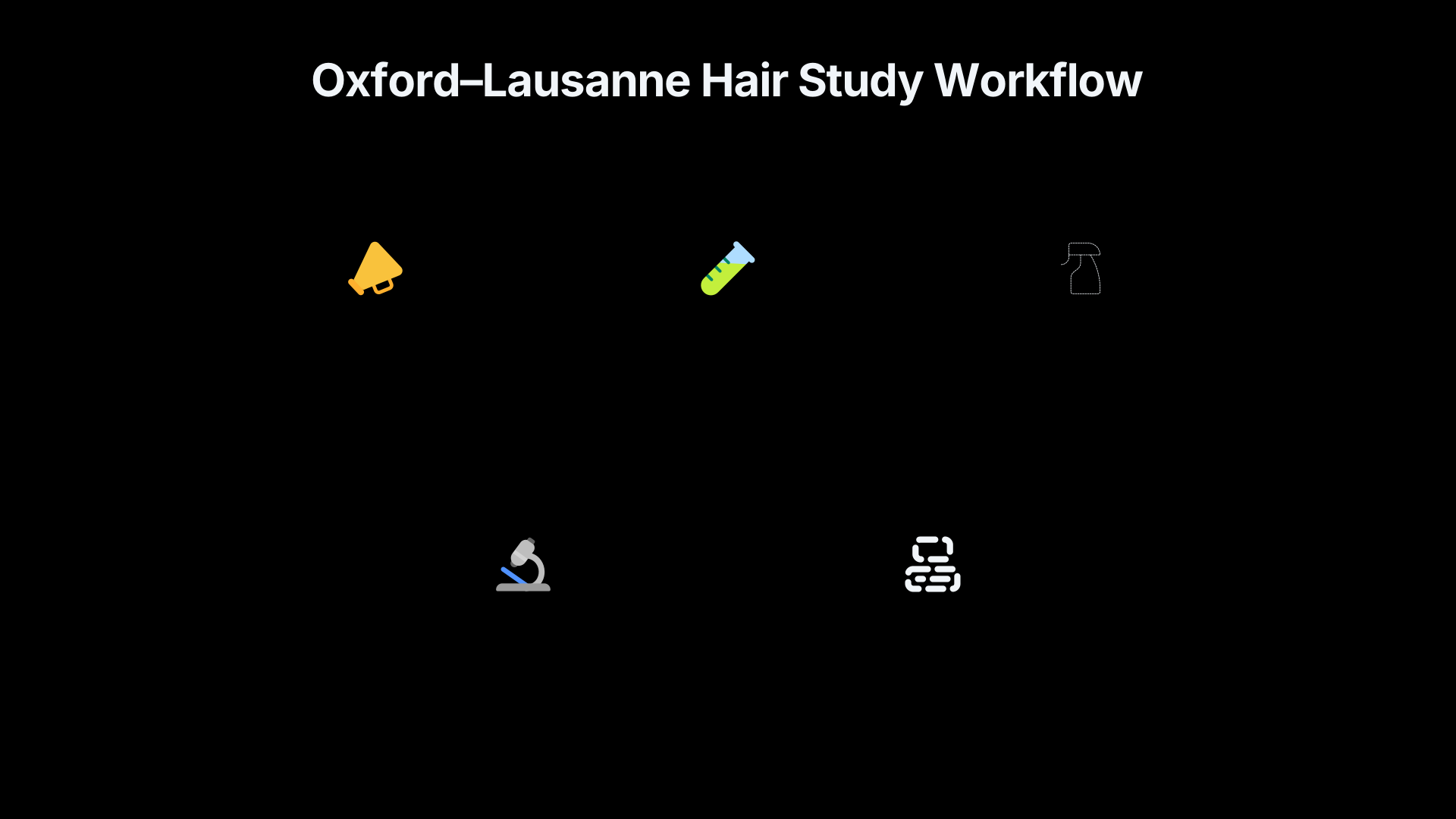
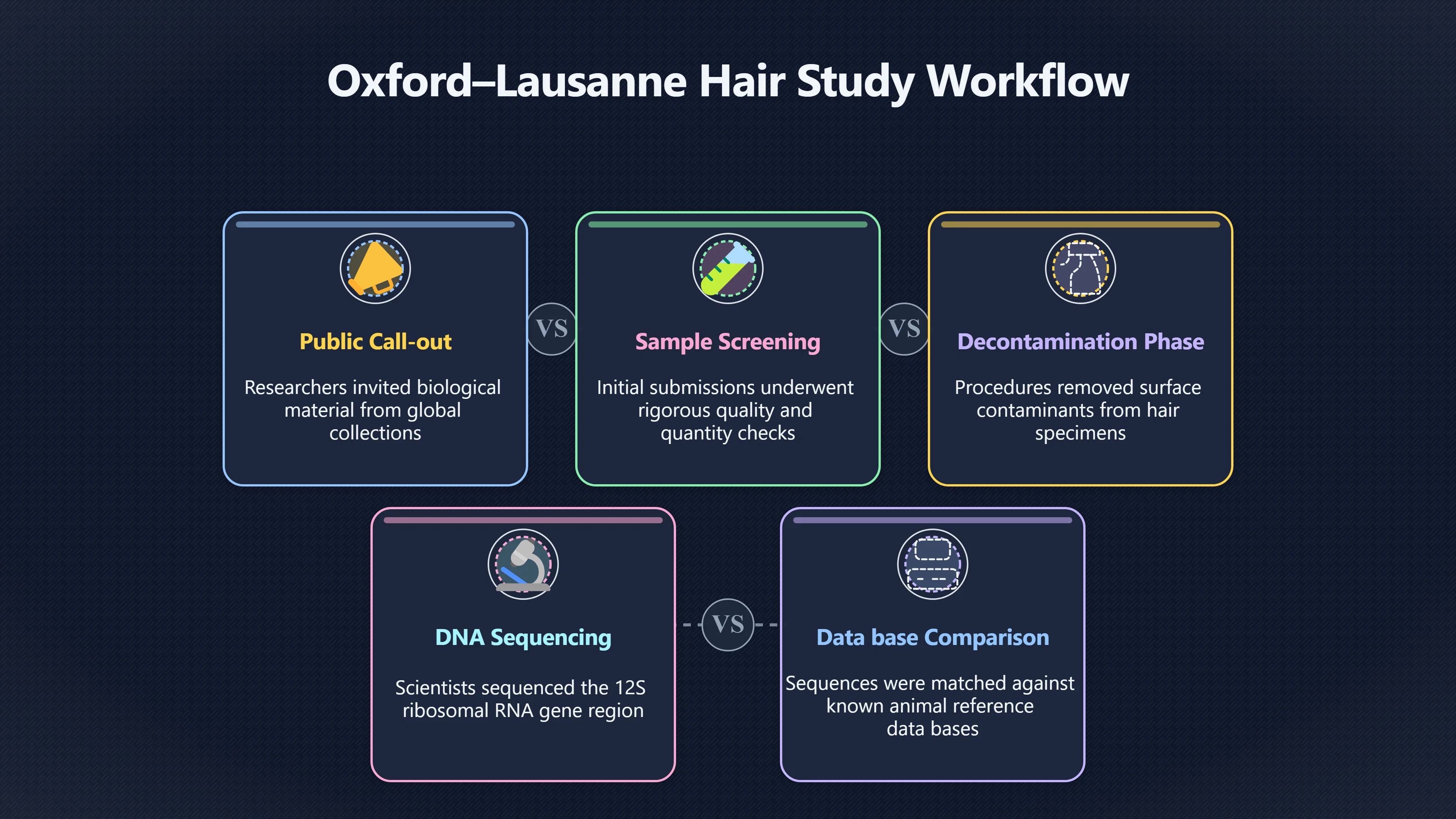
How the sample call-out worked
What the 30 tested hairs matched
The headline finding was straightforward: none of the analysed samples provided evidence for an unknown primate species. Instead, the specimens matched a range of familiar mammals already known to inhabit the regions where they were collected.[PMC]pmc.ncbi.nlm.nih.govGenetic analysis of hair samples attributed to yeti, bigfoot and…by BC Sykes · 2014 · Cited by 49 — We have used rigorous decontami…
The identified animals included:[scmp.com]scmp.combryan sykes links yeti hair samples dna ancient polar bearSouth China Morning PostBryan Sykes links yeti hair samples to the DNA of an…19 Oct 2013 — Sykes compared DNA from hair samples taken…
- Brown and black bears.
-
Horses.<div class="content-enhancement content-enhancement--insight-grid" markdown="1">
- Cattle.
- Sheep and goats.
- Deer.
- Dogs, wolves and coyotes.
- Raccoons.
- Porcupines.
- Tapirs.
- Humans.[Wikipedia]WikipediaOpen source on wikipedia.org.</div>
Several samples submitted as possible Bigfoot or sasquatch evidence turned out to be ordinary North American mammals. Material linked to Russian almasty reports also matched known species rather than an unidentified hominin. The results demonstrated a recurring pattern in cryptid investigations: hair that appears unusual in the field often proves genetically unremarkable when tested in a laboratory.[Wikipedia]WikipediaAlmas (folkloreAlmas (folklore
For cryptozoology, this outcome was important even though it was not dramatic. The study transformed many long-circulating claims into specific species identifications. Instead of remaining mysterious artefacts, the samples became evidence of misidentification, contamination, folklore attribution or simple uncertainty about an animal’s origin.[PMC]pmc.ncbi.nlm.nih.govGenetic analysis of hair samples attributed to yeti, bigfoot and…by BC Sykes · 2014 · Cited by 49 — We have used rigorous decontami…
Why the polar bear result became controversial
What the study changed in cryptid testing
The lasting importance of the Oxford–Lausanne study is methodological rather than sensational. It showed that biological evidence associated with cryptids can be collected, screened and genetically identified using standard laboratory techniques. The project also highlighted the limits of such evidence. Hair samples without roots often contain only fragmented mitochondrial DNA, making precise identification difficult and sometimes leaving room for competing interpretations.[PMC]pmc.ncbi.nlm.nih.govGenetic analysis of hair samples attributed to yeti, bigfoot and…by BC Sykes · 2014 · Cited by 49 — We have used rigorous decontami…
Equally important, the study demonstrated the value of examining many samples rather than focusing on a single celebrated specimen. By treating cryptid evidence as a population of testable objects, the researchers were able to replace speculation with species-level identifications in most cases. The result was not confirmation of Bigfoot, the yeti or other anomalous primates, but a clearer understanding of what the available biological evidence actually represented.[Royal Society Publishing]royalsocietypublishing.orgSykes Corresponding Author · Bryan C. SykesRoyal Society PublishingGenetic analysis of hair samples attributed to yeti, bigfoot and…by BC Sykes · 2014 · Cited by 49 — Genetic an…
Within the broader history of cryptozoology, the Oxford–Lausanne project stands as a rare example of a large-scale, peer-reviewed attempt to evaluate alleged cryptid material under consistent scientific conditions. Its principal finding was simple but influential: when purported cryptid hairs were subjected to genetic testing, they overwhelmingly matched known animals rather than unknown primates.[Royal Society Publishing+2PubMed]royalsocietypublishing.orgSykes Corresponding Author · Bryan C. SykesRoyal Society PublishingGenetic analysis of hair samples attributed to yeti, bigfoot and…by BC Sykes · 2014 · Cited by 49 — Genetic an…
Amazon book picks
Further Reading
Books and field guides related to What the Oxford Hair Study Really Found. Use these as the next step if you want deeper reading beyond the article.
The Seven Daughters of Eve
Strong author connection to the study discussed on the page.
Field Guide To Bigfoot, Yeti, & Other Mystery Primates Worldwide
Provides context for hair samples linked to mystery primates.
eBay marketplace picks
Marketplace Samples
Live-tested eBay searches with available results related to this page.

Endnotes
1.
Source: pmc.ncbi.nlm.nih.gov
Link:https://pmc.ncbi.nlm.nih.gov/articles/PMC4100498/
2.
Source: pmc.ncbi.nlm.nih.gov
Title: PMCMolecular analysis of’anomalous primate’ hair samples
Link:https://pmc.ncbi.nlm.nih.gov/articles/PMC4100509/
3.
Source: Wikipedia
Link:https://en.wikipedia.org/wiki/Bigfoot
4.
Source: Wikipedia
Title: Almas (folklore)
Link:https://en.wikipedia.org/wiki/Almas_%28folklore%29
5.
Source: pmc.ncbi.nlm.nih.gov
Title: PMCHimalayan’yeti’ DNA: polar bear or DNA degradation
Link:https://pmc.ncbi.nlm.nih.gov/articles/PMC4298200/
6.
Source: Wikipedia
Title: Bryan Sykes
Link:https://en.wikipedia.org/wiki/Bryan_Sykes
7.
Source: Wikipedia
Link:https://en.wikipedia.org/wiki/Yeti
8.
Source: royalsocietypublishing.org
Title: Sykes Corresponding Author · Bryan C. Sykes
Link:https://royalsocietypublishing.org/rspb/article/281/1789/20140161/77194/Genetic-analysis-of-hair-samples-attributed-to
9.
Source: pubmed.ncbi.nlm.nih.gov
Link:https://pubmed.ncbi.nlm.nih.gov/24990672/
10.
Source: hurriyetdailynews.com
Title: yetis hair samples looked for a study 21518
Link:https://www.hurriyetdailynews.com/yetis-hair-samples-looked-for-a-study-21518
11.
Source: scmp.com
Title: bryan sykes links yeti hair samples dna ancient polar bear
Link:https://www.scmp.com/news/world/article/1334769/bryan-sykes-links-yeti-hair-samples-dna-ancient-polar-bear
12.
Source: royalsocietypublishing.org
Link:https://royalsocietypublishing.org/doi/abs/10.1098/rspb.2014.0161
Additional References
13.
Source: researchgate.net
Link:https://www.researchgate.net/publication/263583915_Correction_to_Genetic_analysis_of_hair_samples_attributed_to_yeti_bigfoot_and_other_anomalous_primates
14.
Source: researchgate.net
Link:https://www.researchgate.net/publication/269770665_Response_to_Edward_and_Barnett
15.
Source: retractionwatch.com
Title: bigfoot paper corrected because it doesnt exist the authors institution that is
Link:https://retractionwatch.com/2015/04/14/bigfoot-paper-corrected-because-it-doesnt-exist-the-authors-institution-that-is/
16.
Source: scispace.com
Title: genetic analysis of hair samples attributed to yeti bigfoot 3c18zy7l7d
Link:https://scispace.com/pdf/genetic-analysis-of-hair-samples-attributed-to-yeti-bigfoot-3c18zy7l7d.pdf
17.
Source: researchgate.net
Link:https://www.researchgate.net/scientific-contributions/Bryan-Sykes-38917996
18.
Source: youtube.com
Title: Yeti Is Real, DNA Proves It, Claims Scientist Bryan Sykes
Link:https://www.youtube.com/watch?v=rzYLGWudaLI
19.
Source: jakegoheen.com
Title: mammalogy reader
Link:https://www.jakegoheen.com/reprints/mammalogy_reader.pdf
20.
Source: youtube.com
Link:https://www.youtube.com/watch?v=KfBdcUpL2bA
21.
Source: youtube.com
Title: Mystery solved? UB study finds”Yeti” DNA tied to local bears
Link:https://www.youtube.com/watch?v=ymwVDxoGc34
22.
Source: youtube.com
Title: Mystery of the Yeti put to rest
Link:https://www.youtube.com/watch?v=VC5oJk2Z2qc
Topic Tree