Within Cryptozoology
Why One Monster Would Never Be Enough
A real large cryptid would need mates, food, habitat, and generations of survival, not just isolated sightings.
On this page
- Why species need breeding populations
- Food, habitat, and ecological traces
- Why absence matters over time
Page outline Jump by section
Introduction
A single famous sighting is never enough to establish a real cryptid. If a large unknown animal exists, it must usually be part of a breeding population: enough males and females, spread through suitable habitat, finding food, reproducing, dying, and leaving traces over many generations. That is why population ecology raises the burden of proof in cryptozoology. The claim is not just “someone saw one strange animal”; it is “a hidden population has persisted without producing the ordinary evidence that populations produce”.
This matters because the most famous cryptids are usually described as large animals: an ape-like Sasquatch, a long-necked Loch Ness creature, a surviving prehistoric reptile, a big cat outside its known range. Large animals are hard to hide indefinitely because they eat, move, breed, shed DNA, leave tracks, produce droppings, sometimes die in accessible places, and affect the ecosystems they occupy. Modern wildlife biology does find elusive animals, but it does so through bodies, bones, camera traps, genetic samples, dens, kills, scat, hair and repeatable field signs — not sightings alone. Standards used for large-carnivore monitoring in Europe, for example, distinguish hard evidence such as live capture, dead animals, genetic proof, GPS locations and high-quality images from unsupported sightings or poor-quality pictures.[lciepub.nina.no]lciepub.nina.no638988265540892975 LCIE Monitoring Standards638988265540892975 LCIE Monitoring Standards
Why one monster would never be enough
A hidden species cannot normally be reduced to one dramatic individual. For a cryptid to persist through time, it needs a viable breeding population: enough individuals to avoid immediate demographic collapse, enough genetic diversity to avoid severe inbreeding, and enough successful reproduction to replace deaths. In conservation biology, the old “50/500” rule — often simplified as 50 effective breeders for short-term inbreeding concerns and 500 for longer-term genetic adaptability — has been heavily debated, but the debate mostly pushes thresholds upwards, not downwards. Jamieson and Allendorf warned that confusion arises when a short-term genetic rule is used as if it proves long-term viability, while later conservation commentary argued that many species may need effective population sizes closer to 100 or 1,000, corresponding to much larger census populations.[PubMed]pubmed.ncbi.nlm.nih.govHow does the 50/500 rule apply to MVPs?by IG Jamieson · 2012 · Cited by 530 — Here, we argue that the confusion arises when the gen…
That does not mean every animal population needs the same number. A small fish, a parthenogenetic invertebrate, a recently isolated island population and a long-lived ape would not all be judged by one formula. But the general point is powerful: a supposed population of large mammals cannot be made plausible by imagining one lonely survivor. If the claim is that Bigfoot has lived across North America for centuries, or that a large animal has inhabited Loch Ness for many human generations, the real claim is about many animals over time.
This is why sceptics often ask a different question from believers. Believers may ask, “Could one witness have seen something real?” Ecologists ask, “Where is the population?” The second question is harder because populations create patterns. They need ranges, mates, juvenile stages, food webs, births, deaths and dispersal. They should not appear only as isolated adult forms in ambiguous sightings.
The problem becomes sharper for cryptids described as ancient survivors. A plesiosaur-like Loch Ness animal, for instance, would not merely have to survive as a single relic. It would need a lineage of breeding animals persisting long after the extinction of non-avian dinosaurs, through climatic shifts, habitat changes and the formation of the modern loch. That is a much larger claim than “there may be something in the water”.
Food, habitat and the size of the ecological footprint
What real populations leave behind
A breeding population leaves evidence at several levels. Some traces are direct: bodies, bones, teeth, skins, hair, droppings, nests, dens, eggs, calls or clear photographs. Others are ecological: prey remains, repeated tracks in suitable habitat, seasonal movement patterns, genetic traces in water or soil, and local impacts on food webs. A single ambiguous footprint can be debated indefinitely; a population should produce a pattern that survives scrutiny.
This is why “no body” is not a trivial objection. Wild animals die. They are scavenged, decomposed and sometimes hidden, so no one expects a perfect archive of remains. But over decades, a population of large animals should occasionally produce recoverable bones, roadkill, hunter encounters, forensic-quality hair, identifiable scat or DNA. The more numerous, widespread and long-lived the alleged animal is, the more damaging the absence of such evidence becomes.
The contrast with recognised wildlife monitoring is stark. European large-carnivore standards classify a dead animal, a captured animal, confirmed DNA from biological samples, GPS-collar locations and high-quality images as hard evidence; unsupported sightings and poor-quality pictures fall into weaker categories. For lynx, even tracks on snow become stronger only when documented and assessed by experts, while a single footprint or an unanalysed presumed scat remains weak.[lciepub.nina.no]lciepub.nina.no638988265540892975 LCIE Monitoring Standards638988265540892975 LCIE Monitoring Standards
Cryptozoology often reverses that hierarchy. Sightings accumulate first, while physical evidence remains ambiguous or absent. That does not make every witness dishonest. It means the evidence is poorly matched to the scale of the claim. A fleeting sighting can support the modest claim that a person saw something they could not identify. It cannot, by itself, support the much larger claim that an unrecognised breeding population is present.
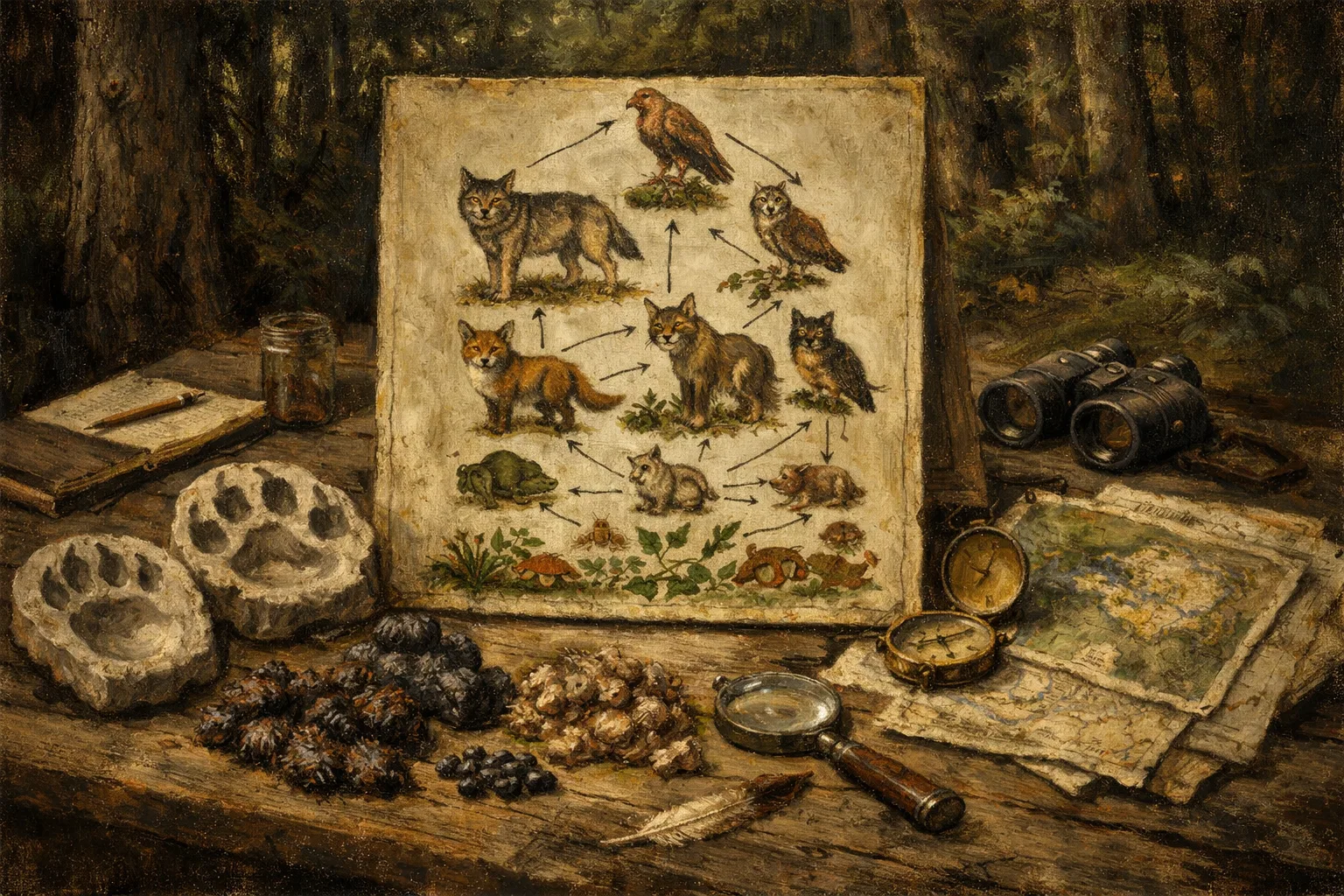
Genetic testing illustrates the difference. In 2014, Bryan Sykes and colleagues examined hair samples attributed to Yeti, Bigfoot, Sasquatch and other “anomalous primates”. Their systematic survey used mitochondrial DNA sequencing on 30 samples; apart from two Himalayan samples with unusual bear affinities, the hairs came from known living mammals rather than unknown apes.[PMC]pmc.ncbi.nlm.nih.govOpen source on nih.gov. The result did not logically disprove every possible cryptid, but it did show what happens when claim-specific physical material is tested: it either identifies the animal or fails to support the cryptid claim.
Loch Ness shows why habitat limits matter
Loch Ness is a useful case because it seems, at first glance, like a place where a large animal could hide. The water is deep, dark and cold; visibility is poor; folklore is strong; and reported sightings have persisted for decades. But ecology turns that atmosphere into testable questions. How much life does the loch support? What species are actually present? How much prey biomass exists? Would a population of large air-breathing or fish-eating animals leave sonar, carcass, DNA or feeding evidence?
The 2019 environmental DNA study led by University of Otago researchers sampled Loch Ness water for genetic material shed by organisms. The public summary reported eel DNA at almost every sampling location and a significant quantity of it, while also emphasising that the data did not reveal eel size. The study found no support for prehistoric reptiles or many other proposed monster identities; the most biologically conservative suggestion left standing was that some sightings might involve eels, not a hidden dinosaur-like population.[University of Otago]otago.ac.nzfirst edna study of loch ness points to something fishyfirst edna study of loch ness points to something fishy
Environmental DNA, or eDNA, is not magic. It can miss organisms, degrade, be transported, or fail if sampling design is poor. But it is now widely used because organisms shed genetic material into water, soil and air, making it possible to detect species without seeing or catching them directly. Reviews describe eDNA as a sensitive, non-invasive tool for biodiversity monitoring, especially useful where visual detection struggles with rare or low-density species.[PMC]pmc.ncbi.nlm.nih.govOpen source on nih.gov.
That makes the Loch Ness result important in a limited but meaningful way. It does not prove that no person ever saw a strange wake, an unusually large eel, a swimming deer, a bird, a seal-like visitor, a log or a misjudged object. It does weaken claims that a stable population of large unknown vertebrates lives there. A breeding population is not just one animal avoiding cameras; it is many animals shedding cells, eating prey, dying, reproducing and occupying an ecosystem that researchers can increasingly sample.
Bigfoot and the problem of a hidden continental population
Bigfoot claims face a different version of the same burden. The alleged habitat is not a single loch but a vast patchwork of forests, mountains, parks, logging roads, farms, suburbs and private land. That scale can make the idea feel more plausible: surely something could hide somewhere in North America. But a continent-scale claim also multiplies the expected traces. If Sasquatch is reported across many states and provinces, then the implied population is not one remote troop; it is a widespread breeding species living alongside people.
Recent reporting on Canadian Sasquatch sightings captured the tension well. The reports were added to a database containing thousands of sightings, but some occurred in Chatham-Kent, one of Ontario’s least forested and most intensely farmed regions. The same account noted the sceptical point that a giant primate would require several hundred individuals across large habitat, yet no bones, body or DNA samples have been recovered.[The Guardian]theguardian.comThe Guardian Sasquatch ‘sightings’ reignite fervour and scepticism about ape-like beast | Canada | The GuardianThe Guardian Sasquatch ‘sightings’ reignite fervour and scepticism about ape-like beast | Canada | The Guardian
The ecological burden is especially high because Bigfoot is usually imagined as a large primate. Non-human great apes are not small, inconspicuous animals; they have social structures, diets, nests or sleeping sites, vocalisations, parasites, dung, hair and remains. A temperate North American ape would also need to solve seasonal food problems that real apes do not face in the same way. Bears can hibernate or den through harsh periods; apes cannot simply be assumed to use the same strategy.
None of this proves that every Bigfoot report is worthless. Some reports may be sincere, culturally meaningful or difficult to reconstruct. But population ecology changes the question from “Could this witness be wrong?” to “Could hundreds or thousands of large primates leave no confirmed biological record?” That is a much less forgiving question.
The most plausible explanations for the evidence pattern are therefore mundane but not insulting: misidentified bears, people, shadows, tree stumps, hoaxes, folklore, expectation, distance errors and memory effects. A black bear standing briefly on its hind legs can be startling, especially in poor light or at distance. A cultural image of a tall, shaggy, bipedal figure then gives the mind a ready-made category into which ambiguous perception can fall.
Why absence matters more as time passes
“Absence of evidence is not evidence of absence” is often quoted in cryptozoology, but it is only partly true. Absence becomes evidence when evidence should be expected. If a creature is tiny, short-lived, recently arrived, deep underground, or in an inaccessible habitat, the expected evidence may be weak. If it is a large animal said to occupy well-visited forests or a bounded loch for generations, the expected evidence becomes much stronger.
Time is the crucial multiplier. One year without a carcass is not decisive. Fifty years of intensive searching, tourist attention, cameras, roads, sonar, genetic sampling, wildlife surveys and citizen photography make the absence more meaningful. The longer a claimed population persists without producing hard evidence, the more the burden shifts from “science has not looked hard enough” to “the claimed population is not behaving like a real population”.
This is not a closed-minded rule. Science regularly accepts surprising animals when evidence is good. The saola, a large forest bovid from Viet Nam and Laos, was scientifically described in the early 1990s and is often cited as one of the most striking recent large-mammal discoveries. Its recognition did not rest on blurry folklore alone: physical remains, local knowledge, morphology and DNA helped establish that it was a real species.[news.ku.dk]news.ku.dkSaving the Asian Unicorn – If It Still Exists – University of CopenhagenSaving the Asian Unicorn – If It Still Exists – University of Copenhagen
That comparison is useful because it prevents a common mistake. Cryptozoology often points to real discoveries and says, “Science has been wrong before.” True — but when zoology corrects itself, it does so through evidence that can be examined. The saola did not become real because people wanted an “Asian unicorn” to exist. It became real because investigators obtained material that could be tested, described and compared.
For cryptids, then, the ecological burden of proof is not an unfair demand for impossible certainty. It is a demand that the evidence match the biological claim. A hidden breeding population should eventually produce more than stories.
The burden of proof in practical terms
For a large cryptid claim to become zoologically serious, it would need evidence that connects the sighting tradition to a living population. The most persuasive evidence would not be another isolated anecdote, but a chain of mutually reinforcing findings:
- Biological material: hair, scat, saliva, tissue, bone or environmental DNA that cannot be assigned to a known species after competent testing.
- Repeatability: signs found repeatedly in the same suitable habitat, not scattered anecdotes with no ecological pattern.
- Population clues: juveniles, adults, breeding sites, seasonal movement, feeding evidence and mortality evidence.
- Independent confirmation: multiple qualified observers, laboratories or institutions reaching compatible conclusions.
- Ecological fit: enough food, habitat and space to support the number of individuals required for survival.
- Elimination of ordinary causes: known animals, hoaxes, artefacts, poor images and local folklore effects tested before a new species is proposed.
This standard is demanding because the claim is demanding. A breeding population of large unknown animals would be one of the most important zoological discoveries of the modern era. It would affect conservation law, land management, taxonomy, evolutionary biology and local communities. It would also require protection, not just proof.
The reverse is also true. If evidence remains limited to sightings, ambiguous tracks, low-quality images and unverified samples, the responsible conclusion is not that a cryptid has been disproved with mathematical finality. It is that the case has not met the ecological burden of proof. In cryptozoology, that distinction matters: mystery may remain at the level of individual experiences, but a real species needs a population, and a population should leave a biological trail.
Amazon book picks
Further Reading
Books and field guides related to Why One Monster Would Never Be Enough. Use these as the next step if you want deeper reading beyond the article.
Abominable Science!
Directly addresses evidence standards for cryptids and hidden-animal claims.
Sasquatch: Legend Meets Science
Engages directly with the question of whether a hidden ape population could exist.
Where the Wild Things Were
Shows how large animal populations shape ecosystems and leave detectable effects.
eBay marketplace picks
Marketplace Samples
Live-tested eBay searches with available results related to this page.


Endnotes
1.
Source: lciepub.nina.no
Title: 638988265540892975 LCIE Monitoring Standards 10 2025
Link:https://lciepub.nina.no/pdf/638988265540892975_LCIE_Monitoring%20Standards_10_2025.pdf
2.
Source: lochnessproject.org
Link:https://www.lochnessproject.org/ARCHIVE%20ROOM/papershtml/loch_ness_project_history.htm
3.
Source: nmbu.no
Title: Carnivore monitoring | NMBU
Link:https://www.nmbu.no/en/research/carnivore-monitoring
4.
Source: pmc.ncbi.nlm.nih.gov
Link:https://pmc.ncbi.nlm.nih.gov/articles/PMC4100498/
5.
Source: pmc.ncbi.nlm.nih.gov
Link:https://pmc.ncbi.nlm.nih.gov/articles/PMC6470983/
6.
Source: news.ku.dk
Title: Saving the Asian Unicorn – If It Still Exists – University of Copenhagen
Link:https://news.ku.dk/all_news/2025/05/saving-the-asian-unicorn–if-it-still-exists/
7.
Source: lochnessproject.org
Link:https://www.lochnessproject.org/ARCHIVE%20ROOM/papershtml/LOCH_NESS_scottish_naturalist.HTM
8.
Source: lochnessproject.org
Link:https://www.lochnessproject.org/FIELDWORKGROUNDTRUTH/eDNA%20LOCH%20NESS/eDNA%20LOCHNESS_index.html
9.
Source: pubmed.ncbi.nlm.nih.gov
Link:https://pubmed.ncbi.nlm.nih.gov/22868005/
10.
Source: nypost.com
Link:https://nypost.com/2024/12/19/science/scientists-simple-explanation-for-loch-ness-monster-mystery/
11.
Source: theguardian.com
Link:https://www.theguardian.com/world/2026/jun/11/sasquatch-[bigfoot-sightings
12.
Source: otago.ac.nz
Title: first edna study of loch ness points to something fishy
Link:https://www.otago.ac.nz/news/newsroom/first-edna-study-of-loch-ness-points-to-something-fishy
13.
Source: theguardian.com
Title: loch ness monster could be a giant eel say scientists
Link:https://www.theguardian.com/science/2019/sep/05/loch-ness-monster-could-be-a-giant-eel-say-scientists
14.
Source: jstor.org
Link:https://www.jstor.org/stable/43910758
15.
Source: Wikipedia
Link:https://en.wikipedia.org/wiki/Loch
16.
Source: Wikipedia
Link:https://en.wikipedia.org/wiki/Bigfoot
17.
Source: pmc.ncbi.nlm.nih.gov
Link:https://pmc.ncbi.nlm.nih.gov/articles/PMC11043325/
18.
Source: pubmed.ncbi.nlm.nih.gov
Link:https://pubmed.ncbi.nlm.nih.gov/23458501/
19.
Source: pubmed.ncbi.nlm.nih.gov
Link:https://pubmed.ncbi.nlm.nih.gov/24990672/
20.
Source: pmc.ncbi.nlm.nih.gov
Link:https://pmc.ncbi.nlm.nih.gov/articles/PMC4455819/
21.
Source: theguardian.com
Title: genetics evolution dna analysis yeti sasquatch bigfoot zoology primates
Link:https://www.theguardian.com/science/grrlscientist/2014/jul/02/genetics-evolution-dna-analysis-yeti-sasquatch-bigfoot-zoology-primates
22.
Source: ebsco.com
Link:https://www.ebsco.com/research-starters/science/cryptozoology
23.
Source: en.mae.gov.vn
Title: successfully deciphering the genetic code of vietnams rare saola 8857
Link:https://en.mae.gov.vn/successfully-deciphering-the-genetic-code-of-vietnams-rare-saola-8857.htm
Additional References
24.
Source: conservationbytes.com
Title: were sorry but 50500 is still too few
Link:https://conservationbytes.com/2014/01/28/were-sorry-but-50500-is-still-too-few/
25.
Source: youtube.com
Title: What if the Loch Ness Monster was Real?
Link:https://www.youtube.com/watch?v=Wpjngt8kBqk
26.
Source: isaacscience.org
Link:https://isaacscience.org/questions/how_many_monsters_in_loch_ness
27.
Source: youtube.com
Title: The Loch Ness Project: Hunting For A Legend In The Murky Depths
Link:https://www.youtube.com/watch?v=CBBTvegsFzM
28.
Source: researchgate.net
Link:https://www.researchgate.net/publication/346044465_Environmental_DNA_Monitoring_Better_Tracking_of_Endangered_Rare_Cryptic_and_Invasive_Species
29.
Source: academia.edu
Link:https://www.academia.edu/17667784/Methods_for_monitoring_European_large_carnivores_A_worldwide_review_of_relevant_experience
30.
Source: researchgate.net
Link:https://www.researchgate.net/publication/390620130_The_Loch_Ness_Monster_If_It%27s_Real_Could_It_Be_an_Eel
31.
Source: researchgate.net
Link:https://www.researchgate.net/publication/263583915_Correction_to_Genetic_analysis_of_hair_samples_attributed_to_yeti_bigfoot_and_other_anomalous_primates
32.
Source: researchgate.net
Link:https://www.researchgate.net/publication/370136933_Applications_of_environmental_DNA_eDNA_to_detect_subterranean_and_aquatic_invasive_species_A_critical_review_on_the_challenges_and_limitations_of_eDNA_metabarcoding
33.
Source: academia.edu
Link:https://www.academia.edu/13393358/50_500_rule_and_minimum_viable_populations_response_to_Jamieson_and_Allendorf
Topic Tree