Within Cryptozoology
Can Cryptid Footprints Be Trusted?
Footprints can seem persuasive, but mud, snow, distortion, and deliberate fakes often weaken track evidence.
On this page
- How tracks are collected
- Natural distortion in mud and snow
- Famous hoaxes and missing biology
Page outline Jump by section
Introduction
Cryptid footprints can look like the most direct kind of evidence: something heavy crossed a place, pressed a shape into mud or snow, and left a trail that could be measured. In cryptozoology, that visual simplicity is exactly why tracks are so persuasive — and why they are so risky. A footprint is not a body, bone, DNA sample or repeatable sighting. It is a temporary deformation of a surface, shaped by weather, soil, melting, overprinting, camera angle, human expectation and, sometimes, deliberate fakery. The strongest track cases are worth documenting carefully, but a trackway by itself rarely proves an unknown animal. It more often shows that something made an impression, and then asks investigators to rule out known animals, human manufacture and environmental distortion before moving towards a cryptid explanation.
Why footprints feel convincing but prove less than they seem
Footprints have unusual power in cryptozoology because they appear to turn a story into a physical object. A witness account can be dismissed as memory or misidentification, but a plaster cast can be held, photographed, archived and compared. That is why Bigfoot, Yeti and other “hairy hominid” traditions have relied so heavily on tracks. The Arizona State Museum notes that Bigfoot was popularised in 1958 after giant footprints were reported at a northern California worksite, and that hundreds of similar footprints and some handprints have since been reported, with some attributed to bears, some to fraud and many left unexplained.[Arizona State Museum]statemuseum.arizona.eduArizona State MuseumTracking the Legend of Bigfoot | Arizona State MuseumHundreds of similar footprints and a few handprints have now bee…
The problem is that “unexplained” is not the same as “biologically credible”. A footprint preserves only a partial interaction between a foot, a surface and later conditions. It may record size, direction, pressure and gait, but it does not establish the existence of a breeding population, a diet, a range, a carcass record or genetic continuity. That gap matters in cryptozoology because large animals leave many kinds of evidence. If a cryptid is said to be a large mammal, tracks would be only one part of the expected evidence package, not the final proof.
There is also a psychological trap. Tracks invite pattern recognition. A melted bear print can look more human; two overlapping animal prints can look like one huge foot; a shallow depression can acquire toes in the viewer’s imagination. Once a track is labelled “Bigfoot” or “Yeti”, every crease can begin to look anatomical. Good track analysis therefore has to work against the first impression rather than simply illustrate it.
How tracks should be collected
A cryptid track report becomes more useful when it is treated like fragile impression evidence rather than a trophy. Forensic footwear practice is a helpful model because it deals with the same basic problem: a three-dimensional mark in a surface can be damaged, distorted or over-interpreted if it is not recorded before anyone walks around it. Forensic Science Simplified describes footwear and tyre-track examination as a process of detection, documentation, photography and collection, normally followed by analysis by trained examiners.[forensicsciencesimplified.org]forensicsciencesimplified.orgFootwear & Tire Track Examination: How It's DoneDetection, documentation, photography, and collection of imprints and impressions occur i…
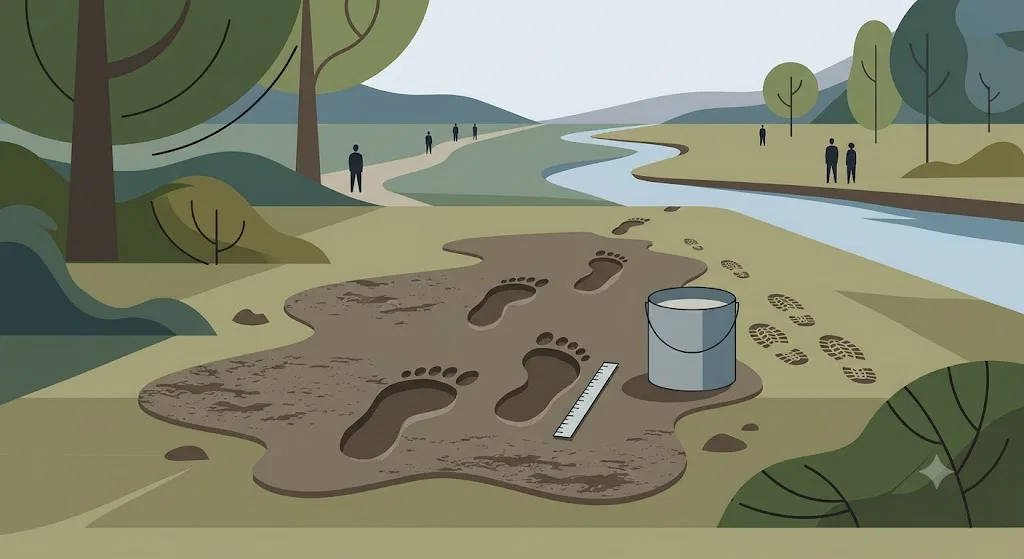
The most important step is to record the track in context before casting it. A cast captures one impression, but context tells the story: where the track began, where it ended, whether other human or animal tracks were nearby, whether the stride is consistent, and whether the surface changed along the route. Forensic guidance stresses photography with scale, correct camera angle and documentation of the impression’s position; the Wisconsin Department of Justice warns that scale placement, camera position and angled photography can affect interpretation.[wisdoj.gov]wisdoj.govDo Not Remove Any Embedded Debris from Impressions! 2. Place the L-scale/rulers next to the impression…
A useful cryptid track record should therefore include:<div class="content-enhancement content-enhancement--insight-grid" markdown="1">
- Overview photographs showing the wider setting, approach route and surrounding tracks.
- Mid-range photographs showing the trackway, stride, direction of travel and nearby disturbance.
- Close photographs with a scale placed at the same depth as the impression, with the camera square to the print.
- Substrate notes describing mud, sand, snow, ice crust, leaf litter, slope and moisture.
- Weather timing including temperature changes, thaw, rain, wind or sun exposure since the track was supposedly made.
- A map or sketch marking each print and any human, vehicle, dog, bear or livestock sign nearby.
- Casts or 3D scans only after the scene has been photographed and protected.</div>
This matters because many famous cryptid tracks were found in uncontrolled conditions. Sightseers, investigators and journalists may have walked through the area before casts were taken. Snow may have melted. Mud may have slumped. A print photographed without a scale may become impossible to compare. The most dramatic-looking cast is often less valuable than a well-documented, boring-looking trackway.
Mud, snow and the ways nature fakes anatomy
Mud and snow do not behave like neutral recording devices. They are active, unstable materials. A foot presses down, the surface heaves up, water drains or freezes, edges collapse, and later melting can enlarge or soften the original shape. In forensic impression work, photography and casting are described as complementary because the quality of recovery depends on the surface and the detail preserved; research on 3D footwear impressions notes that photography and casting each have strengths and limitations depending on the substrate and the impression.[Bournemouth University Research Online]eprints.bournemouth.ac.ukOpen source on bournemouth.ac.uk.
Snow is especially treacherous. A fresh print may preserve toes, claws or shoe tread for a short time, but thawing can widen the depression, erase small details and fuse separate marks. The U.S. Fish and Wildlife Service treats snow tracks as useful clues to animal size, gait and habits, but the value is in interpreting tracks as part of a pattern, not simply reading one dramatic print in isolation.[U.S. Fish and Wildlife Service]fws.govU.S. Fish and Wildlife Service Snow Tracks | U.S. Fish & Wildlife ServiceU.S. Fish and Wildlife Service Snow Tracks | U.S. Fish & Wildlife Service
Bears are a recurring source of confusion. A bear’s hind foot can resemble a long bare human foot, especially when the fore and hind prints overlap or when the midsection of the front track fails to register. Wildlife Illinois notes that in black bear tracks the midportion or heel of the front track may not register, changing the apparent shape of the print.[Wildlife Illinois]wildlifeillinois.orgOpen source on wildlifeillinois.org. The Finnish large carnivore information service similarly explains that when a bear walks, the hind leg can land in front of the forepaw print, producing tracks that resemble barefoot human footprints.[Suurpedot.fi]largecarnivores.fiSuurpedot.fi Signs of a bearSuurpedot.fi Signs of a bear
This is one reason single prints are weak evidence. A clear trackway can reveal gait, stride, left-right alternation and repeated anatomy. A lone “giant foot” in snow may instead be a melted print, an overlap, a slip, a partial bear track or an ordinary human mark enlarged by thaw. The more a cryptid claim depends on one perfect-looking impression, the more cautious the reader should be.
Famous hoaxes changed the value of every later track
The Bigfoot tradition is inseparable from track evidence, and track evidence is inseparable from hoaxing. The 1958 Bluff Creek episode is central: large footprints reported near a road-building site helped popularise the term “Bigfoot”. Later accounts connected the episode to Ray Wallace, a road contractor whose family displayed carved wooden feet after his death and said he had used them to make tracks. The Arizona State Museum summarises the case by noting that Bigfoot was popularised through the 1958 media reports and that a Wallace relative later found carved wooden feet matching some casts.[Arizona State Museum]statemuseum.arizona.eduArizona State MuseumTracking the Legend of Bigfoot | Arizona State MuseumHundreds of similar footprints and a few handprints have now bee… Smithsonian Magazine also treats the Wallace connection as one reason for scepticism about later Bigfoot evidence associated with the same northern California setting.[Smithsonian Magazine]smithsonianmag.comOpen source on smithsonianmag.com.
Hoaxes do not prove that every later footprint is fake. They do something more subtle: they lower the evidential value of tracks unless the chain of custody is strong. Once carved feet, staged reports and prank tracks enter the record, later investigators have to ask whether a print is only anatomically interesting, or whether it is also protected from ordinary human manufacture.
That distinction matters in cases involving detailed casts. Some Bigfoot advocates have argued that certain prints show features too sophisticated for casual fakery: apparent midfoot flexibility, pressure ridges, deformities or “dermal ridges” resembling friction-skin patterns. Scientific American reported that the late anatomist Jeffrey Meldrum kept more than 200 alleged Bigfoot casts and regarded some as intriguing because of anatomy, hair striations, musculature and a possible midtarsal break — a flexible midfoot feature associated with apes more than modern human feet.[Scientific American]scientificamerican.comScientific American Bigfoot AnatomyScientific American Bigfoot Anatomy
But sophistication is not a guarantee of authenticity. In a 1988 paper, anthropologist John H. Bodley tested whether dermal ridges could be faked in Sasquatch-like footprints and concluded that they could be produced with relative ease under some soil conditions, while also stressing that this did not prove the specific tracks he was discussing were fake.[rex.libraries.wsu.edu]rex.libraries.wsu.eduSasquatch Footprints: Can Dermal Ridges be Faked?Sasquatch Footprints: Can Dermal Ridges be Faked? The lesson is narrow but important: even details that look biological may be reproducible, and therefore need careful evaluation rather than automatic promotion to proof.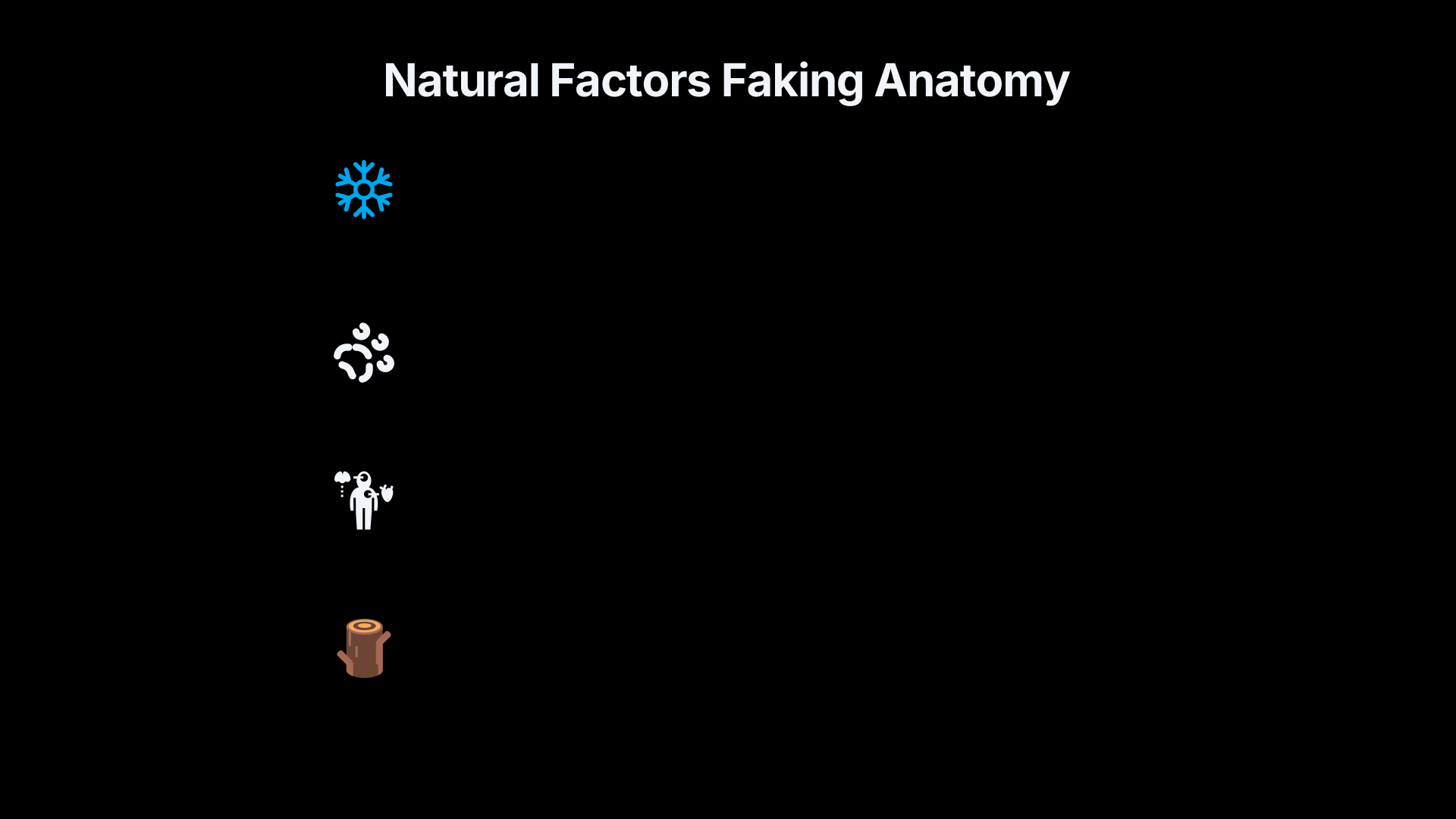
The Yeti footprint problem: snow, bears and a famous photograph
The Yeti shows the same problem in a different landscape. The best-known Yeti footprint image is Eric Shipton’s 1951 photograph from a Himalayan expedition, often reproduced with an ice axe for scale. National Geographic describes Shipton’s image as the key footprint evidence in Yeti lore, while later interpretations have often turned towards bears rather than an unknown ape-like animal.[National Geographic]nationalgeographic.comyeti abominable snowman bear daniel tayloryeti abominable snowman bear daniel taylor
The original context is more complicated than the famous close-up suggests. In an Alpine Journal account, Michael Ward described Shipton taking several photographs, including views with Ward, his own footprints and a rucksack for comparison, because they had no direct measuring equipment.[alpinejournal.org.uk]alpinejournal.org.ukOpen source on alpinejournal.org.uk. That broader context is crucial: a close-up can make a print look singular and iconic, while a trackway photograph may reveal a more ambiguous sequence of marks.
Modern Yeti explanations often focus on bears, snow deformation and local wildlife rather than a hidden primate. Daniel Taylor, who spent decades investigating Yeti claims, has argued that bear tracks and Himalayan terrain can explain many reports; an interview summary in Scroll notes his view that Shipton’s reference to several prints is consistent with a bear interpretation, possibly involving a mother and cubs.[Scroll.in]scroll.inOpen source on scroll.in.
This does not make the Shipton photograph uninteresting. It remains a culturally powerful image and a useful case study in how a single track can carry decades of interpretation. But as evidence, it suffers from the same weakness as many cryptid footprints: no specimen, no repeatable observation, no definitive biological material and a plausible route from known animals plus snow conditions to an extraordinary-looking mark.
Missing biology: what tracks cannot supply
The strongest objection to footprint-based cryptozoology is not that all tracks are fake. It is that tracks alone do not solve the biological problem. A large, unknown primate or similar cryptid would need a population, not a solitary print-maker. It would require food, habitat, reproduction, disease, death and remains. The broader scientific view of Bigfoot remains sceptical partly because no accepted body, bones or remains have been found, and because such an animal would be ecologically and biogeographically difficult to reconcile with known evidence.[Wikipedia]WikipediaOpen source on wikipedia.org.
Track evidence can suggest where to look next, but it cannot substitute for what zoology normally requires. Even a long trackway does not identify a species unless the anatomy is unambiguous and alternative explanations are weaker. A cast cannot tell researchers whether there is a breeding population. It cannot exclude a skilled hoaxer unless the scene is controlled. It cannot provide DNA unless associated biological material is preserved and tested.
A practical credibility test for cryptid tracks
The fairest way to assess cryptid footprints is not to ask, “Could this be real?” Almost anything could be imagined as possible. The better question is, “What would make this track hard to explain by known animals, human activity, surface distortion or hoaxing?” That keeps the burden of proof where it belongs.
A stronger track case usually has several features at once: a long, coherent trackway; fresh discovery; minimal contamination; repeated left-right anatomy; clear stride and gait; high-quality photographs with scale; casts or 3D scans; independent witnesses; documented weather; and associated biological material. A weaker case depends on a single print, a late photograph, no scale, poor chain of custody, a highly publicised location, dramatic claims of depth or size, or a discoverer already connected with hoaxes.
The most useful rule is simple: tracks are leads, not verdicts. They can justify careful fieldwork, comparison with known animal tracks and preservation for later study. They can show why cryptozoology remains fascinating. But they are also among the easiest forms of evidence to misread, exaggerate or fake. In the track record of cryptids, the mud often preserves less certainty than the story built on top of it.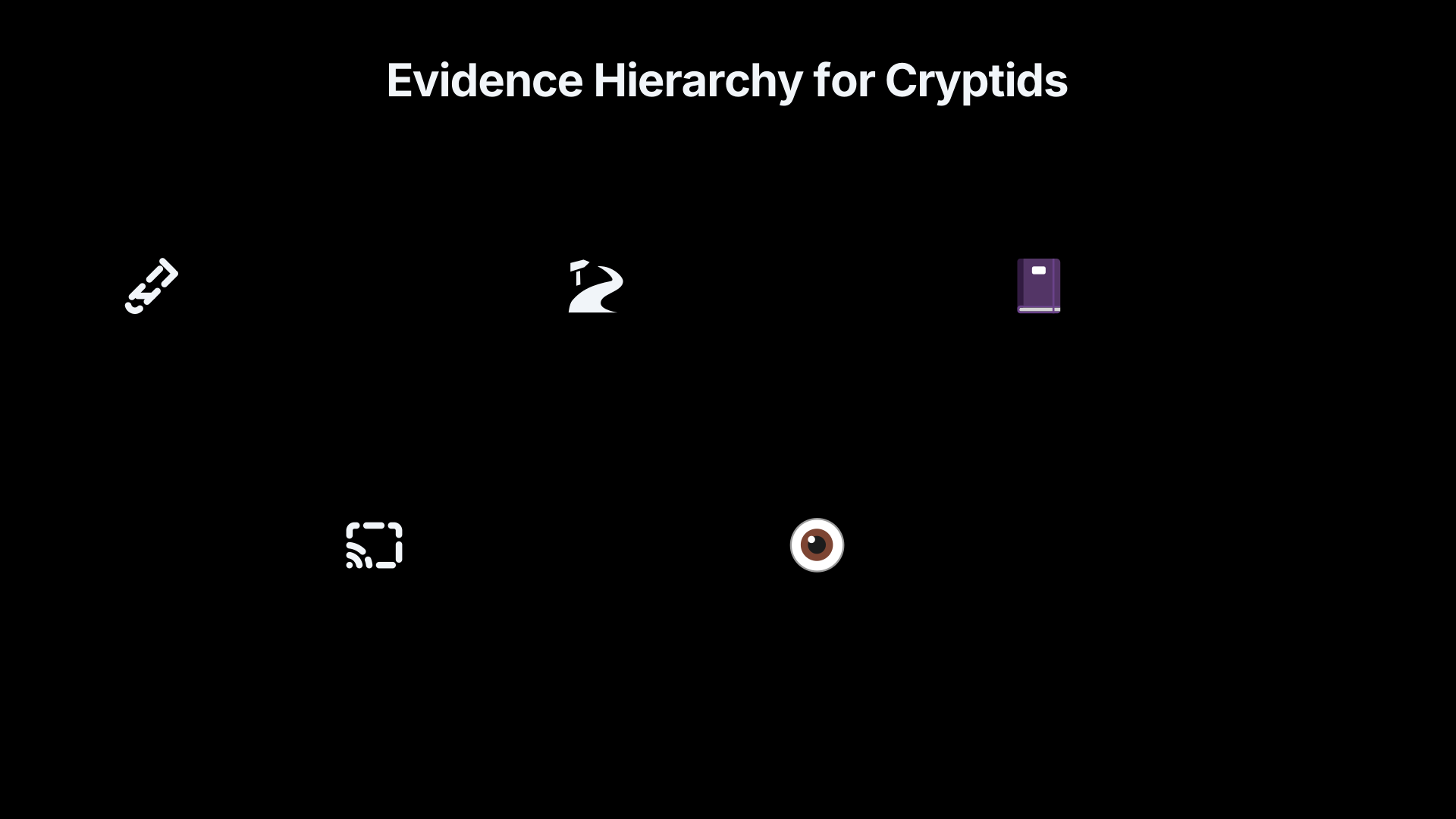
Amazon book picks
Further Reading
Books and field guides related to Can Cryptid Footprints Be Trusted?. Use these as the next step if you want deeper reading beyond the article.
Sasquatch: Legend Meets Science
Places footprint evidence at the center of the Bigfoot debate.
Tracking and the Art of Seeing
Provides real-world context for interpreting footprints and trackways.
eBay marketplace picks
Marketplace Samples
Live-tested eBay searches with available results related to this page.
Endnotes
1.
Source: statemuseum.arizona.edu
Link:https://statemuseum.arizona.edu/online-exhibit/curators-choice/tracking-legend-bigfoot
2.
Source: forensicsciencesimplified.org
Link:https://www.forensicsciencesimplified.org/fwtt/how.html
3.
Source: wisdoj.gov
Link:https://www.wisdoj.gov/Forensic%20Science/Footwear%20Evidence%20Brochure.pdf
4.
Source: rex.libraries.wsu.edu
Title: Sasquatch Footprints: Can Dermal Ridges be Faked?
Link:https://rex.libraries.wsu.edu/esploro/fulltext/journalArticle/Sasquatch-Footprints-Can-Dermal-Ridges-be/99900502191101842?institution=01ALLIANCE_WSU&mId=13333063550001842&repId=12332649320001842
5.
Source: alpinejournal.org.uk
Link:https://www.alpinejournal.org.uk/Contents/Contents_1999_files/AJ%201999%2081-87%20Ward%20Footprints.pdf
6.
Source: scroll.in
Link:https://scroll.in/article/921823/how-a-scholar-proved-yeti-footprints-were-made-by-bears-and-why-he-thinks-it-lives-on-as-a-symbol
7.
Source: Wikipedia
Link:https://en.wikipedia.org/wiki/Bigfoot
8.
Source: alpinejournal.org.uk
Title: AJ 2001 141 151 Gillman Yeti
Link:https://www.alpinejournal.org.uk/Contents/Contents_2001_files/AJ%202001%20141-151%20Gillman%20Yeti.pdf
9.
Source: Wikipedia
Title: Raymond L. Wallace
Link:https://en.wikipedia.org/wiki/Raymond_L._Wallace
10.
Source: Wikipedia
Link:https://en.wikipedia.org/wiki/Yeti
11.
Source: Wikipedia
Title: Grover Krantz
Link:https://en.wikipedia.org/wiki/Grover_Krantz
12.
Source: Wikipedia
Title: Patterson–Gimlin film
Link:https://en.wikipedia.org/wiki/Patterson%E2%80%93Gimlin_film
13.
Source: eprints.bournemouth.ac.uk
Link:https://eprints.bournemouth.ac.uk/35684/1/Recovering%20of%203D%20footwear%20impressions%20from%20sandy%20substrates_technical%20note%20on%20the%20contribution%20of%20SfM%20photogrammetry.pdf
14.
Source: fws.gov
Title: U.S. Fish and Wildlife Service Snow Tracks | U.S. Fish & Wildlife Service
Link:https://www.fws.gov/story/snow-tracks
15.
Source: wildlifeillinois.org
Link:https://wildlifeillinois.org/discover-animal-signs/black-bear-tracks/
16.
Source: largecarnivores.fi
Title: Suurpedot.fi Signs of a bear
Link:https://www.largecarnivores.fi/species/brown-bear/signs-of-a-bear.html
17.
Source: smithsonianmag.com
Link:https://www.smithsonianmag.com/history/why-so-many-people-still-believe-in-bigfoot-180970045/
18.
Source: scientificamerican.com
Title: Scientific American Bigfoot Anatomy
Link:https://www.scientificamerican.com/article/bigfoot-anatomy/
19.
Source: nationalgeographic.com
Title: yeti abominable snowman bear daniel taylor
Link:https://www.nationalgeographic.com/animals/article/yeti-abominable-snowman-bear-daniel-taylor
20.
Source: frontiersin.org
Title: polar bears footprints dna snow tracks
Link:https://www.frontiersin.org/news/2023/12/04/polar-bears-footprints-dna-snow-tracks
21.
Source: reddit.com
Link:https://www.reddit.com/r/Cryptozoology/comments/zmsyt4/bigfoot_why_the_midtarsal_break_is_nonsense/
22.
Source: reddit.com
Title: The Yeti
Link:https://www.reddit.com/r/Cryptozoology/comments/bjbhh8/the_yeti_not_a_bear/
23.
Source: bigfootforums.com
Title: Footprint Evidence
Link:https://bigfootforums.com/topic/75316-footprint-evidence-the-london-trackway/
24.
Source: cryptidz.fandom.com
Link:https://cryptidz.fandom.com/wiki/Bigfoot/Evidence
25.
Source: forensicscience.ie
Link:https://forensicscience.ie/physical-analysis/impression-analysis/
26.
Source: adfg.alaska.gov
Link:https://www.adfg.alaska.gov/static/education/educators/curricula/pdfs/tracks.pdf
Additional References
27.
Source: youtube.com
Title: When Survivorman Les Stroud Tried to Trick a Bigfoot Expert
Link:https://www.youtube.com/watch?v=AnDM5Wd-xqw
28.
Source: reddit.com
Link:https://www.reddit.com/r/Cryptozoology/comments/189ygc9/a_point_i_disagree_with_bigfoot_skeptics_on/
29.
Source: instagram.com
Link:https://www.instagram.com/reel/DR3DY_sj1rP/
30.
Source: aafs.org
Link:https://www.aafs.org/sites/default/files/media/documents/050_BPR_e1.pdf
31.
Source: facebook.com
Link:https://www.facebook.com/RMSOBigfoot/posts/according-to-dr-meldrum-the-lines-are-from-the-dried-cracking-mud-where-the-sasq/1431404405272993/
32.
Source: instagram.com
Link:https://www.instagram.com/reel/DaFBgAHj86-/
33.
Source: shutterstock.com
Link:https://www.shutterstock.com/search/bear-tracks
34.
Source: robbiegeorgephotography.com
Link:https://www.robbiegeorgephotography.com/bear-tracks?srsltid=AfmBOoq7P28dGWDT0FIYU_P7uMbHdnQTOmqQCClY5n5bS9_jTnQFmeON
35.
Source: facebook.com
Link:https://www.facebook.com/groups/1002571683091379/posts/8912355562112912/
36.
Source: skepticalinquirer.org
Link:https://skepticalinquirer.org/2017/09/bigfoot-as-big-myth-seven-phases-of-mythmaking/
Topic Tree