Within Meaning
Why Official Answers Do Not End Monsters
Scientific, engineering and hoax explanations can weaken monster claims while still leaving believers room to doubt institutions.
On this page
- When explanations answer facts but not feelings
- Eels, hoaxes and engineering failures as partial closures
- How distrust keeps local monster stories alive
Page outline Jump by section
Introduction
Official explanations rarely end cryptid stories. In many famous cases, scientists, investigators and government-backed studies have offered plausible accounts for sightings, photographs or physical traces. Yet belief often survives. The reason is not simply that people reject evidence. Official answers usually address a specific factual question—what a photograph shows, what DNA was found, or whether a creature could survive in a habitat—while leaving untouched the memories, local identities and suspicions that helped the legend grow in the first place. Within cryptozoology, this creates a recurring pattern. A scientific explanation may reduce the likelihood of a monster, but believers can still view institutions as incomplete, dismissive or biased. The result is not a clean victory for either side. Instead, the legend persists in a space between official closure and public doubt.
When explanations answer facts but not feelings
Many cryptid investigations focus on evidence that can be measured: photographs, biological samples, sonar readings or environmental surveys. From a scientific perspective, these are the strongest ways to test extraordinary claims. From a cultural perspective, however, they often address a different question from the one many witnesses think they are asking.
A person who reports seeing a large unknown creature in a remote forest or loch may not feel that a laboratory analysis explains the experience itself. If officials conclude that a sighting was a bear, a wave pattern or a photographic error, the witness still remembers encountering something frightening and unusual. The official explanation can therefore feel detached from lived experience even when it accounts for the available evidence.
This gap is especially important in cryptid traditions connected to wilderness. Encounters are often personal, fleeting and emotionally intense. Scientific institutions evaluate physical traces, while local communities remember stories. Because those forms of evidence operate differently, official conclusions may settle a technical dispute without settling a cultural one.
Cryptozoology has long been shaped by tension between amateur investigators and mainstream science. Researchers of science and pseudoscience have noted that many cryptid enthusiasts see established scientific institutions as unwilling to seriously consider anomalous reports, while scientists generally argue that extraordinary claims require stronger evidence than cryptid cases have provided.[Skeptical Inquirer]skepticalinquirer.orgcryptozoology and pseudoscienceSkeptical InquirerCryptozoology and Pseudoscience23 May 2012 — (For more on this in the context of Bigfoot research specifically, see Bri…
Eels, hoaxes and engineering failures as partial closures
Some of the most influential official explanations in cryptozoology are notable because they appear convincing yet still leave room for continued belief.
The Loch Ness eel hypothesis
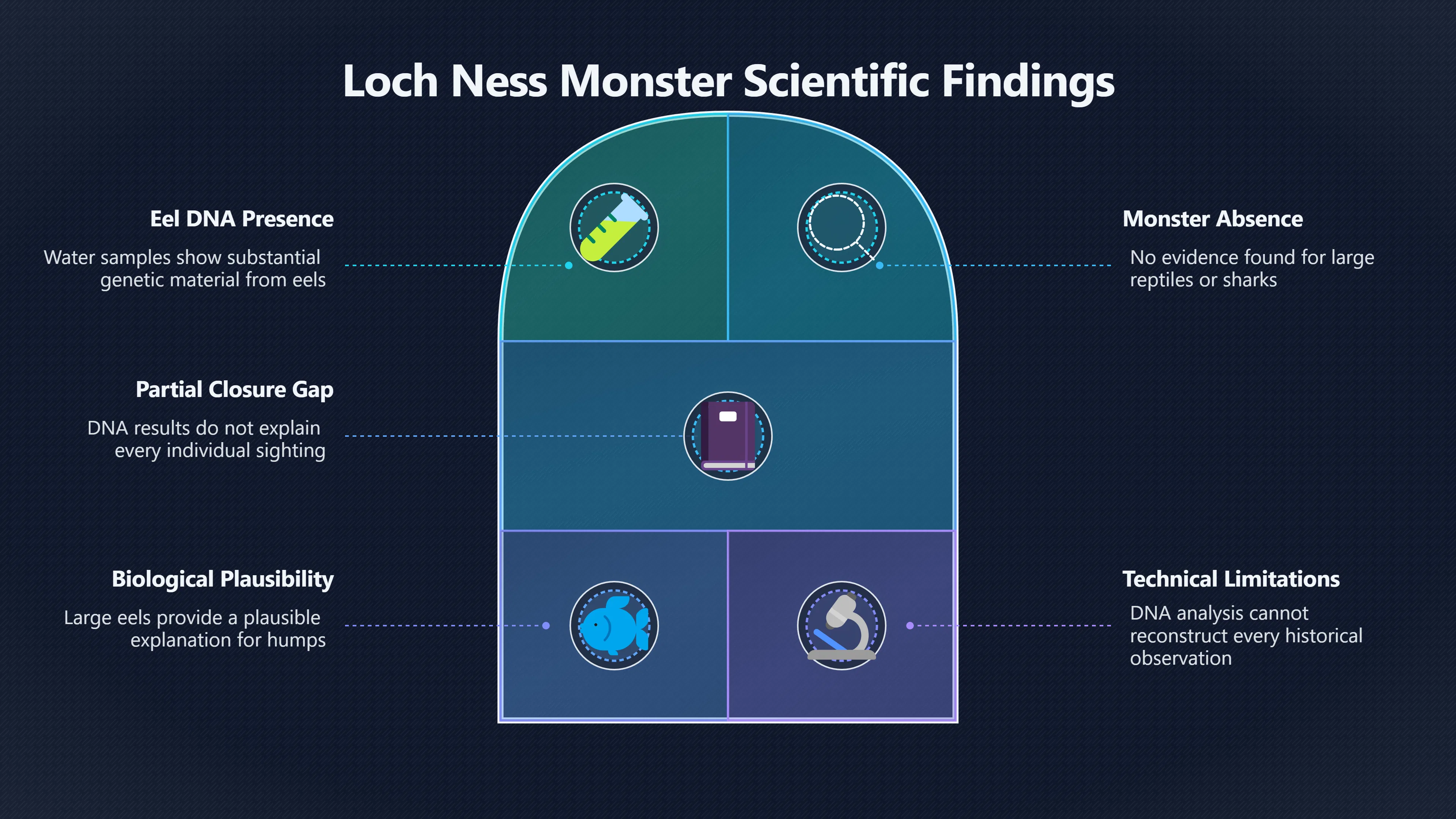
One of the most widely discussed recent examples came from environmental DNA research in Loch Ness. Researchers collected extensive water samples and found no evidence for large unknown reptiles, sharks, catfish or other proposed monster candidates. They did, however, find substantial eel DNA, leading scientists to suggest that unusually large eels could account for at least some sightings.[Wikipedia+2University of Otago]WikipediaLoch Ness MonsterLoch Ness Monster
From a scientific perspective, this was a powerful narrowing of possibilities. Yet it did not eliminate uncertainty. The study did not claim that every sighting had been explained, and researchers acknowledged that environmental DNA cannot reconstruct every observation ever reported. The result was a curious form of partial closure: the evidence weakened the monster hypothesis while leaving enough ambiguity for believers to argue that the mystery remained open.[Wikipedia]WikipediaLoch Ness MonsterLoch Ness Monster
That ambiguity matters. For many Nessie supporters, “there are eels in the loch” is not a satisfying answer to reports describing humps, necks or large moving objects. The explanation addresses biological plausibility, but not necessarily the visual and emotional details people associate with famous encounters.
Hoaxes that do not kill the legend
The history of Bigfoot and Loch Ness contains numerous admitted hoaxes, fabricated footprints and disputed photographs. The famous “surgeon’s photograph” of the Loch Ness Monster, once treated as compelling evidence, is now widely regarded as a hoax. Similarly, many Bigfoot traces have later been linked to deliberate fabrication.[Wikipedia+2Wikipedia]WikipediaLoch Ness MonsterLoch Ness Monster
Yet exposing individual hoaxes rarely destroys the broader legend. Believers often argue that proving some evidence false says little about other reports. In fact, hoaxes can sometimes strengthen distrust. If investigators or journalists once promoted misleading evidence, believers may conclude that authorities are also capable of dismissing genuine evidence unfairly.
This dynamic creates a self-reinforcing cycle. Each exposed hoax weakens a particular claim but can simultaneously deepen suspicion about who controls the narrative surrounding the phenomenon.
Technical investigations and unresolved expectations
Large-scale searches also illustrate the problem. Decades of organised observation, photography, sonar work and monitoring at Loch Ness have failed to produce definitive proof of a monster. The Loch Ness Investigation Bureau and related efforts generated extensive observation programmes without confirming the creature’s existence.[Discovery]discovery.nationalarchives.gov.ukThe Loch Ness Phenomena Investigation Bureau LtdIt was wound up in 1977, having ultimately failed to discover any substantial ev…
For sceptics, repeated failure to obtain evidence is itself evidence. For committed believers, however, unsuccessful searches can be interpreted differently. Remote environments are vast, observations are imperfect and technologies have limitations. A negative result therefore becomes evidence that investigators failed to find the creature, not necessarily that no creature exists.
The same logic appears in Bigfoot debates. Scientific reviews point to the absence of bodies, fossils, verified DNA or reliable physical remains as reasons to reject the existence of a large unknown ape in North America. Supporters often respond that elusive behaviour, inaccessible terrain or institutional bias explain the lack of confirmation.[Wikipedia]WikipediaOpen source on wikipedia.org.
How distrust keeps local monster stories alive
Official explanations often emerge from institutions that are geographically and culturally distant from the communities where cryptid stories circulate. Universities, laboratories, government agencies and national media organisations may provide technically sophisticated analyses, but they do not automatically possess local trust.
In many regions, monster stories are woven into community identity. Residents may know specific locations associated with sightings, family stories or long-standing local traditions. When an outside expert arrives and offers a concise explanation, some people perceive it as reducing a rich local history to a technical problem.
Distrust does not require a belief in conspiracy. It can arise from more ordinary concerns:<div class="content-enhancement content-enhancement--caution" markdown="1">
- Experts may seem unfamiliar with local conditions.
- Witness testimony may appear undervalued.
- Scientific standards may be viewed as too narrow.
- Previous institutional mistakes can reduce confidence in current conclusions.</div>
As a result, official explanations often compete not only with monster claims but also with broader attitudes about authority and expertise.
Cryptid debates therefore become governance stories as much as zoological ones. They ask who gets to define reality in contested spaces: local observers, dedicated enthusiasts, scientific institutions or public agencies. Even when official investigations provide strong explanations, communities may continue telling monster stories because the stories preserve local knowledge, identity and scepticism toward distant authorities.
Why the mystery survives after the explanation
The persistence of cryptid legends does not necessarily mean that official explanations are weak. In many cases, the scientific account is far better supported than the monster hypothesis. The Loch Ness DNA surveys, the exposure of famous hoaxes and the lack of verified biological evidence for creatures such as Bigfoot have substantially narrowed the space for extraordinary claims.[PMC+3University of Otago+3The Guardian]otago.ac.nzfirst edna study of loch ness points to something fishyUniversity of OtagoFirst eDNA Study Of Loch Ness Points To Something Fishy5 Sept 2019 — The “monster-factor” has provided Professor Gemme…
What survives is often something different from the original claim. The debate shifts from “Does the creature exist?” to “Can institutions fully explain what people experienced?” Once the argument moves onto that terrain, official answers face a harder task. Facts can resolve particular pieces of evidence, but they cannot always erase the feeling that remote wilderness still contains unknown possibilities or that authorities may not have the final word.
That is why cryptid stories frequently endure after investigations conclude. The explanation may satisfy the evidence, while the legend continues to satisfy a deeper desire for mystery, local ownership of knowledge and scepticism toward official certainty.
Amazon book picks
Further Reading
Books and field guides related to Why Official Answers Do Not End Monsters. Use these as the next step if you want deeper reading beyond the article.
Abominable Science!
Reviews scientific explanations for famous monster claims and why they persist.
Why People Believe Weird Things
Directly addresses why evidence and official explanations often fail to change minds.
The Monster Theory Reader
Explains how monsters continue to matter even after factual questions are addressed.
eBay marketplace picks
Marketplace Samples
Live-tested eBay searches with available results related to this page.

Endnotes
1.
Source: Wikipedia
Link:https://en.wikipedia.org/wiki/Bigfoot
2.
Source: Wikipedia
Title: Loch Ness Monster
Link:https://en.wikipedia.org/wiki/Loch_Ness_Monster
3.
Source: pmc.ncbi.nlm.nih.gov
Link:https://pmc.ncbi.nlm.nih.gov/articles/PMC4100498/
4.
Source: skepticalinquirer.org
Title: cryptozoology and pseudoscience
Link:https://skepticalinquirer.org/newsletter/cryptozoology-and-pseudoscience/
5.
Source: otago.ac.nz
Title: first edna study of loch ness points to something fishy
Link:https://www.otago.ac.nz/news/newsroom/first-edna-study-of-loch-ness-points-to-something-fishy
6.
Source: theguardian.com
Title: loch ness monster could be a giant eel say scientists
Link:https://www.theguardian.com/science/2019/sep/05/loch-ness-monster-could-be-a-giant-eel-say-scientists
7.
Source: discovery.nationalarchives.gov.uk
Link:https://discovery.nationalarchives.gov.uk/details/r/d14f140f-80cc-424b-aa35-a4140661c172
8.
Source: skepticalinquirer.org
Title: Is Bigfoot Dead?
Link:https://skepticalinquirer.org/2023/12/is-bigfoot-dead/
9.
Source: skepticalinquirer.org
Link:https://skepticalinquirer.org/2026/02/this-isnt-about-bigfoot/
10.
Source: otago.ac.nz
Title: otago scientist reveals loch ness monster could be a giant eel
Link:https://www.otago.ac.nz/news/newsroom/otago-scientist-reveals-loch-ness-monster-could-be-a-giant-eel
Additional References
11.
Source: reddit.com
Link:https://www.reddit.com/r/Cryptozoology/comments/mrim12/loch_ness_theories/
12.
Source: facebook.com
Link:https://www.facebook.com/groups/470765477828717/posts/1522055439366377/
13.
Source: reddit.com
Link:https://www.reddit.com/r/skeptic/comments/1m4rmuw/the_case_for_bigfoot/
14.
Source: skeptic.org.uk
Link:https://www.skeptic.org.uk/category/paranormal/cryptozoology/
15.
Source: facebook.com
Title: 1968 the loch ness investigation bureauonthisday 1968 volunteers from the loch n
Link:https://www.facebook.com/BBCArchive/videos/1968-the-loch-ness-investigation-bureauonthisday-1968-volunteers-from-the-loch-n/1275656194647660/
16.
Source: youtube.com
Link:https://www.youtube.com/watch?v=6MiiwSuhk8k
17.
Source: sciencefocus.com
Title: loch ness monster dna study reveals plausible explanation for sightings
Link:https://www.sciencefocus.com/news/loch-ness-monster-dna-study-reveals-plausible-explanation-for-sightings
18.
Source: facebook.com
Title: Did anyone see the Loch Ness Monster at Cliffs golf course?Loch Ness monster
Link:https://www.facebook.com/groups/golfplusvr/posts/1676496856572480/
19.
Source: researchgate.net
Link:https://www.researchgate.net/publication/390620130_The_Loch_Ness_Monster_If_It%27s_Real_Could_It_Be_an_Eel
20.
Source: monster-street.com
Title: Monsters Based on True Stories and Reported Encounters
Link:https://monster-street.com/monsters-based-on-true-stories-and-reported-encounters/
Topic Tree