Within Yeti DNA
How real bones became Yeti relics
Relics from caves, monasteries and collections show how real animal remains can gain a legendary identity over time.
On this page
- The paw, skin, femur, hair and tooth examples
- Why relic identity can survive without fraud
- What DNA can and cannot say about local tradition
Page outline Jump by section
Introduction
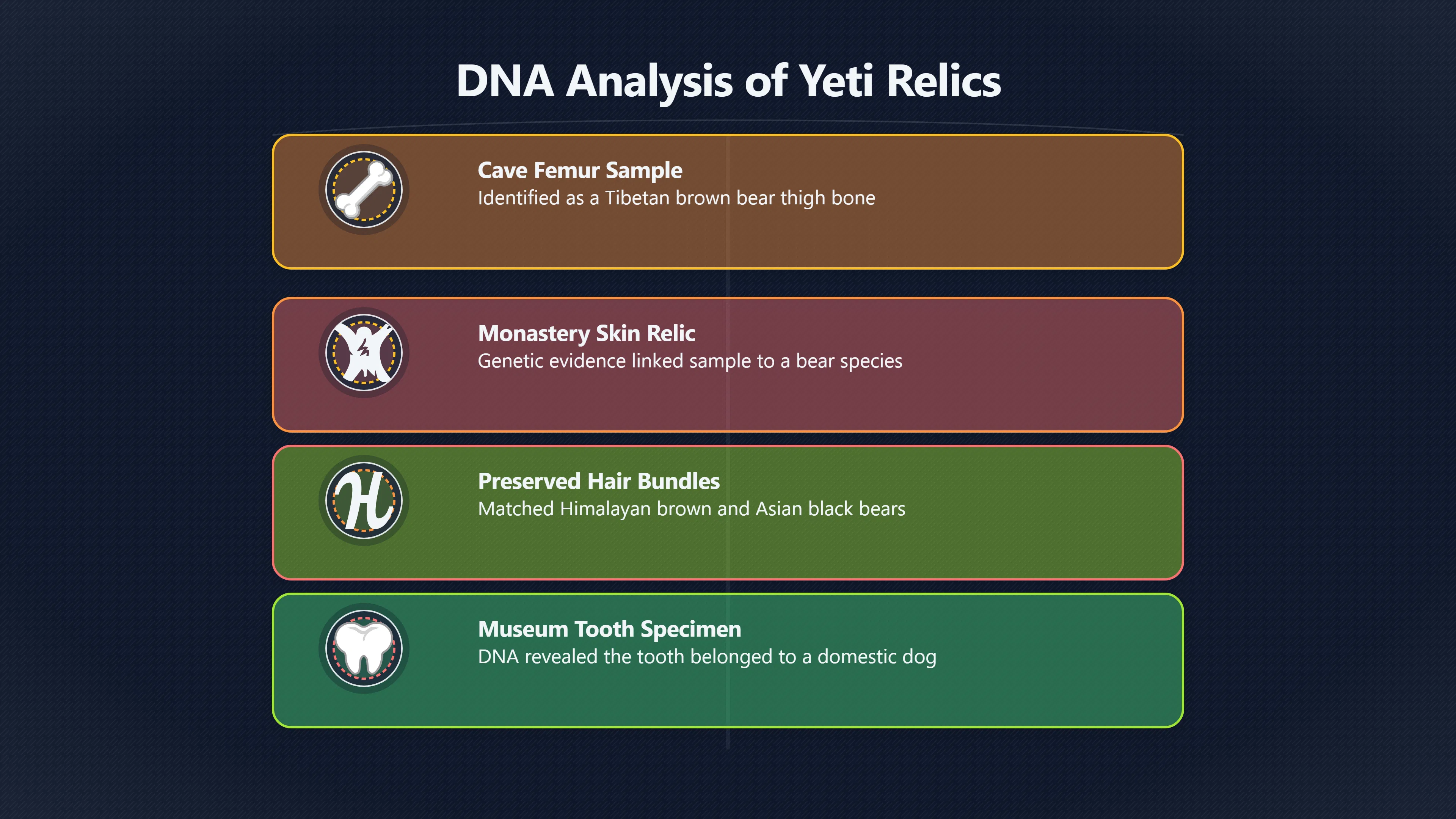
Among the most tangible pieces of Yeti evidence were not footprints or eyewitness reports but physical relics preserved in monasteries, caves, museums and private collections. For decades, these objects were displayed as possible remains of the legendary Himalayan creature: patches of skin, hair bundles, bones, teeth and even parts of hands or paws. Modern genetic testing has transformed the discussion. Instead of revealing an unknown primate, the strongest analyses have repeatedly identified known animals, especially Himalayan and Tibetan bears. In one notable case, a supposed Yeti tooth proved to belong to a domestic dog. These findings did not simply dismiss folklore; they showed how ordinary animal remains could acquire extraordinary identities as they moved through religious, cultural and expeditionary contexts.[National Geographic]nationalgeographic.comyeti legends real animals dna bears himalaya scienceNational GeographicYeti Legends Are Based on These Real Animals, DNA…29 Nov 2017 — DNA analysis of multiple supposed Yeti samples—incl…
The paw, skin, femur, hair and tooth examples
The most influential study of Yeti relics was published in 2017 by a team led by Charlotte Lindqvist. Researchers examined nine specimens attributed to the Yeti, including bone, skin, hair, tooth and faecal material gathered from museums, private collections and Himalayan sources. Eight were identified as bears and one as a dog.[University at Buffalo+2National Geographic]buffalo.edulindqvist yeti bearsUniversity at BuffaloStudy ties DNA samples from purported yetis to Asian bears29 Nov 2017 — A new study led by UB biologist Charlotte Li…
Several examples illustrate how varied these relics were:
A cave femur. One specimen was a thigh bone reportedly found in a cave by a spiritual healer. DNA analysis identified it as coming from a Tibetan brown bear rather than an unknown creature. The object had travelled from a local discovery context into the wider Yeti narrative before scientific testing reclassified it.[The Atlantic]theatlantic.comThese include: a thigh bone found by a spiritual healer in a cave …Read moreThe AtlanticDNA Reveals the Yeti Is Actually a Bunch of BearsNovember 29, 2017 — 28 Nov 2017 — Lindqvist and her colleagues used DNA to i…
How monastery relics acquired a Yeti identity
Many famous Yeti relics originated in Buddhist monasteries rather than scientific collections. The objects were often embedded in local stories, pilgrimage traditions and sacred histories long before Western explorers became interested in them.[explorehimalaya.com]explorehimalaya.comThe Yeti: Myth, Mystery, and Sacred Legends of the HimalayaOctober 29, 2025 — Here stands the 340-year-old Khumjung Monastery, a place of…
The well-known scalp preserved at Khumjung Monastery illustrates this process. The relic became internationally famous after expeditions arranged examinations by zoologists and anatomists. Investigators generally concluded that it was not evidence of a Yeti, yet the object remained important within its local cultural setting. Its significance derived not only from biological identity but also from its connection to local history and religious tradition.[Atlas Obscura]atlasobscura.comAtlas Obscura The Yeti Scalp of KhumjungAtlas ObscuraThe Yeti Scalp of KhumjungMarch 23, 2017 — 23 Mar 2017 — A small village monastery in northeast Nepal claims to have a 300-y…
A similar pattern surrounded relics associated with Pangboche Monastery. Stories linked the objects to revered religious figures and long-standing local traditions. Later scientific examination of some associated remains failed to support a Yeti origin, but this did not erase the cultural narratives that had developed around them.[Wikipedia]WikipediaPangboche HandPangboche Hand
What modern researchers encountered, therefore, was not merely a collection of misidentified bones and hairs. They encountered objects whose identities had been shaped by generations of storytelling, reverence and interpretation.[explorehimalaya.com]explorehimalaya.comThe Yeti: Myth, Mystery, and Sacred Legends of the HimalayaOctober 29, 2025 — Here stands the 340-year-old Khumjung Monastery, a place of…
Why relic identity can survive without fraud
A common misunderstanding is that a bear identification automatically implies deliberate deception. The evidence does not require that conclusion.
Many relics entered collections before modern zoology, genetics or wildlife surveys were available in remote Himalayan regions. A bear skull fragment, patch of skin or unusual bone found under mysterious circumstances could plausibly be interpreted through local traditions that already included stories of wild, human-like mountain beings.[University at Buffalo]buffalo.edulindqvist yeti bearsUniversity at BuffaloStudy ties DNA samples from purported yetis to Asian bears29 Nov 2017 — A new study led by UB biologist Charlotte Li…
Several factors help explain how this could happen without fraud:
-
Bears can leave tracks that appear surprisingly human-like in snow, especially when hind feet overlap front footprints.<div class="content-enhancement content-enhancement--insight-grid" markdown="1">
- Himalayan brown bears are large, uncommon and often encountered only briefly in difficult terrain.
- Isolated body parts are much harder to identify than complete animals.
What DNA can and cannot say about local tradition
Genetic analysis is exceptionally good at answering one question: which species provided the sample? For many Yeti relics, the answer is now clear. The tested specimens overwhelmingly trace back to Himalayan brown bears, Tibetan brown bears, Asian black bears and, in one case, a dog.[University at Buffalo+2National Geographic]buffalo.edulindqvist yeti bearsUniversity at BuffaloStudy ties DNA samples from purported yetis to Asian bears29 Nov 2017 — A new study led by UB biologist Charlotte Li…
What DNA cannot determine is why communities interpreted those remains as Yeti relics, how the associated stories evolved, or what social and religious functions the objects served. A laboratory can identify a bear femur, but it cannot measure the symbolic importance that the bone may have acquired within local tradition.[explorehimalaya.com]explorehimalaya.comThe Yeti: Myth, Mystery, and Sacred Legends of the HimalayaOctober 29, 2025 — Here stands the 340-year-old Khumjung Monastery, a place of…
This distinction matters because the scientific and cultural questions are different. Genetics addresses biological identity. Folklore addresses meaning. The strongest evidence now suggests that many famous Yeti relics originated from bears and occasionally other familiar animals, yet their historical significance lies in showing how real animal remains can become woven into a legendary landscape. Rather than exposing a hidden ape, the relics reveal the long interaction between Himalayan wildlife, religious tradition and one of cryptozoology’s most enduring mysteries.[National Geographic+2University at Buffalo]nationalgeographic.comyeti legends real animals dna bears himalaya scienceNational GeographicYeti Legends Are Based on These Real Animals, DNA…29 Nov 2017 — DNA analysis of multiple supposed Yeti samples—incl…
Amazon book picks
Further Reading
Books and field guides related to How real bones became Yeti relics. Use these as the next step if you want deeper reading beyond the article.
Field Guide To Bigfoot, Yeti, & Other Mystery Primates Worldwide
Directly relevant to relics, traditions and Yeti evidence.
eBay marketplace picks
Marketplace Samples
Live-tested eBay searches with available results related to this page.



Endnotes
1.
Source: buffalo.edu
Title: lindqvist yeti bears
Link:https://www.buffalo.edu/ubnow/stories/2017/11/lindqvist-yeti-bears.html
2.
Source: explorehimalaya.com
Link:https://explorehimalaya.com/yeti-myth-mystery-sacred-legends-himalaya/
3.
Source: Wikipedia
Title: Pangboche Hand
Link:https://en.wikipedia.org/wiki/Pangboche_Hand
4.
Source: Wikipedia
Link:https://en.wikipedia.org/wiki/Yeti
5.
Source: nationalgeographic.com
Title: yeti legends real animals dna bears himalaya science
Link:https://www.nationalgeographic.com/science/article/yeti-legends-real-animals-dna-bears-himalaya-science
6.
Source: theatlantic.com
Link:https://www.theatlantic.com/science/archive/2017/11/[yeti-dna
7.
Source: atlasobscura.com
Title: Atlas Obscura The Yeti Scalp of Khumjung
Link:https://www.atlasobscura.com/places/the-yeti-scalp-of-khumjung-khumjung-nepal
8.
Source: www3.ntu.edu.sg
Title: NewAtlas 171129 DNA tests on Yeti hair and bone samples bear results
Link:https://www3.ntu.edu.sg/CorpComms2/Documents/2017/11_Nov/NewAtlas_171129_DNA%20tests%20on%20Yeti%20hair%20and%20bone%20samples%20bear%20results.pdf
Additional References
9.
Source: geologyin.com
Link:https://www.geologyin.com/2017/12/science-solves-mystery-of-elusive-yeti.html
10.
Source: standard.co.uk
Link:https://www.standard.co.uk/news/world/scientists-discover-truth-behind-yeti-mystery-after-analysing-dna-of-alleged-remains-a3704511.html
11.
Source: alphabiolabs.co.uk
Link:https://www.alphabiolabs.co.uk/blog/dna-tests-disprove-yeti-theory/
12.
Source: news.sky.com
Link:https://news.sky.com/story/dna-tests-reveal-yeti-remains-in-museums-are-actually-from-bears-and-a-dog-11148432
13.
Source: reuters.com
Title: abominable news purported yeti evidence came from bears dog id USKBN1DT01W
Link:https://www.reuters.com/article/lifestyle/science/abominable-news-purported-yeti-evidence-came-from-bears-dog-idUSKBN1DT01W/
14.
Source: pmc.ncbi.nlm.nih.gov
Title: PMCHimalayan’yeti’ DNA: polar bear or DNA degradation
Link:https://pmc.ncbi.nlm.nih.gov/articles/PMC4298200/
15.
Source: asianage.com
Title: dna evidence suggests ancient samples of yeti actually belong to bears
Link:https://www.asianage.com/life/more-features/291117/dna-evidence-suggests-ancient-samples-of-yeti-actually-belong-to-bears.html
16.
Source: theguardian.com
Title: dna sampling exposes nine yeti specimens as eight bears and a dog
Link:https://www.theguardian.com/science/2017/nov/29/dna-sampling-exposes-nine-yeti-specimens-as-eight-bears-and-a-dog
17.
Source: science.org
Title: So much for the abominable snowman
Link:https://www.science.org/content/article/so-much-abominable-snowman-study-finds-yeti-dna-belongs-bears
18.
Source: worldtravelfamily.com
Link:https://worldtravelfamily.com/the-yeti-skull-at-khumjung-monastery-nepal/
Topic Tree