Within Populations
Elusive Does Not Mean Evidence Free
Snow leopards, wolverines and other elusive animals show that hard-to-see wildlife still leaves repeatable traces.
On this page
- Why rare animals can be hard to see
- Tracks, scat, hair and carcasses as converging evidence
- What cryptid claims should produce if populations exist
Page outline Jump by section
Introduction
One of the most useful comparisons in cryptozoology comes from animals that are genuinely difficult to observe. Snow leopards inhabit vast mountain ranges, wolverines roam remote forests and tundra, and other rare carnivores can avoid direct human observation for years. Yet these species are not known solely from fleeting sightings. They leave behind a web of repeatable, measurable traces that allow scientists to confirm their presence, estimate population size, identify individuals and track movements. The lesson is simple: elusive animals may be hard to see, but they are rarely evidence-free. When considering claims about hidden breeding populations of cryptids, the key question is not whether an animal can avoid being photographed. It is whether a population can exist without generating the kinds of traces that real populations routinely produce.
Why Rare Animals Can Be Hard to See
Elusiveness is a genuine biological phenomenon. Many species live at low densities, occupy inaccessible terrain, move primarily at night, or actively avoid humans. Snow leopards are often called the “ghost of the mountains” because they inhabit rugged high-altitude landscapes across Central Asia and can travel over enormous home ranges while remaining largely unseen. Modern snow leopard conservation relies heavily on camera traps, genetic sampling and other indirect methods precisely because direct encounters are uncommon.[Springer]link.springer.comSnow tracking also requires considerable…Read more…
Wolverines present a similar challenge. They occupy large territories, often in remote snowy environments, and can travel long distances across difficult terrain. Historically, reports of wolverines in some regions were uncertain until researchers collected photographs, hair samples and genetic evidence that confirmed their presence.[Montana FWP]fwp.mt.govmly selected 15-km × 15-km cells in Idaho, Montana, Washington…
These examples demonstrate an important distinction. Being difficult to observe is not the same as leaving no evidence. Wildlife biologists frequently study animals they rarely see directly because those animals continually interact with the environment in detectable ways.[American Scientist]americanscientist.orgAmerican ScientistMonitoring Elusive MammalsWithout the benefit of firsthand observations, investigators have traditionally had to rely o…
Tracks, Scat, Hair and Carcasses Form a Chain of Evidence
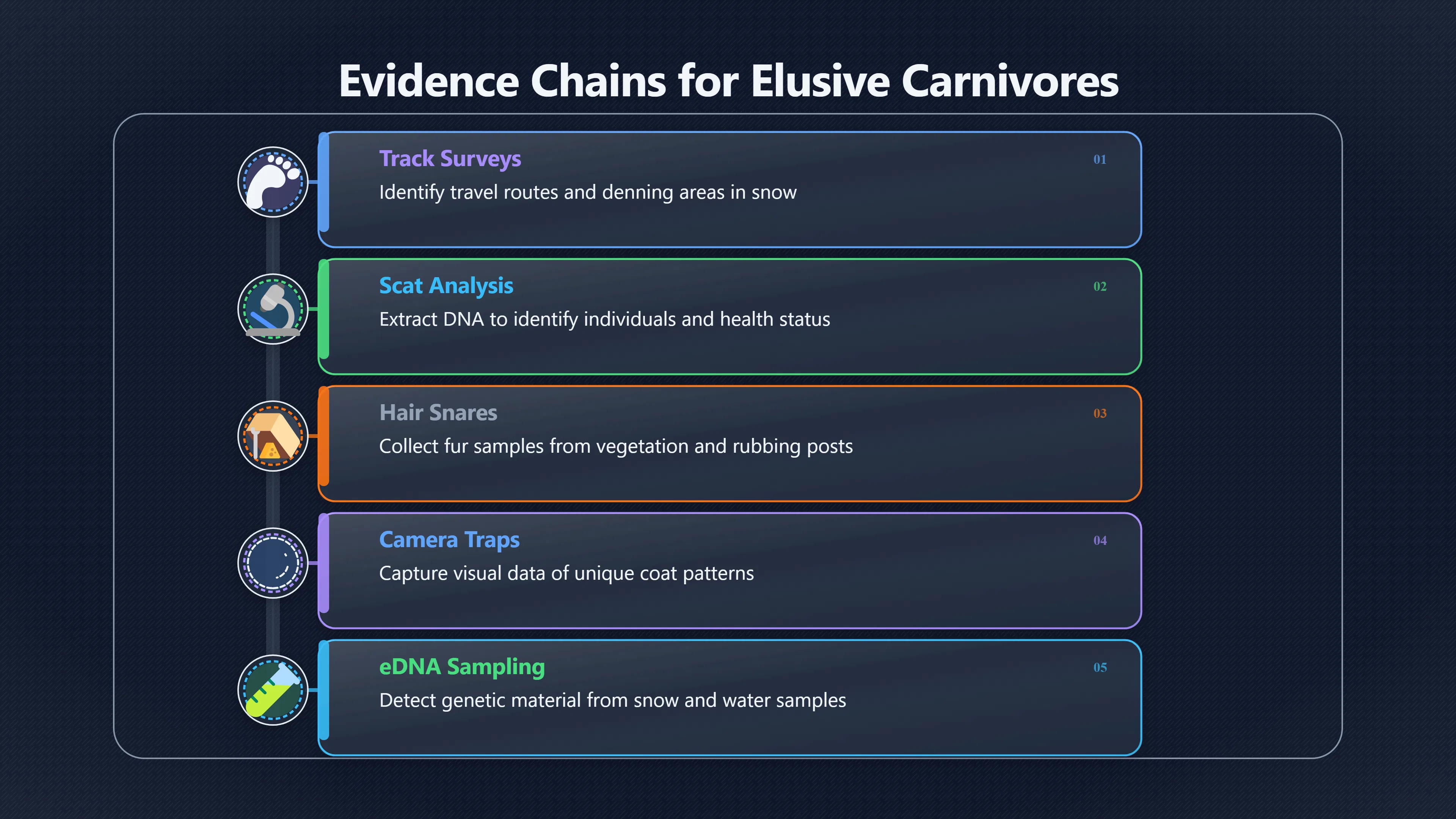
A single type of evidence can be ambiguous. A footprint may be misidentified, a photograph may be unclear, and scat can be mistaken for that of another species. What makes wildlife detection reliable is the convergence of multiple independent traces.
Tracks Reveal Presence and Movement
Scat Contains More Information Than Sightings
Animal droppings are among the most valuable traces left by elusive wildlife. Scat contains DNA, dietary information and clues about health, sex and population structure. Snow leopard conservation programmes routinely use non-invasive genetic analysis of scat to identify individuals and estimate population numbers. Researchers have successfully detected multiple snow leopards through scat surveys in areas where direct observations were extremely rare.[OUP Academic+2ZSL Publications]academic.oup.comscat collection. In the site where both techniques were…Read more…
The scientific value of scat is especially revealing. A sighting tells researchers that someone may have seen an animal. A genetically verified scat sample can identify a species, distinguish one individual from another and sometimes reveal relationships within a population.[ResearchGate+2Wildlife Conservation Network]researchgate.netPopulation monitoring of snow leopards using noninvasive…We conducted a pilot study to optimize moecular markers for the a…
Hair and DNA Extend the Evidence Trail
Hair caught on vegetation, rubbing posts or specially designed snares provides another powerful source of evidence. Wolverine surveys across western North America have relied extensively on hair snares and camera stations, producing genetic confirmation even when animals were rarely observed directly.[Montana FWP]fwp.mt.govmly selected 15-km × 15-km cells in Idaho, Montana, Washington…
Advances in environmental DNA (eDNA) have pushed detection even further. Researchers have extracted DNA from snow, footprints and other environmental samples to confirm the presence of elusive carnivores. In some cases, DNA recovered from tracks has verified species that otherwise left few visible signs.[National Geographic]nationalgeographic.comenvironmental dna snow helps track lynx rare animalsNational GeographicHow DNA from snow helps scientists track elusive animals19 Nov 2018 — Researchers are using environmental DNA to help…
Carcasses, Bones and Feeding Sign Accumulate Over Time
Populations also leave evidence through death. Animals die from disease, predation, accidents and old age. Their remains enter ecosystems as carcasses, bones, teeth and other physical traces.
Wolverines, for example, leave distinctive feeding sign at carcasses, including heavily fragmented bones and excavation marks where food has been cached or recovered. These traces help researchers distinguish their activity from that of other scavengers.[conservationnw.org]conservationnw.orgFigure 14 Wolverine scat. Photo by David MoskowitzWolverine Remote Camera and DNA TrapsApril 5, 2019 — Wolverine scats can appear very similar to other similar sized carnivores such as co…
Over decades and centuries, breeding populations generate an accumulating physical record. Even when carcasses are rapidly scavenged, some remains persist and become part of museum collections, fossil deposits or documented wildlife records. This accumulation is one reason why known rare species eventually become supported by multiple forms of evidence rather than isolated reports.
Camera Traps Turn Invisible Animals Into Data
One of the strongest lessons from modern wildlife biology is how quickly evidence accumulates once systematic monitoring begins.
What Cryptid Claims Should Produce If Populations Exist
The comparison with known elusive species helps clarify the ecological burden of proof.
If a large cryptid population exists, especially one alleged to have persisted for generations, it should not be expected to reveal itself primarily through eyewitness accounts. Instead, it should generate the same categories of evidence that support the existence of snow leopards, wolverines and other hard-to-study animals.
A breeding population would be expected to leave:<div class="content-enhancement content-enhancement--insight-grid" markdown="1">
- Repeated tracks in suitable habitat.
- Hair containing recoverable DNA.
- Scat that can be genetically analysed.
- Feeding sites, nests, dens or resting locations.
- Roadkills, carcasses, bones or skeletal remains.
- Environmental DNA in water, soil or snow.
- Increasing numbers of camera-trap detections as monitoring expands.
- Evidence from multiple independent sources that converges on the same conclusion.</div>
None of these traces must appear immediately, but a persistent population should produce them over time. The larger the claimed animal and the longer its supposed presence, the stronger this expectation becomes.
This does not mean every cryptid report is necessarily false. It means that population-level claims are judged against the behaviour of real populations. Known elusive animals demonstrate that rarity and secrecy do not prevent evidence from accumulating. In wildlife biology, the strongest discoveries are rarely built on sightings alone. They emerge when tracks, DNA, photographs, scat, carcasses and other traces begin pointing to the same animal from multiple directions.[snowleopardnetwork.org+3American Scientist+3Montana FWP]americanscientist.orgAmerican ScientistMonitoring Elusive MammalsWithout the benefit of firsthand observations, investigators have traditionally had to rely o…
Amazon book picks
Further Reading
Books and field guides related to Elusive Does Not Mean Evidence Free. Use these as the next step if you want deeper reading beyond the article.
Abominable Science!
Contrasts cryptid sightings with evidence used to confirm real species.
The Hidden Life of Wolves
Demonstrates how elusive mammals leave abundant evidence despite being hard to observe.
The Wolverine Way
Illustrates how difficult-to-see animals are still documented through multiple evidence streams.
Tracking and the Art of Seeing
Focuses on tracks and field signs as evidence of animal presence.
eBay marketplace picks
Marketplace Samples
Live-tested eBay searches with available results related to this page.


Endnotes
1.
Source: link.springer.com
Link:https://link.springer.com/article/10.1007/s00265-025-03574-8
2.
Source: snowleopardnetwork.org
Link:https://snowleopardnetwork.org/module-1-camera-trap-surveys/
3.
Source: fwp.mt.gov
Link:https://fwp.mt.gov/conservation/wildlife-management/wildlife-migration/tracking/furbearer-carnivore/wolverine
4.
Source: programs.wcs.org
Title: These methods
Link:https://programs.wcs.org/portals/42/[media
5.
Source: academic.oup.com
Link:https://academic.oup.com/jmammal/article-abstract/92/4/771/888116
6.
Source: researchgate.net
Link:https://www.researchgate.net/publication/227502224_Population_monitoring_of_snow_leopards_using_noninvasive_collection_of_scat_samples_A_pilot_study
7.
Source: researchgate.net
Link:https://www.researchgate.net/publication/376481936_Capturing_environmental_DNA_in_snow_tracks_of_polar_bear_Eurasian_lynx_and_snow_leopard_towards_individual_identification
8.
Source: conservationnw.org
Title: Figure 14 Wolverine scat. Photo by David Moskowitz
Link:https://conservationnw.org/wp-content/uploads/2017/06/Wolverine-Remote-Camera-Trap-Guidelines-2019.docx.pdf
9.
Source: academic.oup.com
Link:https://academic.oup.com/jmammal/article/92/4/771/888116
10.
Source: snowleopardnetwork.org
Link:https://snowleopardnetwork.org/wp-content/uploads/2020/04/Fuller__McCarthy_Final05.pdf
11.
Source: snowleopardnetwork.org
Link:https://snowleopardnetwork.org/module-5-genetics/
12.
Source: researchgate.net
Title: wolverine monitoring program and for each scat a GPS location was noted
Link:https://www.researchgate.net/publication/230690139_Large-scale_noninvasive_genetic_monitoring_of_wolverines_using_scats_reveals_density_dependent_adult_survival
13.
Source: americanscientist.org
Link:https://www.americanscientist.org/article/monitoring-elusive-mammals
14.
Source: blog.ncascades.org
Title: the magic of wolverine tracking
Link:https://blog.ncascades.org/naturalist-notes/the-magic-of-wolverine-tracking/
15.
Source: zslpublications.onlinelibrary.wiley.com
Title: j.1469 1795.2008.00195.x
Link:https://zslpublications.onlinelibrary.wiley.com/doi/10.1111/j.1469-1795.2008.00195.x
16.
Source: wildnet.org
Title: snow leopard discovery found in dna
Link:https://wildnet.org/news/snow-leopard-discovery-found-in-dna/
17.
Source: nationalgeographic.com
Title: environmental dna snow helps track lynx rare animals
Link:https://www.nationalgeographic.com/animals/article/environmental-dna-snow-helps-track-lynx-rare-animals
18.
Source: snowleopard.org
Link:https://snowleopard.org/our-work/research/research-tools/
19.
Source: snowleopard.org
Title: Guess what?
Link:https://snowleopard.org/guess-what-snow-leopard-numbers/
20.
Source: snowleopard.org
Title: tracking predator and prey
Link:https://snowleopard.org/tracking-predator-and-prey/
21.
Source: snowleopard.org
Link:https://snowleopard.org/new-research-most-snow-leopard-population-studies-are-biased/
22.
Source: Wikipedia
Link:https://en.wikipedia.org/wiki/Snow
Additional References
23.
Source: linkedin.com
Link:https://www.linkedin.com/pulse/use-environmental-dna-edna-population-surveys-snow-tom-hicks-msc-o62be
24.
Source: cascadiawild.org
Link:https://www.cascadiawild.org/wolverine-tracking-project.html
25.
Source: facebook.com
Link:https://www.facebook.com/worldwildlifefund/posts/news-nepal-has-announced-its-first-robust-estimate-of-the-countrys-elusive-snow-/1320608149430652/
26.
Source: panthera.org
Link:https://panthera.org/blog-post/decoding-snow-leopard-dna-and-diversity
27.
Source: blog.nature.org
Title: camera trap chronicles up close with snow leopards
Link:https://blog.nature.org/2025/09/21/camera-trap-chronicles-up-close-with-snow-leopards/
28.
Source: glacier.org
Title: wolverine research underway in glacier
Link:https://glacier.org/newsblog/wolverine-research-underway-in-glacier/
29.
Source: biorxiv.org
Title: 2021.02.24.432722v1.full text
Link:https://www.biorxiv.org/content/10.1101/2021.02.24.432722v1.full-text
30.
Source: youtube.com
Title: Searching for the Snow Leopard | National Geographic
Link:https://www.youtube.com/watch?v=5vQDZXlXaAI
31.
Source: globalsnowleopard.org
Title: PAWS guidelines 2020
Link:https://globalsnowleopard.org/wp-content/uploads/2020/08/PAWS-guidelines-2020.pdf
32.
Source: youtube.com
Link:https://www.youtube.com/watch?v=rKWVvMaml_8
Topic Tree