Within Proof
Why a Body Changes the Whole Claim
A claimed new animal becomes scientifically serious only when researchers can inspect and preserve a real reference specimen.
On this page
- What counts as a voucher specimen
- Why photos and sightings cannot anchor a species name
- How preserved material lets other scientists recheck the claim
Page outline Jump by section
Introduction
In cryptozoology, the difference between a persistent mystery and a scientifically recognised animal often comes down to one thing: a voucher specimen. Zoologists do not formally establish species from sightings, stories or even impressive photographs alone. Instead, they anchor species names to physical reference material that can be preserved, studied and re-examined by other researchers. A cryptid may attract attention through eyewitness reports or images, but it becomes a serious taxonomic claim only when there is a specimen that independent scientists can inspect. This requirement is not a bureaucratic formality. It is the mechanism that allows science to distinguish a genuinely new animal from misidentification, folklore, hoaxes or unusual examples of known species.[code.iczn.org]code.iczn.orgoup taxon is based in the original publication.Read more…
What Counts as a Voucher Specimen?
A voucher specimen is a preserved, documented example of the organism being claimed. It serves as a permanent reference that allows later researchers to verify the identification and reassess the evidence if scientific methods improve. Museums and research collections treat such specimens as essential records because they are the only reliable way to confirm exactly what organism was studied.[mbd.osu.edu]mbd.osu.eduMuseum of Biological DiversityA "voucher" is a representative of the taxon dealt with in a biological study. Voucher specimens deposited…
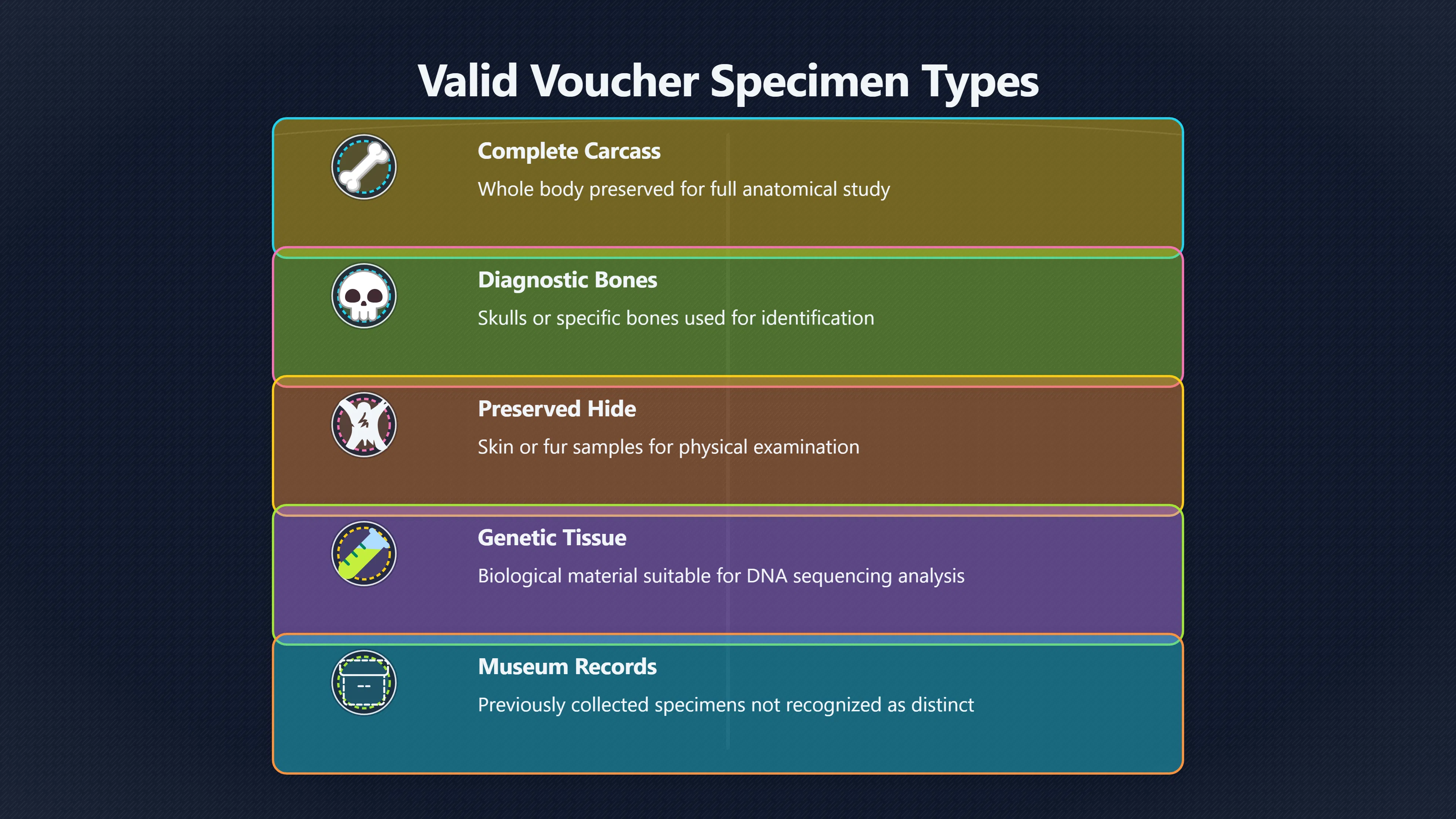
For a cryptid claim, a voucher specimen does not necessarily have to be an intact body. Depending on the animal and circumstances, it could include:
- A complete carcass.
- A skeleton, skull or diagnostic bone.
- A preserved skin or hide.
- Tissue suitable for genetic analysis.
- A museum specimen collected previously but not recognised as distinct.
- In some specialised situations, a specimen represented through formal type procedures recognised by zoological nomenclature rules.[Alisa N. Bokulich+2code.iczn.org]bokulich.orgAlisa NHolotypes, Stratotypes, and Measurement Prototypesby A Bokulich · Cited by 20 — The specimen that is designated a holotype need n…
The key requirement is that the material can be examined by other qualified researchers rather than remaining in private possession or existing only as a claim.
Why Photos and Sightings Cannot Anchor a Species Name
Cryptozoological debates often focus on photographs, videos, footprint casts or eyewitness testimony. Such evidence may be intriguing, but it lacks the permanence and testability needed for taxonomy.
A photograph records appearance from a particular angle under particular conditions. It cannot reveal many anatomical traits used to distinguish species. A sighting report cannot be re-examined years later. Footprints can suggest an animal’s presence but cannot provide a complete anatomical comparison. Even high-quality images leave unanswered questions about size, variation, age, sex and biological relationships.[Natural History Museum]nhm.ac.ukNatural History MuseumWhat is a type specimen?What is a holotype? A holotype is the individual specimen to which the name of a species is…
The problem is not that photographs are useless. They are often valuable evidence. The problem is that they do not provide a stable reference point for a scientific name. Taxonomic names are intended to remain meaningful for decades or centuries. To achieve that stability, zoology links names to physical type specimens rather than to observations alone.[iczn.org+2naturalhistory.museumwales.ac.uk]iczn.orger to. Names of species can be…Read more…
This distinction explains why famous cryptid photographs may generate public interest without resolving scientific questions. Images can suggest that further investigation is warranted, but they cannot by themselves establish the existence of a new species.
Why a Body Changes the Whole Claim
The evidential value of a cryptid claim changes dramatically when physical material appears.
A reported encounter with an unknown creature is anecdotal. A photograph adds visual evidence. A hair sample permits laboratory testing. A preserved body, skull or tissue sample allows detailed anatomical and genetic comparison with known animals. Each step increases the ability of independent researchers to evaluate the claim.[mbd.osu.edu]mbd.osu.eduMuseum of Biological DiversityA "voucher" is a representative of the taxon dealt with in a biological study. Voucher specimens deposited…
Physical specimens make it possible to answer questions that sightings cannot:<div class="content-enhancement content-enhancement--caution" markdown="1">
- Is the animal actually different from known species?
- Is it a hybrid?
- Is it an abnormal individual?
- Is the specimen authentic or fabricated?
- Does its DNA fit within existing species variation?
- Are the distinctive traits consistent across multiple specimens?[OUP Academic]academic.oup.comOUP AcademicHow to describe a new species in zoology and avoid mistakesby MF Braby · 2024 · Cited by 60 — When designating a holotype, th…</div>
For many alleged cryptids, the central difficulty is not a lack of stories but a lack of material that survives rigorous scrutiny. Without a voucher specimen, debates often become arguments over interpretation rather than investigations of a biological object.
How Preserved Material Lets Other Scientists Recheck the Claim
Science depends on repeatability and independent verification. A voucher specimen allows both.
When a specimen is deposited in a recognised collection, researchers can revisit it years later with new techniques. DNA sequencing methods improve. Imaging technology advances. Comparative collections expand. Questions that could not be answered at the time of discovery may become answerable later.[OUP Academic]academic.oup.comOUP AcademicHow to describe a new species in zoology and avoid mistakesby MF Braby · 2024 · Cited by 60 — When designating a holotype, th…
This re-examination function is one of the most important reasons voucher specimens exist. Museums and natural history collections preserve material specifically so future scientists can verify earlier conclusions. The specimen remains available even if the original discoverer retires, dies or changes their interpretation.[mbd.osu.edu+2lacmip.github.io]mbd.osu.eduMuseum of Biological DiversityA "voucher" is a representative of the taxon dealt with in a biological study. Voucher specimens deposited…
Without preserved material, later researchers must rely on descriptions, photographs or recollections. Those secondary records may be informative, but they cannot substitute for direct access to the organism itself.
The Link Between Voucher Specimens and Species Names
Modern zoological nomenclature is built around the concept of a name-bearing type. A holotype is the specimen upon which a newly described species is based. The species name becomes permanently connected to that reference specimen. If disputes arise in the future, researchers can return to the type material to determine what the name actually refers to.[code.iczn.org]code.iczn.orgoup taxon is based in the original publication.Read more…
The International Code of Zoological Nomenclature permits some exceptional circumstances, but it explicitly discourages establishing new species-group taxa without preserved type material unless special reasons justify doing so. The general expectation remains that species descriptions should be anchored to preserved specimens whenever feasible.[iczn.org]iczn.orgal is permissible under the Code, but is discouraged unless justified by special…Read more…
This principle has direct implications for cryptozoology. Even if researchers became convinced that a cryptid represented an unknown animal, the path to formal scientific recognition would still require reference material that could serve as the species’ objective point of comparison.
Why the Standard Exists
The voucher specimen requirement is sometimes portrayed as an unnecessarily strict barrier. In practice, it exists because zoology has centuries of experience with mistakes, misidentifications and incomplete descriptions.
Physical reference material provides a safeguard against:
- Hoaxes and fabricated evidence.
- Misidentified known animals.
- Poor-quality observations.
- Taxonomic confusion caused by vague descriptions.
- Future uncertainty about what a species name actually denotes.[Naturalis+2naturalhistory.museumwales.ac.uk]repository.naturalis.nlAttaching Names to Biological Species: The Use and ValueAttaching Names to Biological Species: The Use and Value…March 10, 2021 — by R Sluys · 2021 · Cited by 30 — However, photos a…
For cryptids, this standard is especially important because the claims are often extraordinary and controversial. A voucher specimen transforms the discussion from “What did people think they saw?” into “What organism can researchers examine?” That shift is why the discovery of a body, skeleton or preserved tissue would fundamentally change the scientific status of any cryptid claim. It provides the durable, testable reference point on which zoological knowledge is built.[lacmip.github.io+2Natural History Museum]lacmip.github.ioType Collection - LACMIP EMu Handbook20 Jan 2023 — Type specimens, or “types”, are the physical, name-bearing vouchers for new species…
Amazon book picks
Further Reading
Books and field guides related to Why a Body Changes the Whole Claim. Use these as the next step if you want deeper reading beyond the article.
The Princeton Guide to Evolution
Provides context for species recognition and classification.
eBay marketplace picks
Marketplace Samples
Live-tested eBay searches with available results related to this page.
Endnotes
1.
Source: code.iczn.org
Link:https://code.iczn.org/types-in-the-species-group/article-73-name-bearing-types-fixed-in-the-original-publication-holotypes-and-syntypes/
2.
Source: mbd.osu.edu
Link:https://mbd.osu.edu/collections/acarology/about/depositions
3.
Source: lacmip.github.io
Link:https://lacmip.github.io/emu/documentation/typecollection/
4.
Source: bokulich.org
Title: Alisa N
Link:https://bokulich.org/wp-content/uploads/2020/09/understanding-scientific-types-accepted.pdf
5.
Source: iczn.org
Link:https://www.iczn.org/the-code/declaration-45-addition-of-recommendations/
6.
Source: naturalhistory.museumwales.ac.uk
Title: What are Type Specimens?
Link:https://naturalhistory.museumwales.ac.uk/molluscatypes/TypeSpecimens.php
7.
Source: iczn.org
Link:https://www.iczn.org/outreach/guidelines-for-authors-and-editors/whats-in-a-name/
8.
Source: academic.oup.com
Link:https://academic.oup.com/zoolinnean/article/202/4/zlae043/7664331
9.
Source: repository.naturalis.nl
Title: Attaching Names to Biological Species: The Use and Value
Link:https://repository.naturalis.nl/pub/800037/Attaching-Names-to-Biological-Species-1-.pdf
10.
Source: iczn.org
Link:https://www.iczn.org/outreach/faqs/
11.
Source: code.iczn.org
Title: article 72 general provisions
Link:https://code.iczn.org/types-in-the-species-group/article-72-general-provisions/
12.
Source: iczn.org
Link:https://www.iczn.org/
13.
Source: iczn.org
Link:https://www.iczn.org/assets/dfa53e9e0c/ICZN-Advice-for-editors-of-popular-works-web-v10-_.pdf
14.
Source: iczn.org
Link:https://www.iczn.org/outreach/
15.
Source: iczn.org
Link:https://www.iczn.org/cases/declarations/
16.
Source: code.iczn.org
Title: article 16 names published after 1999
Link:https://code.iczn.org/chapter-4-criteria-of-availability/article-16-names-published-after-1999/
17.
Source: iczn.org
Link:https://www.iczn.org/the-code/the-code-online/
18.
Source: academic.oup.com
Link:https://academic.oup.com/jmammal/article/106/2/522/7900324
19.
Source: youtube.com
Title: Holotype Specimens
Link:https://www.youtube.com/watch?v=BTi27YckvSA
20.
Source: youtube.com
Title: Voucher specimens
Link:https://www.youtube.com/watch?v=T89HhjaISuE
21.
Source: youtube.com
Title: Preparing and Submitting Voucher Specimens and Why it Matters
Link:https://www.youtube.com/watch?v=N0LNjIFEOkM
22.
Source: youtube.com
Title: Type Specimens
Link:https://www.youtube.com/watch?v=wuEHNA2JIoE
23.
Source: nhm.ac.uk
Link:https://www.nhm.ac.uk/discover/what-is-a-type-specimen.html
Additional References
24.
Source: basingstoke.gov.uk
Link:https://www.basingstoke.gov.uk/museums
25.
Source: visitnewbury.org.uk
Link:https://visitnewbury.org.uk/attractions/west-berkshire-museum/
26.
Source: westberkshireheritage.org
Link:https://www.westberkshireheritage.org/west-berkshire-museum
27.
Source: artfund.org
Link:https://www.artfund.org/explore/museums-and-galleries/west-berkshire-museum
28.
Source: readingmuseum.org.uk
Link:https://www.readingmuseum.org.uk/reading-museum
29.
Source: tripadvisor.co.uk
Link:https://www.tripadvisor.co.uk/Attraction_Review-g190745-d7147860-Reviews-West_Berkshire_Museum-Newbury_Berkshire_England.html
30.
Source: researchgate.net
Link:https://www.researchgate.net/publication/315620044_The_need_for_reference_specimens_in_zoological_taxonomy_and_nomenclature
31.
Source: bohrium.com
Link:https://www.bohrium.com/en/sciencepedia/feynman/keyword/iczn
32.
Source: researchgate.net
Title: not as a replacement for, a preserved type specimen. View.Read more
Link:https://www.researchgate.net/publication/334382567_ICZN_Declaration_45_a_remedy_for_the_nomenclatural_and_typification_dilemma_regarding_soft-bodied_meiofaunal_organisms
33.
Source: facebook.com
Link:https://www.facebook.com/groups/415851935172452/posts/7696869537070619/
Topic Tree