Within Sightings
When Fear Makes Sightings Feel More Certain
Fear can make a strange encounter feel unforgettable while still leaving size, distance and identity badly distorted.
On this page
- Why intense encounters narrow attention
- What eyewitness research says about stress
- How fear reshapes cryptid reports after the event
Page outline Jump by section
Introduction
Many cryptid reports begin with a moment of surprise: a dark figure appears at the edge of a road, something large moves through trees, or an unfamiliar shape emerges from water. Witnesses often describe these encounters as intensely frightening and unforgettable. The paradox is that fear can make an experience feel exceptionally real while simultaneously reducing the accuracy of important details such as size, distance, movement and identity. Research on eyewitness memory consistently shows that high stress changes how people perceive and remember events, creating conditions in which sincere observers can become highly confident in an interpretation that is nevertheless mistaken.[PMC+2PMC]pmc.ncbi.nlm.nih.govPMCWhy eyewitnesses failNIHby TD Albright · 2017 · Cited by 137 — A meta-analytic review of the effects of high stress on eyewitness memory. Initial eyewit… Within cryptozoology, this mechanism matters because many alleged sightings occur under exactly the conditions known to challenge perception: sudden encounters, low visibility, unfamiliar environments and strong emotional arousal. Understanding how fear affects attention and memory helps explain why some reports remain compelling personal experiences even when later investigation points toward ordinary animals or environmental misperceptions.
Why Intense Encounters Narrow Attention
Fear is not simply an emotion layered on top of perception. It changes perception itself.
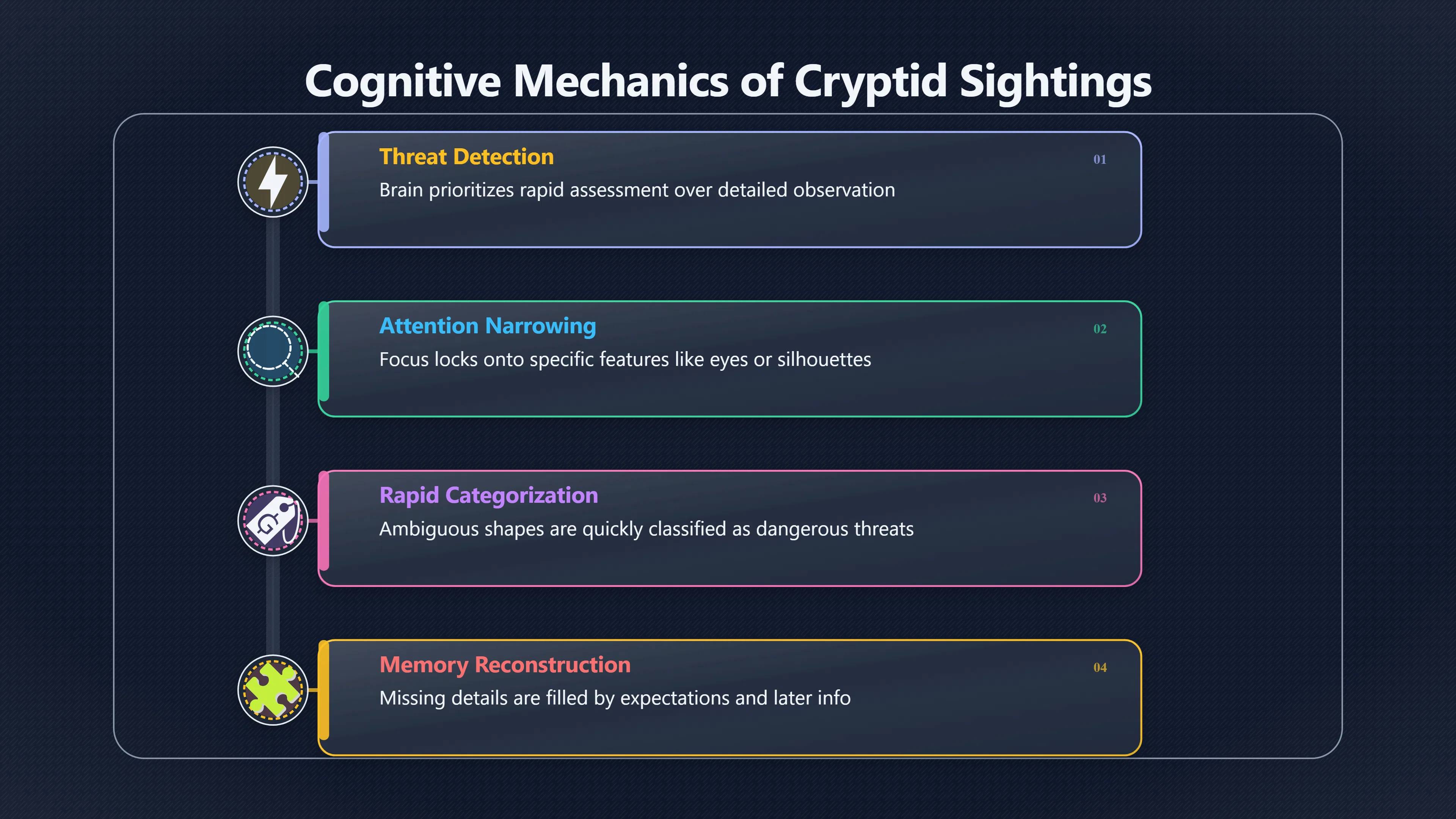
When people encounter something they interpret as threatening, the brain prioritises rapid assessment over detailed observation. Attention becomes concentrated on the most immediately important feature of the scene. In laboratory and field studies of eyewitness memory, this narrowing of attention is often demonstrated through the “weapon focus effect”, in which observers remember a threatening object vividly but recall surrounding details less accurately. Researchers generally interpret this as evidence that perceived danger redirects limited attentional resources toward the source of threat.[PMC+2Taylor & Francis Online]pmc.ncbi.nlm.nih.govRevisiting the role of attention in the “weapon focus effect” - PMCby HM Körner · 2023 · Cited by 14 — Keywords: Weapon focus effect…
A cryptid encounter can produce a similar pattern even without a weapon. Consider a witness who suddenly believes a large unknown creature is approaching. Their attention may lock onto a pair of eyes, a silhouette, a movement pattern or a perceived threat. At the same time, other information that would aid identification—relative size, nearby landmarks, viewing angle, colouration or ordinary animal features—may receive far less processing.
This can produce a striking combination:<div class="content-enhancement content-enhancement--insight-grid" markdown="1">
- Strong memory for the emotional impact of the encounter.
- Weak memory for contextual details.
- High confidence that “something extraordinary” was present.
- Reduced ability to reconstruct exactly what was seen.</div>
The result is not fabrication. It is a predictable consequence of how attention operates under perceived threat.[Frontiers+2PMC]frontiersin.orgFrontiersThe Dynamic and Fragile Nature of Eyewitness Memory…by AN Wulff · 2021 · Cited by 23 — We argue that acute stress, often expe…
Fear Encourages Rapid Categorisation
Another consequence of fear is that the brain tends to favour quick interpretation over careful analysis.
From a survival perspective, assuming that an ambiguous shape might be dangerous is often safer than ignoring a genuine threat. Psychologists sometimes describe this as a bias toward threat detection under uncertainty. In practical terms, a witness who sees an unclear moving figure may rapidly classify it as a large unknown creature before gathering enough information for a more accurate identification.
What Eyewitness Research Says About Stress
The relationship between stress and memory is more nuanced than the simple claim that “stress makes memory unreliable”.
Researchers generally agree that very high levels of stress can impair eyewitness accuracy, particularly when a person must later identify or describe specific details. Surveys of memory experts and reviews of eyewitness research repeatedly find broad agreement that intense stress can reduce the accuracy of recall and identification.[PMC+2ResearchGate]pmc.ncbi.nlm.nih.govby C Marr · 2020 · Cited by 58 — Across all 17 surveys, 79% of laypeople agreed that high stress harms the accuracy of eyewitness test…
Importantly, stress does not erase memory. Instead, it changes what is remembered.
A witness may accurately recall:<div class="content-enhancement content-enhancement--phrase-stack" markdown="1">
- Feeling terrified.
- The sudden appearance of an object or figure.
- The general direction of movement.
- The fact that the encounter occurred.</div>
Yet the same witness may be far less accurate regarding:<div class="content-enhancement content-enhancement--insight-grid" markdown="1">
- Exact size.
- Distance from the observer.
- Duration of the sighting.
- Fine anatomical features.
- Relative position of objects in the scene.</div>
The National Academies’ review of eyewitness science identifies stress, trauma, viewing conditions and exposure duration as important factors influencing reliability. Human perception and memory are not passive recording systems; they are active processes that can fail in systematic ways.[National Academies+2National Academies]nationalacademies.orgNational AcademiesChapter: 4 Basic Research on Vision and MemoryIdentifying the Culprit: Assessing Eyewitness Identification (2014). Chap…
Vivid Does Not Mean Precise
One of the most persistent misconceptions about eyewitness reports is the belief that emotionally powerful memories must be accurate.
In reality, emotional intensity often increases a person’s sense that the memory is important without guaranteeing that every remembered detail is correct. Memory researchers have long noted that people can be highly confident about memories formed during stressful experiences while still making significant errors about specific elements of the event.[PMC+2Frontiers]pmc.ncbi.nlm.nih.govPMCWhy eyewitnesses failNIHby TD Albright · 2017 · Cited by 137 — A meta-analytic review of the effects of high stress on eyewitness memory. Initial eyewit…
For cryptid reports, this distinction is crucial. A witness may be completely sincere when insisting that they will “never forget what happened”. The emotional certainty may accurately reflect the impact of the experience while telling us relatively little about whether the observed object was an unknown creature, a bear, a moose, a bird seen under unusual conditions or another ordinary source.
How Fear Reshapes Cryptid Reports After the Event
The effects of fear do not stop when the encounter ends.
Memory is reconstructive. People do not replay stored recordings; they rebuild memories each time they recall them. During this reconstruction process, missing details are often filled in using expectations, assumptions and later information. Eyewitness researchers have repeatedly shown that memory can be influenced by discussion, repeated retelling and post-event information.[National Academies+2PMC]nationalacademies.orgNational AcademiesChapter: 4 Basic Research on Vision and MemoryIdentifying the Culprit: Assessing Eyewitness Identification (2014). Chap…
In cryptid cases, this can occur in several ways.
A witness may initially report only a large dark shape. Later conversations introduce questions about height, posture or unusual features. News stories, books, documentaries or online discussions provide imagery that helps the witness make sense of the event. Over time, the memory can become more detailed and coherent than it was immediately after the sighting.
This process does not require dishonesty. It emerges from normal memory mechanisms.
Estimating Size and Distance Under Fear
One recurring pattern in unusual-animal reports is uncertainty about scale.
Fear can distort judgments of size, speed and distance because these judgments depend heavily on context. When visibility is poor and emotional arousal is high, observers often have limited reference points. A figure briefly seen at night may appear much larger than it actually was. An animal crossing a road may seem closer, faster or more imposing than later measurements would suggest.
Because many cryptid descriptions depend on extraordinary size, these distortions are especially important. An ordinary animal that is overestimated in height or bulk can begin to resemble something unknown.
The Story Becomes Cleaner Than the Experience
Real perception is messy. Witnesses often see only fragments of an event.
Fear increases the likelihood that those fragments will later be organised into a coherent narrative. The final account may feel internally consistent because the brain naturally prefers complete stories over disconnected impressions. Yet the polished narrative can conceal the uncertainty that existed during the original encounter.
For investigators of cryptid reports, this means the earliest statements are often the most valuable. They are usually closer to the raw experience and less influenced by later interpretation.
Why This Mechanism Matters in Cryptozoology
Stress-related error does not prove that every cryptid sighting is a misidentification. It does, however, explain why emotionally powerful encounters deserve careful scrutiny rather than automatic acceptance.
The conditions that produce many cryptid reports—surprise, darkness, isolation, ambiguity and fear—closely resemble the conditions that eyewitness researchers identify as challenging for accurate perception and memory. Under those circumstances, a witness may genuinely encounter something alarming and remain entirely honest about the experience while still being mistaken about what the object or animal actually was.[National Academies+3National Academies+3PMC]nationalacademies.orgNational AcademiesChapter: 4 Basic Research on Vision and MemoryIdentifying the Culprit: Assessing Eyewitness Identification (2014). Chap…
The key lesson is that fear often increases subjective certainty while decreasing observational precision. In cryptozoology, that combination can transform a fleeting glimpse of something unfamiliar into a deeply convincing report of an unknown creature.
Amazon book picks
Further Reading
Books and field guides related to When Fear Makes Sightings Feel More Certain. Use these as the next step if you want deeper reading beyond the article.
Mistakes Were Made (but Not by Me)
Shows how people become more certain after emotional experiences.
eBay marketplace picks
Marketplace Samples
Live-tested eBay searches with available results related to this page.



Endnotes
1.
Source: pmc.ncbi.nlm.nih.gov
Title: PMCWhy eyewitnesses fail
Link:https://pmc.ncbi.nlm.nih.gov/articles/PMC5544328/
2.
Source: pmc.ncbi.nlm.nih.gov
Link:https://pmc.ncbi.nlm.nih.gov/articles/PMC8024237/
3.
Source: pmc.ncbi.nlm.nih.gov
Link:https://pmc.ncbi.nlm.nih.gov/articles/PMC12408934/
4.
Source: pmc.ncbi.nlm.nih.gov
Link:https://pmc.ncbi.nlm.nih.gov/articles/PMC10545598/
5.
Source: researchgate.net
Link:https://www.researchgate.net/publication/345145478_The_Effects_of_Stress_on_Eyewitness_Memory_A_Survey_of_Memory_Experts_and_Laypeople
6.
Source: researchgate.net
Link:https://www.researchgate.net/publication/315525817_The_Relationship_Between_Eyewitness_Confidence_and_Identification_Accuracy_A_New_Synthesis
7.
Source: researchgate.net
Title: 6382288 The effect of fear on eyewitness’ retrieval in recognition memory
Link:https://www.researchgate.net/publication/6382288_The_effect_of_fear_on_eyewitness%27_retrieval_in_recognition_memory
8.
Source: researchgate.net
Title: 371071064 The Weapon Focus Effect in Eyewitness Memory
Link:https://www.researchgate.net/publication/371071064_The_Weapon_Focus_Effect_in_Eyewitness_Memory
9.
Source: researchgate.net
Link:https://www.researchgate.net/publication/357176852_Effects_of_stress_on_eyewitness_identification_in_the_laboratory
10.
Source: youtube.com
Link:https://www.youtube.com/watch?v=m6aY9Wr-xjI
11.
Source: youtube.com
Title: WEAPON FOCUS EFFECT
Link:https://www.youtube.com/watch?v=4hlCV6DVeyo
12.
Source: tandfonline.com
Link:https://www.tandfonline.com/doi/full/10.1080/1068316X.2022.2079643
13.
Source: frontiersin.org
Link:https://www.frontiersin.org/journals/psychology/articles/10.3389/fpsyg.2021.666724/full
14.
Source: pubmed.ncbi.nlm.nih.gov
Link:https://pubmed.ncbi.nlm.nih.gov/17144153/
15.
Source: nationalacademies.org
Link:https://www.nationalacademies.org/read/18891/chapter/6
16.
Source: nationalacademies.org
Link:https://www.nationalacademies.org/read/18891/chapter/7
17.
Source: nationalacademies.org
Link:https://www.nationalacademies.org/projects/PGA-STL
18.
Source: research-information.bris.ac.uk
Title: eyewitness memory
Link:https://research-information.bris.ac.uk/en/publications/eyewitness-memory/
19.
Source: nationalacademies.org
Title: using science to improve eyewitness testimony
Link:https://www.nationalacademies.org/news/using-science-to-improve-eyewitness-testimony
20.
Source: nationalacademies.org
Link:https://www.nationalacademies.org/projects/PGA-STL-13-02/publication/18891
21.
Source: nationalacademies.org
Link:https://www.nationalacademies.org/read/18891/chapter/3
22.
Source: nationalacademies.org
Title: Recently, some police departments and prosecutors have
Link:https://www.nationalacademies.org/read/18891/chapter/4
23.
Source: pmc.ncbi.nlm.nih.gov
Link:https://pmc.ncbi.nlm.nih.gov/articles/PMC4720310/
24.
Source: Wikipedia
Title: Weapon focus
Link:https://en.wikipedia.org/wiki/Weapon_focus
Additional References
25.
Source: reddit.com
Link:https://www.reddit.com/r/Cryptozoology/comments/14v9ptf/animals_in_unusual_situations_can_be/
26.
Source: judicature.duke.edu
Link:https://judicature.duke.edu/articles/a-clearer-view-the-impact-of-the-national-academy-of-sciences-report-on-eyewitness-identification/
27.
Source: facebook.com
Link:https://www.facebook.com/groups/2444705539158223/posts/3622520958043336/
28.
Source: themantic-education.com
Title: key studies weapon focus and its effects on eye witness memories loftus 1987
Link:https://www.themantic-education.com/ibpsych/2019/02/18/key-studies-weapon-focus-and-its-effects-on-eye-witness-memories-loftus-1987/
29.
Source: psychologyinaction.org
Link:https://www.psychologyinaction.org/looking-down-the-memory-barrel-does-the-weapon-focus-effect-impact-our-legal-system/
30.
Source: college.police.uk
Title: effect visual distractors weapon focus effect eyewitness memory
Link:https://www.college.police.uk/research/projects/effect-visual-distractors-weapon-focus-effect-eyewitness-memory
31.
Source: innocenceproject.org
Link:https://www.innocenceproject.org/wp-content/uploads/2016/02/NAS-Report-ID.pdf
32.
Source: dev.cjcenter.org
Link:https://dev.cjcenter.org/_files/apcj/APCJ%20FALL%202016-final%20v12-2%20-%20Carlson.pdf_1481581505.pdf
33.
Source: eresearch.qmu.ac.uk
Link:https://eresearch.qmu.ac.uk/server/api/core/bitstreams/31db0d27-061e-41b6-85fb-c3de0885c715/content
34.
Source: sites.libsyn.com
Title: In this deep dive, we examine the chilling North
Link:https://sites.libsyn.com/463089/real-cryptid-evidence
Topic Tree