Within Cryptozoology
Could Prehistoric Monsters Still Be Alive?
Claims about living dinosaurs or plesiosaurs sound exciting, but fossil history does not remove the need for present-day evidence.
On this page
- Why fossil survival stories appeal
- Plesiosaur and dinosaur cryptid claims
- The ecological burden of survival
Page outline Jump by section
Introduction
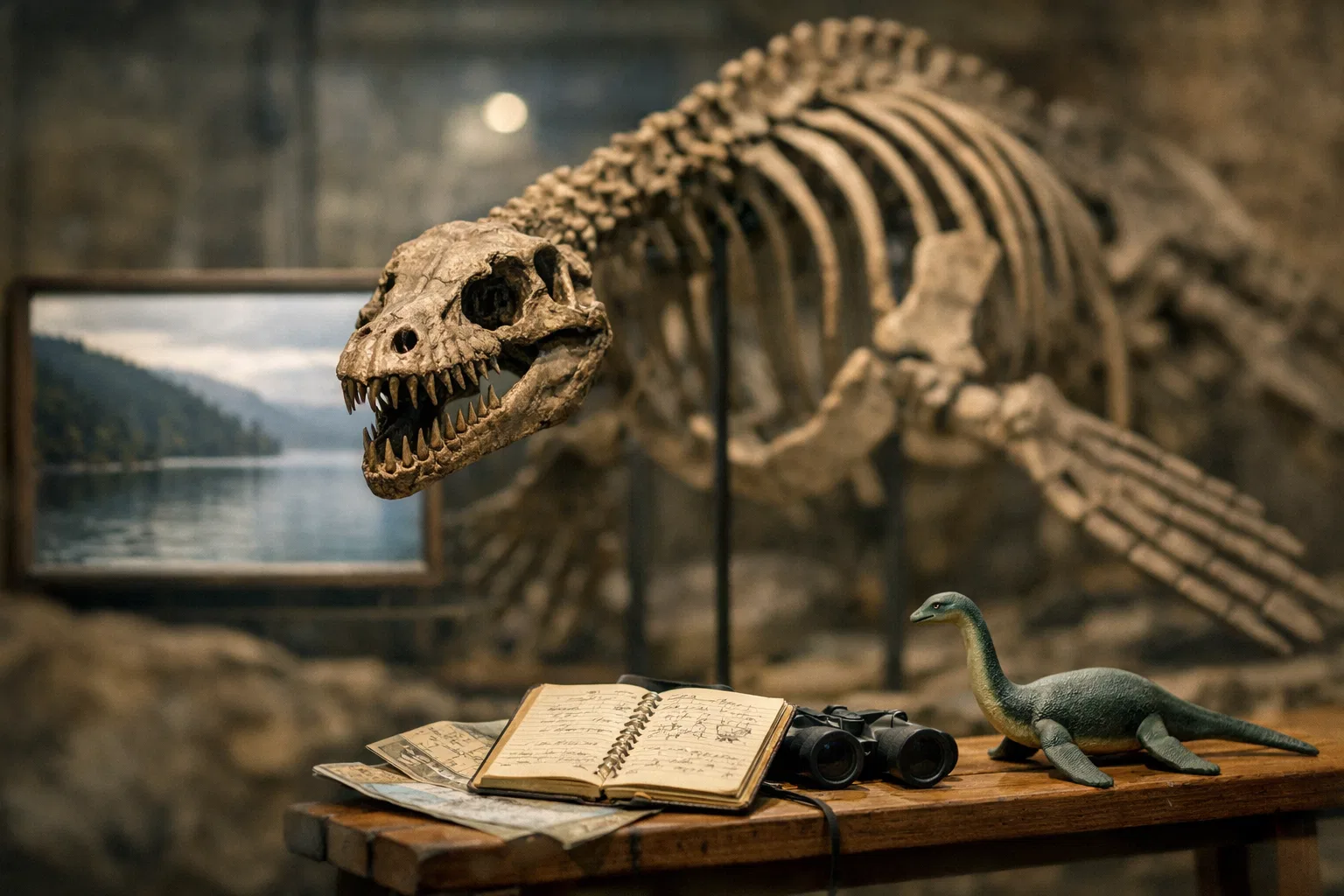
Claims about living dinosaurs, surviving plesiosaurs and other “prehistoric monsters” are among the most dramatic ideas in cryptozoology. They work because fossils give the stories a ready-made body plan: a long neck in a lake becomes a plesiosaur, a large swamp animal becomes a sauropod, and an ancient-looking fish becomes proof that anything might still be hiding. The problem is that fossil history does not remove the need for present-day evidence. A fossil can show that a lineage once existed; it cannot show that a breeding population is alive today.
The best-known examples, such as the Loch Ness Monster and mokele-mbembe, have produced stories, expeditions and cultural fascination, but not bodies, bones, tissue, clear DNA, reliable photographs or repeatable observations. Modern palaeontology also makes the claim harder, not easier: non-avian dinosaurs and plesiosaurs disappear from the reliable post-Cretaceous record, while genuine rediscoveries such as the coelacanth involve real specimens, named species and living populations, not just a resemblance to extinct animals.[National Park Service]nps.govNational Park Service Extinction EventsNational…28 Feb 2025 — Dinosaurs survived the mass extinction ・ went extinct at the end of the Cretaceous ・ these groups lasted to pra…
Why fossil survival stories appeal
The appeal begins with a real scientific fact: the fossil record is incomplete. Fossilisation is rare, erosion destroys evidence, and many habitats leave a patchy record. This gives cryptozoological survival stories a tempting opening. If palaeontologists can miss fossils, perhaps a living remnant could also be missed. The coelacanth is the classic example: it was known from ancient fossils and was thought to have disappeared tens of millions of years ago before a living specimen was recognised in 1938. Today, two living species are known, and the lineage is famous precisely because it changed scientific expectations.[Natural History Museum]nhm.ac.ukOpen source on nhm.ac.uk.
But the coelacanth is often used too loosely. It does not show that any famous prehistoric animal might plausibly survive anywhere. It shows that a deep-water fish lineage persisted in habitats humans rarely sampled, and that its survival became accepted only after a physical specimen was obtained. The living coelacanth is also not a Jurassic or Cretaceous species unchanged in time; modern coelacanths belong to a surviving lineage, while the living species themselves are distinct from the fossil forms.[Smithsonian Ocean]ocean.si.eduSmithsonian OceanCoelacanth | Smithsonian OceanIt wasn't until 1938 when a live coelacanth was caught in a fishing trawl. The first livin…
That distinction matters for cryptozoology. “This animal resembles something prehistoric” is a weak claim unless it is joined to present-day evidence. Crocodiles, horseshoe crabs, tuatara and coelacanths can look ancient to a casual observer, but they are not time travellers. They are modern organisms with evolutionary histories. The phrase “living fossil” can be useful as shorthand, but it can also mislead readers into imagining that evolution stopped for certain animals.[Wikipedia]WikipediaLiving fossilLiving fossil
Prehistoric-survivor claims also borrow authority from museum imagery. Plesiosaurs, sauropods and other extinct animals have instantly recognisable silhouettes, so an ambiguous sighting can be matched to a familiar fossil reconstruction. Yet fossil resemblance is not identification. A wake, a line of swimming birds, a floating log, a large eel, a swimming deer or an elephant glimpsed in vegetation can become “prehistoric” once witnesses, journalists or later writers apply the fossil template.
Plesiosaur and dinosaur cryptid claims
Loch Ness and the plesiosaur problem
The Loch Ness Monster is the most famous modern “surviving plesiosaur” claim. The popular image is a large animal with a long neck, small head and one or more humps, vaguely resembling an elasmosaur or other long-necked plesiosaur. That comparison became especially durable because it is visual, simple and memorable. It also fits poorly with the evidence.
Plesiosaurs were marine reptiles, not dinosaurs, and they were part of Mesozoic ocean ecosystems. The Natural History Museum describes them as major marine predators for millions of years, with different plesiosaur groups disappearing before or at the end of the Cretaceous. There is no accepted modern population of plesiosaurs, and the claim that one lives in a cold Scottish freshwater loch requires much more than an outline that resembles an old reconstruction.[Natural History Museum]nhm.ac.ukOpen source on nhm.ac.uk.
Loch Ness has also been tested in ways that older monster-hunting claims were not. In 2018, Neil Gemmell and colleagues sampled environmental DNA, or eDNA, from Loch Ness water. The public framing leaned on the monster legend, but the scientific value was broader: eDNA can reveal traces of organisms that shed cells into water. Reports from the project stated that the survey found DNA from known organisms, including abundant eel DNA, but no reptile DNA and no evidence for a prehistoric reptile.[The Guardian+2University of Otago]theguardian.comThe Guardian Loch Ness monster could be a giant eel, say scientistsThe Guardian Loch Ness monster could be a giant eel, say scientists
That does not prove that every single sighting has a known explanation. It does make the plesiosaur claim much less credible. A large air-breathing reptile population would need to feed, reproduce, surface and leave biological traces. If the answer to every negative result is that the animal was absent from the sampled place, too rare to detect, too deep to see and too elusive to photograph, the claim becomes difficult to test. In science, that is not a strength; it is a warning sign.
Mokele-mbembe and the “Congo dinosaur”
Mokele-mbembe is usually described in Western cryptozoology as a large swamp-dwelling creature in the Congo Basin, often interpreted as a surviving sauropod dinosaur. The claim has been fuelled by reports of a long neck, large body and aquatic habits. It has also been shaped by outsiders: explorers, cryptozoologists, journalists, film-makers and creationist groups have repeatedly reinterpreted local stories through the lens of dinosaurs.[EBSCO]ebsco.comOpen source on ebsco.com.
The evidence remains weak. Summaries of the case consistently note that expeditions have not produced hard physical evidence. Reports vary over whether the being is an animal, a spirit, a rhinoceros-like creature, a reptile or something else. That variability does not automatically make the tradition meaningless; oral traditions can preserve local knowledge, symbolic meaning and environmental memory. But it does make the specific claim “living sauropod” difficult to defend.[EBSCO]ebsco.comOpen source on ebsco.com.
The dinosaur framing also creates a biological mismatch. Sauropods were large land animals with enormous food needs, complex life histories and, if alive today, a need for a viable breeding population. A hidden lone survivor would not work. A population would need habitat, mates, juveniles, carcasses, dung, tracks, feeding damage and eventually discoverable remains. In a region that has seen local communities, hunters, loggers, researchers, conservation workers, satellite observation and repeated expeditions, the absence of physical evidence matters.
There is also a cultural risk in the way this claim is often handled. Some recent reporting on mokele-mbembe stresses that local traditions have been transformed by foreign monster-hunting narratives. A story that may have had spiritual, metaphorical or ecological meaning can become flattened into “Africans report a dinosaur”, which is a much poorer and more extractive reading. For a cryptozoology page, the key point is not to dismiss local testimony wholesale, but to separate cultural significance from zoological proof.[New Lines Magazine]newlinesmag.comthe congos dinosaur of discordthe congos dinosaur of discord
Fossil reality: what extinction actually implies
The fossil record does not say that every extinct lineage vanished at the exact moment of its last fossil. It does, however, provide a large-scale pattern. Non-avian dinosaurs, many marine reptiles and numerous other groups disappear at or before the Cretaceous–Palaeogene boundary around 66 million years ago. The US National Park Service’s palaeontology overview states that dinosaurs and several other groups lasted to practically the end of the Cretaceous, and then there is no good evidence for them in the following Palaeocene.[National Park Service]nps.govNational Park Service Extinction EventsNational…28 Feb 2025 — Dinosaurs survived the mass extinction ・ went extinct at the end of the Cretaceous ・ these groups lasted to pra…
That phrase “good evidence” is important. Palaeontologists know that fossils can be reworked: older bones may erode out of ancient rock and become redeposited in younger sediment. This can create misleading claims of “late-surviving” dinosaurs unless the geological context is secure. The fossil record is not accepted uncritically; it is interpreted through dating, stratigraphy, sedimentology, anatomy and comparison with other sites. A cryptid claim that relies only on “the fossil record has gaps” is therefore much weaker than it sounds.
The ecological burden of survival
Large prehistoric-survivor claims often focus on hiding, but the harder problem is living. Animals do not merely occupy space; they draw energy from ecosystems. A large predator needs prey. A large herbivore needs enough vegetation. A breeding population needs enough individuals to avoid inbreeding and random extinction. Young animals must survive. Dead animals must go somewhere. These ecological demands are why the “one monster in a lake” image is biologically weak.
For a lake cryptid, the food problem is especially direct. Loch Ness is large and deep, but size alone does not mean high productivity. Discussions of monster biomass have long turned on whether the loch could support a population of large animals. Even estimates sympathetic to unknown-animal possibilities have to face the basic arithmetic: a stable population of large predators would require a persistent food base, not just occasional fish.[lochnessproject.org]lochnessproject.orgResearch Loch NessResearch Loch Ness
Air-breathing animals add another burden. A plesiosaur-like reptile would need to surface. It would also need to reproduce, and a population would include different sizes and ages. Over decades of sightings, sonar searches, cameras, tourist boats, shoreline observation and modern phones, the evidence should improve if such animals were present. Instead, the record remains dominated by ambiguous sightings and contested images.
For swamp and forest claims such as mokele-mbembe, concealment is more plausible than in a busy lake, but the ecological burden does not disappear. A sauropod-sized animal would alter vegetation, leave tracks, produce dung, die, and be known materially to hunters and local communities. Elephants, gorillas, okapis and other elusive forest animals can be difficult to study, but they are confirmed through specimens, photographs, dung, DNA, tracks and repeated field observations. A living sauropod would not be exempt from the same evidential expectations.
This is where cryptozoology often slips from open-mindedness into special pleading. It is reasonable to say that remote habitats can hide species. It is not reasonable to give the largest, strangest and most evolutionarily surprising proposed animals the lowest evidential standard. The more extraordinary the survival claim, the more ordinary forms of evidence become necessary: tissue, bones, clear imagery, DNA, repeatable observation and ecological fit.
What would count as real evidence?
A credible prehistoric-survivor case would not need to begin with a perfect specimen, but it would need to move beyond stories and silhouettes. Different kinds of evidence would carry different weight:
- A body, skeleton or diagnostic tissue would be decisive if it could be independently examined, dated and compared with known animals.
-
Clear DNA evidence would matter if sampling, contamination control and database comparison were strong enough to identify a lineage, not merely an unknown fragment.<div class="content-enhancement content-enhancement--insight-grid" markdown="1">
- Repeated, high-quality photographs or video would help, especially if they showed anatomy from multiple angles and came with location, scale and chain-of-custody details.
- Consistent ecological traces such as tracks, dung, feeding marks, nests, eggshells or shed skin would be important if they could not be attributed to known animals.
- A plausible breeding population would be essential. A lone survivor of a Mesozoic lineage is not a viable explanation across decades or centuries.</div>
The real lesson for cryptozoology
The strongest lesson is not that all surprising animals are impossible. New species are still described, rediscoveries happen, and local knowledge has sometimes preceded scientific recognition. The lesson is that prehistoric branding can make weak evidence feel stronger than it is. A lake monster becomes more exciting when called a plesiosaur. A swamp legend becomes more dramatic when called a sauropod. A deep evolutionary lineage becomes more mysterious when called a “living fossil”. None of those labels supplies the missing animal.
For readers, the useful question is not “Could something ancient have survived somewhere?” In the broadest sense, yes: ancient lineages survive all around us, from sharks and crocodilians to coelacanths and cycads. The sharper question is: “Does this specific claim have the evidence required for this specific animal, in this specific habitat, at this specific scale?” For Loch Ness plesiosaurs and Congo Basin sauropods, the answer remains no.
That does not make the stories worthless. They reveal how people use fossils to imagine hidden nature, how local traditions can be reshaped by outsiders, and how popular culture turns palaeontology into mystery. But fossil reality cuts both ways. It gives cryptozoology some of its most memorable images, while also showing why a surviving prehistoric monster would leave more than a story behind.
Amazon book picks
Further Reading
Books and field guides related to Could Prehistoric Monsters Still Be Alive?. Use these as the next step if you want deeper reading beyond the article.
Field Guide To Bigfoot, Yeti, & Other Mystery Primates Worldwide
Provides context for survival-cryptid claims and broader cryptozoological traditions.
Abominable Science!
Directly examines claims about surviving prehistoric creatures and famous cryptids.
Cryptozoology A To Z
Covers many alleged prehistoric-survival creatures and related cases.
The Complete Dinosaur
Rating: 3.5/5 from 9 Google Books ratings
Helps readers evaluate claims involving surviving dinosaurs and ancient lineages.
eBay marketplace picks
Marketplace Samples
Live-tested eBay searches with available results related to this page.



Endnotes
1.
Source: Wikipedia
Title: Living fossil
Link:https://en.wikipedia.org/wiki/Living_fossil
2.
Source: ebsco.com
Link:https://www.ebsco.com/research-starters/science/mokele-mbembe-cryptozoology
3.
Source: lochnessproject.org
Title: Research Loch Ness
Link:https://www.lochnessproject.org/ARCHIVE%20ROOM/papershtml/loch_ness_surgeon_[sturgeon
4.
Source: Wikipedia
Link:https://en.wikipedia.org/wiki/Loch
5.
Source: Wikipedia
Title: Mokele mbembe
Link:https://en.wikipedia.org/wiki/Mokele-mbembe
6.
Source: Wikipedia
Link:https://en.wikipedia.org/wiki/Sauropoda
7.
Source: Wikipedia
Title: Loch Ness Monster
Link:https://en.wikipedia.org/wiki/Loch_Ness_Monster
8.
Source: Wikipedia
Title: Cretaceous–Paleogene extinction event
Link:https://en.wikipedia.org/wiki/Cretaceous%E2%80%93Paleogene_extinction_event
9.
Source: Wikipedia
Title: Lazarus taxon
Link:https://en.wikipedia.org/wiki/Lazarus_taxon
10.
Source: Wikipedia
Link:https://en.wikipedia.org/wiki/Plesiosaur
11.
Source: conservation.org
Title: fish story how a coelacanth discovery set off a flurry of science subterfuge
Link:https://www.conservation.org/news/fish-story-how-a-coelacanth-discovery-set-off-a-flurry-of-science-subterfuge
12.
Source: lochnessproject.org
Link:https://www.lochnessproject.org/FIELDWORKGROUNDTRUTH/eDNA%20LOCH%20NESS/eDNA%20LOCHNESS_index.html
13.
Source: ebsco.com
Link:https://www.ebsco.com/research-starters/zoology/loch-ness-monster-cryptozoology
14.
Source: nps.gov
Title: National Park Service Extinction Events
Link:https://www.nps.gov/subjects/fossils/extinction-events.htm
15.
Source: ocean.si.edu
Link:https://ocean.si.edu/ocean-life/fish/coelacanth
16.
Source: nhm.ac.uk
Link:https://www.nhm.ac.uk/discover/coelacanths-the-fish-that-outdid-the-loch-ness-monster.html
17.
Source: nhm.ac.uk
Link:https://www.nhm.ac.uk/discover/what-is-a-plesiosaur.html
18.
Source: theguardian.com
Title: The Guardian Loch Ness monster could be a giant eel, say scientists
Link:https://www.theguardian.com/science/2019/sep/05/loch-ness-monster-could-be-a-giant-eel-say-scientists
19.
Source: otago.ac.nz
Title: first edna study of loch ness points to something fishy
Link:https://www.otago.ac.nz/news/newsroom/first-edna-study-of-loch-ness-points-to-something-fishy
20.
Source: newlinesmag.com
Title: the congos dinosaur of discord
Link:https://newlinesmag.com/reportage/the-congos-dinosaur-of-discord/
21.
Source: londonzoo.org
Link:https://www.londonzoo.org/whats-here/animals/okapi
22.
Source: africamuseum.be
Title: Royal Museum for Central Africa Okapis | Royal Museum for Central Africa
Link:https://www.africamuseum.be/en/learn/[provenance
23.
Source: facebook.com
Link:https://www.facebook.com/naturalhistorymuseum/posts/its-hard-to-believe-that-these-creatures-once-inhabited-our-oceans-the-skeletons/1395191745979721/
24.
Source: facebook.com
Link:https://www.facebook.com/naturalhistorymuseum/posts/this-fish-swam-so-far-under-the-radar-for-66-million-years-people-thought-it-was/870335748465326/
25.
Source: merriam-webster.com
Link:https://www.merriam-webster.com/dictionary/loch
26.
Source: nhm.org
Link:https://nhm.org/press/plesiosaur
27.
Source: creation.com
Link:https://creation.com/en/articles/okapi
28.
Source: nps.gov
Title: Mass Extinctions Through Geologic Time
Link:https://www.nps.gov/subjects/fossils/mass-extinctions-through-geologic-time.htm
Additional References
29.
Source: youtube.com
Title: The Speculative Evolution of the Loch Ness Monster
Link:http://www.youtube.com/watch?v=obTvy_Un878
30.
Source: youtube.com
Title: Truth is Scarier than Fiction
Link:https://www.youtube.com/watch?v=JOQoiHNRfnw&list=PLejN8i5OvgzGuSU8hQuxFPYVHvs1kKFEM
31.
Source: youtube.com
Title: Cryptid Profile: Mokele-mbembe and the “Lost” Dinosaurs of the Congo
Link:http://www.youtube.com/watch?v=TI_9mN8JzpI
32.
Source: youtube.com
Title: After 90 Years, The Loch Ness Monster Debate Is Over
Link:http://www.youtube.com/watch?v=9cZ8SQBnYDk
33.
Source: youtube.com
Title: Living Fossils, Evolution, and Cryptids
Link:http://www.youtube.com/watch?v=ebb47QvvAKg
34.
Source: youtube.com
Title: The Coelacanth and the Problem with Cryptozoology
Link:http://www.youtube.com/watch?v=xxfbIqNnQ_c
35.
Source: researchgate.net
Link:https://www.researchgate.net/publication/390620130_The_Loch_Ness_Monster_If_It%27s_Real_Could_It_Be_an_Eel
36.
Source: brill.com
Link:https://brill.com/downloadpdf/display/title/5607.pdf?srsltid=AfmBOorWpD8NGPJKwgZSqwbfay-ECS7mXRulgWsj0AJE0g7kvUXBqimF
37.
Source: instagram.com
Link:https://www.instagram.com/p/DTb-kyyDktY/
38.
Source: reddit.com
Link:https://www.reddit.com/r/pics/comments/hfkpk4/adrian_shine_the_head_of_the_loch_ness_monster/
Topic Tree