Within Populations
What Counts as Hard Evidence for Hidden Animals?
Wildlife monitoring standards separate strong evidence such as DNA and carcasses from sightings that cannot carry major claims alone.
On this page
- Why monitoring systems grade evidence
- DNA, dead animals, GPS and high quality images
- Where eyewitness reports fit in the hierarchy
Page outline Jump by section
Introduction
Claims about hidden or disputed animals often focus on sightings: someone reports seeing a large ape, a mysterious lake creature, or an unexpected predator. Wildlife agencies, however, do not evaluate such claims primarily through witness testimony. Large-carnivore monitoring has developed formal evidence hierarchies that distinguish observations that can be independently verified from those that cannot. These systems provide a practical model for cryptozoology because they deal with rare, elusive and sometimes controversial animals that are genuinely difficult to detect. The key lesson is simple: extraordinary claims about breeding populations require evidence that can be checked, preserved and re-examined. In modern wildlife governance, DNA samples, carcasses, telemetry records and unambiguous images carry far more weight than even sincere eyewitness reports.[lciepub.nina.no]lciepub.nina.noMonitoring standards for large carnivores in EuropeOctober 23, 2025 — C1: Hard evidence = hard fact i.e., evidence that unambiguously confirms the presence of a target species (live captur…
Why Monitoring Systems Grade Evidence
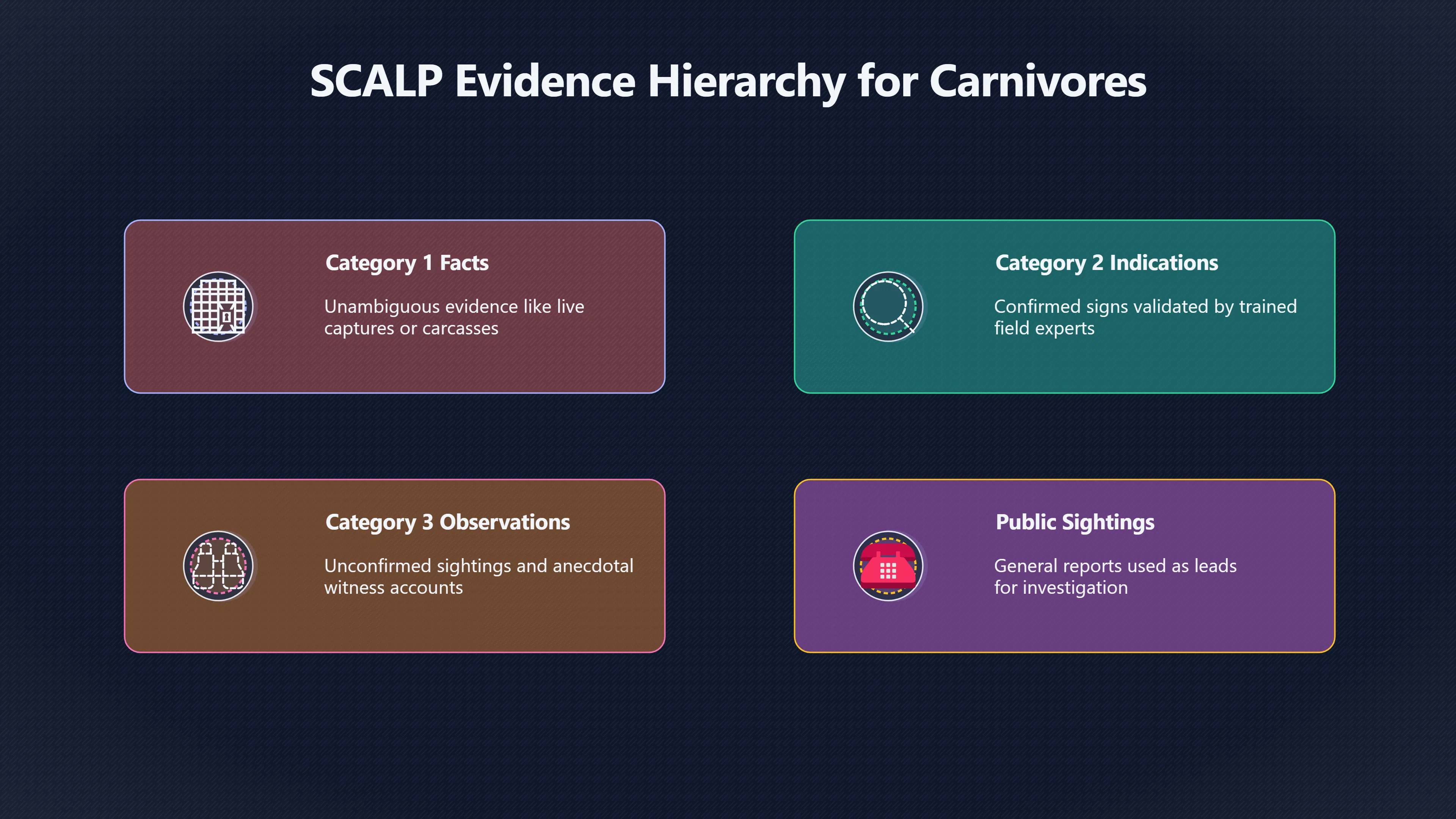
Large carnivores such as wolves, lynx, bears and wolverines are often elusive, wide-ranging and active in remote landscapes. Because mistaken identifications are common, European monitoring programmes have developed standardised evidence categories rather than treating all reports equally. The best-known examples are the SCALP criteria (originally developed for lynx monitoring in the Alps) and the related standards used by the Large Carnivore Initiative for Europe (LCIE).[dbb-wolf.de+2lciepub.nina.no]dbb-wolf.deSCALP CriteriaC1: clear evidence = hard facts that clearly verify the presence of the respective animal species (live capture, animal fou…
These systems generally divide records into three broad levels:<div class="content-enhancement content-enhancement--insight-grid" markdown="1">
- Category 1 (C1): Hard facts or clear evidence.[dbb-wolf.de]dbb-wolf.deSCALP CriteriaC1: clear evidence = hard facts that clearly verify the presence of the respective animal species (live capture, animal fou…
- Category 2 (C2): Confirmed indications validated by trained experts.
- Category 3 (C3): Unconfirmed observations.[kora.ch+2ResearchGate]kora.chSCALP categoriesC1 – clear evidence: wolves found dead, photos and videos in which wolves are clearly recognisable, live captures and gen…</div>
The purpose is not to dismiss witnesses. Rather, it is to separate evidence that can independently demonstrate an animal’s presence from evidence that depends heavily on interpretation. A photograph, DNA profile or recovered body can be examined repeatedly by different experts. A fleeting visual encounter usually cannot.[lciepub.nina.no]lciepub.nina.noMonitoring standards for large carnivores in EuropeOctober 23, 2025 — C1: Hard evidence = hard fact i.e., evidence that unambiguously confirms the presence of a target species (live captur…
This distinction matters when the claim involves a breeding population. Conservation authorities may record thousands of public reports, but population estimates, management decisions and legal protections are generally built on verifiable evidence streams rather than sighting counts alone.[kora.ch]kora.chOpen source on kora.ch.
Which Evidence Counts as a Hard Fact?
Under modern large-carnivore standards, the strongest evidence is evidence that directly establishes the identity of the animal without relying primarily on personal judgement.<div class="youtube-embed-container youtube-embed-fallback youtube-embed-link-only"><div class="youtube-embed-card"><div class="youtube-embed-link-panel">Genomic tools for conservation of species: a practitioner's guide - Part II</div><div class="youtube-embed-footer"><p class="youtube-embed-title">Genomic tools for conservation of species: a practitioner's guide - Part II</p><p class="youtube-embed-actions">Open on YouTube</p></div></div></div>
DNA Evidence
Genetic evidence has become one of the most important tools in carnivore monitoring. DNA can be obtained from hair, scat, saliva left on prey, blood, tissue or urine. Proper laboratory analysis can identify the species and, in many cases, the individual animal. This allows researchers to estimate population size, track dispersal and confirm reproduction.[Life Wolfalps EU]lifewolfalps.euLife Wolfalps EUTHE INTEGRATED MONITORING OF THE WOLF ALPINEThe collection of genetic material (from scat, hair, blood, urine and saliva collected…Read more…
For cryptozoological claims, this standard is significant because a genuinely unknown large mammal should eventually leave recoverable genetic material. A DNA sequence that clearly does not match known species would represent a major scientific discovery. By contrast, many alleged cryptid hair samples and biological traces have ultimately been identified as known animals when subjected to genetic testing.
Dead Animals and Physical Remains
A carcass is often treated as definitive evidence. Monitoring standards repeatedly classify a dead animal among the strongest forms of confirmation because researchers can inspect anatomy, collect tissue samples and preserve specimens for future study.[lciepub.nina.no+2dbb-wolf.de]lciepub.nina.noMonitoring standards for large carnivores in EuropeOctober 23, 2025 — C1: Hard evidence = hard fact i.e., evidence that unambiguously confirms the presence of a target species (live captur…
This is one reason large-animal cryptid claims face a substantial burden of proof. Breeding populations experience mortality. Animals die from disease, predation, accidents, starvation and old age. Over long periods, populations normally produce bones, teeth, tissue and other physical remains. The absence of such material becomes increasingly difficult to explain as the claimed population size increases.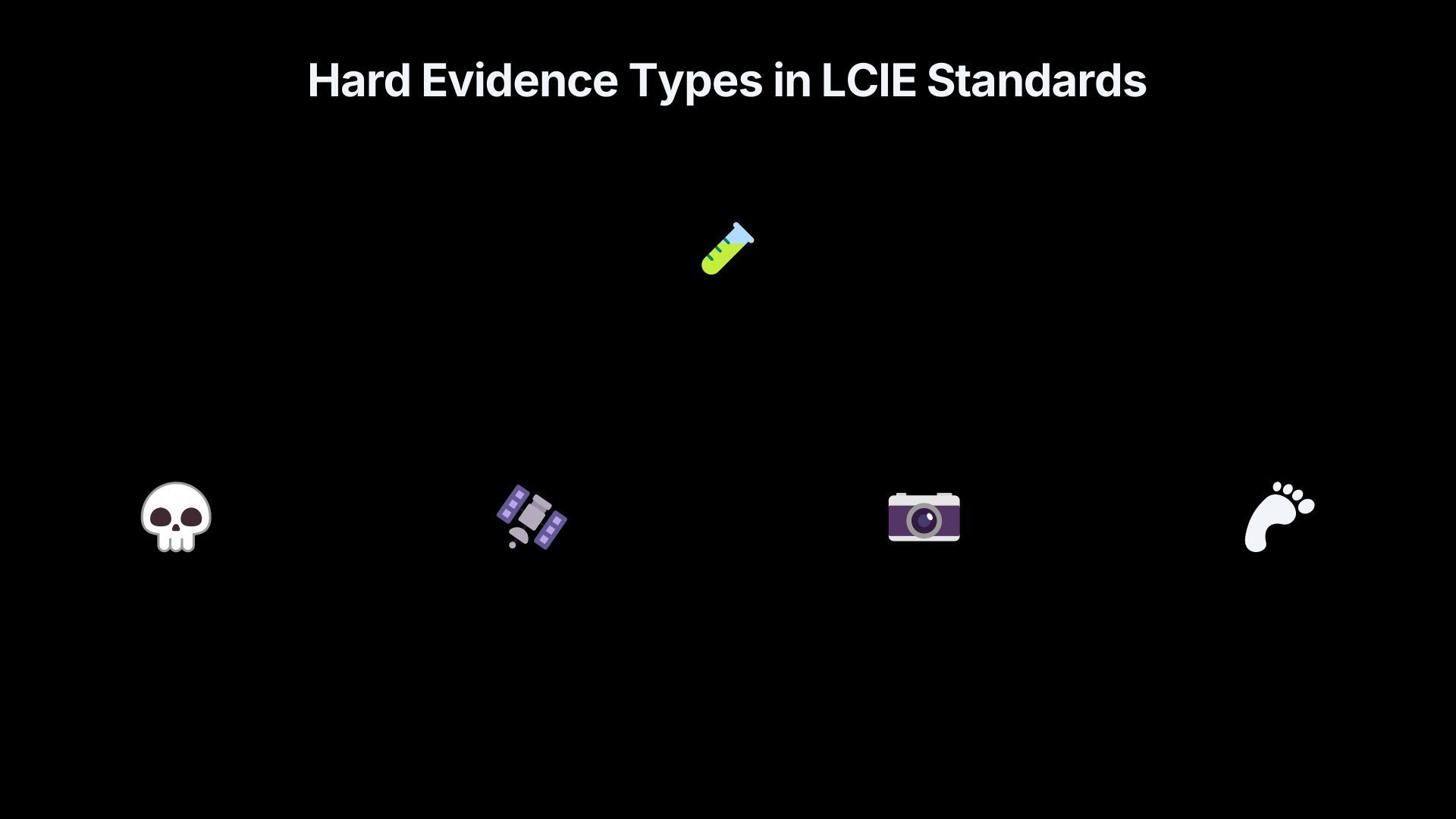
Telemetry and GPS Data
Telemetry refers to tracking animals through radio collars, GPS devices or similar systems. Because location data are automatically recorded and independently verifiable, telemetry records are commonly placed within the highest evidence category.[lciepub.nina.no+2dbb-wolf.de]lciepub.nina.noMonitoring standards for large carnivores in EuropeOctober 23, 2025 — C1: Hard evidence = hard fact i.e., evidence that unambiguously confirms the presence of a target species (live captur…
Although telemetry is usually used after an animal has already been captured and identified, its inclusion in monitoring standards illustrates a broader principle: evidence becomes stronger when it can be objectively recorded and independently checked.
High-Quality Photographs and Video
Not all images are equal. Monitoring systems typically recognise only photographs or videos in which the animal is clearly identifiable. Blurry silhouettes, distant shapes and ambiguous images are often downgraded or excluded.[kora.ch]kora.chSCALP categoriesC1 – clear evidence: wolves found dead, photos and videos in which wolves are clearly recognisable, live captures and gen…
This point is especially relevant to cryptozoology. Many famous cryptid photographs remain controversial precisely because they lack the clarity needed for reliable species identification. Wildlife agencies routinely reject comparable imagery when assessing real carnivore records. The standard is not whether an image is intriguing, but whether experts can confidently determine what it shows.<div class="youtube-embed-container youtube-embed-fallback youtube-embed-link-only"><div class="youtube-embed-card"><div class="youtube-embed-link-panel">Wolf conservation and management under the EU Action Plan | Nicola Notaro</div><div class="youtube-embed-footer"><p class="youtube-embed-title">Wolf conservation and management under the EU Action Plan | Nicola Notaro</p><p class="youtube-embed-actions">Open on YouTube</p></div></div></div>
What Happens to Tracks, Scat and Kill Sites?
Many field signs occupy an intermediate category. Tracks in snow, livestock kills, scratch marks, dens and scats can provide valuable information, but their reliability depends heavily on documentation and expert evaluation.[lciepub.nina.no+2dbb-wolf.de]lciepub.nina.noMonitoring standards for large carnivores in EuropeOctober 23, 2025 — C1: Hard evidence = hard fact i.e., evidence that unambiguously confirms the presence of a target species (live captur…
A trained investigator may confirm that a particular track pattern or kill site is consistent with a wolf, lynx or bear. Such records are often classified as confirmed observations rather than hard facts. They contribute to monitoring programmes but do not carry the same evidential weight as DNA or a carcass.[dbb-wolf.de+2kora.ch]dbb-wolf.deSCALP CriteriaC1: clear evidence = hard facts that clearly verify the presence of the respective animal species (live capture, animal fou…
The distinction reflects a practical reality: indirect signs can be misidentified. Large dog tracks may resemble wolf tracks. Scat can be confused between species. Livestock injuries may have multiple possible causes. Expert review reduces error but does not eliminate it.[kora.ch]kora.chSCALP categoriesC1 – clear evidence: wolves found dead, photos and videos in which wolves are clearly recognisable, live captures and gen…
For disputed animals, field signs become most persuasive when they lead to stronger evidence. A footprint that directs researchers to hair, DNA or camera-trap imagery has far greater value than a footprint that remains an isolated observation.
Where Eyewitness Reports Fit in the Hierarchy
Eyewitness reports are not ignored in wildlife management. In many regions they help identify areas that deserve further investigation. Public observations can alert authorities to newly arrived animals, possible breeding activity or unusual movements.[ResearchGate]researchgate.netResearchGate(PDF) Monitoring of Large Carnivores in GermanyHard evidence = Hard fact, i.e. evidence, that unambiguously confirms the pres…
However, monitoring systems consistently place unaided visual sightings near the bottom of the evidence hierarchy. SCALP classifications, for example, commonly treat undocumented sightings as unconfirmed records. Even photographs may remain unconfirmed if image quality is poor.[kora.ch]kora.chSCALP categoriesC1 – clear evidence: wolves found dead, photos and videos in which wolves are clearly recognisable, live captures and gen…
This approach reflects decades of experience. People frequently misjudge size, distance, lighting and species identity. Honest observers can make mistakes, especially during brief encounters or stressful situations. Wildlife agencies therefore use sightings as leads rather than proof.[dbb-wolf.de]dbb-wolf.deSCALP CriteriaC1: clear evidence = hard facts that clearly verify the presence of the respective animal species (live capture, animal fou…
In cryptozoology, this creates a sharp contrast between popular discussion and scientific assessment. Public debate often centres on the number of witnesses. Monitoring frameworks focus instead on whether the reports generate independently verifiable evidence.<div class="youtube-embed-container youtube-embed-fallback youtube-embed-link-only"><div class="youtube-embed-card"><div class="youtube-embed-link-panel">Tracking the Gray Wolf in Yellowstone | Explorer</div><div class="youtube-embed-footer"><p class="youtube-embed-title">Tracking the Gray Wolf in Yellowstone | Explorer</p><p class="youtube-embed-actions">Open on YouTube</p></div></div></div>
What Large-Carnivore Standards Mean for Cryptid Claims
The governance lesson from large-carnivore monitoring is straightforward. A claim that a hidden population of large animals exists is not tested primarily by counting stories. It is tested by looking for the forms of evidence that established wildlife populations routinely leave behind.[lciepub.nina.no]lciepub.nina.noMonitoring standards for large carnivores in EuropeOctober 23, 2025 — C1: Hard evidence = hard fact i.e., evidence that unambiguously confirms the presence of a target species (live captur…
Modern monitoring programmes combine genetics, camera traps, carcass recovery, telemetry and expert validation because no single method is perfect. Yet all of these methods share an important feature: they create records that other investigators can inspect and verify.[Life Wolfalps EU+2kora.ch]lifewolfalps.euLife Wolfalps EUTHE INTEGRATED MONITORING OF THE WOLF ALPINEThe collection of genetic material (from scat, hair, blood, urine and saliva collected…Read more…
For cryptozoological claims involving large mammals or large predators, the ecological burden of proof therefore resembles the burden applied to wolves, bears and lynx. A breeding population should eventually produce hard evidence. Until such evidence appears, eyewitness reports may justify curiosity and investigation, but they do not meet the evidential standards that wildlife monitoring systems use to confirm the existence of elusive animals.[lciepub.nina.no+2dbb-wolf.de]lciepub.nina.noMonitoring standards for large carnivores in EuropeOctober 23, 2025 — C1: Hard evidence = hard fact i.e., evidence that unambiguously confirms the presence of a target species (live captur…
Amazon book picks
Further Reading
Books and field guides related to What Counts as Hard Evidence for Hidden Animals?. Use these as the next step if you want deeper reading beyond the article.
Abominable Science!
Examines what counts as convincing evidence for extraordinary animal claims.
Forensic DNA Typing
Explains why genetic evidence carries such weight in species identification.
eBay marketplace picks
Marketplace Samples
Live-tested eBay searches with available results related to this page.



Endnotes
1.
Source: lciepub.nina.no
Title: Monitoring standards for large carnivores in Europe
Link:https://lciepub.nina.no/pdf/638988265540892975_LCIE_Monitoring%20Standards_10_2025.pdf
2.
Source: dbb-wolf.de
Link:https://www.dbb-wolf.de/wolf-management//scalp-criteria
3.
Source: kora.ch
Link:https://www.kora.ch/en/projects/large-carnivore-monitoring/scalp-categories
4.
Source: researchgate.net
Link:https://www.researchgate.net/publication/278122494_Monitoring_the_Lynx_in_the_Alps
5.
Source: kora.ch
Link:https://www.kora.ch/en/projects/large-carnivore-monitoring/what-is-monitoring
6.
Source: researchgate.net
Link:https://www.researchgate.net/publication/259620593_Monitoring_of_Large_Carnivores_in_Germany
7.
Source: carnivores.eu
Link:https://carnivores.eu/en/pdf/787
8.
Source: lcie.org
Link:https://www.lcie.org/Publications
9.
Source: lifewolfalps.eu
Title: Life Wolfalps EUTHE INTEGRATED MONITORING OF THE WOLF ALPINE
Link:https://www.lifewolfalps.eu/wp-content/uploads/2022/05/A5_-LWA_WAG_Monitoring-Standards-of-the-Wolf-alpine-population.pdf
Additional References
10.
Source: endangeredlandscapes.org
Link:https://www.endangeredlandscapes.org/news/from-deterrence-to-dna-how-carnivore-monitoring-is-shaping-smarter-conservation/
11.
Source: environment.ec.europa.eu
Link:https://environment.ec.europa.eu/news/practical-support-handbook-monitoring-large-carnivores-dinaric-balkan-pindos-region-2025-06-18_en
12.
Source: europarc.org
Link:https://www.europarc.org/wp-content/uploads/2017/02/Kaczensky_et_al_2013_Status_management_and_distribution_of_large_carnivores_in_Europe_1.pdf
13.
Source: wilknet.pl
Link:https://wilknet.pl/user-data/downloads/2015%20Joint%20Wolf%20Monitoring%20Standards%20DE%26PL_BfNSkript398.pdf
14.
Source: europarc.org
Link:https://www.europarc.org/wp-content/uploads/2017/02/Kaczensky_et_al_2013_Status_management_and_distribution_of_large_carnivores_in_Europe_2.pdf
15.
Source: ofb.hal.science
Title: dead animals, DNA, verified camera trap images);
Link:https://ofb.hal.science/hal-05111247/file/Kaczensky%20et%20al.%202024%20Rapport%20LCIE.pdf
16.
Source: programme2014-20.interreg-central.eu
Title: eu Good-practice-of-lynx-monitor-and-conserv
Link:https://programme2014-20.interreg-central.eu/Content.Node/Good-practice-of-lynx-monitor-and-conserv.pdf
17.
Source: carpathianconvention.org
Title: BOKU Report LC Carnivore Monitoring
Link:https://www.carpathianconvention.org/tl_files/carpathiancon/Downloads/03%20Meetings%20and%20Events/Working%20Groups/Biodiversity/12%20meeting/BOKU%20Report%20LC%20Carnivore%20Monitoring.pdf
18.
Source: progettolinceitalia.it
Title: SCALPplus monitoring report 2023
Link:https://www.progettolinceitalia.it/wp-content/uploads/2026/04/SCALPplus-monitoring-report-2023.pdf
19.
Source: storymaps.arcgis.com
Link:https://storymaps.arcgis.com/stories/1f378c6b268c45419a5d38d29fc9a799
Topic Tree