Within New Species
Why New Species Are Usually Tiny
Most new animals are small, hard to identify, and easy to miss, which makes them very different from famous large cryptids.
On this page
- Why body size changes discovery odds
- Insects, parasites, fungi, and small reptiles
- What size means for cryptid claims
Page outline Jump by section
Introduction
The fact that scientists continue to discover new species is often cited in discussions about cryptozoology. However, the overwhelming majority of these discoveries are not giant animals hiding in well-known landscapes. They are usually tiny organisms: insects, mites, parasitic worms, fungi, small reptiles, obscure fish, and species that look almost identical to already known animals. The reason is not mysterious. Small body size dramatically increases the chances that a species can remain overlooked, while large animals leave far more evidence of their existence. Modern taxonomy therefore tends to reveal hidden biodiversity at the small end of the size spectrum rather than confirming famous monster claims.[PLOS]journals.plos.orgHow Many Species Are There on Earth and in the Ocean?by C Mora · 2011 · Cited by 4416 — Our results suggest that some 86% of existing… Understanding this difference helps explain why “new species are discovered every year” is true without making reports of Bigfoot, lake monsters, or surviving prehistoric giants equally plausible.
Why Body Size Changes Discovery Odds
Body size is one of the strongest predictors of how easily a species can escape notice.
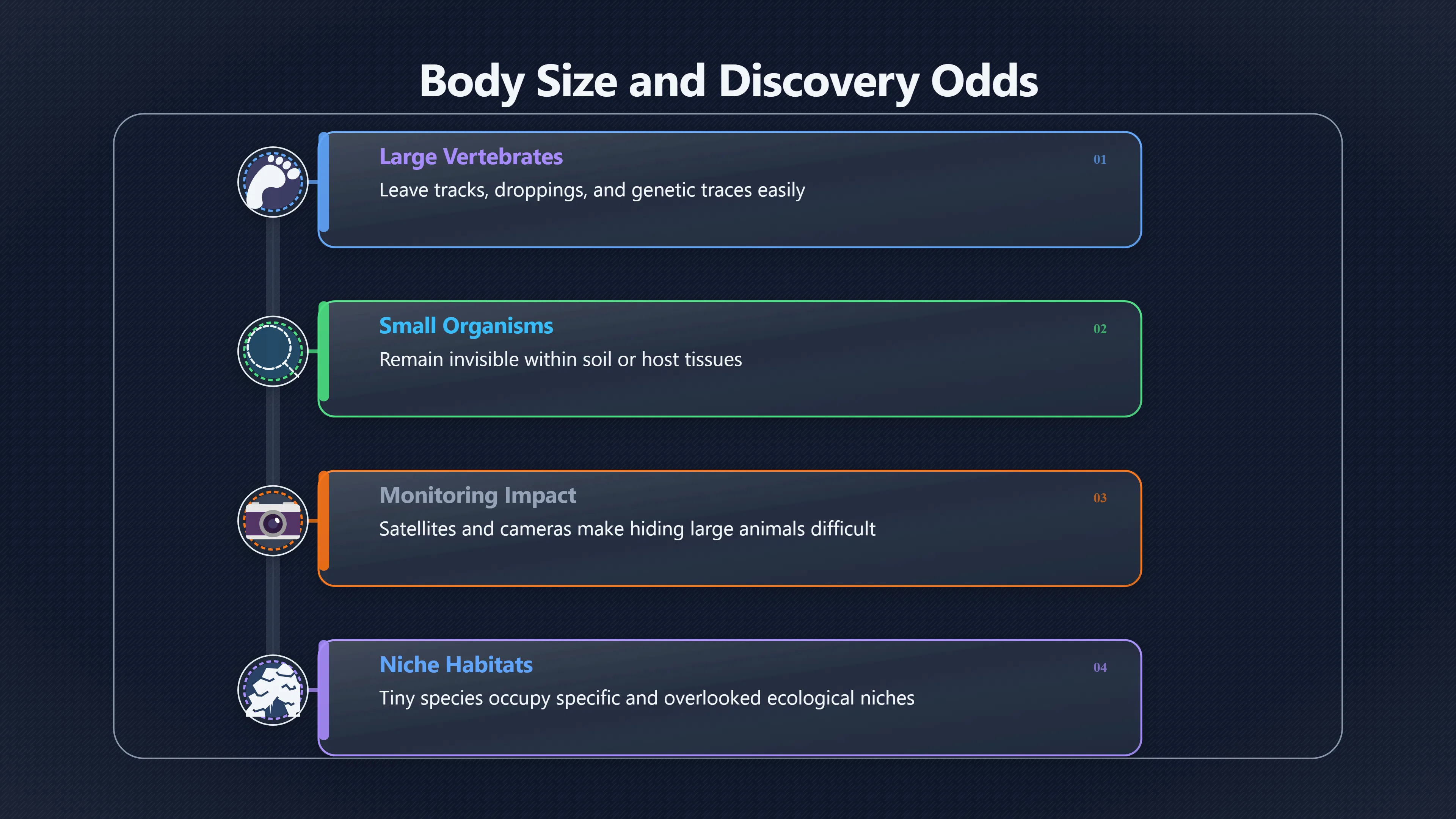
Large animals require food, water, territory, and breeding populations. They leave tracks, droppings, carcasses, nests, feeding damage, roadkill, camera-trap images, and genetic traces. In regions that are heavily populated, surveyed, photographed, and increasingly monitored by satellites and automated cameras, maintaining a hidden population of large vertebrates becomes difficult.
Tiny organisms operate under different rules. A beetle can spend its entire life inside a single tree. A parasitic wasp may be only a few millimetres long. A microscopic fungus can live within soil, leaf litter, or a host organism without attracting attention. Such species may be abundant in their own ecological niche while remaining effectively invisible to casual observers.[Microsoft]microsoft.comwhat we know and dont know about earths missing biodiversityWhat we know and don't know about earth's missing…Jan 1, 2012 — Estimates of non-microbial diversity on Earth range from 2 mi…
The challenge is not merely finding these organisms. Scientists must also determine whether they represent a species already known to science. For many groups, this requires specialist microscopy, anatomical comparison, genetic sequencing, and examination of museum collections. Formal species description is often the slowest step in the process.[naturalsciences.be]naturalsciences.bedocument its unique traits, give it a name…Read more…
A useful contrast is that an undiscovered large mammal usually requires a hidden population, whereas an undiscovered insect may require only a taxonomist noticing a subtle difference in wing veins or DNA.
Insects, Parasites, Fungi, and Small Reptiles
The groups that dominate species discovery are precisely those where small size and specialised lifestyles make detection difficult.
Insects and Other Tiny Arthropods
Insects are the most diverse animal group on Earth. Roughly 900,000 insect species have been described, but estimates of total diversity range far higher, with millions still potentially unnamed. Recent research suggests that scientists are currently describing thousands of new insect species every year.[Smithsonian Institution+2University of Arizona News]si.eduThis representation approximates 80 percent of the world's species. The true figure…Read more…
Many live in places that humans rarely inspect closely:<div class="content-enhancement content-enhancement--phrase-pills" markdown="1">
- Rainforest canopies
- Soil and leaf litter
- Cave systems
- Host plants
- Dead wood
- Freshwater sediments</div>
Even when specimens are collected, they may sit in museum drawers for decades before receiving formal study. A striking recent example involved a tiny parasitic wasp collected in Chile in 1983 that remained undescribed until researchers recognised it as a distinct genus and species more than forty years later.[The Guardian]theguardian.comThe wasp, Attenboroughnculus tau, measures just 3.5mm in length and is notable for a distinctive T-shaped mark on its abdomen. Though col…
Parasites and Symbionts
Parasites represent another major source of hidden biodiversity. Many organisms host species that are highly specialised to a particular animal or plant. Researchers studying global biodiversity have noted that parasites, mites, nematodes, fungi, and other symbionts associated with insects alone may account for enormous numbers of undescribed species.[ScienceDaily]sciencedaily.comA new estimate of biodiversity on EarthAug 30, 2017 — They then reviewed all groups of organisms associated with insects as p…
These organisms are easy to miss because discovering them often requires finding the host first, then examining tissues, body surfaces, or microscopic structures.
Fungi
Fungi provide one of the clearest examples of why undiscovered life is usually small. Only a fraction of fungal diversity has been formally named. Estimates vary, but researchers consistently conclude that known fungi represent a small share of total fungal species. Many fungi exist as microscopic filaments in soil, wood, roots, or living hosts.[PMC]pmc.ncbi.nlm.nih.govPMCHow many species are there on Earth?Progress and problemsby JJ Wiens · 2023 · Cited by 118 — Using this approach, they estimated that there are about 7.8 million animal spec…
As molecular techniques improve, entirely new fungal lineages continue to emerge from samples that would once have appeared ordinary. Their existence does not require hidden forests full of giant organisms; it requires looking more carefully at environments already under our feet.
Small Reptiles and Other Overlooked Vertebrates
Not all discoveries are microscopic. Small vertebrates are still found regularly, especially in tropical forests, mountain regions, and islands. Examples include miniature geckos, skinks, frogs, and tiny fish. These animals can remain overlooked because they occupy restricted habitats, resemble known species, or are active only at particular times.[The Guardian]theguardian.comThe Guardian Who's the smallest of them all?Meet the world's amazing tiniest creaturesFebruary 8, 2024 — The article explores some of the world's smallest creatures, providing insig…
In many cases, researchers only recognise them after genetic analysis reveals that what seemed to be one widespread species is actually several distinct species.
Hidden Species That Do Not Look New
Another reason small species dominate discovery is the prevalence of so-called cryptic species.
A cryptic species is a real biological species that closely resembles another species. Two populations may appear nearly identical to the human eye while differing genetically, behaviourally, or reproductively. Advances in DNA barcoding and molecular taxonomy have revealed many such cases across insects, reptiles, birds, fungi, and other groups.[The Guardian]theguardian.comThe Guardian Discovery of 'cryptic species' shows Earth is even moreThe GuardianDiscovery of 'cryptic species' shows Earth is even more…December 25, 2020 — 25 Dec 2020 — The discovery of these cryptic s…
This process often increases biodiversity counts without requiring the discovery of any conspicuous new animal. Scientists may reclassify one familiar-looking species into several separate species after analysing genetics and anatomy.
For the public, this can seem less dramatic than finding a giant unknown beast. Scientifically, however, it is one of the most important sources of modern species discovery.
What Size Means for Cryptid Claims
The pattern of species discovery matters because it changes how zoologists evaluate cryptid reports.
Finding a new species is not unusual. Finding a large, breeding population of an undiscovered mammal in a well-studied region is unusual. The evidential burden rises with body size because larger animals generate more observable traces.
This does not mean large animals are never discovered. Occasionally, sizeable vertebrates are formally described or documented in greater detail, particularly in remote regions. However, these cases usually involve animals already represented by specimens, local knowledge, photographs, or previous scientific records rather than creatures known only from folklore and ambiguous sightings.[The Sun]thesun.co.ukNative to the high-altitude regions of New Guinea, these elusive nocturnal creatures can grow up to 85 cm long and weigh around 2 kg—thre…
The contrast can be summarised simply:<div class="content-enhancement content-enhancement--insight-grid" markdown="1">
- Tiny species are easy to overlook and hard to identify.
- Large species are harder to overlook and easier to detect.
- Modern discoveries overwhelmingly arise from the first category.</div>
See on Amazon</a></div></div></article><article class="fr-book-card"><a class="fr-book-cover" href="https://www.amazon.com/s?k=The+Variety+of+Life+by+Colin+Tudge&i=stripbooks&tag=searcht-20" target="_blank" rel="sponsored noopener noreferrer" aria-label="Open The Variety of Life on Amazon"><span class="fr-book-cover-fallback">Book</span><img class="fr-book-cover-thumb" src="https://books.google.com/books/content?id=IlvQwAEACAAJ&printsec=frontcover&img=1&zoom=1&source=gbs_api" alt="Cover for The Variety of Life" loading="lazy" decoding="async" fetchpriority="low" referrerpolicy="no-referrer" onerror="this.hidden=true;this.closest('.fr-book-cover').classList.add('fr-book-cover-placeholder');"></a><div class="fr-book-info"><h4 class="fr-book-title"><a href="https://www.amazon.com/s?k=The+Variety+of+Life+by+Colin+Tudge&i=stripbooks&tag=searcht-20" target="_blank" rel="sponsored noopener noreferrer" title="The Variety of Life">The Variety of Life</a></h4><p class="fr-book-author">By Colin Tudge</p><p class="fr-book-desc">Explains why immense diversity exists among small organisms.</p><div class="fr-book-actions"><a href="https://www.amazon.com/s?k=The+Variety+of+Life+by+Colin+Tudge&i=stripbooks&tag=searcht-20" class="fr-amazon-btn" target="_blank" rel="sponsored noopener noreferrer">
See on Amazon</a></div></div></article><article class="fr-book-card"><a class="fr-book-cover" href="https://www.amazon.com/s?k=Endless+Forms+by+Seirian+Sumner&i=stripbooks&tag=searcht-20" target="_blank" rel="sponsored noopener noreferrer" aria-label="Open Endless Forms on Amazon"><span class="fr-book-cover-fallback">Book</span><img class="fr-book-cover-thumb" src="https://books.google.com/books/content?id=pHlHEAAAQBAJ&printsec=frontcover&img=1&zoom=1&source=gbs_api" alt="Cover for Endless Forms" loading="lazy" decoding="async" fetchpriority="low" referrerpolicy="no-referrer" onerror="this.hidden=true;this.closest('.fr-book-cover').classList.add('fr-book-cover-placeholder');"></a><div class="fr-book-info"><h4 class="fr-book-title"><a href="https://www.amazon.com/s?k=Endless+Forms+by+Seirian+Sumner&i=stripbooks&tag=searcht-20" target="_blank" rel="sponsored noopener noreferrer" title="Endless Forms">Endless Forms</a></h4><p class="fr-book-author">By Seirian Sumner</p><p class="fr-book-desc">Highlights the kinds of small organisms that are still being discovered.</p><div class="fr-book-actions"><a href="https://www.amazon.com/s?k=Endless+Forms+by+Seirian+Sumner&i=stripbooks&tag=searcht-20" class="fr-amazon-btn" target="_blank" rel="sponsored noopener noreferrer">
See on Amazon</a></div></div></article><article class="fr-book-card"><a class="fr-book-cover" href="https://www.amazon.com/s?k=Entangled+Life+by+Merlin+Sheldrake&i=stripbooks&tag=searcht-20" target="_blank" rel="sponsored noopener noreferrer" aria-label="Open Entangled Life on Amazon"><span class="fr-book-cover-fallback">Book</span><img class="fr-book-cover-thumb" src="https://books.google.com/books/content?id=OuupDwAAQBAJ&printsec=frontcover&img=1&zoom=1&source=gbs_api" alt="Cover for Entangled Life" loading="lazy" decoding="async" fetchpriority="low" referrerpolicy="no-referrer" onerror="this.hidden=true;this.closest('.fr-book-cover').classList.add('fr-book-cover-placeholder');"></a><div class="fr-book-info"><h4 class="fr-book-title"><a href="https://www.amazon.com/s?k=Entangled+Life+by+Merlin+Sheldrake&i=stripbooks&tag=searcht-20" target="_blank" rel="sponsored noopener noreferrer" title="Entangled Life">Entangled Life</a></h4><p class="fr-book-author">By Merlin Sheldrake</p><p class="fr-book-desc">Demonstrates how overlooked small life forms dominate undiscovered biodiversity.</p><div class="fr-book-actions"><a href="https://www.amazon.com/s?k=Entangled+Life+by+Merlin+Sheldrake&i=stripbooks&tag=searcht-20" class="fr-amazon-btn" target="_blank" rel="sponsored noopener noreferrer">
See on Amazon</a></div></div></article></div><div class="fr-section-footer"><div class="fr-browse-links" aria-label="Browse more on Amazon"><span class="fr-browse-links-label">Browse more on Amazon:</span><a class="fr-browse-more" href="https://www.amazon.com/s?k=The+Species+Seekers%3A+Heroes%2C+Fools%2C+and+the+Mad+Pursuit+of+Life+on+Earth&i=stripbooks&tag=searcht-20" target="_blank" rel="sponsored noopener noreferrer">The Species Seekers: Heroes, Fools, and the Mad Pursuit of Life on Earth</a><a class="fr-browse-more" href="https://www.amazon.com/s?k=The+Variety+of+Life&i=stripbooks&tag=searcht-20" target="_blank" rel="sponsored noopener noreferrer">The Variety of Life</a><a class="fr-browse-more" href="https://www.amazon.com/s?k=Endless+Forms&i=stripbooks&tag=searcht-20" target="_blank" rel="sponsored noopener noreferrer">Endless Forms</a></div><p class="fr-disclosure">As an Amazon Associate I earn from qualifying purchases.</p></div></div></section>
Amazon book picks
Further Reading
Books and field guides related to Why New Species Are Usually Tiny. Use these as the next step if you want deeper reading beyond the article.
The Species Seekers: Heroes, Fools, and the Mad Pursuit of Li...
Covers real-world species discovery patterns.
Endless Forms
Highlights the kinds of small organisms that are still being discovered.
Entangled Life
Demonstrates how overlooked small life forms dominate undiscovered biodiversity.
eBay marketplace picks
Marketplace Samples
Live-tested eBay searches with available results related to this page.



Endnotes
1.
Source: journals.plos.org
Link:https://journals.plos.org/plosbiology/article?id=10.1371%2Fjournal.pbio.1001127
2.
Source: pmc.ncbi.nlm.nih.gov
Title: PMCHow many species are there on Earth?
Link:https://pmc.ncbi.nlm.nih.gov/articles/PMC10659151/
3.
Source: microsoft.com
Title: what we know and dont know about earths missing biodiversity
Link:https://www.microsoft.com/en-us/research/publication/what-we-know-and-dont-know-about-earths-missing-biodiversity/
4.
Source: naturalsciences.be
Link:https://www.naturalsciences.be/en/discover-join/discover—taxonomy-what-why-and-how/how-do-we-describe-a-new-species
5.
Source: news.arizona.edu
Title: Pictured here is a lanternfly from India. John J.Read more
Link:https://news.arizona.edu/news/new-species-are-now-being-discovered-faster-ever-study-suggests
6.
Source: sciencedaily.com
Link:https://www.sciencedaily.com/releases/2017/08/170830094326.htm
7.
Source: sciencedaily.com
Link:https://www.sciencedaily.com/releases/2025/12/251224032345.htm
8.
Source: si.edu
Link:https://www.si.edu/spotlight/buginfo/bugnos
9.
Source: theguardian.com
Link:https://www.theguardian.com/tv-and-radio/2026/may/07/tiny-parasitic-wasp-named-after-david-attenborough-100th-birthday-attenboroughnculus-tau
10.
Source: theguardian.com
Title: fly arousing orchid zombie fungus among new plant fungus species finds 2025
Link:https://www.theguardian.com/environment/2026/jan/08/fly-arousing-orchid-zombie-fungus-among-new-plant-fungus-species-finds-2025
11.
Source: theguardian.com
Title: The Guardian Who’s the smallest of them all?
Link:https://www.theguardian.com/environment/2024/feb/08/whos-the-smallest-of-them-all-meet-the-worlds-amazing-tiniest-creatures-aoe
12.
Source: theguardian.com
Title: The Guardian Discovery of’cryptic species’ shows Earth is even more
Link:https://www.theguardian.com/environment/2020/dec/25/discovery-of-cryptic-species-shows-earth-is-even-more-biologically-diverse-aoe
13.
Source: frontiersin.org
Link:https://www.frontiersin.org/journals/cellular-and-infection-microbiology/articles/10.3389/fcimb.2025.1497085/full
14.
Source: thesun.co.uk
Link:https://www.thesun.co.uk/tech/35059183/massive-giant-woolly-rat-found-largest-in-world/
15.
Source: pubmed.ncbi.nlm.nih.gov
Link:https://pubmed.ncbi.nlm.nih.gov/17624962/
16.
Source: dictionary.cambridge.org
Link:https://dictionary.cambridge.org/zht/%E8%A9%9E%E5%85%B8/%E8%8B%B1%E8%AA%9E-%E6%BC%A2%E8%AA%9E-%E7%B9%81%E9%AB%94/biodiversity
17.
Source: popularmechanics.com
Title: cryptic species
Link:https://www.popularmechanics.com/science/animals/a70281942/cryptic-species/
Additional References
18.
Source: nhm.ac.uk
Link:https://www.nhm.ac.uk/discover/new-species.html
19.
Source: sciencenews.org
Link:https://www.sciencenews.org/article/insects-species-estimate-earth
20.
Source: journals.uchicago.edu
Link:https://www.journals.uchicago.edu/doi/10.1086/693564
21.
Source: reuters.com
Title: amphibious mouse among 27 new species discovered perus amazon 2024 12 20
Link:https://www.reuters.com/business/environment/amphibious-mouse-among-27-new-species-discovered-perus-amazon-2024-12-20/
22.
Source: researchgate.net
Link:https://www.researchgate.net/profile/Stuart-Pimm/publication/229073676_What_we_know_and_don%27t_know_about_Earth%27s_missing_biodiversity/links/59e212feaca2724cbfe00754/What-we-know-and-dont-know-about-Earths-missing-biodiversity.pdf
23.
Source: vox.com
Link:https://www.vox.com/down-to-earth/459398/animals-species-unknown-dark-taxa
24.
Source: researchgate.net
Title: Do the cryptic species have more probability to become new species
Link:https://www.researchgate.net/post/Do-the-cryptic-species-have-more-probability-to-become-new-species
25.
Source: ourworldindata.org
Link:https://ourworldindata.org/how-many-species-are-there
26.
Source: nationalgeographic.com
Title: 110824 earths species 8 7 million biology planet animals science
Link:https://www.nationalgeographic.com/science/article/110824-earths-species-8-7-million-biology-planet-animals-science
27.
Source: reddit.com
Link:https://www.reddit.com/r/explainlikeimfive/comments/1ax7f6b/eli5_how_do_you_know_that_90_of_species_are/
Topic Tree