Within Coelacanth
Where a Living Fossil Could Hide
Coelacanths were plausible surprises because they lived in difficult deep-water habitats, not because any hidden monster is equally likely.
On this page
- Why deep marine habitats are hard to survey
- How caves and steep slopes fit coelacanth biology
- Why habitat plausibility matters for cryptids
Page outline Jump by section
Introduction
The coelacanth is often cited in cryptozoology because it demonstrates that a large vertebrate can remain unknown to modern science far longer than expected. The key reason, however, was not mystery for its own sake. Coelacanths survived in a habitat that humans rarely observed: deep, rugged marine environments hundreds of metres below the surface. Their rediscovery makes sense when viewed through the lens of habitat accessibility rather than as proof that any legendary creature might still exist.
Why Deep Marine Habitats Are Hard to Survey
For most of human history, the ocean below diving depth was effectively invisible. Even today, large portions of the deep sea remain poorly explored because reaching them requires specialised vessels, submersibles, remotely operated vehicles or technical diving equipment.
Living coelacanths are typically found at depths of roughly 150–250 metres, though they may move deeper while feeding. These depths lie beyond ordinary recreational diving and in an environment where direct observation is expensive and infrequent.[Smithsonian Ocean+2Springer]ocean.si.eduSmithsonian OceanCoelacanth | Smithsonian OceanCoelacanths live in temperate waters in the "twilight zone," generally between 500-800 fee…
Several factors made detection especially difficult:
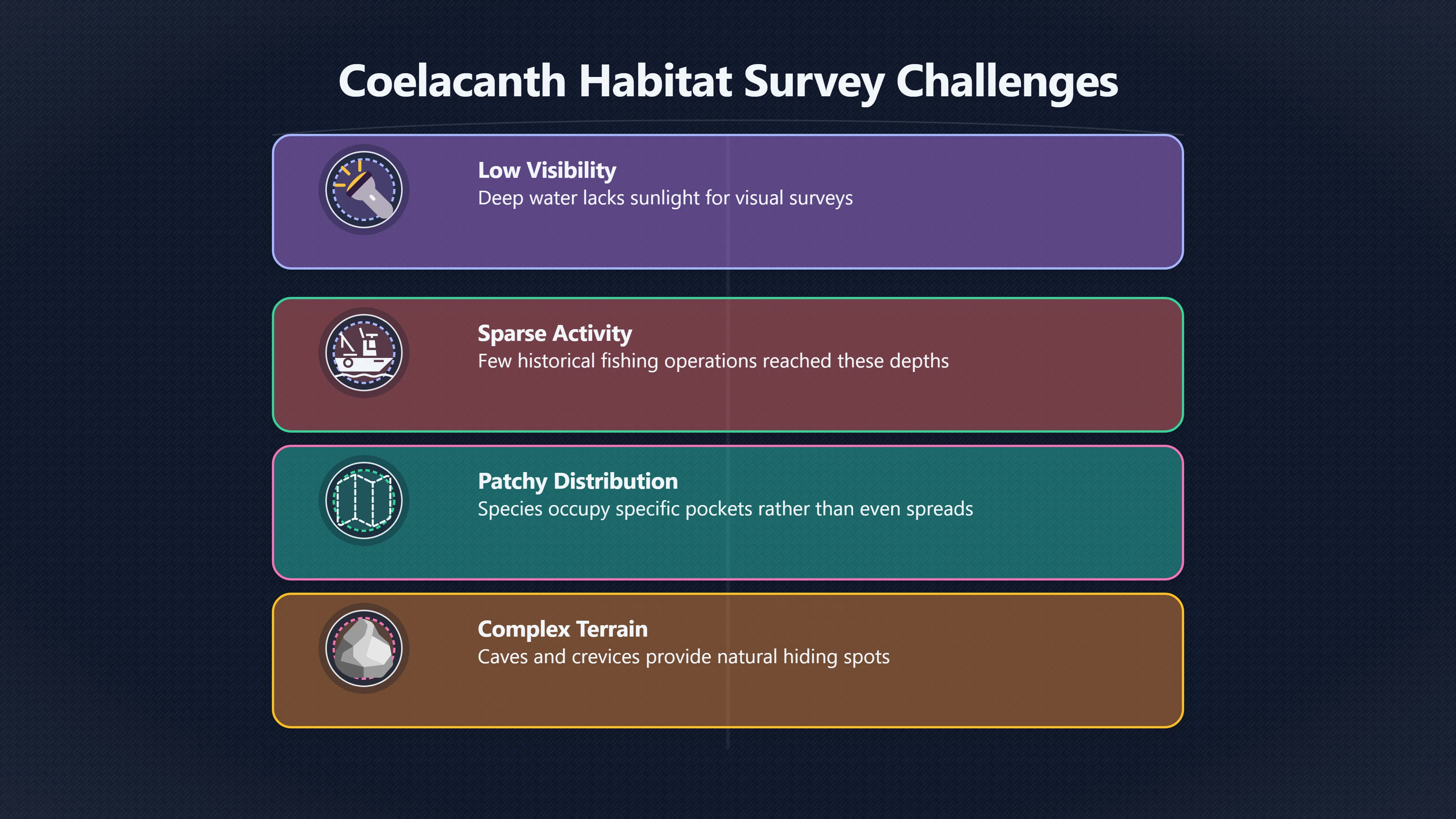
- Low visibility and limited access: Deep water receives little sunlight, making visual surveys challenging.
- Sparse human activity: Few fishermen historically worked consistently at coelacanth depths.
- Patchy distribution: Coelacanths are not spread evenly through the ocean but occupy specific habitat pockets.
How Caves and Steep Slopes Fit Coelacanth Biology
The coelacanth’s habitat is not merely remote; it closely matches the fish’s biology.
Modern coelacanth populations are strongly associated with steep volcanic island slopes, submarine canyons, overhangs and cave systems. During daylight hours, individuals often rest in underwater caves or sheltered recesses. At night they emerge to forage across surrounding slopes and deeper waters.[Smithsonian Ocean+2NOAA Institutional Repository]ocean.si.eduSmithsonian OceanCoelacanth | Smithsonian OceanCoelacanths live in temperate waters in the "twilight zone," generally between 500-800 fee…
Research in the Comoros Islands, South Africa and Indonesia has repeatedly linked coelacanth presence to these rugged underwater landscapes. Scientists have observed them occupying cave systems, lava formations and canyon habitats where temperatures remain relatively cool and stable.[NOAA Institutional Repository+2UDSM Journals]repository.library.noaa.govNOAA Institutional RepositoryESA status review report for the celacanthLike coelacanths in the Comoros, those in South Africa use highly…
Several biological advantages come from these environments:
Shelter from currents. Deep caves and overhangs provide refuge from strong ocean currents that would otherwise require more energy to resist.[NOAA Institutional Repository]repository.library.noaa.govNOAA Institutional RepositoryESA status review report for the celacanthLike coelacanths in the Comoros, those in South Africa use highly…
Energy conservation. Coelacanths have unusually slow metabolisms. Resting in cool, sheltered habitats reduces energy expenditure and suits a lifestyle based on low activity and opportunistic feeding.[ResearchGate]researchgate.netFeeding ecology and evolutionary survival of the living…During nocturnal feeding, coelacanths are generally thought to mov…
Access to prey. Steep slopes and reef walls support fish communities that provide feeding opportunities when coelacanths leave their daytime shelters.[ResearchGate]researchgate.netFeeding ecology and evolutionary survival of the living…During nocturnal feeding, coelacanths are generally thought to mov…
Physical concealment. A cave-dwelling animal may remain entirely unseen even when humans are nearby. Modern surveys have shown that suitable coelacanth habitat often consists of intricate networks of cracks, crevices and overhangs extending into darkness.[Nature]nature.comFirst record of a living coelacanth from North Maluku…by A Chappuis · 2025 · Cited by 1 — The topography of the deep-reef habit…
The important point is that coelacanths were not simply living in”the deep sea” as a vast empty space. They occupied specific geological refuges that naturally reduced encounters with humans.
Why Habitat Plausibility Matters for Cryptids
The coelacanth is frequently used as an argument that any cryptid could be real because science has been surprised before. Habitat analysis shows why that conclusion is too broad.
The coelacanth’s survival was plausible because it occupied an environment with three crucial characteristics:
- Large areas remained poorly observed.
- The habitat could support a breeding population.
- The animal left few opportunities for detection.
Deep volcanic slopes and submarine cave systems satisfy all three conditions. A large terrestrial animal living in heavily populated regions generally does not.[Smithsonian Ocean+2NOAA Institutional Repository]ocean.si.eduSmithsonian OceanCoelacanth | Smithsonian OceanCoelacanths live in temperate waters in the "twilight zone," generally between 500-800 fee…
This distinction is important in cryptozoological reasoning. When evaluating reports of unknown animals, habitat quality matters as much as the animal itself. A claim becomes more credible when the proposed habitat genuinely limits observation and can sustain a population. It becomes less credible when the alleged creature would need to inhabit environments that are already extensively surveyed.
What the Coelacanth Example Actually Teaches
The strongest cryptozoological lesson from the coelacanth is not that extraordinary creatures routinely escape science. It is that observation opportunities are unevenly distributed across habitats.
Deep-water cave systems around volcanic islands provided a combination of darkness, depth, difficult terrain and low human access that allowed a sizeable fish lineage to remain largely unnoticed until the twentieth century. Once researchers began exploring those habitats directly, coelacanth populations were found in multiple locations and their ecological requirements became increasingly clear.[SciELO+2NOAA Institutional Repository]scielo.org.zaCoelacanth discoveries in Madagascar, with…by A Cooke · 2021 · Cited by 7 — The discovery of a substantial population of coelacanths t…
In that sense, the coelacanth is a reminder that some environments naturally conceal life better than others. The species remained hidden not because it was magical, but because it lived in one of the few places on Earth where a large vertebrate genuinely had a reasonable chance of avoiding notice for centuries.[Smithsonian Ocean+2Natural History Museum]ocean.si.eduSmithsonian OceanCoelacanth | Smithsonian OceanCoelacanths live in temperate waters in the "twilight zone," generally between 500-800 fee…
eBay marketplace picks
Marketplace Samples
Live-tested eBay searches with available results related to this page.
Endnotes
1.
Source: link.springer.com
Link:https://link.springer.com/chapter/10.1007/978
2.
Source: repository.library.noaa.gov
Link:https://repository.library.noaa.gov/view/noaa/17113/noaa_17113_DS1.pdf
3.
Source: researchgate.net
Link:https://www.researchgate.net/publication/225638327_Feeding_ecology_and_evolutionary_survival_of_the_living_coelacanth_Latimeria_chalumnae
4.
Source: nature.com
Link:https://www.nature.com/articles/s41598-025-90287-7
5.
Source: researchgate.net
Link:https://www.researchgate.net/publication/350467942_Coelacanth_discoveries_in_Madagascar_with_recommendations_on_research_and_conservation
6.
Source: researchgate.net
Link:https://www.researchgate.net/publication/391058397_First_record_of_a_living_coelacanth_from_North_Maluku_Indonesia
7.
Source: ocean.si.edu
Link:https://ocean.si.edu/ocean-life/fish/coelacanth
8.
Source: vliz.be
Title: Vlaams Instituut voor de Zee Marine World Heritage
Link:https://www.vliz.be/projects/marineworldheritage/Features/feature5a.php
9.
Source: nhm.ac.uk
Title: The mysterious and long-hidden world of the coelacanth
Link:https://www.nhm.ac.uk/discover/coelacanths-the-fish-that-outdid-the-loch-ness-monster.html
10.
Source: journals.udsm.ac.tz
Link:https://journals.udsm.ac.tz/index.php/tjs/article/download/7676/5798/20026
11.
Source: scielo.org.za
Link:https://scielo.org.za/scielo.php?pid=S0038-23532021000200020&script=sci_arttext
12.
Source: Wikipedia
Link:https://en.wikipedia.org/wiki/Coelacanth
13.
Source: jstor.org
Link:https://www.jstor.org/stable/2387536
14.
Source: encyclopedia.pub
Link:https://encyclopedia.pub/entry/59111
Additional References
15.
Source: fishbase.se
Link:https://www.fishbase.se/summary/Latimeria-chalumnae.html
16.
Source: vims.edu
Link:https://www.vims.edu/research/facilities/fishcollection/_archive/highlights/coelacanth.php
17.
Source: facebook.com
Link:https://www.facebook.com/WildlifePhotographerOfTheYear/posts/up-close-and-personal-until-1938-it-was-thought-coelacanths-had-been-extinct-for/1419448826204837/
18.
Source: borea.mnhn.fr
Link:https://borea.mnhn.fr/sites/default/files/pdfs/A17-29Cupello.pdf
19.
Source: reddit.com
Link:https://www.reddit.com/r/Cryptozoology/comments/1psocu4/you_cannot_use_the_coelacanth_as_evidence_that/
20.
Source: instagram.com
Link:https://www.instagram.com/p/DVq8hDEiETE/?hl=en
21.
Source: animaldiversity.org
Title: Latimeria chalumnae
Link:https://animaldiversity.org/accounts/Latimeria_chalumnae/
22.
Source: oceanrep.geomar.de
Link:https://oceanrep.geomar.de/39246/1/sajsci_v102_n9_a15b.pdf
23.
Source: pmc.ncbi.nlm.nih.gov
Link:https://pmc.ncbi.nlm.nih.gov/articles/PMC12019534/
24.
Source: mnhn.hal.science
Link:https://mnhn.hal.science/mnhn-05046247v1/document
Topic Tree