Within Prehistoric Claims
When Fossils Look Younger Than They Are
Older bones can be moved into younger rocks, creating misleading hints that extinct animals survived longer than they did.
On this page
- How bones can move between sediments
- Why geological context matters
- How this affects dinosaur survival claims
Page outline Jump by section
Introduction
How Bones Can Move Between Sediments
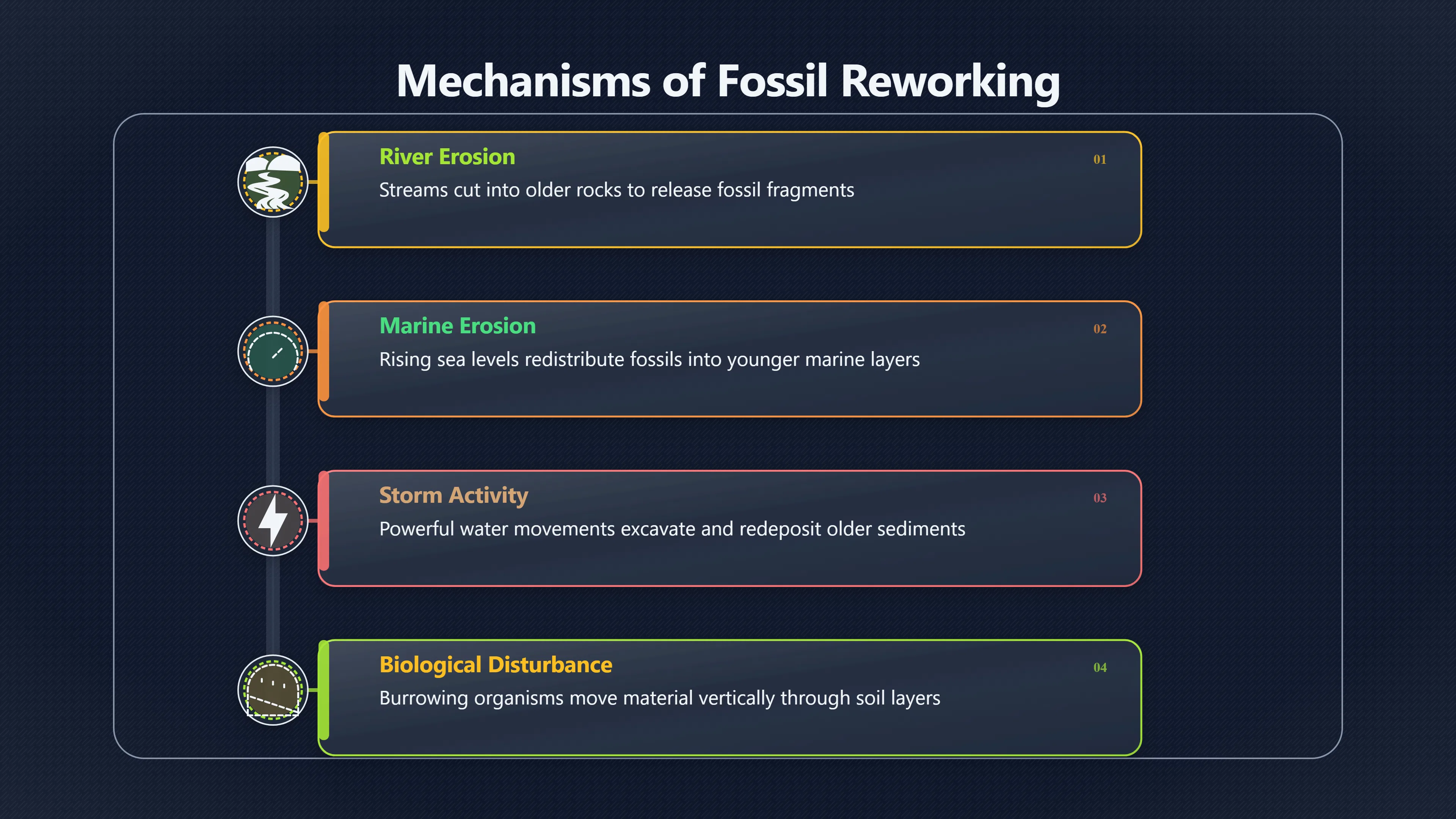
Fossils are not permanently fixed in place once they form. Geological processes can expose older fossil-bearing rocks to erosion, releasing bones, shells, teeth, and other remains into rivers, coastal systems, or other environments. Those fossils may then be transported and incorporated into younger sediments. This process is known as reworking.[Updates from the Paleontology Lab]vmnhpaleontology.wordpress.comreworked fossils part 1Updates from the Paleontology LabReworked fossils, Part 1 | Updates from the Paleontology LabSep 28, 2010 — It simply means that the foss…
Several mechanisms can produce reworked fossils:[vmnhpaleontology.wordpress.com]vmnhpaleontology.wordpress.comreworked fossils part 1Updates from the Paleontology LabReworked fossils, Part 1 | Updates from the Paleontology LabSep 28, 2010 — It simply means that the foss…
- River erosion: Streams can cut into older fossil-bearing rocks, carry fossil fragments downstream, and deposit them within younger sediments.
- Marine erosion: Rising sea levels or shifting coastlines can erode older seabed deposits and redistribute fossils into younger marine layers.
- Storms and currents: Powerful water movement can excavate older sediments and redeposit their contents elsewhere.
Why Geological Context Matters More Than the Fossil Alone
A fossil’s age is not determined solely by the fossil itself. Palaeontologists evaluate the surrounding geology, sedimentary structures, associated fossils, and dating evidence to establish whether a specimen is in its original position, known as being in situ, or has been reworked.[American Museum of Natural History]amnh.orgWhen paleontologists dig deeper in sedimentary rock they are, in effect, looking…Read more…
This is why fossil discoveries are documented with such attention to their exact location within a rock layer. If erosion has disturbed the specimen, the apparent age of the surrounding sediment may not represent the age of the fossil itself. A bone that is millions of years older than the deposit containing it can create a false impression of survival beyond an extinction boundary.[Updates from the Paleontology Lab]vmnhpaleontology.wordpress.comreworked fossils part 1Updates from the Paleontology LabReworked fossils, Part 1 | Updates from the Paleontology LabSep 28, 2010 — It simply means that the foss…
Researchers look for clues that suggest reworking, including:<div class="content-enhancement content-enhancement--insight-grid" markdown="1">
- Abrasion, rounding, or weathering inconsistent with the surrounding fossils.
- Differences in mineralisation compared with other fossils in the same layer.
- Sedimentary evidence that older material was being eroded nearby.
- Fossil assemblages that contain species known from very different geological periods.[ResearchGate+2Smithsonian Research Online]researchgate.netTaphonomic analysis assessing the degree of abrasion on fossil specimens from reworked sediments may approximate distance of transport or…</div>
The broader geological setting often proves more informative than the specimen itself. A seemingly extraordinary fossil can become far less remarkable when placed within a sedimentary system known to recycle older material.
The Dinosaur Survival Debate and Reworked Fossils
Why This Matters for Cryptozoology
Cryptozoological claims about surviving dinosaurs or other supposedly extinct prehistoric animals often rely on the idea that the fossil record leaves room for hidden survivors. Reworked fossils demonstrate why palaeontologists are cautious about such arguments.
A fossil found in unexpectedly young rocks is not automatically evidence that a lineage survived longer than believed. The first question is whether the fossil is genuinely contemporary with the younger sediments. Only after reworking and other geological explanations have been excluded can a late-survival hypothesis be taken seriously.[National Park Service]nps.govNational Park ServiceGlossary of Paleontological Terms - Fossils and…Aug 13, 2024 — Reworked (geology), A fossil or other object that…
This does not mean that extinction dates can never be revised. Scientific understanding changes when robust evidence appears. However, the history of alleged post-extinction fossils shows that geological context frequently provides a more convincing explanation than survival. In many cases, what initially looks like a prehistoric animal lingering into a later age turns out to be an older fossil that has simply taken a second journey through the sedimentary record.[Updates from the Paleontology Lab+2Wikipedia]vmnhpaleontology.wordpress.comreworked fossils part 1Updates from the Paleontology LabReworked fossils, Part 1 | Updates from the Paleontology LabSep 28, 2010 — It simply means that the foss…
Amazon book picks
Further Reading
Books and field guides related to When Fossils Look Younger Than They Are. Use these as the next step if you want deeper reading beyond the article.
The Rise and Fall of the Dinosaurs
Provides context for extinction timing and fossil interpretation.
eBay marketplace picks
Marketplace Samples
Live-tested eBay searches with available results related to this page.

Endnotes
1.
Source: Wikipedia
Title: Cretaceous–Paleogene extinction event
Link:https://en.wikipedia.org/wiki/Cretaceous%E2%80%93Paleogene_extinction_event
2.
Source: researchgate.net
Link:https://www.researchgate.net/publication/255132637_Evidence_of_Reworked_Cretaceous_Fossils_and_Their_Bearing_on_the_Existence_of_Tertiary_Dinosaurs
3.
Source: researchgate.net
Link:https://www.researchgate.net/publication/282238650_Dinosaurs_that_did_not_die_Evidence_for_Paleocene_dinosaurs_in_the_Ojo_Alamo_Sandstone_San_Juan_Basin_New_Mexico
4.
Source: nature.com
Link:https://www.nature.com/articles/s41598-025-34479-1
5.
Source: Wikipedia
Link:https://en.wikipedia.org/wiki/Fossil
6.
Source: Wikipedia
Title: Sedimentary rock
Link:https://en.wikipedia.org/wiki/Sedimentary_rock
7.
Source: Wikipedia
Link:https://en.wikipedia.org/wiki/Taphonomy
8.
Source: researchgate.net
Link:https://www.researchgate.net/publication/285337364_Taphonomy_and_Paleoecology_A_Critical_Review_of_Archaeology%27s_Sister_Disciplines
9.
Source: nps.gov
Link:https://www.nps.gov/subjects/fossils/glossary-of-paleontological-terms.htm
10.
Source: vmnhpaleontology.wordpress.com
Title: reworked fossils part 1
Link:https://vmnhpaleontology.wordpress.com/2010/09/28/reworked-fossils-part-1/
11.
Source: pubs.geoscienceworld.org
Title: Paleocene non avian dinosaurs
Link:https://pubs.geoscienceworld.org/sgi/italianjgeo/article/144/2/147/659200/Paleocene-non-avian-dinosaurs
12.
Source: repository.si.edu
Title: Smithsonian Research Online Taphonomy
Link:https://repository.si.edu/bitstreams/c2474480-068e-4881-a956-2c6ef8a67f71/download
13.
Source: nps.gov
Title: National Park Service Taphonomy—Death & Decay
Link:https://www.nps.gov/subjects/fossils/taphonomy.htm
14.
Source: amnh.org
Link:https://www.amnh.org/exhibitions/permanent/human-origins/understanding-our-past/fossil-dating-methods
15.
Source: bgs.ac.uk
Link:https://www.bgs.ac.uk/discovering-geology/fossils-and-geological-time/fossils/
16.
Source: nps.gov
Title: case study grand canyon evolution
Link:https://www.nps.gov/subjects/fossils/case-study-grand-canyon-evolution.htm
17.
Source: nps.gov
Title: fossils and evolution
Link:https://www.nps.gov/subjects/fossils/fossils-and-evolution.htm
18.
Source: nps.gov
Title: A Fossil’s Journey
Link:https://www.nps.gov/teachers/classrooms/a-fossil-s-journey.htm
19.
Source: nps.gov
Title: volcanoes and fossils
Link:https://www.nps.gov/subjects/fossils/volcanoes-and-fossils.htm
Additional References
20.
Source: opengeology.org
Link:https://opengeology.org/historicalgeology/geologic-time/
21.
Source: epgp.inflibnet.ac.in
Link:https://epgp.inflibnet.ac.in/epgpdata/uploads/epgp_content/S000001AN/P001775/M024488/ET/1508923009Quadrant1.pdf
22.
Source: publishing.cdlib.org
Link:https://publishing.cdlib.org/ucpressebooks/public/book/the-bug-creek-problem-and-the-cretaceous-tertiary-transition-at-mcguire-creek-montana.html
23.
Source: youtube.com
Link:https://www.youtube.com/watch?v=CunN7ARpsAQ
24.
Source: youtube.com
Link:https://www.youtube.com/watch?v=3Z2a0B3CEYc
25.
Source: earthathome.org
Link:https://earthathome.org/quick-faqs/how-do-scientists-date-rocks-and-fossils/
26.
Source: reddit.com
Link:https://www.reddit.com/r/Paleontology/comments/1iudcnu/if_a_fossil_of_nonavian_dinosaur_that_was_younger/
27.
Source: reddit.com
Title: I don’t understand how rocks are aged specifically
Link:https://www.reddit.com/r/geology/comments/1cg9fox/i_dont_understand_how_rocks_are_aged_specifically/
28.
Source: opengeology.org
Link:https://opengeology.org/historicalgeology/tools-of-historical-geology/fossil-taphonomy/
29.
Source: reddit.com
Link:https://www.reddit.com/r/Paleontology/comments/u5dewe/any_papers_or_studies_on_erosion_and_redeposition/
Topic Tree