Within Cryptozoology
Why Bigfoot Evidence Still Falls Short
Bigfoot reports are famous, but the missing bodies, bones, DNA, and repeatable observations keep the claim outside zoology.
On this page
- What witnesses and track hunters report
- Why large mammals leave traces
- Hoaxes, misidentifications, and missing DNA
Page outline Jump by section
Introduction
Bigfoot remains cryptozoology’s most famous North American test case because the claim is simple, dramatic and, in principle, scientifically testable: a large, hairy, bipedal primate is said to live across forests and rural edges of the United States and Canada. The difficulty is that the evidence has never crossed the line from suggestive reports to zoological proof. Witnesses describe encounters, track hunters cast large footprints, enthusiasts debate the 1967 Patterson-Gimlin film, and organisations maintain sighting databases. Yet scientists remain unconvinced because no confirmed body, bones, tissue, reliable DNA sample, repeatable observation or breeding population has been documented. That absence matters. A real large mammal does not leave only stories; over time it leaves recoverable biological traces, especially in landscapes full of hunters, roads, trail cameras, wildlife biologists and environmental DNA testing.[National Geographic+2bfro.net]nationalgeographic.comforensic expert says bigfoot is realOthers know it as Bigfoot. Thousands of people claim to have seen the hairy hominoid, but the evidence of its existence…Read more…
The Bigfoot question is therefore not whether people have reported strange experiences. They clearly have. The sharper question is whether those reports add up to evidence for an undiscovered animal. So far, the strongest scientific answer is no: the record is a mixture of eyewitness claims, ambiguous tracks, disputed images, known hoaxes, misidentified animals and biological samples that, when tested, have belonged to known species. Royal Society Publishing+2zslpublications.onlinelibrary.wiley.com[royalsocietypublishing.org]royalsocietypublishing.orgRoyal Society PublishingGenetic analysis of hair samples attributed to yeti, bigfoot and…by BC Sykes · 2014 · Cited by 49 — Genetic an…
What witnesses and track hunters report
Bigfoot reports usually follow a recognisable pattern: a large upright figure glimpsed at a distance, heavy footfalls, wood knocks, howls, a strong smell, snapped branches or footprints far larger than a human’s. The reports cluster especially in forested regions of the Pacific Northwest, but they are not confined there. The Bigfoot Field Researchers Organization, founded in 1995, presents itself as a volunteer network collecting “credible sightings and related reports” across the United States and Canada, and its database has become one of the main public archives used by believers, journalists and curious mapmakers.[bfro.net]bfro.netBFRO Geographical Database of Bigfoot Sightings & ReportsThis comprehensive database of credible sightings and related reports is maintai…
That archive is useful for understanding the culture and geography of the claim, but it is not the same thing as a verified zoological dataset. Reports are submitted by witnesses, filtered by investigators, and often rely on memory, interpretation and context rather than physical specimens. A sighting database can reveal where people report Bigfoot-like encounters; it cannot by itself prove that the encounters were caused by an unknown primate. This distinction is central to why Bigfoot remains inside cryptozoology rather than zoology.
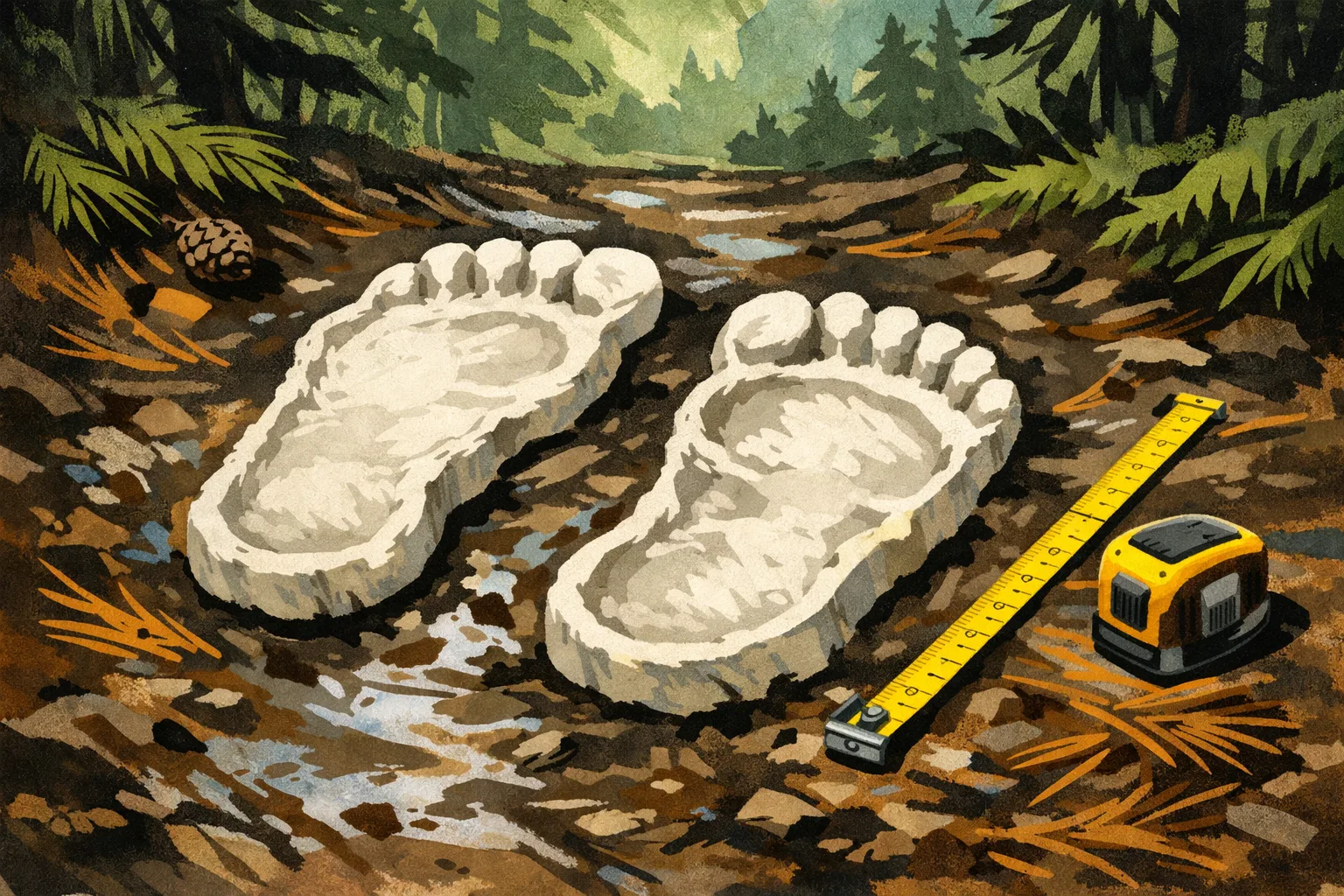
Footprints are the most persistent physical-looking evidence. Since the name “Bigfoot” was popularised around large tracks reported in northern California in 1958, casts of oversized human-like prints have played a major role in the legend. Some advocates argue that certain casts show anatomical details, mid-foot flexibility or skin ridge patterns that would be difficult for a casual hoaxer to fake. Anthropologist Jeffrey Meldrum has been one of the best-known academic defenders of the footprint evidence, while critics in the same broad field argue that closer analysis has not made the case stronger. Scientific American summarised this divide through the criticism of anthropologist David Daegling, who argued that the evidence “looks worse” on deeper analysis rather than better.[Scientific American]scientificamerican.combigfoot anatomybigfoot anatomy
The problem is not that every track is obviously fake. Some are poorly photographed, weathered, partial, distorted by mud or snow, or found without a clear chain of custody. Others may be hoaxes. The deeper scientific issue is that tracks are indirect evidence. They can be interesting, but a new large mammal cannot be confirmed from footprints alone when the prints are not consistently linked to hair, scat, tissue, camera evidence, carcasses or repeated observations by independent specialists in the same area.
Why large mammals leave traces
A living Bigfoot population would not be a single animal. It would require enough individuals to breed over many generations, avoid inbreeding, find food, move through habitat, rear young, die and leave remains. That is where the claim becomes biologically demanding. A large primate spread across North America would be expected to leave a wide signature: bones, teeth, scat, hair with distinctive DNA, feeding sites, sleeping sites, roadkill, hunter encounters, high-quality camera-trap images or repeated observations by wildlife professionals.
This is why the missing body matters so much. Sceptics are not demanding an impossibly high standard invented only for Bigfoot. New species are described from physical evidence: specimens, tissue, DNA, photographs linked to specimens, or repeated observations under conditions that let other researchers verify the claim. National Geographic’s older coverage of Bigfoot captured the basic scientific concern plainly: thousands of people have claimed sightings, but the evidence remains fuzzy, there are few clear photographs, no bones have been found, and many footprint hoaxes have been admitted.[National Geographic]nationalgeographic.comforensic expert says bigfoot is realOthers know it as Bigfoot. Thousands of people claim to have seen the hairy hominoid, but the evidence of its existence…Read more…
Modern ecology has made this absence harder, not easier, to explain. North America is heavily monitored compared with many regions where new species are still being found. Hunters, hikers, foresters, road crews, drones, trail cameras, conservation surveys and environmental DNA sampling all increase the chance that a large unknown mammal would leave recoverable evidence. Even rare animals such as wolverines, cougars in marginal ranges, or elusive bears are documented through tracks, scat, hair, camera traps and carcasses. Bigfoot reports, by contrast, have not produced a confirmed biological trail.
DNA has been a major test — and it has not helped Bigfoot
DNA testing is one of the clearest places where Bigfoot claims have met modern science. Hair is especially important because many alleged Bigfoot samples are tufts, fibres or hairs collected from fences, trees, cabins or reported encounter sites. If Bigfoot were a real unknown primate, at least some of these samples should eventually produce DNA that is neither human contamination nor a known North American animal.
The best-known systematic study was published in Proceedings of the Royal Society B in 2014. Bryan Sykes and colleagues analysed mitochondrial DNA from 30 hair samples attributed to “yeti, bigfoot and other anomalous primates”. The result did not support an unknown primate. Apart from two Himalayan samples initially reported as having affinity with an ancient polar bear lineage, the tested hairs came from known living mammals. Later discussion challenged the polar-bear interpretation too, suggesting the Himalayan material was likely from a local bear rather than a new cryptid.[Royal Society Publishing+2PubMed]royalsocietypublishing.orgRoyal Society PublishingGenetic analysis of hair samples attributed to yeti, bigfoot and…by BC Sykes · 2014 · Cited by 49 — Genetic an…
For North American Bigfoot, the point is even simpler: tested samples have not yielded confirmed Bigfoot DNA. Reporting on the study noted that North American “Bigfoot” samples matched ordinary sources including black bear, raccoon, cow, porcupine, canids and human hair. That pattern is exactly what sceptics would expect if people are collecting ambiguous biological material from places where known animals and humans are present.[Phys.org]phys.org2014 07 bigfoot hair samples wolves2014 07 bigfoot hair samples wolves
The FBI file often cited in Bigfoot lore points in the same direction. In the 1970s, Bigfoot researcher Peter Byrne asked the FBI to examine hair and tissue samples. When the file was later released, the result was not an unknown primate: the hairs were concluded to be from the deer family. The episode is revealing because it shows that some Bigfoot evidence has reached formal laboratories, but the results have repeatedly favoured known animals rather than the discovery of a new one.[ABC News]abcnews.comOpen source on abcnews.com.
Hoaxes, misidentifications and the problem of ambiguous evidence
Bigfoot evidence is weakened not only by missing proof but by a long record of hoaxes and ordinary explanations. The 1958 northern California tracks that helped popularise the name “Bigfoot” later became associated with Ray Wallace, whose family said after his death that he had used large carved wooden feet to fake tracks. Earlier footprint pranks in the Pacific Northwest also shaped the tradition. This does not prove every track is fake, but it shows that track evidence sits in a culture where hoaxing is technically easy, historically common and sometimes rewarded with attention.[Wikipedia]WikipediaOpen source on wikipedia.org.
Misidentification is just as important. Bears can stand or move briefly on their hind legs, appear startlingly human-like in poor light, and occupy many of the same wooded landscapes where Bigfoot is reported. A 2024 Journal of Zoology study by Floe Foxon tested whether reported Sasquatch sightings correlate with black bear populations across the United States and Canada, while adjusting for human population and forest area. The study found a statistically significant association: on average, every additional 1,000 bears was associated with a 4% increase in Sasquatch sightings. Foxon’s cautious conclusion was not that every report is a bear, but that many supposed Sasquatch sightings are likely misidentified known animals.[zslpublications.onlinelibrary.wiley.com]zslpublications.onlinelibrary.wiley.comBigfoot: If it's there, could it be a bear?Bigfoot: If it's there, could it be a bear?
That kind of result does not explain every individual story, and it does not need to. Scientific scepticism works cumulatively. A large share of reports can be explained by bears, people, shadows, poor distance judgement, expectation, jokes, altered photographs, costume hoaxes, animal sounds or ordinary tracks distorted by substrate and weather. Once those explanations account for many cases, the remaining unexplained reports do not automatically become Bigfoot; they remain unexplained unless they produce independent, testable evidence.
Why scientists remain unconvinced
Scientists remain unconvinced because Bigfoot evidence has the wrong shape for a real large mammal. It is abundant in stories but poor in specimens; rich in cultural repetition but weak in testable biology. The claim predicts durable, discoverable traces, yet the evidence base remains dominated by sightings, footprints, recordings and images that are difficult to verify independently.
The main objections are straightforward:<div class="content-enhancement content-enhancement--insight-grid" markdown="1">
- No confirmed body or bones: A breeding population should produce dead individuals, remains, teeth or other material that can be examined.
- No confirmed DNA: Hair and tissue samples attributed to Bigfoot have repeatedly tested as known animals or humans.
- No repeatable observation: Scientists cannot reliably return to a site and document the animal under controlled or independently verifiable conditions.
- Too many ordinary explanations: Bears, people, hoaxes, faulty perception and ambiguous tracks explain many reports without requiring a new species.
- No supporting ecological record: A large North American primate would need food, habitat, ancestry, population size and fossil or biological context that have not been demonstrated.</div>
This is why Bigfoot is such a useful case study in cryptozoology. The claim is not dismissed because scientists refuse to accept new animals. Zoology accepts new species when evidence is strong enough. Bigfoot remains outside zoology because the evidence has not produced the basic materials that would let the claim be checked, replicated and incorporated into mammalian biology.
What would change the assessment
The standard of proof for Bigfoot is high, but it is not mysterious. A body, a partial skeleton, a skull, a tooth, tissue with a clear chain of custody, or repeatable DNA evidence from independent laboratories would change the discussion immediately. So would a pattern of high-quality camera-trap images linked to recoverable biological samples from the same location. The key is convergence: different kinds of evidence pointing to the same unknown animal under conditions that allow independent verification.
A single dramatic sighting would not be enough. Nor would another blurry video, isolated footprint, anonymous hair sample or story from a remote road. The evidence would need to survive the ordinary questions asked of any zoological discovery: Where exactly was it found? Who handled it? Could it be contamination? Can another laboratory replicate the result? Does it match known animals? Does it fit a plausible population and habitat? Can researchers find more?
Until evidence of that kind appears, Bigfoot remains best understood as a powerful cryptozoological legend supported by sincere testimony, disputed traces and cultural momentum, but not by the physical proof required to establish a new large mammal. Its persistence says a great deal about wilderness, belief, folklore and the appeal of the unknown. It does not yet say that an undiscovered giant primate is living in North America.
Amazon book picks
Further Reading
Books and field guides related to Why Bigfoot Evidence Still Falls Short. Use these as the next step if you want deeper reading beyond the article.
Sasquatch: Legend Meets Science
Discusses tracks, anatomy claims, and evidence arguments.
Abominable Science!
Examines why Bigfoot evidence has not convinced mainstream science.
eBay marketplace picks
Marketplace Samples
Example marketplace items related to this page. Use the search link to explore similar finds on eBay.

Endnotes
1.
Source: bfro.net
Link:https://www.bfro.net/gdb/
2.
Source: zslpublications.onlinelibrary.wiley.com
Title: Bigfoot: If it’s there, could it be a bear?
Link:https://zslpublications.onlinelibrary.wiley.com/doi/10.1111/jzo.13148
3.
Source: bfro.net
Link:https://www.bfro.net/
4.
Source: Wikipedia
Link:https://en.wikipedia.org/wiki/Bigfoot
5.
Source: phys.org
Title: 2014 07 bigfoot hair samples wolves
Link:https://phys.org/news/2014-07-bigfoot-hair-samples-wolves.html
6.
Source: history.com
Title: bigfoot fbi file investigation discovery
Link:https://www.history.com/articles/bigfoot-fbi-file-investigation-discovery
7.
Source: zslpublications.onlinelibrary.wiley.com
Link:https://zslpublications.onlinelibrary.wiley.com/doi/abs/10.1111/jzo.13148
8.
Source: bfro.net
Title: Sighting Reports Recently Added Reports posted since
Link:https://www.bfro.net/gdb/newadd.asp?Show=AB
9.
Source: vault.fbi.gov
Link:https://vault.fbi.gov/bigfoot/Bigfoot%20Part%2001%20%28Final%29/at_download/file
10.
Source: time.com
Title: bigfoot dna bear animal
Link:https://time.com/2949457/bigfoot-dna-bear-animal/
11.
Source: time.com
Title: dna analysis debunks bigfoot myth points to unknown bear species
Link:https://time.com/2948745/dna-analysis-debunks-bigfoot-myth-points-to-unknown-bear-species/
12.
Source: Wikipedia
Title: Patterson–Gimlin film
Link:https://en.wikipedia.org/wiki/Patterson%E2%80%93Gimlin_film
13.
Source: people.com
Title: famous 1967 bigfoot film was staged says director of new doc 11926085
Link:https://people.com/famous-1967-bigfoot-film-was-staged-says-director-of-new-doc-11926085
14.
Source: youtube.com
Title: Bigfoot DNA?
Link:https://www.youtube.com/watch?v=V5X-E62tGwY
15.
Source: nationalgeographic.com
Title: forensic expert says bigfoot is real
Link:https://www.nationalgeographic.com/culture/article/forensic-expert-says-bigfoot-is-real
16.
Source: royalsocietypublishing.org
Link:https://royalsocietypublishing.org/doi/abs/10.1098/rspb.2014.0161
17.
Source: scientificamerican.com
Title: bigfoot anatomy
Link:https://www.scientificamerican.com/article/bigfoot-anatomy/
18.
Source: scientificamerican.com
Title: Scientific American If Bigfoot Were Real
Link:https://www.scientificamerican.com/blog/tetrapod-zoology/if-bigfoot-were-real/
19.
Source: pubmed.ncbi.nlm.nih.gov
Link:https://pubmed.ncbi.nlm.nih.gov/24990672/
20.
Source: abcnews.com
Link:https://abcnews.com/US/fbi-unveils-documents-related-1970s-bigfoot-investigation/story?id=63511477
21.
Source: wsj.com
Link:https://www.wsj.com/arts-culture/film/a-new-bigfoot-documentary-helps-explain-our-conspiracy-minded-era-f9ef6237
22.
Source: theguardian.com
Title: The Guardian’It never happened
Link:https://www.theguardian.com/artanddesign/2025/apr/12/28-fake-images-that-fooled-the-world
23.
Source: theguardian.com
Title: sasquatch bigfoot sightings fervour scepticism ape ontario
Link:https://www.theguardian.com/world/2026/jun/11/sasquatch-bigfoot-sightings-fervour-scepticism-ape-ontario
24.
Source: royalsocietypublishing.org
Link:https://royalsocietypublishing.org/rspb/article/281/1789/20140161/77194/Genetic-analysis-of-hair-samples-attributed-to
Additional References
25.
Source: youtube.com
Title: The Crazed Hunt for the Himalayan Yeti | Monstrum
Link:https://www.youtube.com/watch?v=98M3Az_ku4A
26.
Source: youtube.com
Title: The True Story of Grover Krantz and the Mysterious Giant Bigfoot
Link:https://www.youtube.com/watch?v=OvB-ukjM0Hw
27.
Source: pmc.ncbi.nlm.nih.gov
Link:https://pmc.ncbi.nlm.nih.gov/articles/PMC4100498/
28.
Source: researchgate.net
Link:https://www.researchgate.net/publication/263583915_Correction_to_Genetic_analysis_of_hair_samples_attributed_to_yeti_bigfoot_and_other_anomalous_primates
29.
Source: dailygrail.com
Link:https://www.dailygrail.com/2023/01/900-bears-per-bigfoot-new-statistical-analysis-finds-that-many-sasquatch-encounters-are-likely-misidentified-bear-sightings/
30.
Source: facebook.com
Link:https://www.facebook.com/groups/1294386217413894/posts/2535251949993975/
31.
Source: facebook.com
Link:https://www.facebook.com/RMSOBigfoot/posts/are-the-two-maps-compiled-by-bigfoot-mapping-project-a-coincidence/1482541450159288/
32.
Source: kaggle.com
Link:https://www.kaggle.com/datasets/thedevastator/unlocking-mysteries-of-bigfoot-through-sightings
33.
Source: facebook.com
Link:https://www.facebook.com/groups/expeditionbigfoot/posts/9521979747891887/
34.
Source: reddit.com
Link:https://www.reddit.com/r/zoology/comments/156gz5h/bigfoot_almost_certainly_doesnt_exist_but_how/
Topic Tree