Within Cryptozoology
What Would Prove a Cryptid Is Real?
A new species needs verifiable specimens, genetic data, descriptions, and independent review, not just stories.
On this page
- Bodies, bones, tissue, and DNA
- Repeatable observations and habitat evidence
- From specimen to formal species description
Page outline Jump by section
Introduction
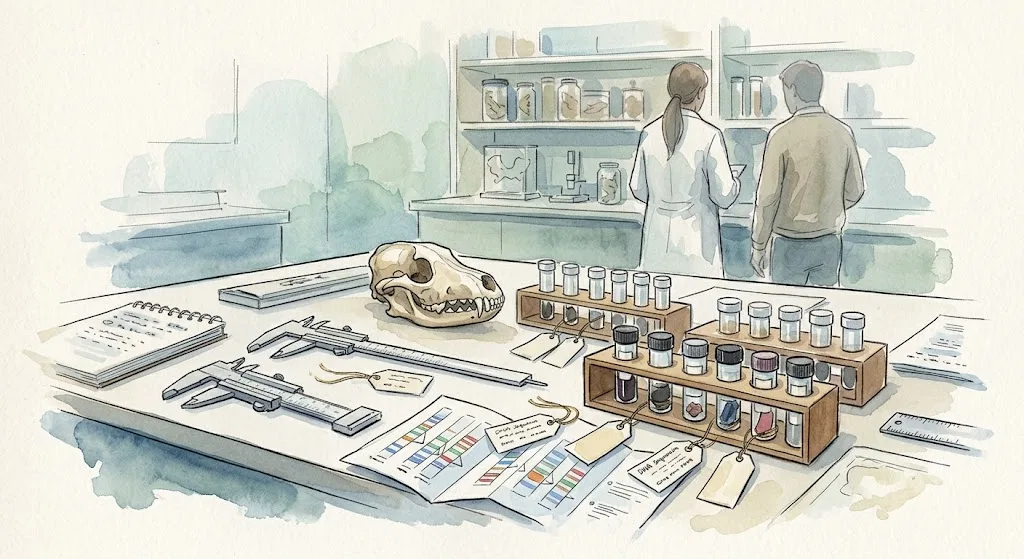
A cryptid would be proved real in the same way any other new animal species is proved real: by producing evidence that other scientists can inspect, test, compare and preserve. Stories, tracks, blurry images and local names may justify investigation, but they do not by themselves establish a species. The strongest case normally includes a verifiable body, bone, tissue sample or other voucher specimen; genetic data tied to that specimen; a clear anatomical description; locality and habitat information; and publication in a peer-reviewed taxonomic work under the rules of zoological naming.
That standard is not designed to dismiss unusual animals in advance. It is what lets zoology separate a new species from a misidentified known animal, a hoax, a diseased individual, a hybrid, a folklore tradition or an artefact of poor sampling. For cryptozoology, the key question is therefore not “Could unknown animals exist?” but “What evidence would survive independent checking?” The answer is demanding, but clear.
Proof starts with something other people can examine
The central weakness of most famous cryptid claims is not that they are strange. It is that the evidence is usually non-transferable. A witness saw something; a photograph is unclear; a footprint cast lacks a known maker; a sound recording has no visible animal attached to it. Such material can be interesting, but it leaves independent researchers unable to repeat the identification.
Zoological taxonomy is built around the opposite principle: a scientific name must be anchored to a reference point. Under the International Code of Zoological Nomenclature, a species-group name is normally tied to a name-bearing type, and a holotype is the single specimen on which a new species name is based in the original publication. The Code’s own guidance defines a holotype as that reference specimen, while a later ICZN declaration recommends that, whenever feasible, new species-group taxa should be based on at least one preserved type specimen.[code.iczn.org]code.iczn.orgoup taxon is based in the original publication.Read more…
That does not mean every discovery begins with a complete carcass. A skull, skin, preserved tissue, skeleton, fossil, museum specimen, or in some cases a documented living specimen may be enough, depending on the animal and the taxonomic problem. What matters is that the evidence is accessible to qualified researchers, linked to locality data, and preserved in a collection or record system where later scientists can re-check the claim.
For a cryptid, the evidential threshold therefore changes sharply once there is physical material. A Bigfoot sighting remains an anecdote; a hair sample becomes testable; a jawbone, skull, or tissue sample with unusual anatomy and DNA becomes much more serious. But even then, “unusual” is not enough. The material has to be shown not merely to be unidentified, but to belong to a distinct animal lineage that is not already known.
Bodies, bones, tissue and DNA
The strongest proof for a new animal species usually combines physical and genetic evidence. A preserved specimen lets scientists examine anatomy: teeth, bones, hair structure, scales, feathers, genitalia, body proportions, internal organs or other characters that distinguish one species from another. DNA can then test whether the animal falls within known variation or represents a separate lineage.
Modern species descriptions increasingly use this combined approach, often called integrative taxonomy. The idea is simple: no single line of evidence is always decisive. Morphology may be misleading when species look alike; DNA may be misleading if sampling is sparse, contaminated or taken from only one gene; behaviour and habitat may vary within a species. Strong descriptions therefore combine multiple lines of evidence, such as anatomy, genetics, ecology, geography and comparison with museum material. Recent taxonomic guidance stresses that a new animal species description should include the key elements needed to name, diagnose and publish the species properly, while avoiding common errors in nomenclature and evidence handling.[OUP Academic]academic.oup.comOUP AcademicHow to describe a new species in zoology and avoid mistakesby MF Braby · 2024 · Cited by 60 — We provide practical guidelines…
The olinguito is a useful modern example because it shows what real proof looks like for a charismatic mammal. It was not accepted because someone reported a cute, unfamiliar carnivore in the Andes. It was described after a taxonomic revision of olingos that drew on museum specimens, fieldwork, genetic evidence, morphology, geography and ecological modelling. The published ZooKeys paper described the new species in detail and reported its biology from museum and field evidence in western Ecuador and Colombia.[Zookeys]zookeys.pensoft.netZookeys Taxonomic revision of the olingos (BassaricyonZookeys Taxonomic revision of the olingos (Bassaricyon
DNA evidence is powerful, but it is not magic. A DNA barcode is best understood as an identification tool that compares a sequence with reference material; it is not automatically a full species description. The Convention on Biological Diversity’s DNA barcoding guide distinguishes barcoding from DNA taxonomy and notes that barcoding primarily supports species identification rather than replacing the broader work of classification.[Convention on Biological Diversity]cbd.intConvention on Biological Diversity A Step-by-Step Guide for DNA BarcodingConvention on Biological Diversity A Step-by-Step Guide for DNA Barcoding
For cryptid claims, this distinction matters. A claimed “unknown primate” hair that yields bear DNA is evidence against the primate claim. A sample that yields a poor, partial or contaminated sequence is not proof of a new species. A sample that yields a genuinely novel sequence would still need context: where it came from, whether contamination was excluded, whether the sequence is reproducible, whether it matches a physical voucher, and whether the animal can be distinguished from known species.
Why cryptid DNA usually weakens rather than proves the claim
Cryptozoology often appeals to DNA because it sounds like a shortcut: no body needed, just a hair, scat sample, water sample or scrap of tissue. In practice, DNA has mostly made famous cryptid claims harder to sustain.
A notable peer-reviewed case is the 2014 Proceedings of the Royal Society B study that tested hair samples attributed to yeti, Bigfoot, Sasquatch and other “anomalous primates”. The researchers used decontamination procedures and mitochondrial sequencing on 30 samples. Most came from known living mammals, including bears, horses, dogs and other ordinary species rather than unknown apes.[PubMed]pubmed.ncbi.nlm.nih.govOpen source on nih.gov.
That kind of result does not prove that no unknown animal could ever exist in a region. It does show why cryptid evidence has to be tested rather than admired. A hair that looks mysterious in a display case may become a bear, wolf, cow or human hair once sequenced. The scientific value is not in preserving the mystery; it is in resolving what the sample actually is.
Environmental DNA, or eDNA, is another attractive tool. It detects genetic traces shed into water, soil, snow or other environments through skin, hair, faeces, gametes or carcass material. It can be valuable for surveying rare or elusive species because it does not require seeing or capturing the animal. But it is also vulnerable to false negatives, false positives, uneven shedding, transport of DNA, degradation, incomplete reference databases and sampling design problems. Reviews of eDNA methods repeatedly stress that detection depends on many factors and that absence of a signal is not always proof of absence.[Springer]link.springer.comOpen source on springer.com.
The Loch Ness eDNA work illustrates the correct level of caution. The survey sampled Loch Ness and other lochs, filtered water and analysed DNA using an international team. Public summaries reported no unexpected DNA matching a large unknown reptile or monster-type animal, while eel DNA was abundant. That was useful evidence about what the loch’s sampled water contained; it was not the same thing as formally describing a giant eel or proving every possible creature absent.[Loch Ness Project]lochnessproject.orgOpen source on lochnessproject.org.
Repeatable observations and habitat evidence
A new species claim becomes stronger when the physical evidence is accompanied by repeatable observations. Scientists want to know whether the animal exists as a population, not as a one-off rumour. That requires evidence of where it lives, how often it is encountered, whether there are juveniles and adults, what habitat it uses, and whether independent observers can find it again.
This is where many cryptid claims run into a biological problem. A large animal usually needs a breeding population, food, territory, waste, remains and ecological interactions. Even elusive species leave traces: camera-trap images, scat, kills, nests, dens, tracks, shed hair, bones, roadkill, acoustic signals or repeated eDNA detections. The larger the alleged animal and the more populated or surveyed the landscape, the more difficult it becomes to explain why such traces remain ambiguous.
Biodiversity databases use a similar logic. GBIF, the Global Biodiversity Information Facility, treats occurrence records as evidence that a species was recorded at a particular place and time. It distinguishes preserved specimens, living specimens, fossil specimens, observations and material citations, and it emphasises data quality because names, dates, locations and record types determine whether an occurrence can be trusted and reused.[GBIF]gbif.orgOpen source on gbif.org.
For cryptozoology, this means a credible evidence package would not rely on a single dramatic encounter. It would build a pattern:<div class="content-enhancement content-enhancement--metric" markdown="1">
- Multiple independent records: sightings, images, samples or detections from different observers and times, not all dependent on one story.
- Precise locality data: enough detail for qualified researchers to revisit the area, while protecting sensitive species if needed.
- Consistent anatomy: descriptions, images and specimens that point to the same animal rather than a shifting legend.
- Biological plausibility: habitat, food sources and population size that make survival possible.
- Negative controls: checks against known animals, hoaxes, contamination and sampling error.</div>
This is not bureaucratic fussiness. It is how a claim becomes portable. A good record lets someone else ask, “Can I test this?” A weak record asks them to trust the original observer.
From specimen to formal species description
Finding a strange animal is only the beginning. To become a recognised species, the evidence must be translated into a formal taxonomic description. That process has two related but distinct parts: taxonomy and nomenclature.
Taxonomy is the scientific judgement that a population or specimen represents a distinct species. It asks whether the animal is truly different from known species, how much variation exists within related species, and where the new form fits in evolutionary relationships. Nomenclature is the rule-governed naming system. The ICZN does not decide whether every proposed species is biologically “real”; it sets the rules for whether names are properly formed, published and tied to types. The ICZN FAQ explains that the Code guides zoologists in establishing new names, determining availability and resolving naming problems.[iczn.org]iczn.orgOpen source on iczn.org.
A strong new species description normally includes:<div class="content-enhancement content-enhancement--step-flow" markdown="1">
- A designated type specimen. The holotype or type series is identified, with repository information so other researchers can inspect it.
- A diagnosis. The paper states how the species differs from its closest relatives.
- A detailed description. Relevant anatomy, measurements, photographs, illustrations, scans or other documentation are provided.
- Comparative material. The authors compare the proposed species with existing species and museum specimens.
- Locality and habitat data. The description records where the specimen came from and, where known, its ecological setting.
- Genetic data where useful. DNA sequences are deposited in accessible databases and tied to voucher specimens.
- Valid publication. The name and description appear in a recognised scientific publication that meets nomenclatural rules.</div>
Journals often add their own safeguards. The European Journal of Taxonomy, for example, requires authors to register type specimens in an official natural history collection with public access before publication. PLOS guidance for taxonomic work requires specimen numbers and complete repository information, including the museum name and location, for publication.[European Journal of Taxonomy]europeanjournaloftaxonomy.euOpen source on europeanjournaloftaxonomy.eu.
For a cryptid, this is the point at which the claim leaves popular mystery culture and enters zoology. A creature is not scientifically accepted because it receives a Latin-sounding name in a book, website or documentary. It becomes a candidate species when a description is published in a way that lets other taxonomists evaluate, accept, revise or reject it.
What if the animal is rare, endangered or hard to collect?
The demand for specimens raises an ethical question: what if the alleged animal is extremely rare? Must scientists kill one to prove it exists? This is a real debate in taxonomy, not a problem unique to cryptozoology.
The ICZN’s rules have historically allowed some names to be based on evidence other than a preserved physical type in unusual circumstances, but this remains controversial. The Commission’s Declaration 45 states that new species-group taxa should, whenever feasible, be established on at least one preserved type specimen, and that additional evidence such as photographs, recordings and DNA sequences should be provided where useful.[iczn.org]iczn.orgDeclaration 45 – Addition of Recommendations to Article…Whenever feasible, new species-group taxa should be established on the basis o…
The controversy became vivid in debates over “typeless” or photograph-based species descriptions. Some taxonomists argue that high-quality photographs may be justified when an animal is seen clearly but cannot ethically or practically be collected. Others warn that descriptions without physical specimens can create long-term confusion because later researchers cannot examine internal anatomy, DNA, age, sex, pathology or hidden diagnostic traits. A ZooKeys commentary on typeless species notes that photograph-based descriptions may later turn out to coincide with earlier species or miss internal features, while broader debate pieces describe the issue as a genuine split in modern taxonomy.[Zookeys+2PMC]zookeys.pensoft.netOpen source on pensoft.net.
This matters for cryptids because “no specimen because it is too rare” can easily become a shield against testing. Conservation ethics can justify non-lethal sampling, camera traps, eDNA, biopsy darts, naturally shed hair, faeces, carcass recovery or temporary capture. They do not justify lowering the standard to rumours alone. A rare species may require gentler proof methods, but it still needs proof.
The most persuasive non-lethal route would combine high-resolution images, repeated independent observations, diagnostic DNA from non-invasive samples, ecological data and, ideally, a naturally dead specimen or recoverable tissue. For a large cryptid, that is a high bar, but not an unfair one.
Why famous “once hidden” animals do not rescue weak cryptid evidence
Cryptozoology often invokes the okapi and the coelacanth as proof that sceptics can be wrong. They are good examples, but not in the way they are often used.
The okapi was known to local people before European scientific recognition, and early reports did not by themselves make it a zoological species. The decisive shift came when physical material reached scientists: skin, skull and anatomical evidence that allowed taxonomists to classify it as a giraffid and formally recognise it in the early twentieth century.[Tetrapod Zoology]tetzoo.comthe discovery of the okapi part 1the discovery of the okapi part 1
The coelacanth is even more famous. Coelacanths were known from fossils and were thought to have died out millions of years ago until a specimen was found in 1938. The Natural History Museum’s account emphasises the specimen: an actual fish, recovered from a trawler catch, preserved and studied. The American Museum of Natural History similarly describes the 1938 specimen discovered by Marjorie Courtenay-Latimer as the object that brought coelacanths into modern zoology.[Natural History Museum]nhm.ac.ukOpen source on nhm.ac.uk.
These cases show that surprising discoveries happen. They do not show that any famous cryptid is likely to be real. In both examples, the claim became scientific when physical evidence appeared and could be examined. The lesson is not “legends are often true”; it is “even astonishing animals become accepted through ordinary evidence.”
A practical proof standard for cryptid claims
A useful standard for cryptozoology should be neither gullible nor dismissive. It should ask what evidence would make the claim testable by people who do not already believe it. The answer depends on the claim, but the decision path is straightforward.
Low-value evidence: eyewitness stories, local legends, second-hand accounts, unaudited footprint casts, indistinct photographs, anonymous samples and dramatic but unrepeatable encounters. These can motivate investigation, but they do not prove a species.
Investigative evidence: clear images with location data, repeated sightings by independent observers, consistent trackways, acoustic records, scat, hair, eDNA detections or ecological signs. These can justify field surveys and sampling, especially if they are collected under documented conditions.
High-value evidence: tissue, bone, teeth, skin, feathers, scales, a carcass, a living specimen under expert examination, or a non-invasive DNA sample tied to strong visual and locality evidence. This is where a cryptid claim becomes scientifically serious.
Publication-grade evidence: a specimen or defensible type basis, diagnostic anatomical comparison, genetic analysis, locality and habitat data, deposition of material or data in accessible repositories, and peer-reviewed description under ICZN rules. This is what can turn an unknown animal into a recognised species.
The governance value of this standard is that it protects both science and the public conversation. It prevents every ambiguous video from being treated as a discovery, but it also leaves a clear route for genuine surprises. A cryptid does not have to be believed first and proved later. It has to become examinable.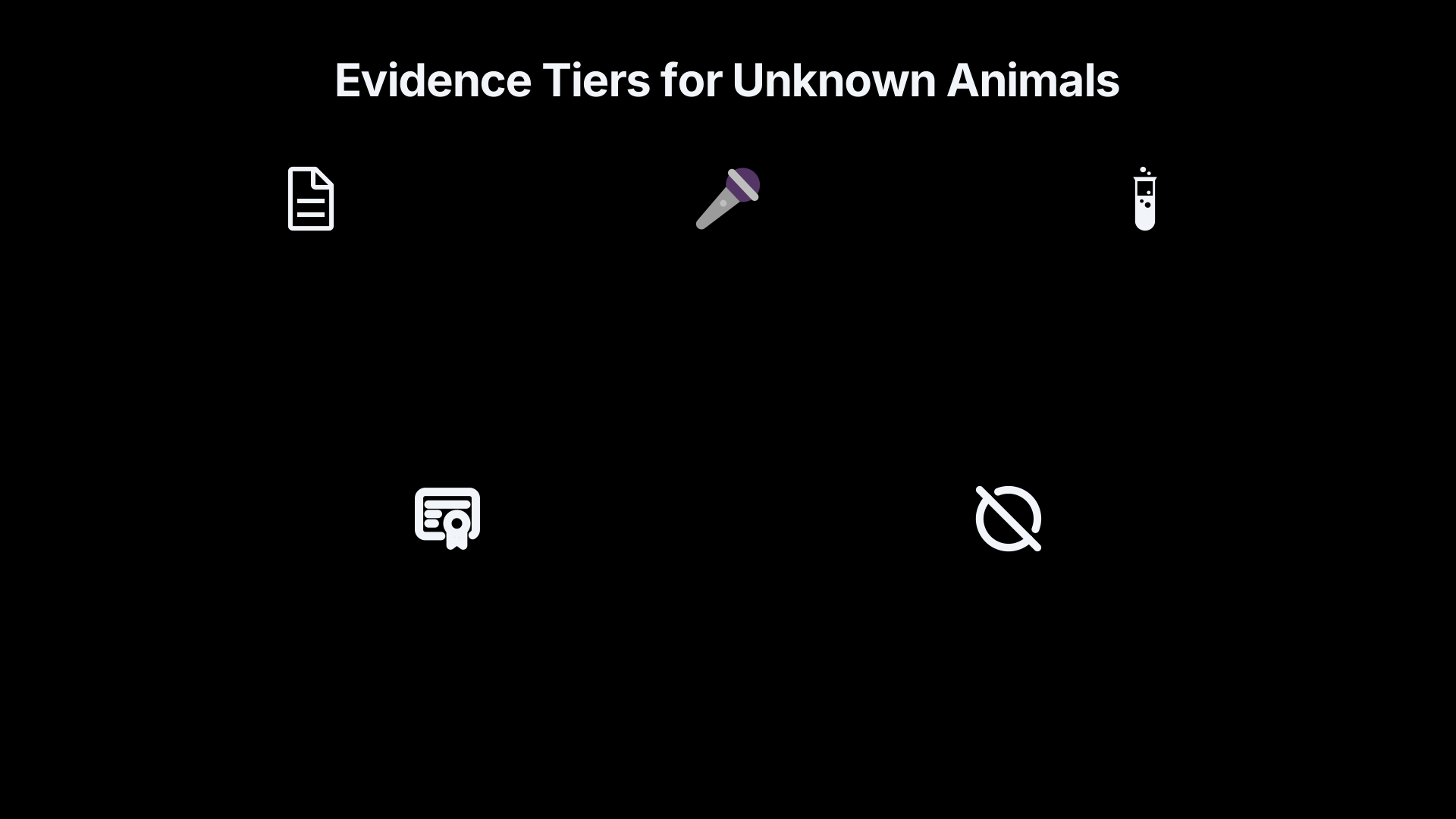
The real test is independent review
Scientific proof is not a single heroic moment. It is a chain of custody, comparison and correction. Who collected the sample? Where was it found? Could it have been contaminated? Which museum holds the specimen? Which known species were ruled out? Are the DNA sequences public? Can other researchers inspect the material? Does the published description meet nomenclatural rules? Do later specialists accept, revise or synonymise the claim?
That last step is important because species descriptions are not infallible. Names can be challenged, species can be merged, and interpretations can change when more specimens or better genetic data become available. GBIF notes that even major biodiversity systems face taxonomic uncertainty in groups where authoritative reviewed checklists are incomplete.[GBIF]gbif.orgOpen source on gbif.org.
For cryptozoology, this is a useful corrective to both extremes. Scepticism does not mean unknown animals cannot exist. Belief does not mean a reported animal has met the burden of proof. The standard is public, repeatable and practical: produce verifiable material, document it well, compare it rigorously, publish it properly and let independent experts test it. Until then, a cryptid remains a claim about an animal, not a confirmed animal species.
Amazon book picks
Further Reading
Books and field guides related to What Would Prove a Cryptid Is Real?. Use these as the next step if you want deeper reading beyond the article.
Hunting Monsters
Explains what kinds of evidence support or fail extraordinary claims.
Abominable Science!
Focuses on evidence standards and scientific evaluation of cryptids.
Why Evolution is True
Provides context for how zoological evidence is evaluated scientifically.
eBay marketplace picks
Marketplace Samples
Live-tested eBay searches with available results related to this page.



Endnotes
1.
Source: code.iczn.org
Link:https://code.iczn.org/types-in-the-species-group/article-73-name-bearing-types-fixed-in-the-original-publication-holotypes-and-syntypes/
2.
Source: iczn.org
Link:https://www.iczn.org/the-code/declaration-45-addition-of-recommendations/
3.
Source: academic.oup.com
Link:https://academic.oup.com/zoolinnean/article/202/4/zlae043/7664331
4.
Source: pmc.ncbi.nlm.nih.gov
Link:https://pmc.ncbi.nlm.nih.gov/articles/PMC3760134/
5.
Source: pmc.ncbi.nlm.nih.gov
Link:https://pmc.ncbi.nlm.nih.gov/articles/PMC4100498/
6.
Source: link.springer.com
Link:https://link.springer.com/article/10.1007/s10531-025-03112-y
7.
Source: gbif.org
Link:https://www.gbif.org/data-quality-requirements-occurrences
8.
Source: docs.gbif.org
Title: basis of record
Link:https://docs.gbif.org/course-data-use/en/basis-of-record.html
9.
Source: iczn.org
Link:https://www.iczn.org/outreach/faqs/
10.
Source: gbif.org
Link:https://www.gbif.org/about-species-counts
11.
Source: iczn.org
Link:https://www.iczn.org/the-code/the-code-online/
12.
Source: iczn.org
Title: best practice
Link:https://www.iczn.org/assets/6ecc2ac99f/best-practice.pdf
13.
Source: code.iczn.org
Title: article 72 general provisions
Link:https://code.iczn.org/types-in-the-species-group/article-72-general-provisions/
14.
Source: code.iczn.org
Title: article 79 list of available names in zoology
Link:https://code.iczn.org/the-international-commission-on-zoological-nomenclature/article-79-list-of-available-names-in-zoology/
15.
Source: code.iczn.org
Link:https://code.iczn.org/
16.
Source: journals.plos.org
Title: submission guidelines
Link:https://journals.plos.org/plosone/s/submission-guidelines
17.
Source: journals.plos.org
Title: submission guidelines
Link:https://journals.plos.org/plosbiology/s/submission-guidelines
18.
Source: journals.plos.org
Title: submission guidelines
Link:https://journals.plos.org/ecosystems/s/submission-guidelines
19.
Source: journals.plos.org
Title: submission guidelines
Link:https://journals.plos.org/plospathogens/s/submission-guidelines
20.
Source: journals.plos.org
Link:https://journals.plos.org/plosone/article?id=10.1371%2Fjournal.pone.0049710
21.
Source: training.gbif.org
Link:https://training.gbif.org/en/data-mobilization/solutions
22.
Source: docs.gbif.org
Title: data capture review solutions
Link:https://docs.gbif.org/course-data-mobilization/en/data-capture-review-solutions.html
23.
Source: gbif.org
Title: sampling event data
Link:https://www.gbif.org/sampling-event-data
24.
Source: ipt.gbif.org
Title: occurrence data
Link:https://ipt.gbif.org/manual/en/ipt/latest/occurrence-data
25.
Source: gbif.org
Link:https://www.gbif.org/analytics/global
26.
Source: time.com
Title: dna analysis debunks bigfoot myth points to unknown bear species
Link:https://time.com/2948745/dna-analysis-debunks-bigfoot-myth-points-to-unknown-bear-species/
27.
Source: pmc.ncbi.nlm.nih.gov
Title: PMC To be or not to be… Integrative taxonomy and species
Link:https://pmc.ncbi.nlm.nih.gov/articles/PMC9836410/
28.
Source: zookeys.pensoft.net
Title: Zookeys Taxonomic revision of the olingos (Bassaricyon
Link:https://zookeys.pensoft.net/article/3550/
29.
Source: cbd.int
Title: Convention on Biological Diversity A Step-by-Step Guide for DNA Barcoding
Link:https://www.cbd.int/doc/publications/cbd-ts-94-en.pdf
30.
Source: pubmed.ncbi.nlm.nih.gov
Link:https://pubmed.ncbi.nlm.nih.gov/24990672/
31.
Source: lochnessproject.org
Link:https://www.lochnessproject.org/FIELDWORKGROUNDTRUTH/eDNA%20LOCH%20NESS/eDNA%20LOCHNESS_index.html
32.
Source: europeanjournaloftaxonomy.eu
Link:https://europeanjournaloftaxonomy.eu/index.php/ejt/about/submissions
33.
Source: zookeys.pensoft.net
Link:https://zookeys.pensoft.net/article/10945/
34.
Source: pmc.ncbi.nlm.nih.gov
Link:https://pmc.ncbi.nlm.nih.gov/articles/PMC5672740/
35.
Source: tetzoo.com
Title: the discovery of the okapi part 1
Link:https://tetzoo.com/blog/2023/4/11/the-discovery-of-the-okapi-part-1
36.
Source: londonzoo.org
Link:https://www.londonzoo.org/whats-here/animals/okapi
37.
Source: nhm.ac.uk
Link:https://www.nhm.ac.uk/discover/coelacanths-the-fish-that-outdid-the-loch-ness-monster.html
38.
Source: pmc.ncbi.nlm.nih.gov
Link:https://pmc.ncbi.nlm.nih.gov/articles/PMC11933275/
39.
Source: pmc.ncbi.nlm.nih.gov
Link:https://pmc.ncbi.nlm.nih.gov/articles/PMC12831013/
40.
Source: pmc.ncbi.nlm.nih.gov
Link:https://pmc.ncbi.nlm.nih.gov/articles/PMC4964951/
41.
Source: emea.illumina.com
Title: loch ness edna
Link:https://emea.illumina.com/company/news-center/feature-articles/loch-ness-edna.html
42.
Source: nhm.ac.uk
Title: 150 year old museum specimen revealed as missing link in evoluti
Link:https://www.nhm.ac.uk/press-office/press-releases/150-year-old-museum-specimen-revealed-as-missing-link-in-evoluti.html
43.
Source: ielc.libguides.com
Link:https://ielc.libguides.com/sdzg/factsheets/okapi/taxonomy
44.
Source: Wikipedia
Title: International Code of Zoological Nomenclature
Link:https://en.wikipedia.org/wiki/International_Code_of_Zoological_Nomenclature
45.
Source: Wikipedia
Link:https://en.wikipedia.org/wiki/Okapi
46.
Source: mbmg.pensoft.net
Link:https://mbmg.pensoft.net/article/58056/
47.
Source: tetzoo.com
Title: the discovery of the okapi part 2
Link:https://tetzoo.com/blog/2023/4/28/the-discovery-of-the-okapi-part-2
48.
Source: hal.science
Link:https://hal.science/hal-01076864v1/document
49.
Source: bio-nica.info
Link:https://www.bio-nica.info/biblioteca/ICZNCode.pdf
Additional References
50.
Source: youtube.com
Title: Why Most New Species Are Discovered By Amateurs
Link:https://www.youtube.com/watch?v=B5fT_ohCl68
51.
Source: usa.gov
Link:https://www.usa.gov/states/california
52.
Source: ca.gov
Link:https://www.ca.gov/
53.
Source: researchgate.net
Link:https://www.researchgate.net/publication/256426055_Taxonomic_revision_of_the_olingos_Bassaricyon_with_description_of_a_new_species_the_Olinguito
54.
Source: researchgate.net
Link:https://www.researchgate.net/publication/263583915_Correction_to_Genetic_analysis_of_hair_samples_attributed_to_yeti_bigfoot_and_other_anomalous_primates
55.
Source: researchgate.net
Link:https://www.researchgate.net/publication/299644087_Describing_new_species_in_the_absence_of_sampled_specimens_a_taxonomist%27s_own-goal
56.
Source: researchgate.net
Link:https://www.researchgate.net/publication/320622474_New_Species_Described_From_Photographs_Yes_No_Sometimes_A_Fierce_Debate_and_a_New_Declaration_of_the_ICZN
57.
Source: wired.com
Link:https://www.wired.com/2016/12/beautiful-fly-ignites-bitter-feud-among-scientists
58.
Source: amnh.org
Link:https://www.amnh.org/explore/videos/shelf-life/coelacanth-discovery-preservation
59.
Source: svpow.com
Link:https://svpow.com/checklist-for-new-zoological-genus-and-species-names-draft/
Topic Tree