Within Isc Professionalisat
Where Hidden Animals Became Monster Culture
The ISC tried to separate possible real animals from supernatural monsters, but public cryptid culture kept blurring that line.
On this page
- How the ISC defined a hidden animal
- Why paranormal material threatened credibility
- Why the boundary stayed unstable
Page outline Jump by section
Introduction
For the International Society of Cryptozoology (ISC), the most important governance problem was not finding unknown animals. It was deciding what counted as an unknown animal in the first place. The society’s claim to scientific legitimacy depended on a clear distinction: cryptozoology was supposed to investigate possible flesh-and-blood organisms, not ghosts, demons, magical beasts, psychic entities or supernatural monsters. Yet the public culture surrounding cryptids consistently blurred those categories. Bigfoot, lake monsters and similar creatures were often discussed alongside paranormal experiences, occult beliefs and folklore traditions, making it difficult for the ISC to maintain the disciplinary boundary on which its professional ambitions depended.[Wikipedia]WikipediaInternational Society of CryptozoologyInternational Society of Cryptozoology This boundary problem became one of the central obstacles to professionalisation. Even when ISC leaders argued that cryptozoology was merely the study of “hidden animals”, many of the creatures attracting public attention occupied an unstable zone between zoology, folklore and the paranormal. As a result, the society spent much of its existence trying to define where legitimate investigation ended and monster culture began.[cryptozoologicalreferencelibrary.files.wordpress.com+2cryptozoologymuseum.com]cryptozoologicalreferencelibrary.files.wordpress.comVOL. 1. WINTER 1982. Cryptozoology, 1, 1982, 1-12. 1982 International Society of Cryptozoology. ETH-B. OTHER. ZURICH. Sto. WHAT IS CRYPTO…
How the ISC Defined a Hidden Animal
The ISC inherited its basic definition from Bernard Heuvelmans, who described cryptozoology as the study of “hidden animals”. The concept referred to animals whose existence had not yet been accepted by formal zoology but which might plausibly exist in nature. The model frequently invoked by cryptozoologists was the okapi, an animal known locally in Central Africa before its recognition by Western science in the early twentieth century. The ISC even adopted the okapi as its emblem because it represented a successful transition from rumour to accepted zoological fact.[Wikipedia]WikipediaBernard HeuvelmansBernard Heuvelmans
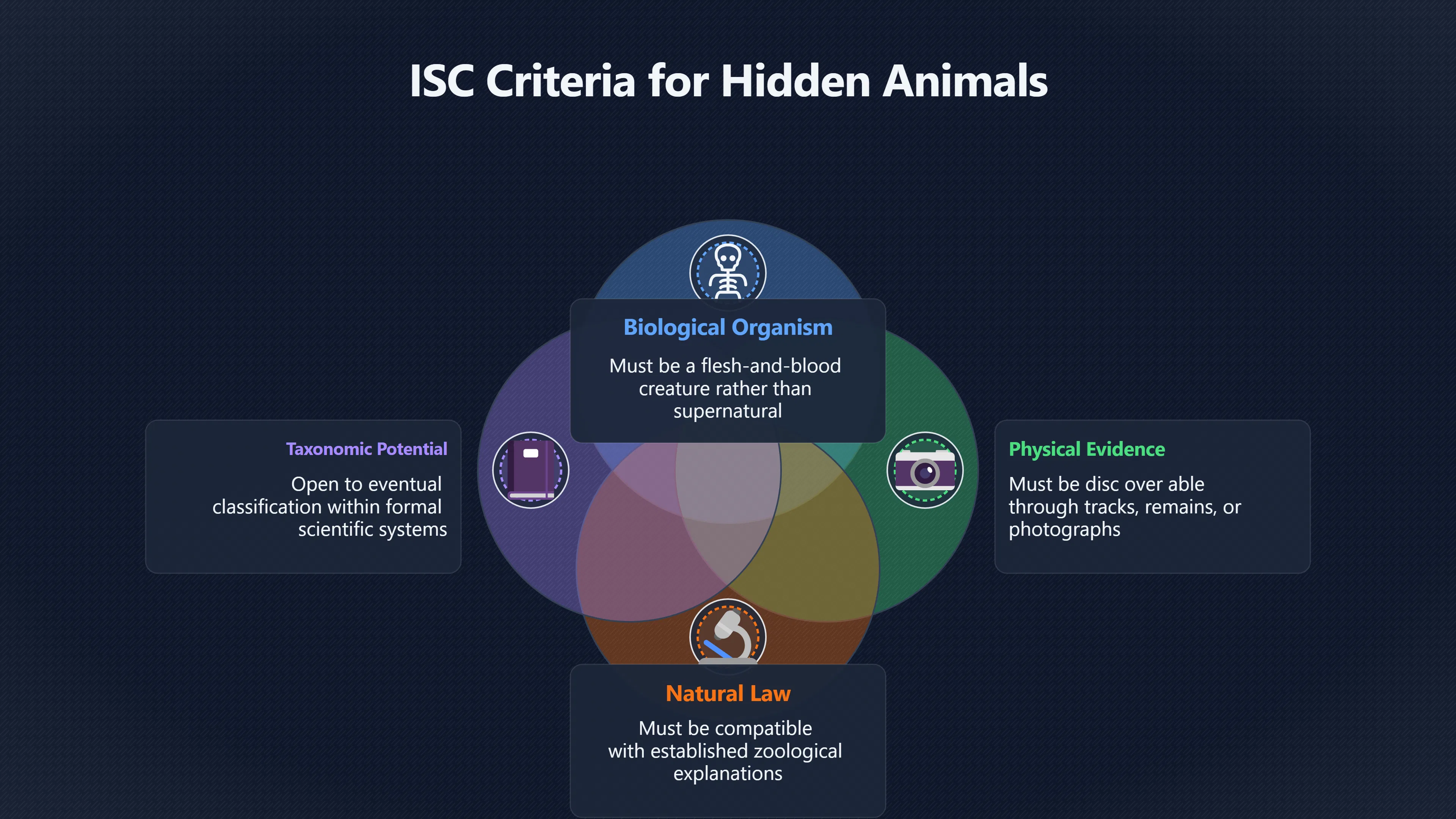
Under this framework, a cryptid was expected to be:<div class="content-enhancement content-enhancement--insight-grid" markdown="1">
- A biological organism rather than a supernatural being.
- Potentially discoverable through evidence such as tracks, remains, photographs or specimens.
- Compatible with natural laws and zoological explanation.
Why Paranormal Material Threatened Credibility
The boundary was not merely philosophical. It was a practical credibility strategy.
Mainstream zoologists were already sceptical because cryptozoological claims typically relied on indirect evidence such as stories, footprints, ambiguous photographs and local traditions. If the field also embraced explicitly supernatural claims, it became even harder to argue that it belonged within scientific inquiry.[ResearchGate]researchgate.netResearchGate(PDF) A Review of Cryptozoology: Towards a Scientific…Cryptozoology is still generally considered a non-academic disciplin…
Several pressures pushed cryptozoology toward the paranormal:
Folklore sources. Many cryptid reports originated in legends and traditional narratives. Heuvelmans considered folklore valuable because he believed myths could preserve information about real animals. However, folklore often contained magical or symbolic elements that were difficult to separate from possible zoological observations.[Academia+2BioArticles Online]academia.eduA Review of Cryptozoology: Towards a Scientific Approach…Heuvelmans emphasized the importance of indirect evidence, such as fo…
Popular media incentives. Publishers, television programmes and magazines frequently marketed cryptids as monsters rather than as zoological puzzles. Monster narratives attracted larger audiences than discussions of animal distribution, taxonomy or ecology. Over time, the entertainment value of the mystery often overshadowed the ISC’s preferred scientific framing.[scholarworks.iu.edu]scholarworks.iu.eduof Pop Goes the Cryptid: The Evolution of Cryptozoology…by SA Hill · 2026 — Bernard Heuvelmans catalyzed the field of cryptozoology to…
Overlap with other fringe subjects. Public audiences frequently grouped Bigfoot, lake monsters, UFO encounters, psychic phenomena and occult mysteries into a single category of unexplained events. Even when cryptozoologists rejected such connections, outsiders often treated them as parts of the same cultural package. Folklore researchers have noted that cryptozoology occupied a broader landscape that also included Fortean and occult approaches to anomalies.[Wikipedia]WikipediaOpen source on wikipedia.org.
The result was a reputational dilemma. The more cryptozoology relied on folklore and anecdotal reports, the harder it became to demonstrate that it was fundamentally different from paranormal investigation.[Sage Journals]journals.sagepub.comSage Journals Heuvelmans the Heretic and Hidden AnimalsSage JournalsHeuvelmans the Heretic and Hidden Animals - Floe Foxon…21 Mar 2024 — Cryptozoology seeks to study 'hidden animals' by se…
Why the Boundary Stayed Unstable
Many Famous Cryptids Occupied the Middle Ground
The ISC could define a hidden animal on paper, but many famous cryptids did not fit neatly into that category.
Creatures such as the Loch Ness Monster, Bigfoot and the Yeti were often presented by cryptozoologists as undiscovered biological species. Yet the same figures appeared in folklore, religious traditions, supernatural stories and later paranormal interpretations. Different audiences could understand the same creature as an animal, a spirit, a relic species or something entirely unknown.[Wikipedia]WikipediaOpen source on wikipedia.org.
This ambiguity made enforcement difficult. The society could insist that it was studying hypothetical animals, but public interest frequently centred on the mysterious and extraordinary aspects of the stories.
Folklore Was Both a Resource and a Liability
No Stable Gatekeeping System Emerged
The ISC functioned as a gatekeeper by maintaining journals, membership standards and a formal definition of cryptozoology. However, those mechanisms remained limited in scale and influence. After the society’s decline, there was no widely recognised institution capable of enforcing a distinction between zoological cryptids and paranormal monsters.[Wikipedia]WikipediaInternational Society of CryptozoologyInternational Society of Cryptozoology
Observers of the field have noted that the collapse of the ISC weakened efforts to maintain a zoological definition of cryptids. In the internet era, the term”cryptid” expanded dramatically and came to include many entities that earlier ISC figures would likely have excluded as supernatural, fictional or purely folkloric.[Wikipedia]WikipediaInternational Society of CryptozoologyInternational Society of Cryptozoology
What the Boundary Problem Revealed
The hidden-animal versus paranormal-monster divide exposed a deeper weakness in the ISC’s professionalisation project. The society could establish journals, officers and formal definitions, but it could not fully control how the public understood the creatures at the centre of the field. Its leaders envisioned cryptozoology as a specialised investigation of potentially real animals. Popular culture increasingly treated cryptids as a broader category of mysterious beings, whether biological, supernatural or symbolic.[Wikipedia+2scholarworks.iu.edu]WikipediaInternational Society of CryptozoologyInternational Society of Cryptozoology
Because cryptozoology depended heavily on reports, traditions and ambiguous evidence, the line between hidden animal and monster was never entirely secure. The ISC’s attempt to police that boundary became one of the clearest examples of how governance, rather than simply evidence, shaped the fate of cryptozoology as a would-be scientific discipline.[Sage Journals+2ResearchGate]journals.sagepub.comSage Journals Heuvelmans the Heretic and Hidden AnimalsSage JournalsHeuvelmans the Heretic and Hidden Animals - Floe Foxon…21 Mar 2024 — Cryptozoology seeks to study 'hidden animals' by se…
Amazon book picks
Further Reading
Books and field guides related to Where Hidden Animals Became Monster Culture. Use these as the next step if you want deeper reading beyond the article.
Abominable Science!
Directly addresses the boundary between zoology, folklore, and monster culture.
On the Track of Unknown Animals
Introduces the hidden-animal framework central to the ISC.
Hunting Monsters
Examines how cryptid claims intersect with science and popular culture.
The United States of Cryptids
Shows how cryptids became embedded in regional folklore and monster culture.
eBay marketplace picks
Marketplace Samples
Live-tested eBay searches with available results related to this page.

Endnotes
1.
Source: Wikipedia
Title: International Society of Cryptozoology
Link:https://en.wikipedia.org/wiki/International_Society_of_Cryptozoology
2.
Source: researchgate.net
Link:https://www.researchgate.net/publication/288975639_A_Review_of_Cryptozoology_Towards_a_Scientific_Approach_to_the_Study_of_Hidden_Animals
3.
Source: cryptozoologicalreferencelibrary.files.wordpress.com
Link:https://cryptozoologicalreferencelibrary.files.wordpress.com/2020/08/heuvelmans-1982.pdf
4.
Source: cryptozoologymuseum.com
Link:https://cryptozoologymuseum.com/what-is-cryptozoology/
5.
Source: Wikipedia
Title: Bernard Heuvelmans
Link:https://en.wikipedia.org/wiki/Bernard_Heuvelmans
6.
Source: academia.edu
Link:https://www.academia.edu/20109683/A_Review_of_Cryptozoology_Towards_a_Scientific_Approach_to_the_Study_of_Hidden_Animals_
7.
Source: scholarworks.iu.edu
Link:https://scholarworks.iu.edu/journals/index.php/cl/article/view/41746/44352
8.
Source: Wikipedia
Link:https://en.wikipedia.org/wiki/Cryptozoology
9.
Source: researchgate.net
Title: 379174634 Heuvelmans the Heretic and Hidden Animals
Link:https://www.researchgate.net/publication/379174634_Heuvelmans_the_Heretic_and_Hidden_Animals
10.
Source: Wikipedia
Title: Bernard (footballer)
Link:https://en.wikipedia.org/wiki/Bernard_%28footballer%29
11.
Source: journals.sagepub.com
Title: Sage Journals Heuvelmans the Heretic and Hidden Animals
Link:https://journals.sagepub.com/doi/10.1177/03080188241233107
12.
Source: scientificamerican.com
Title: inaugural issue of journal of cryptozoology
Link:https://www.scientificamerican.com/blog/tetrapod-zoology/inaugural-issue-of-journal-of-cryptozoology/
13.
Source: biologyonline.com
Title: Bio Articles Online Cryptozoology
Link:https://www.biologyonline.com/articles/cryptozoology-evidence-creatures
14.
Source: cryptidarchives.fandom.com
Title: Bernard Heuvelmans
Link:https://cryptidarchives.fandom.com/wiki/Bernard_Heuvelmans
15.
Source: agupubs.onlinelibrary.wiley.com
Link:https://agupubs.onlinelibrary.wiley.com/doi/abs/10.1029/EO063i043p00825-06
16.
Source: searchworks.stanford.edu
Link:https://searchworks.stanford.edu/view/10790802
17.
Source: gktoday.in
Title: international society of cryptozoology
Link:https://www.gktoday.in/international-society-of-cryptozoology/
Additional References
18.
Source: reddit.com
Link:https://www.reddit.com/r/Cryptozoology/comments/1eelq8f/cryptozoology_definition/
19.
Source: onlinebooks.library.upenn.edu
Link:https://onlinebooks.library.upenn.edu/webbin/serial?id=cryptozoology
20.
Source: facebook.com
Link:https://www.facebook.com/groups/400522827658573/posts/1580690862975091/
21.
Source: isu.edu
Link:https://www.isu.edu/media/libraries/rhi/book-reviews/ICSJ-review.pdf
22.
Source: youtube.com
Link:https://www.youtube.com/user/bernardbear
23.
Source: wearethemutants.com
Title: impossible animals bernard heuvelmans and the making of cryptozoology
Link:https://wearethemutants.com/2020/10/06/impossible-animals-bernard-heuvelmans-and-the-making-of-cryptozoology/
24.
Source: amazon.com
Link:https://www.amazon.com/Encyclopedia-Cryptozoology-Global-Animals-Pursuers/dp/0786420367?tag=searcht-20
25.
Source: reddit.com
Title: Cryptozoology According To Bernard Heuvelmans“Cryptozoology
Link:https://www.reddit.com/r/Cryptozoology/comments/1o0fhsr/cryptozoology_according_to_bernard_heuvelmans/
26.
Source: hangar1publishing.com
Link:https://hangar1publishing.com/blogs/cryptids/bernard-heuvelmans-cryptozoologist?srsltid=AfmBOopjILCew1d4yEDaLP9L4AxMCoKQRWb9rNd5scDcKrXVp6jc2zzi
27.
Source: cryptozoonews.com
Link:https://www.cryptozoonews.com/icmj/
Topic Tree