Within Deep Sea
When Real Drifters Look Like Monsters
Jellies, siphonophores and other fragile midwater animals can create strange shapes that look monstrous in brief sightings.
On this page
- Why the midwater is hard to sample
- Animals that distort surface sightings
- How data turns mystery into identification
Page outline Jump by section
Introduction
Many sea-monster reports depend on a simple assumption: that an unusual shape seen on the ocean must belong to a single large animal. The midwater zone challenges that assumption. Between the sunlit surface and the deep seafloor lies the largest living habitat on Earth, a vast volume of open water filled with delicate jellyfish, siphonophores, comb jellies, larvaceans and other drifting organisms that are rarely seen intact. Because these animals are transparent, fragile, reflective and often extraordinarily long, they can create fleeting silhouettes that appear far stranger than their biological reality. Modern deep-ocean observation has shown that some of the most “monster-like” forms in the sea are not unknown giants at all, but poorly understood midwater animals viewed under difficult conditions.[MBARI+2The Guardian]mbari.orgMidwater EcologyMidwater EcologyJune 22, 2022 — At MBARI, we study midwater animals directly, using undersea vehicles to carry our cameras, instrume… For cryptozoology, the lesson is not that mystery disappears. Rather, many historical reports gain plausible natural explanations once researchers can observe the midwater environment directly. The same habitat that once encouraged speculation is now revealing real organisms whose appearance can easily exceed human expectations.[MBARI]mbari.orgMidwater EcologyMidwater EcologyJune 22, 2022 — At MBARI, we study midwater animals directly, using undersea vehicles to carry our cameras, instrume…
Why the Midwater Is Hard to Sample
Animals That Distort Surface Sightings
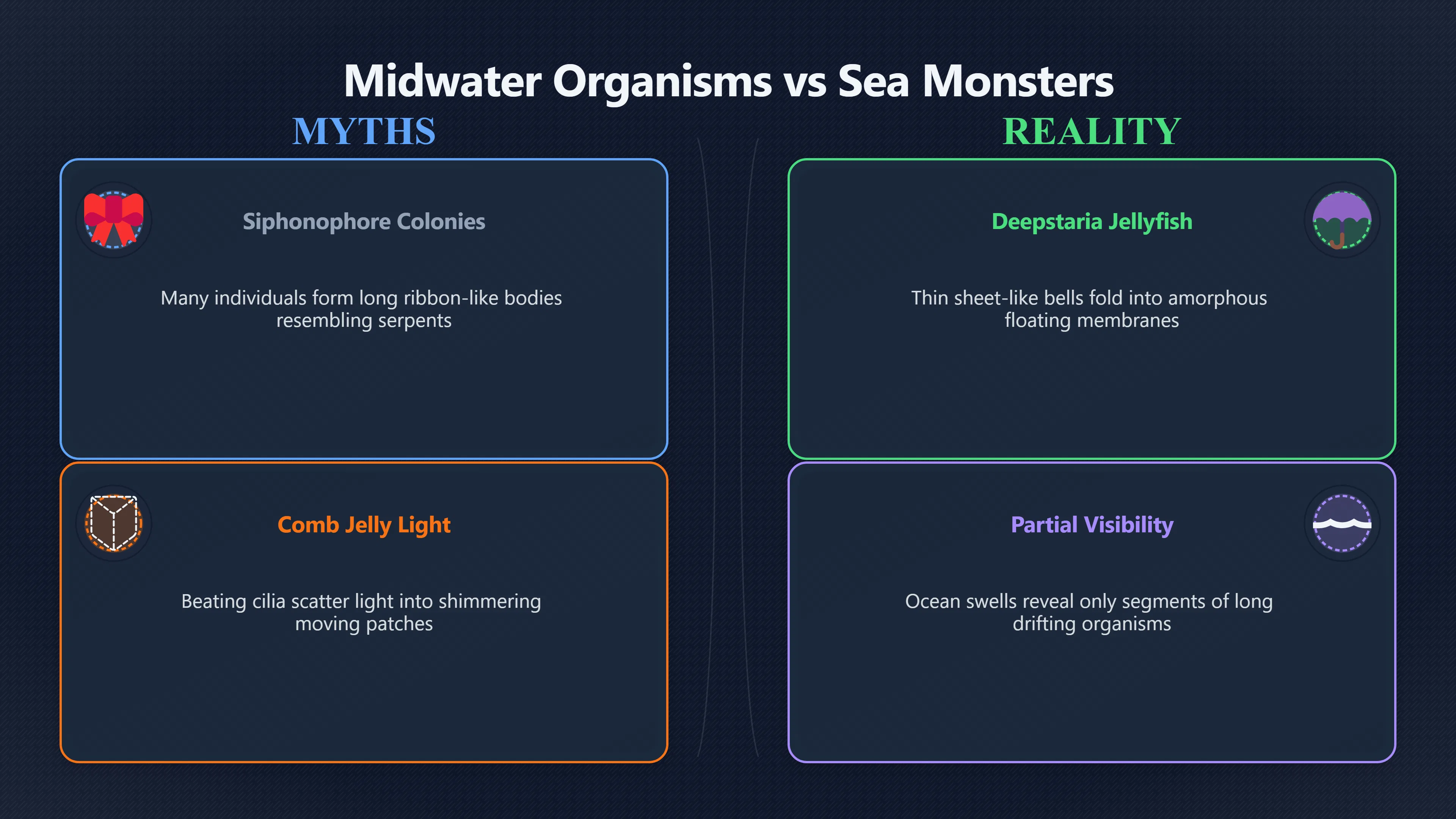
Siphonophores: Colonies That Resemble Sea Serpents
Among the strongest candidates for generating monster-like impressions are siphonophores. Although they can look like single enormous creatures, they are actually colonies composed of many specialised individuals working together. Some species form long trailing structures, glowing chains or ribbon-like bodies that extend through the water column. Because different parts of a colony perform different functions, a brief sighting may reveal only a section of the whole organism, creating the impression of an animal far larger or stranger than what is actually being observed.[Wikipedia]WikipediaOpen source on wikipedia.org.
Modern exploration has repeatedly documented spectacular siphonophores in deep and midwater habitats. Their length, transparency and drifting motion can mimic descriptions historically associated with sea serpents. In poor visibility, a colony rising toward the surface or viewed obliquely could appear segmented, undulating or tentacled.[NOAA Ocean Exploration]noaa.govOcean ExplorationNOAA Ocean ExplorationSeptember 28, 2020: SiphonophoreThis siphonophore was seen while conducting midwater exploration at 880 meters (2,8…
The problem is amplified by scale perception. Open ocean observers often lack nearby reference points. A partially visible siphonophore may be interpreted as a massive animal when only a small portion of a long colony is visible above or below the surface.[Wikipedia]WikipediaOpen source on wikipedia.org.
Giant Jellies and Shifting Shapes
Some deep and midwater jellyfish possess body forms unlike the familiar coastal species most people recognise. Species such as Deepstaria can form huge, thin, sheet-like bells that fold, collapse and inflate into changing shapes. Seen briefly at the surface or illuminated by unusual lighting, such forms can resemble floating membranes, heads, cloaks or amorphous creatures rather than jellyfish.[Wikipedia]WikipediaDeepstaria enigmaticaDeepstaria enigmatica
Other jellyfish trail exceptionally long tentacles that may be visible independently of the body. Historical observers who saw a line, filament or series of drifting appendages without identifying the source organism could easily conclude they were observing a giant unknown animal rather than a jellyfish extending feeding structures through the water.[Wikipedia]WikipediaAtolla jellyfishAtolla jellyfish
Comb Jellies and Optical Illusions
Comb jellies, or ctenophores, are famous for rows of beating cilia that scatter light into shimmering colours. Their transparent bodies can appear and disappear depending on viewing angle, sea state and illumination. This makes them particularly prone to misinterpretation. A cluster of large comb jellies near the surface may create flashes, moving lines or glowing patches that seem disconnected from any recognisable organism.[The Guardian]theguardian.comThe Guardian'Chock full of incredible animals': marine expedition uncovers 31 new species in two weeks A two-week marine biology expeditiThe research was led by 24 international scientists aboard the Falkor (too), a vessel from the Schmidt Ocean Institute, supported by the…
Because the human visual system expects solid animals with clear boundaries, nearly invisible gelatinous creatures often look more mysterious than they actually are. The observer perceives fragments of a form rather than the whole organism.
Why Monster Reports Often Emphasise Length and Movement
Many classic sea-monster descriptions focus on elongated bodies, multiple humps, undulating motion or partial appearances. Midwater organisms naturally produce these effects.
Several mechanisms contribute:<div class="content-enhancement content-enhancement--insight-grid" markdown="1">
- Partial visibility: Only a segment of a long colony or tentacle may be visible at one time.
- Wave interference: Ocean swell can alternately reveal and conceal different sections of an organism.
- Transparency: Observers may see only the pigmented or reflective portions of a largely invisible body.
- Colony structure: Multiple connected units can resemble body segments or humps.
- Bioluminescence: Light-producing tissues may create the illusion of eyes, markings or articulated parts.[Wikipedia]WikipediaOpen source on wikipedia.org.</div>
The result is a recurring pattern in which real animals generate observations that are accurate in some details but misleading in overall interpretation. An observer may genuinely report a long, moving shape while misunderstanding the biological structure responsible for it.
How Data Turns Mystery into Identification
What the Midwater Teaches About Sea Monsters
The midwater zone demonstrates that the boundary between “monster” and “misidentification” is often shaped by observation quality. A drifting siphonophore colony, a transparent comb jelly or a giant deep-water jellyfish can appear extraordinary when seen briefly from a ship, through waves, glare or darkness. In many cases the observer is not inventing a sighting; they are encountering a real animal whose biology is unfamiliar and whose appearance is distorted by environment and perspective.[MBARI+2ResearchGate]mbari.orgMidwater EcologyMidwater EcologyJune 22, 2022 — At MBARI, we study midwater animals directly, using undersea vehicles to carry our cameras, instrume…
The more scientists explore this habitat, the clearer the pattern becomes. The ocean’s largest unexplored living space is full of organisms capable of inspiring sea-monster stories, but those organisms increasingly have names, evolutionary relationships and documented behaviours. The mystery remains real, yet it is increasingly a mystery of identification rather than one of hidden leviathans.[The Guardian+2MBARI]theguardian.comThe Guardian'Chock full of incredible animals': marine expedition uncovers 31 new species in two weeks A two-week marine biology expeditiThe research was led by 24 international scientists aboard the Falkor (too), a vessel from the Schmidt Ocean Institute, supported by the…
eBay marketplace picks
Marketplace Samples
Live-tested eBay searches with available results related to this page.

Endnotes
1.
Source: mbari.org
Title: Midwater Ecology
Link:https://www.mbari.org/team/midwater-ecology/
2.
Source: par.nsf.gov
Title: www.Read more
Link:https://par.nsf.gov/servlets/purl/10573371
3.
Source: researchgate.net
Link:https://www.researchgate.net/publication/377470546_Life_in_the_Midwater_The_Ecology_of_Deep_Pelagic_Animals
4.
Source: Wikipedia
Link:https://en.wikipedia.org/wiki/Siphonophore
5.
Source: oceanexplorer.noaa.gov
Title: Ocean Exploration
Link:https://oceanexplorer.noaa.gov/multimedia/daily-image-[media
6.
Source: Wikipedia
Title: Deepstaria enigmatica
Link:https://en.wikipedia.org/wiki/Deepstaria_enigmatica
7.
Source: Wikipedia
Title: Atolla jellyfish
Link:https://en.wikipedia.org/wiki/Atolla_jellyfish
8.
Source: theguardian.com
Link:https://www.theguardian.com/environment/2026/jun/26/marine-expedition-uncovers-31-[new-species
9.
Source: nypost.com
Title: New York Post Dozens of otherworldly new deep-sea critters discovered
Link:https://nypost.com/2026/06/17/science/31-otherwordly-sea-creatures-discovered-in-south-atlantic/
10.
Source: instagram.com
Link:https://www.instagram.com/reel/CNVQpOjH6Al/
11.
Source: instagram.com
Link:https://www.instagram.com/reel/DJp6T-mS3Nh/
12.
Source: instagram.com
Link:https://www.instagram.com/reel/Cs9g-xkMRkO/
13.
Source: instagram.com
Link:https://www.instagram.com/reel/DJ-QUPgBJkd/
Additional References
14.
Source: pubmed.ncbi.nlm.nih.gov
Link:https://pubmed.ncbi.nlm.nih.gov/38231738/
15.
Source: facebook.com
Link:https://www.facebook.com/SchmidtOcean/posts/marvels-in-the-midwaterrov-pilots-zoomed-in-on-this-siphonophore-at-755-meters-d/1423898126445389/
16.
Source: norceresearch.no
Link:https://www.norceresearch.no/en/news/experiments-suggest-that-deep-sea-mining-and-warming-trigger-stress-in-a-midwater-jellyfish
17.
Source: iatlantic.eu
Link:https://www.iatlantic.eu/news/new-study-demonstrates-the-potential-impact-of-ocean-warming-and-deep-sea-mining-on-midwater-organisms/
18.
Source: facebook.com
Title: deep sea cameras have captured what researchers believe is an entirely new speci
Link:https://www.facebook.com/Hoodfishingentertainment01/posts/deep-sea-cameras-have-captured-what-researchers-believe-is-an-entirely-new-speci/122292013418042047/
19.
Source: geomar.de
Link:https://www.geomar.de/n9207-e
20.
Source: instagram.com
Title: these are the group of medusae responsible for propulsion
Link:https://www.instagram.com/reel/DYiP_eBSIIG/
21.
Source: facebook.com
Link:https://www.facebook.com/Wildfactgalaxy/posts/the-giant-siphonophore-is-terrifyingwhat-looks-like-a-glowing-string-in-the-deep/122129212017151358/
22.
Source: facebook.com
Link:https://www.facebook.com/awaretvindia/posts/siphonophores-the-largest-things-in-the-ocean-science-education/122348722328009574/
23.
Source: instagram.com
Title: Meet the grizzly bear of gelatinous animals
Link:https://www.instagram.com/reel/DXpDmHtuxAN/
Topic Tree